
Sign up to save your podcasts
Or



Based on Podcast App listening data
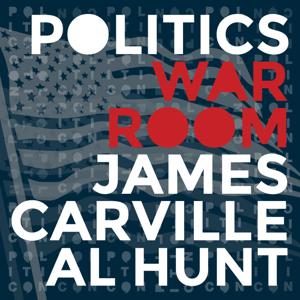
The specter of 2016 still looms in the minds of Democrats everywhere, creating no small amount of fear and uncertainty about what might happen come November. But while caution may prove prudent, there is no denying that there are stark differences between four years ago and today. Hart Research Associates president Geoff Garin outlines key polling numbers explaining a likely turn away from Trump in the coming months. And nowhere is that resentment towards the current status quo felt more than among America's beaten and broken middle class, whom New York Times economics reporter Jim Tankersley explores the plight of in his new book "The Riches of the Land."
With all eyes on Trump v. Biden , it can be easy to forget that there's a lot more at stake this November than just the presidency. Even congressional races may finally be getting the attention they deserve. But National Democratic Redistricting Committee president Kelly Burton and Democratic Legislative Campaign Committee preside Jessica Post argue that the real work is far more granular, down at the local legislative level. And the world of political scandal, journalist Seth A. Richardson (The Cleveland Plain Dealer) highlights one of the most staggering examples of graft in American history, involving an energy company, a wide array of figures at the heart of Ohio politics, and $60 million in bribes.
Much of the blame for the sad state of affairs the United States is facing gets heaped at the feet of Donald J. Trump. But while a fair amount of guilt should be borne by his contemporary enablers, there has also been a clear path over the last 50 years that has led the Republican party towards the existential darkness the president is now dragging them into. Bradlee Professor of Government & the Press at Harvard University’s Kennedy School of Government Thomas Patterson and Julian Zelizer, the Malcolm Stevenson Forbes Class of 1941 Professor of History and Public Affairs at Princeton School of Public & International Affairs, pinpoint the key players in this grand decline, including Nixon, Cohn, Reagan and Gingrich.
While the coronavirus creates chaos and uncertainty in every sector, there are few things as vital to both the immediate and distant future of the United States as the country's education system. And its importance is matched only by the complexity involved in starting the school year safely in a few months. As West Des Moines Community Schools Superintendent Dr. Lisa Remy points out, every school is different, and no one plan will suffice for all of the nearly 13,000 school districts throughout the country. And on the topic of learning, author Ben Sheehan ("OMG WTF Does The Constitution Actually Say?") laments the lack of civic education and what that means for the future of American democracy.
The Hard Hat Riot of 1970 may have lost some of its historical importance in the eyes of everyone but the most astute modern day political operatives. But author David Paul Kuhn ("The Hard Hat Riot") and political strategist Stan Greenberg ("RIP GOP") make the case that any Democrat worth their salt should mark that infamous clash between college students and construction workers as the inception of the greatest electoral barrier their party has faced in the 50 years since. That is the disenfranchisement of blue collar whites, and their departure from the left was felt in the 2016, just as they may serve as Biden's key to victory in 2020. Plus, Al and James discuss Trump's latest outrages.
The prevailing belief of the day may be that the Republican Party has sold its soul to the devil and a Democratic victory in November is America's only hope for salvation. But Oklahoma Senator James Lankford begs to differ, asserting that his colleagues in Congress have made efforts to ensure rule of law and equality for all, including introducing police reform and voting protection measures. At the same time, journalist Matt Bai ("All The Truth Is Out: The Week Politics Went Tabloid") argues that by valuing urbanity over all else, the Democrats loosen their connection to some of the most important voters in the country, allowing Trumpism to take hold.
The Supreme Court has dealt powerful blows to the Trump agenda in recent days, protecting DACA recipients' status and upholding anti-discrimination protections for LGBTQ individuals. Duke University School of Law Douglas B. Maggs Professor Emeritus of Law Walter Dellinger notes that the conservative justices see beyond the current president, towards a lifetime of decision-making. But that does not mean the U.S. justice system will remain intact with William Barr at the helm, he warns. On the other hand, political consultants Keith Mason and Paul Begala find hope in the new direction communities around Atlanta and Houston are taking, no matter the outcome of 2020.
There is no doubt that footage of George Floyd's death at the hands of four Minneapolis police officer is as shocking as it is damning of the American criminal justice system. But it is far from being the first incident of its kind, and Columbia University Graduate School of Journalism professor Howard French ("Everything Under The Heavens") refuses to let white people use the excuse they didn't already know this was the reality for black people across the country. He notes it is time for America's institutions to take a long, hard look at themselves if they want this tragedy to not be in vain. And political reporter Ron Brownstein (The Atlantic) crunches the numbers on demographic changes among both Democrat and Republican voters, as well as posits some suggestions for the coalition Biden could build.
Few people have as deep and intimate an understanding of who Donald Trump is as a person as Bloomberg Opinion executive editor Timothy L. O'Brien. Not only has O'Brien written an entire biography of the man in his book "TrumpNation: "The Art of Being The Donald," he was even sued by Trump for libel for giving a true account of the scope of the president's financial worth. In due course, Timothy has actually become an astute observer of the Trump brand, peering beyond the fabricated persona to see what really lies beneath. Plus, Al and James discuss just what might happen if things don't go well for Trump in November.
Yet another death of an African American man at the hand's of the police has lead to demonstrations across United States and around the world. People are yet again demanding greater accountability, transparency and equality in treatment from their peace officers. But what will it really take to dramatically change how men and women in uniform interact with the public, especially minorities? David Harris, the University of Pittsburgh School of Law's Sally Ann Semenko Endowed Chair, tries to answer some of the questions about the nature of this issue and suggest how policing systems can be changed at all levels of government. Plus, Al and James touch base on Trump's photo op and Senate election prospects.
From the publisher's feed
Ranked by our users in the last 21 days
2,027 Listeners
3,363 Listeners

12,495 Listeners

4,589 Listeners
8,028 Listeners

8,093 Listeners

156 Listeners

8,322 Listeners

4,632 Listeners

10,405 Listeners
9,208 Listeners
2,623 Listeners

139 Listeners

3,393 Listeners
2,241 Listeners

3,195 Listeners

285 Listeners

573 Listeners
3,448 Listeners

638 Listeners
1,089 Listeners
777 Listeners