
Sign up to save your podcasts
Or



Based on Podcast App listening data
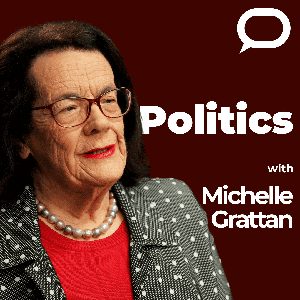
As well as her interviews with politicians and experts, Politics with Michelle Grattan now includes “Word from The Hill”, where she discusses the news with members of The Conversation politics team.
This week Michelle and politics + society editor Amanda Dunn discuss Australia’s response to the war in Ukraine which now includes more than $100 million for lethal and non-lethal assistance and humanitarian aid.
They also canvass Peter Dutton’s recent controversial GoFundMe campaign for flood victims.
Mentioned in this episode:
The Making of an Autocrat
Search: "The Conversation Weekly" for our new series.
Your support matters
Support non-profit journalism you can trust.
Donations 2025
As well as her interviews with politicians and experts, Politics with Michelle Grattan now includes “Word from The Hill”, where she discusses the news with members of The Conversation politics team.
This week Michelle speaks with politics + society editor Amanda Dunn about the escalating crisis in Ukraine as Russia sends in troops to rebel regions and Australia and other countries are set to announce sanctions.
They also discuss Australia’s relationship with China and what role that will play in the election, after a Chinese warship last week targeted a RAAF plane with a laser. An Essential poll, out this week, gives Labor a clear edge (37-28%) when people were asked, “which party would you trust to build a relationship with China in Australia’s best interests?”
Mentioned in this episode:
The Making of an Autocrat
Search: "The Conversation Weekly" for our new series.
Your support matters
Support non-profit journalism you can trust.
Donations 2025
Ahead of the election, Scott Morrison is trying to wedge Labor on national security generally and China in particular.
Opposition defence spokesman Brendan O'Connor tells this podcast: “National security is the the greatest priority of any federal government in order to protect the interests of the country and citizens. But we should not be politicising national security for base political purposes and that’s been on display now for certainly the last couple of weeks.”
“It is a critical issue and will always be a critical issue, but it shouldn’t be debased in the manner in which Scott Morrison has chosen to do so recently.”
On China, O'Connor indicates the difference under a Labor government would be one of tone rather than substance.
“We need to use temperate language in order to maintain peace and stability in the region. That’s not for a moment to suggest we do not call out acts of aggression or coercion.”
(The Essential poll, published on Tuesday, asked which party respondents would trust to build a relationship with China in Australia’s best interests. It found 37% favoured Labor, 28% nominated the Coalition and 34% were unsure.)
O'Connor describes Russian’s President Putin’s move on Ukraine – recognising two breakaway regions and deploying forces for “peacekeeping” – as “a blatant fundamental breach of international law”.
“Our position therefore has to be that we engage with our friends, particularly the NATO states and the United States, as to what best we can do to reduce the likelihood of any invasion by Russia of the Ukraine.”
O'Connor says Labor has concerns about a possible Australian defence capability gap between the current Collins class submarines and the delivery of the first submarine under AUKUS. But how a Labor administration would deal with that gap would depend on being comprehensively briefed in government on options.
Mentioned in this episode:
Your support matters
Support non-profit journalism you can trust.
Donations 2025
The Making of an Autocrat
Search: "The Conversation Weekly" for our new series.
As well as her interviews with politicians and experts, Politics with Michelle Grattan now includes “Word from The Hill”, where she discusses the news with members of The Conversation politics team.
This week she and politics editor Amanda Dunn discuss the government’s torpedoed religious discrimination legislation. Scott Morrison thought he could press the issue and hopefully get the package through parliament. But he found he couldn’t control his backbench, with rebels backing an amendment to protect transgender children. As a result, Morrison then abandoned the package.
Amanda and Michelle also canvass the Morrison family’s appearance on Nine’s 60 Minutes, which brought more debate (and blowback) than ratings.
Meanwhile, as parliament winds down, the government is waging a shock-and-awe attack on Anthony Albanese, with Defence Minister Peter Dutton and Treasurer Josh Frydenberg working in tandem to try to undermine his credentials on national security and economic issues.
Mentioned in this episode:
Your support matters
Support non-profit journalism you can trust.
Donations 2025
The Making of an Autocrat
Search: "The Conversation Weekly" for our new series.
Trent Zimmerman is one of the five Liberal moderates who crossed the floor to vote to amend the religious discrimination package to protect trans children. Scott Morrison’s response was to abandon his legislation.
Asked whether he regrets his decision to vote against the government Zimmerman, who crossed the floor on some other proposed amendments, says he was “standing up on a couple of points of principle for me – and first and foremost was seeking to support amendments to the Sex Discrimination Act, which would have protected trans kids, but also broadened the limitation of the discrimination that’s allowable for children more generally.”
Zimmerman also voted for an unsuccessful amendment (not supported by Labor) to “remove the current provisions which allow teachers to be discriminated in schools as well”.
But he does “support the principle of a Religious Discrimination Act”. “I think it’s a no-brainer that you shouldn’t be allowed to be discriminated [against] based on your religious beliefs. But I just thought that this went above and beyond an orthodox discrimination law, and that’s where my problems arose. And I hope that at some stage we can have the debate again with a more orthodox bill.”
The rebels have come under some sharp attack from their own side but Zimmerman says they didn’t take their decisions lightly. His colleagues were “very emotionally committed to taking the action that they did because of their perceived concerns, but they recognised the magnitude of what they were doing.”
Zimmerman expects his battle against high profile independent Kylea Tink to be “a very tightly contested campaign”. “I’ve never taken elections in North Sydney for granted.”
With the government’s failure to deliver a national integrity commission an issue, he hopes a commission will be a fresh promise for the election.
“Having a national integrity commission, I think, is very important for our community and for politics.”
On the issue of trust, Zimmerman says: “I think what people are looking for is really the answer to the question of who you trust to get certain jobs done that they expect of their government. And I think that when we get to the election, people will be judging the government on its performance in managing the economy, on its overall performance in managing the pandemic.”
Mentioned in this episode:
The Making of an Autocrat
Search: "The Conversation Weekly" for our new series.
Your support matters
Support non-profit journalism you can trust.
Donations 2025
As well as her interviews with politicians and experts, Politics with Michelle Grattan now includes “Word from The Hill”, where she discusses the news with members of The Conversation politics team.
This week they discuss the imbroglio over Scott Morrison’s religious discrimination bill, approved by the Coalition on Tuesday after extensive debate but with dissidents threatening its fate in the House of Representatives.
Moderate Liberal MPs have serious concerns: Bridget Archer, who holds the marginal Tasmanian seat of Bass, told Parliament she would not vote for the bill, while Trent Zimmerman, from NSW, in the party room reserved his right not to do so. Meanwhile, Labor has yet to decide its attitude – if it supports the legislation that would ensure its passage.
Amanda and Michelle also discuss Tuesday’s parliamentary apology to victims of bad behaviour in the parliamentary workplace – with Morrison saying “sorry” to Brittany Higgins.
Meanwhile the opposition immediately homed in on the aged care crisis, which saw the government this week sending in the defence forces to help out in facilities.
Mentioned in this episode:
The Making of an Autocrat
Search: "The Conversation Weekly" for our new series.
Your support matters
Support non-profit journalism you can trust.
Donations 2025
Critics say Anthony Albanese is still an unknown quantity, but in this podcast the opposition leader insists he already has a “legacy” and connections with communities around the country.
“I have a relationship going back [from his time in government] to communities right around Australia during that period and relationships with the business community and with people in electorates from east to west and north to south”.
He says in his almost three years as opposition leader “the government hasn’t been able to attack any of my legacy”, which says “a lot about the achievements and how effective I was as a minister”.
As for the 2019 defeat, Albanese says Labor had a lot of policies but lacked “a narrative”.
This time, Labor has a story to tell. “We want a stronger Australia coming back” based upon three subthemes. These are “future made in Australia”, “rising living standards”, and “more secure work”.
Asked to give an assurance that the overall level of taxation would not be higher under a Labor government than at present, Albanese says: “We’re not planning anything in that direction at all. And we’ve made that very clear. The truth is, that our record as the former Labor government - taxes were lower than they are today under this government”.
Mentioned in this episode:
The Making of an Autocrat
Search: "The Conversation Weekly" for our new series.
Your support matters
Support non-profit journalism you can trust.
Donations 2025
Defence Minister Peter Dutton says he would like to see more American combat capability based in Australia.
Speaking on the “Politics with Michelle Grattan” podcast, Dutton says: “I’d be very open to it. I would be very, very happy to have that discussion with the US if they saw a strategic advantage in doing so.”
He says there is significant visiting by US airforce, navy and army forces (together with the current marine rotation). “And if that is accompanied by, or there’s a subsequent decision to base further numbers, we’d be very happy to have that discussion with the US – or with the UK, for that matter.”
Last September’s AUSMIN talks committed “to significantly advance Australia-United States force posture cooperation”.
Dutton also reiterates he’s working on the acceleration of the timetable for the nuclear-powered submarines, a centrepiece of last year’s AUKUS agreement between Australia, the US and Britain. “I can assure you, the 20 year timeline is nonsense. I believe that we will be able to acquire well before that”.
Discussions with the US and UK have been “very productive” and “I’ll have more to say on that in due course once the discussions continue”.
“Everything [is] on the table with the US and the UK at the moment, and we will achieve capability well ahead of what the critics are pointing out at the moment.”
“I’ve been driving the process, receiving weekly updates, engaging with our counterparts. And this has momentum. It has buy-in from the US and the UK. It has an urgency because of the way in which the Chinese government is positioning in the Indo-Pacific”.
Asked about criticism that his language on China is too belligerent, Dutton says, “I do believe that China is on a pathway of aggression, particularly toward Taiwan, and I want to be part of what I think is a majority view around the world to stop that from taking place.
"I want China to continue to grow economically. I want to see people lifted out of poverty, but I don’t want to see a clash, particularly between great powers. And I think again, we’re better off to be frank in our assessments and to argue from a position of strength, not weakness, because otherwise, we will find ourselves in conflict in the Indo-Pacific, and that’s not what anybody wants.”
Dutton doesn’t step back from his description of Russian President Vladimir Putin as an ageing dictator who is becoming more and more irrational.
“People only need to look at his track record and concerning human rights abuses in Russia. There’s no sense when we’re dealing with a bully of any nature, believing that if we just close our ears and our mouth, that somehow the bully will become a good person.”
Mentioned in this episode:
The Making of an Autocrat
Search: "The Conversation Weekly" for our new series.
Your support matters
Support non-profit journalism you can trust.
Donations 2025
As election year opens, Michelle Grattan speaks with Tanya Plibersek, Labor’s spokeswoman on education and women, about the opposition’s agenda in these two critical areas.
Violence against women is one of our society’s most pressing and intractable issues, and front and centre for Plibersek, who says there is a way to do better.
“We do know so much about what we can do to reduce risks of violence in interpersonal relationships. And of course, it starts with our youngest Australians,” she says. We “need to rely much more on parents to model healthy relationships in the home.”
“It disturbs me that the rates … of domestic violence don’t seem to be coming down and in fact, one of the few areas of crime where statistics continue to go up are areas like sexual assault. So we need to do better at prevention. We need to do better at policing and in our justice system.”
Despite these negatives, Plibersek sees last year’s March4Justice and increased public and media awareness as signs “things are changing, that our society is changing in a way that is, I hope, unstoppable.”
On education, Plibersek talks through the detail of Anthony Albanese’s announcement of $440 million for schools for improvements such as better ventilation and also for mental health and wellbeing initiatives for kids, so hard hit during the pandemic.
As university fees are set to rise for many students this year, Plibersek has said that under a Labor government Australians can expect “a commitment to a fundamental overhaul of our university sector”.
She says she wants to “make sure that every young Australian who is prepared to work hard and study hard can get a place at university and that no one’s discouraged because of the fees”. But although highly critical of the government’s controversial new fees structure Plibersek cannot give a commitment a Labor government would change it quickly. That would need to be worked through with the universities, she says.
Mentioned in this episode:
The Making of an Autocrat
Search: "The Conversation Weekly" for our new series.
Your support matters
Support non-profit journalism you can trust.
Donations 2025
In her last podcast for the year, Michelle Grattan speaks with Treasurer Josh Frydenberg about the mid-year budget update, his optimism about the economy, and the election.
Although Scott Morrison has the option of a March poll, Frydenberg says he is working on the assumption he’ll deliver a budget on March 29, which would put the election in May.
Frydenberg says he’ll be “spending my Christmas period doing other than eating turkey and having a quiet beer on the balcony and looking at the beach in Lorne. I will be thinking about the budget, thinking about next year’s election and hoping to frame the contest about economic management.”
He admits that with the pandemic “there’s a lot of uncertainty out there.” But he stresses that the “one message I want to give to all your listeners today is there is no complacency. We’re not out of this thing yet.”
Frydenberg says he is still “very confident about the economy going forward”, with plenty of spending power to help it along.
“We have this wave of money that’s been accumulated by households and businesses because the restrictions meant that they couldn’t spend it and they will in time.”
Mentioned in this episode:
The Making of an Autocrat
Search: "The Conversation Weekly" for our new series.
Your support matters
Support non-profit journalism you can trust.
Donations 2025
From the publisher's feed
Ranked by our users in the last 21 days
90 Listeners

21 Listeners
6 Listeners

43 Listeners

19 Listeners
22 Listeners

16 Listeners
79 Listeners
49 Listeners
61 Listeners

2 Listeners
8 Listeners
1 Listeners

318 Listeners
68 Listeners

0 Listeners
24 Listeners

114 Listeners

5 Listeners

159 Listeners

0 Listeners

0 Listeners

0 Listeners

12 Listeners

65 Listeners

0 Listeners

0 Listeners
0 Listeners

0 Listeners

51 Listeners
5 Listeners

64 Listeners

3 Listeners
0 Listeners