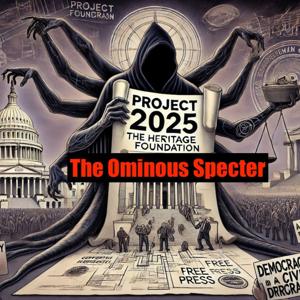
Project 2025: The Ominous Specter

Project 2025: The Ominous Specter

Download on the App Store

Project 2025: The Ominous Specter episodes

  • Centralized Power or Dismantled Democracy? Uncovering the Troubling Implications of Project 2025
    As I delve into the intricacies of Project 2025, a sense of unease settles in, akin to witnessing a seismic shift in the foundational landscape of American governance. This initiative, spearheaded by conservative organizations, aims to radically reshape the federal government, centralizing power in the White House and dismantling the independence of various federal agencies.
    At its core, Project 2025 is rooted in the unitary executive theory, an expansive interpretation of presidential power that seeks to consolidate control over the entire executive branch under direct presidential oversight. Kevin Roberts, a key proponent, succinctly captures this vision: "all federal employees should answer to the president."[4]
    One of the most striking aspects of Project 2025 is its plan to eliminate the independence of agencies like the Department of Justice, the FBI, the Federal Communications Commission (FCC), and the Federal Trade Commission (FTC). These agencies, designed to operate without political interference, are now targeted for overhaul. The project dismisses these entities as "so-called independent agencies," reflecting a disdain for the checks and balances that have long been a cornerstone of American democracy[5].
    For instance, the Federal Trade Commission, a body established to protect consumers and promote competition, would no longer enjoy the autonomy granted by Congress and upheld by the Supreme Court in *Humphrey’s Executor v. United States*. Under Project 2025, the president would gain the power to remove FTC commissioners at will, should they not align with the president’s agenda. This change would fundamentally alter the FTC's ability to function independently, potentially turning it into a tool for partisan policy implementation[5].
    The State Department is another focal point of this initiative. Kiron Skinner, who authored the State Department chapter of Project 2025, advocates for the dismissal of all State Department employees in leadership roles before January 20, 2025. These positions would be filled by ideologically vetted leaders appointed to acting roles, bypassing the need for Senate confirmation. Skinner's rationale is telling: she believes most State Department employees are too left-wing and need to be replaced by those more loyal to a conservative president. When questioned about specific instances where State Department employees obstructed Trump policies, Skinner admitted she could not name any[4].
    The implications of such reforms are far-reaching and profound. By centralizing power and eliminating the independence of federal agencies, Project 2025 would effectively create an "imperial presidency," where the president's authority is virtually unchecked. This would shatter the system of checks and balances that has been a bulwark of American democracy since its inception. As the American Civil Liberties Union (ACLU) notes, the re-election of a president aligned with these policies would have "immense" consequences, p
    This content was created in partnership and with the help of Artificial Intelligence AI.
    5 min
  • Radical Overhaul Ahead: Project 2025 Aims to Reshape American Governance
    As I delve into the intricacies of Project 2025, a sense of profound change and potential upheaval in the American governance landscape becomes increasingly clear. This initiative, spearheaded by The Heritage Foundation, a conservative think tank with deep ties to the Trump administration, aims to reshape the federal government in ways that are both sweeping and contentious.
    At the heart of Project 2025 is a vision to consolidate executive power, a concept often referred to as the "unitary executive theory." This theory, championed by figures like Kevin Roberts, the president of The Heritage Foundation, seeks to place the entire executive branch under direct presidential control. Roberts has been unequivocal about this goal, stating that all federal employees should answer directly to the president, a stance that reflects a broader effort to centralize power in the White House[4].
    One of the most striking aspects of Project 2025 is its proposal to dismantle or significantly alter several key federal agencies. The Department of Homeland Security (DHS), for instance, would be eliminated, and the Transportation Security Administration (TSA) would be privatized. This move is particularly alarming given the critical roles these agencies play in national security and disaster prevention, roles that were established in response to the 9/11 terrorist attacks. The idea of reverting to a pre-9/11 era in terms of national security is, as described by critics, "irresponsible" and poses significant risks to public safety[2].
    The Department of Education is another target, with plans to eliminate it and transfer oversight of education and federal funding to the states. This change would not only decentralize education policy but also gut regulations that prohibit sex-based discrimination and discrimination based on gender identity and sexual orientation in schools. The implications are far-reaching, potentially undermining hard-won protections for marginalized students[2].
    The Environmental Protection Agency (EPA) is also in the crosshairs, with proposals to eliminate many of its regional labs, offices of enforcement and compliance, and scientific integrity and risk information divisions. This would essentially give corporations and big businesses a free hand to pollute, endangering public health by compromising the air, water, and food quality[2].
    The Federal Emergency Management Agency (FEMA) would face a similar fate, with its responsibilities potentially shifted to the Department of Interior or the Department of Transportation. This move would burden states and local governments with the costs of disaster preparedness and response, a shift that could be catastrophic in the face of natural disasters[2].
    Beyond the dismantling of agencies, Project 2025 also seeks to undermine the independence of various regulatory bodies. Independent agencies like the Federal Trade Commission (FTC), Federal Communications Commission (FCC), and Equal Employment Opportuni
    This content was created in partnership and with the help of Artificial Intelligence AI.

    7 min
  • Transformative or Troubling? Project 2025's Proposed Overhaul of the Federal Government
    As I delve into the intricacies of Project 2025, a sense of profound transformation and controversy envelops me. This initiative, backed by influential conservative think tanks such as the Heritage Foundation, is nothing short of a revolutionary blueprint aimed at reshaping the federal government of the United States.
    At its core, Project 2025 advocates for an expansive interpretation of presidential power, often referred to as the unitary executive theory. This concept centralizes greater control over the government in the White House, a vision that has been gaining traction since the Reagan administration. Kevin Roberts, a key proponent, succinctly captures this ideology: "all federal employees should answer to the president."[2]
    One of the most striking aspects of Project 2025 is its proposal to eliminate the independence of several critical federal agencies. The Department of Justice, the FBI, the Federal Communications Commission, and the Federal Trade Commission are all targeted for direct presidential control. This move is part of a broader strategy to consolidate executive power, a plan that has been bolstered by conservative justices and organizations like the Federalist Society[2].
    The State Department is another focal point, with Project 2025 recommending the dismissal of all employees in leadership roles before January 20, 2025. Kiron Skinner, who authored the State Department chapter of the project, believes that most current employees are too left-wing and should be replaced by those more loyal to a conservative president. When questioned about specific instances where State Department employees obstructed Trump policies, Skinner admitted she could not provide any examples[2].
    The scope of Project 2025 extends far beyond these administrative changes, however. It proposes the elimination of entire agencies that have been cornerstone institutions in American governance. The Department of Homeland Security (DHS), created in response to the 9/11 terrorist attacks, would be dismantled, and the Transportation Security Administration (TSA) would be privatized. This move is seen as a significant step backward in national security efforts, as DHS and TSA have played crucial roles in coordinating national security and preventing terrorist attacks[3].
    The Department of Education is another agency on the chopping block, with oversight of education and federal funding set to be handed over to the states. This shift not only undermines federal standards but also jeopardizes regulations against sex-based discrimination, gender identity discrimination, and sexual orientation discrimination in schools[3].
    Environmental protection is also under threat. The Environmental Protection Agency (EPA) would see the elimination of its regional labs, offices of enforcement and compliance, and scientific integrity and risk information divisions. This would essentially give corporations and big businesses a free rein to pollute, endangering public health a
    This content was created in partnership and with the help of Artificial Intelligence AI.
    6 min
  • Transforming the Federal Government: Project 2025's Controversial Vision for Consolidating Presidential Power
    As I delve into the intricacies of Project 2025, a sense of profound transformation and controversy envelops me. This initiative, backed by influential conservative think tanks such as the Heritage Foundation, is more than just a policy blueprint; it's a vision for a radically reshaped federal government, one that centralizes power in the White House and challenges the very fabric of American governance.
    At its core, Project 2025 is rooted in the unitary executive theory, an expansive interpretation of presidential power that aims to consolidate control over the entire executive branch under direct presidential oversight. Kevin Roberts, a key proponent, succinctly captures this ambition: "All federal employees should answer to the president."[4]
    One of the most striking aspects of Project 2025 is its plan to dismantle the independence of various federal agencies. The Department of Justice, the FBI, the Federal Communications Commission, and the Federal Trade Commission are all targeted for reform, with the intention of placing them firmly under presidential control. This move is not merely administrative; it represents a fundamental shift in how power is distributed within the federal government.
    For instance, the State Department is slated for significant overhaul. Project 2025 advocates for the dismissal of all leadership roles within the department before January 20, 2025, to be replaced by ideologically vetted leaders appointed to acting roles that bypass Senate confirmation. Kiron Skinner, who authored the State Department chapter of the project, reflects this ideological bent, suggesting that most State Department employees are too left-wing and need to be replaced by those more loyal to a conservative president. When questioned about specific instances where State Department employees obstructed Trump policies, Skinner admitted she couldn't name any[4].
    The scope of these changes is vast and far-reaching. The 900-page policy proposal outlines the elimination of entire agencies, such as the Consumer Financial Protection Board (CFPB) and the United States Agency for International Development (USAID). These actions are part of a broader effort to streamline the government and save $1 trillion, but they come with significant human and institutional costs. As of the latest data, the Trump administration, guided by Project 2025, has either laid off or plans to lay off 280,253 federal workers and contractors across 27 agencies[5].
    The execution of these plans has been anything but smooth. The Trump administration, aided by Elon Musk's Department of Government Efficiency (DOGE), has implemented these reforms in a manner described as chaotic and legally questionable. Musk's DOGE has taken the Project 2025 blueprint and amplified its impact, often through methods that test the legal boundaries of executive power. This turbulent approach has led to the elimination of agencies and the firing of tens of thousands of workers, all while pushing the
    This content was created in partnership and with the help of Artificial Intelligence AI.
    5 min
  • "Project 2025: Transforming the US Government or Undermining Democracy?"
    As I delve into the intricacies of Project 2025, a sense of profound transformation and controversy emerges. This initiative, backed by influential conservative think tanks such as the Heritage Foundation, is a comprehensive blueprint aimed at reshaping the federal government of the United States. At its core, Project 2025 seeks to consolidate executive power, placing the entire federal government's executive branch under direct presidential control.
    One of the most striking aspects of Project 2025 is its adherence to the unitary executive theory, an expansive interpretation of presidential power that centralizes control in the White House. Kevin Roberts, a key proponent, has explicitly stated that all federal employees should answer directly to the president. This vision is not new; it has roots in the Reagan administration and has been reinforced by conservative justices and organizations like the Federalist Society[4].
    The plan's ambition is evident in its proposals for radical changes within federal agencies. For instance, Project 2025 advocates for the dismissal of all Department of State employees in leadership roles before January 20, 2025. These positions would be filled by ideologically vetted leaders appointed to acting roles, bypassing the need for Senate confirmation. Kiron Skinner, who authored the State Department chapter of the project, has been vocal about her belief that most State Department employees are too left-wing and need to be replaced by those more loyal to a conservative president. When questioned about specific instances where State Department employees obstructed Trump policies, Skinner admitted she could not name any[4].
    The project's scope extends far beyond the State Department. It includes proposals to eliminate entire agencies, such as the Consumer Financial Protection Board (CFPB) and the United States Agency for International Development (USAID). These actions are part of a broader effort to streamline the government and cut costs, with the goal of saving $1 trillion. However, the methods employed by the Trump administration, particularly through Elon Musk's Department of Government Efficiency (DOGE), have been criticized for their chaotic and legally questionable nature. Musk's DOGE has already led to the layoff or planned layoff of 280,253 federal workers and contractors across 27 agencies[5].
    The elimination of agencies like the CFPB is a stark example of Project 2025's intent to dismantle regulatory bodies seen as obstacles to conservative policy goals. The CFPB, established to protect consumers from financial abuse, is viewed by proponents of the project as an overreach of government power. By abolishing such agencies, Project 2025 aims to reduce what it perceives as bureaucratic inefficiencies and restore what it sees as proper executive authority.
    The potential implications of these changes are far-reaching and have sparked significant concern among various stakeholders. Critics argue that these act
    This content was created in partnership and with the help of Artificial Intelligence AI.

    5 min
  • "Unitary Executive Takeover: Project 2025's Threat to American Democracy"
    As I delve into the intricacies of Project 2025, a sense of unease settles in, akin to watching a seismic shift in the foundations of American governance. This initiative, spearheaded by conservative organizations, aims to reshape the federal government in ways that are both profound and troubling.
    At its core, Project 2025 is rooted in the unitary executive theory, an expansive interpretation of presidential power that seeks to centralize control over the government in the White House. Kevin Roberts, a key proponent, succinctly captures this vision: "all federal employees should answer to the president."[4]
    One of the most striking aspects of Project 2025 is its plan to dismantle the independence of various federal agencies. Agencies like the Federal Communications Commission (FCC), the Federal Trade Commission (FTC), and the Federal Election Commission (FEC), which have historically operated with a degree of autonomy to ensure they are not swayed by political whims, are now in the crosshairs. These agencies, designed to be quasi-legislative or quasi-judicial bodies, are protected by Supreme Court precedents such as *Humphrey’s Executor v. United States*, which shields their commissioners from removal except "for cause." However, Project 2025 seeks to overrule this precedent, granting the president the power to remove these commissioners at will if they do not align with the president’s agenda[5].
    The implications are far-reaching. For instance, the Department of State is slated for a significant overhaul. Kiron Skinner, who authored the State Department chapter of Project 2025, advocates for the dismissal of all leadership roles within the department before January 20, 2025. She intends to replace these positions with ideologically vetted leaders appointed to acting roles that do not require Senate confirmation. Skinner's rationale is stark: she believes most State Department employees are too left-wing and need to be replaced by those more loyal to a conservative president[4].
    This ideological purge is not limited to the State Department. The plan extends to other federal agencies, with the aim of ensuring that every branch of the executive government is directly answerable to the president. The White House’s Office of Information and Regulatory Affairs (OIRA) is proposed to play a more intrusive role, reviewing and potentially revising or blocking rules and significant guidance issued by independent agencies. This would further erode the independence of these bodies, aligning them more closely with the president’s policies[5].
    The potential consequences of such reforms are daunting. Experts warn that these changes could destroy the system of checks and balances that has been a cornerstone of American democracy. As the American Civil Liberties Union (ACLU) notes, the re-election of a president aligned with these policies could have "immense" implications, potentially leading to an "imperial presidency" with almost unlimited power to imple
    This content was created in partnership and with the help of Artificial Intelligence AI.

    5 min
  • Controversial Project 2025 Threatens to Centralize Executive Power and Erode Democratic Safeguards in the United States
    As I delve into the intricacies of Project 2025, a sense of unease settles in, not just because of the far-reaching implications it holds for American governance, but also due to the sheer ambition and controversial nature of its proposals. This initiative, spearheaded by conservative organizations, aims to reshape the federal government in a way that centralizes executive power to an unprecedented degree.
    At the heart of Project 2025 lies the unitary executive theory, an expansive interpretation of presidential power that seeks to consolidate control over the entire executive branch under the direct authority of the White House. Kevin Roberts, a key proponent, succinctly captures this vision: "all federal employees should answer to the president."[4]
    One of the most striking aspects of Project 2025 is its plan to dismantle the independence of various federal agencies. Agencies like the Federal Trade Commission (FTC), the Federal Communications Commission (FCC), and the Federal Election Commission (FEC), which were designed to operate without political interference, are now targeted for overhaul. These agencies, established by Congress to ensure impartial oversight, are dismissed by Project 2025 as "so-called independent agencies," reflecting a disdain for the checks and balances they provide[5].
    For instance, the FTC, a quasi-judicial body, has long been shielded from presidential removal by the Supreme Court's ruling in *Humphrey’s Executor v. United States*. However, Project 2025 seeks to overrule this precedent, allowing the president to remove commissioners at will if they do not align with the president's agenda. This move would fundamentally alter the operational independence of these agencies, subjecting them to direct presidential control[5].
    The Department of State is another focal point of Project 2025's reforms. Kiron Skinner, who authored the State Department chapter of the project, advocates for the dismissal of all Department of State employees in leadership roles before January 20, 2025. These positions would then be filled by ideologically vetted leaders appointed to acting roles, bypassing the need for Senate confirmation. Skinner's rationale is telling: she believes most State Department employees are too left-wing and need to be replaced by those more loyal to a conservative president[4].
    The implications of such changes are profound. By placing the entire executive branch under direct presidential control, Project 2025 would effectively create an "imperial presidency," where the president has almost unlimited power to implement policies without the traditional checks and balances. This would not only undermine the independence of critical agencies but also erode the democratic guardrails that have long protected American governance[5].
    Experts and critics alike warn of the devastating consequences of these proposals. The Center for Progressive Reform is tracking Project 2025's executive action proposals across 20 federa
    This content was created in partnership and with the help of Artificial Intelligence AI.

    5 min
  • Transforming the Federal Government: Project 2025's Vision for a Unitary Executive
    As I delve into the intricacies of Project 2025, a sense of profound transformation and controversy envelops me. This initiative, backed by influential conservative think tanks such as the Heritage Foundation, is nothing short of a revolutionary blueprint aimed at reshaping the very fabric of the U.S. federal government.
    At its core, Project 2025 is rooted in the unitary executive theory, an expansive interpretation of presidential power that seeks to centralize greater control over the government in the White House. Kevin Roberts, a key proponent, succinctly captures this vision: "all federal employees should answer to the president."[4]
    One of the most striking aspects of Project 2025 is its proposal to dismantle the independence of various federal agencies. The plan calls for placing the entire executive branch under direct presidential control, effectively eliminating the autonomy of agencies like the Department of Justice, the FBI, the Federal Communications Commission, and the Federal Trade Commission. This move is not merely administrative; it represents a fundamental shift in how power is distributed within the federal government.
    For instance, the State Department is a prime target for overhaul. Kiron Skinner, who authored the State Department chapter of Project 2025, advocates for the dismissal of all leadership roles within the department before January 20, 2025. She intends to replace these positions with ideologically vetted leaders appointed to acting roles that do not require Senate confirmation. Skinner's rationale is clear: she believes most State Department employees are too left-wing and need to be replaced by those more loyal to a conservative president[4].
    The implications of such changes are far-reaching. If implemented, these reforms would not only alter the operational dynamics of these agencies but also significantly impact the lives of federal employees. The American Federation of Government Employees (AFGE) warns that Project 2025 could lead to the termination of up to 1 million federal workers, a figure that underscores the sheer scale of the proposed restructuring[2].
    The 900-page policy proposal of Project 2025 is replete with specific policy objectives and intended reforms. One of the most contentious proposals is the elimination of entire agencies, such as the Consumer Financial Protection Board (CFPB) and the United States Agency for International Development (USAID). These actions, already being executed by the Trump administration through the Department of Government Efficiency (DOGE) led by Elon Musk, have been described as chaotic and legally questionable. Musk's DOGE has reportedly laid off or plans to lay off 280,253 federal workers and contractors, affecting 27 agencies in the process[5].
    The execution of Project 2025's plan has been anything but smooth. The Trump administration's turbulent method of implementation has drawn criticism for its haste and lack of transparency. Despite this, the project's
    This content was created in partnership and with the help of Artificial Intelligence AI.

    5 min
  • "Transforming the Federal Government: Project 2025's Controversial Vision for Consolidated Executive Power"
    As I delve into the intricacies of Project 2025, a sense of profound transformation and controversy envelops me. This initiative, backed by influential conservative think tanks such as the Heritage Foundation, is nothing short of a revolutionary blueprint aimed at reshaping the federal government of the United States. At its core, Project 2025 seeks to consolidate executive power in the White House, fundamentally altering the balance of American governance.
    The project's architects, including figures like Kiron Skinner, who briefly led the State Department's office of policy planning during the Trump administration, envision a government where the entire executive branch is under direct presidential control. This vision is rooted in the unitary executive theory, an expansive interpretation of presidential power that has been gaining traction since the Reagan era. Kevin Roberts, a key proponent, succinctly captures this ambition: "all federal employees should answer to the president."[4]
    One of the most striking aspects of Project 2025 is its proposal to dismantle the independence of critical federal agencies. The Department of Justice, the FBI, the Federal Communications Commission, and the Federal Trade Commission are all targeted for greater presidential oversight. This centralization of power is not merely a bureaucratic reshuffle; it represents a seismic shift in how the U.S. government operates. For instance, the project advocates for the dismissal of all Department of State employees in leadership roles before January 20, 2025, to be replaced by ideologically vetted appointees who do not require Senate confirmation. Skinner's perspective on this is telling: she believes most State Department employees are too left-wing and need to be replaced by those more loyal to a conservative president[4].
    The 900-page policy proposal is replete with specific reforms and policy objectives that paint a picture of a significantly streamlined and ideologically aligned federal workforce. The elimination of entire agencies, such as the Consumer Financial Protection Board and USAID, is a stark example of the project's scope. These actions are part of a broader effort to cut back on civil servants' powers and reduce what the project's backers see as inefficiencies across the federal government. As reported, the Trump administration, aided by Elon Musk's Department of Government Efficiency (DOGE), has already begun implementing these plans, albeit in a manner described as chaotic and legally questionable[5].
    The numbers are staggering: the Trump administration has either laid off or plans to lay off 280,253 federal workers and contractors, impacting 27 agencies. This purge is not just about reducing the federal workforce; it is about reshaping the government's ideological landscape. The project's proponents argue that this will lead to greater efficiency and alignment with conservative values, but critics see it as a dangerous erosion of institutional indep
    This content was created in partnership and with the help of Artificial Intelligence AI.
    5 min
  • Radical Project 2025 Seeks to Reshape American Governance: Implications and Concerns Unveiled
    As I delve into the intricacies of Project 2025, a sense of profound change and potential upheaval in the U.S. federal government becomes increasingly clear. This initiative, backed by influential conservative think tanks such as the Heritage Foundation, is nothing short of a radical blueprint to reshape American governance.
    At its core, Project 2025 is rooted in the unitary executive theory, an expansive interpretation of presidential power that aims to centralize greater control over the government in the White House. Kevin Roberts, a key proponent, has made it clear that all federal employees should answer directly to the president, a notion that has been gaining traction since the Reagan administration. The Supreme Court, with its conservative lean, has supported this stronger unitary executive, setting the stage for Project 2025's ambitious plans[4].
    One of the most striking aspects of Project 2025 is its proposal to dismantle the independence of various federal agencies. The Department of Justice, the FBI, the Federal Communications Commission, and the Federal Trade Commission are all targeted for direct presidential control. This move is not just about streamlining bureaucracy; it's about consolidating power in a way that could fundamentally alter the checks and balances that have long defined American democracy.
    For instance, the plan explicitly recommends dismissing all Department of State employees in leadership roles before January 20, 2025, and replacing them with ideologically vetted leaders appointed to acting roles that do not require Senate confirmation. Kiron Skinner, who authored the State Department chapter of Project 2025, has been vocal about her belief that most State Department employees are too left-wing and need to be replaced by those more loyal to a conservative president. When asked if she could name a time when State Department employees obstructed Trump policy, she admitted she could not, highlighting the ideological rather than performance-based nature of these proposed changes[4].
    The policy proposals outlined in Project 2025 are comprehensive and far-reaching. The 900-page document calls for the elimination of entire agencies, such as the Consumer Financial Protection Board and USAID. These moves are part of a broader effort to cut back on civil servants' powers and reduce what the project's backers see as inefficiencies across the federal government. The Trump administration, with the help of Elon Musk's Department of Government Efficiency (DOGE), has already begun executing these plans, albeit in a chaotic and legally questionable manner. As of the latest data, this has resulted in the layoff or planned layoff of 280,253 federal workers and contractors across 27 agencies[5].
    The implications of these changes are profound. By eliminating agencies like the Consumer Financial Protection Board, the administration is stripping away regulatory bodies that were designed to protect consumers from financial abuse. T
    This content was created in partnership and with the help of Artificial Intelligence AI.
    5 min

About Project 2025: The Ominous Specter

From the publisher's feed

Project 2025: The Ominous Specter Ladies and gentlemen, we find ourselves standing at the precipice of a dark and foreboding future, one in which the very foundations of our democracy are under siege. The threat we face is not an external one, but rather a cancer that has metastasized within the body politic itself. I speak, of course, of the insidious manifesto known as Project 2025 – a blueprint for authoritarian rule that masquerades as a conservative vision for the United States. As we delve into the depths of this pernicious document, crafted in the shadowy halls of the Heritage Foundation, it becomes abundantly clear that we are witnessing nothing less than a frontal assault on the principles that have long sustained our republic. Project 2025 is not merely a misguided set of policy proposals; it is a calculated attempt to dismantle the very fabric of our democratic institutions, to concentrate power in the hands of a few, and to impose a rigid ideological orthodoxy on a nation that has always prided itself on its diversity and its commitment to individual liberty. At its core, Project 2025 seeks to reshape the federal government in the image of a conservative dystopia. Its proponents, consumed by an insatiable hunger for power and an unwavering commitment to their ideological agenda, have meticulously crafted a roadmap for the systematic erosion of checks and balances, the suppression of dissent, and the consolidation of executive authority. It is a vision that should send a shiver down the spine of every freedom-loving American, for it represents nothing less than a repudiation of the very principles upon which this nation was founded. The architects of Project 2025 argue, with a level of audacity that borders on the delusional, that the federal bureaucracy is overrun with unaccountable liberals who impede their agenda. Their solution? A purge of Stalinist proportions, reclassifying tens of thousands of civil servants as political appointees, effectively transforming the machinery of government into an apparatus of ideological conformity. The implications of this proposal alone are staggering – the eradication of expertise, the subversion of meritocracy, and the creation of a loyalty-based system that would make even the most fervent authoritarian blush. But the assault on democratic institutions does not end there. Project 2025's disdain for the separation of powers is as blatant as it is dangerous. Its vision of a "unitary executive theory" is nothing short of a repudiation of the very principles enshrined in our Constitution. By seeking to exert control over independent agencies like the Department of Justice and the FBI, the project's architects aim to transform these bastions of impartiality into instruments of partisan enforcement. It is a move that would make Richard Nixon's transgressions seem like mere child's play, a power grab of such magnitude that it threatens to unravel the very fabric of our democracy. And yet, even as we r

More shows like Project 2025: The Ominous Specter

Fiction - Comedy Fiction by The Sunset Explorers

Fiction - Comedy Fiction

6,448 Listeners

The Ezra Klein Show by New York Times Opinion

The Ezra Klein Show

15,904 Listeners

What's in Project 2025? by KALW

What's in Project 2025?

34 Listeners