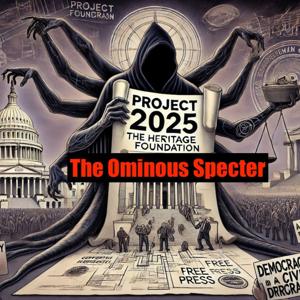
Project 2025: The Ominous Specter

Project 2025: The Ominous Specter

Download on the App Store

Project 2025: The Ominous Specter episodes

  • Project 2025: The Conservative Blueprint Reshaping America's Government
    Project 2025 has emerged as one of the most ambitious and polarizing policy blueprints in recent American history. Developed under the guidance of the Heritage Foundation, with participation from more than 100 conservative organizations, Project 2025 represents a detailed roadmap for the executive branch—the so-called “Mandate for Leadership”—aimed at fundamentally reshaping the federal government should a conservative administration return to the White House.
    At its heart, Project 2025 proposes to dramatically increase presidential control over the federal bureaucracy. According to The Heritage Foundation’s Kevin Roberts, “every federal employee should answer to the president,” and the blueprint recommends eliminating the independence of agencies like the Department of Justice, the FBI, and the Federal Communications Commission. Supporters argue this would remedy what they see as an unaccountable, left-leaning bureaucracy, but critics warn that the plan would threaten the separation of powers and basic civil liberties by putting nearly all executive branch decision-making directly under the president.
    Specifics from the plan highlight its scope. The project calls for the replacement of all State Department leadership before Inauguration Day with appointees handpicked for ideological alignment, bypassing Senate confirmation requirements wherever possible. Kiron Skinner, who authored the State Department chapter, said that career officials had become “too left-wing” and should be replaced with loyal conservatives, despite admitting she could not name a time when these officials had obstructed Trump policies.
    The workforce reductions proposed are equally sweeping. Project 2025 recommends dismissing up to a million federal workers, either by abolishing entire agencies or through mass layoffs. According to reporting from Government Executive, the Trump administration, implementing elements of the playbook through the Musk-led Department of Government Efficiency, has already cut hundreds of thousands of jobs and eliminated agencies such as the Consumer Financial Protection Bureau and USAID, moves claimed to save $1 trillion but mired in legal disputes with federal workers’ unions. These layoffs coincide with aggressive return-to-office mandates and office consolidations, disrupting telework programs relied upon since the pandemic.
    Policy changes extend well beyond personnel. On public health, Project 2025 would fundamentally curtail the Centers for Disease Control and Prevention’s authority. The plan advises preventing the CDC from issuing prescriptive guidance on vaccines and masks, transferring these decisions to parents and providers, and splitting the CDC into two agencies to limit its agenda-setting power. The Food and Drug Administration’s drug approval process would be reformed, and federal public health funding would be channeled directly to states, bypassing agencies like NIH.
    On social policy, the proposals are stark. Project 2025 outli
    This content was created in partnership and with the help of Artificial Intelligence AI.
    5 min
  • Project 2025: Reshaping American Governance with Sweeping Executive Power Consolidation
    Project 2025 is reshaping the landscape of American governance in ways unseen for generations. Conceived by The Heritage Foundation and over a hundred allied conservative groups, with a sprawling document called “Mandate for Leadership” running over 900 pages, the project sets an ambitious course: consolidate executive power, overhaul federal agencies, and imprint a distinctly right-leaning ideology across the machinery of the state.
    The latest developments reveal sweeping changes since President Donald Trump’s inauguration for his second term. With Elon Musk at the helm of the newly created Department of Government Efficiency, or DOGE, implementation has not only started but moved at unanticipated speed and scale. Agencies like the Consumer Financial Protection Bureau and USAID have been eliminated virtually overnight, mirroring the project’s stated goal to "save $1 trillion" and rid the government of what its proponents call unaccountable bureaucracy. Tens of thousands of federal workers, including around 280,000 across 27 agencies, have been or are slated to be laid off, according to Challenger, Gray & Christmas Inc. Agency leaders, especially in foreign policy, have been systematically replaced by ideologically vetted loyalists who, as one Project 2025 advisor put it, will "answer to the president" alone.
    One key feature of Project 2025 is the expansion of presidential powers. As Kevin Roberts of The Heritage Foundation declared, "all federal employees should answer to the president." The plan’s architects rely on the controversial doctrine of “unitary executive theory,” giving the Oval Office greater leverage to direct previously independent agencies like the DOJ, FBI, FCC, and FTC. In practice, Biden- or Obama-era leaders have been removed, often bypassing Senate confirmation in favor of acting appointments drawn from the project’s talent pool—a who's who of conservative legal scholars and former administration officials.
    Policy objectives are equally far-reaching. The executive order signed this February, for example, severely restricts federal hiring—agencies can now add just one new employee for every four who depart, with exceptions only for national security or law enforcement. By identifying redundant or statutorily nonessential agency components, DOGE is empowered to recommend consolidation or outright elimination, provoking intense legal and political battles. According to statements from union leaders such as NTEU’s Tony Reardon, challenges are already underway: “We have taken the necessary action to file a lawsuit to uphold the law and stop this attack.” Simultaneously, the administration has pushed for return-to-office mandates, making remote work much less tenable for government employees.
    Project 2025’s authors are explicit about their social agenda. The American Civil Liberties Union outlines how the blueprint would reverse decades of advancements on abortion rights, LGBTQ protections, and racial equity. The Mandate for Le
    This content was created in partnership and with the help of Artificial Intelligence AI.
    5 min
  • Seismic Shake-Up: Project 2025 Aims to Centralize Executive Power and Dismantle the Administrative State
    Project 2025 represents a seismic attempt to reshape the machinery of American governance, guided by a philosophy that seeks to place virtually all executive power directly under presidential control. Initiated by the Heritage Foundation and an alliance of over a hundred conservative organizations, its centerpiece is the “Mandate for Leadership,” a massive policy playbook published in 2023 designed to act as the transition manual for a potential new administration following the 2024 election.
    At its core, Project 2025 seeks to “destroy the Administrative State,” meaning it aims to strip federal agencies of much of their independence and dismantle what its authors claim are layers of unaccountable and biased bureaucracy. Proponents, such as Kevin Roberts of the Heritage Foundation, argue that “all federal employees should answer to the president,” encapsulating the project’s vision of a centralized, powerful executive branch. To achieve this, Project 2025 recommends the widespread dismissal of current senior officials across agencies like the Department of State—and their immediate replacement with individuals selected for their loyalty and ideological alignment, bypassing traditional Senate confirmation hurdles.
    One of the most controversial levers in the playbook is the resurrection of Schedule F, a proposed employment classification that would allow the president to convert career civil servants into at-will employees, stripping them of long-standing job protections. This maneuver would, according to its critics, allow the White House to purge thousands of nonpartisan officials and replace them with political loyalists—an approach described in detail by advocacy outlets and union leaders as a recipe for “political overreach or abuse of power."
    The document’s scope spans 30 federal departments, each with a dedicated chapter and specific 180-day action plans—right down to pre-drafted executive orders waiting for a president’s signature on inauguration day. Concrete proposals include eliminating entire agencies such as the Consumer Financial Protection Bureau and USAID, mass layoffs affecting hundreds of thousands of federal workers, and strict mandates requiring employees to return to office buildings, often ignoring remote work policies established during the pandemic. Since January 2025, the Trump administration’s Department of Government Efficiency, led by Elon Musk, has acted on this blueprint with remarkable speed, eliminating agencies and laying off more than 280,000 federal employees and contractors across 27 agencies in just a few months.
    In terms of social policy, Project 2025 is unmistakably ambitious. The playbook calls for aggressive curbs on abortion rights, restrictions on LGBTQ protections, and a reversal of progress regarding racial and immigrant rights. Critics such as the American Civil Liberties Union warn that these measures, if implemented, could erode civil liberties and tip the balance of American governance toward an “
    This content was created in partnership and with the help of Artificial Intelligence AI.
    5 min
  • Project 2025: Reshaping American Governance and Expanding Presidential Power
    Project 2025 is setting the stage for a sweeping transformation of American governance, promising changes that could reshape the federal landscape for years to come. Backed by the Heritage Foundation and a coalition of conservative advocacy groups, this policy blueprint is designed to consolidate executive power and implement a far-reaching conservative agenda from the first day of a new presidential administration.
    Central to Project 2025 is its intent to dramatically expand presidential authority over the executive branch. According to project advocates, the goal is to “place the entire executive branch under direct presidential control,” which would eliminate the traditional independence of agencies like the Department of Justice, FBI, Federal Communications Commission, and Federal Trade Commission. “All federal employees should answer to the president,” declared Kevin Roberts, president of the Heritage Foundation, reflecting the project's belief in a unitary executive theory where the president wields unprecedented control over federal administration. This vision calls for mass dismissal of top federal employees and replacing them with ideologically aligned appointees, a process that circumvents the usual need for Senate confirmation and could reshape federal agencies overnight.
    A concrete example of this agenda has already unfolded in the first months of the current administration. The Department of Government Efficiency, led by Elon Musk, has been instrumental in executing proposals that have stunned even Project 2025’s own architects. In rapid succession, agencies such as the Consumer Financial Protection Board and USAID have been dismantled. Challenger, Gray & Christmas, Inc. report that over 280,000 federal workers and contractors across 27 agencies have been laid off or are planned to be laid off, reflecting an unprecedented overhaul of the civil service. Return-to-office mandates have been paired with reductions in federal office space, complicating the lives and careers of hundreds of thousands of workers who had adapted to remote work during the pandemic.
    Project 2025’s scope also extends to emergency management and disaster response. The plan calls for shifting FEMA’s emergency preparedness and response costs overwhelmingly onto states and localities, with the federal government restricting its contribution to catastrophic events only. “FEMA is overtasked, overcompensates for the lack of state and local preparedness and response, and is regularly in deep debt,” warns the Project 2025 blueprint. It also urges Congress to end federal preparedness grants, signaling a major reversal in longstanding disaster response policy.
    The plan proposes similar upheavals in the realm of public broadcasting, with investigations launched into National Public Radio and PBS and calls to reduce or eliminate federal funding for these institutions. In immigration and border security, Project 2025 recommends direct use of military personnel for arrest
    This content was created in partnership and with the help of Artificial Intelligence AI.
    5 min
  • Project 2025: Reshaping American Governance Through Executive Power Consolidation
    Project 2025 is more than a government reform blueprint; it's a sweeping bid to reshape the core of American governance. Developed by conservative think tanks, including the Heritage Foundation, Project 2025 lays out hundreds of pages detailing how a future administration—under President Trump, as recent events have confirmed—could consolidate executive power, overhaul federal agencies, and redefine the federal-state relationship.
    According to project documents, a foundational goal is to place the entire executive branch under direct presidential control. The plan would strip independence from agencies like the Department of Justice, the FBI, and regulatory bodies such as the Federal Communications Commission and the Federal Trade Commission. Kevin Roberts of the Heritage Foundation stated that all federal employees should answer to the president, echoing the controversial unitary executive theory. This vision, bolstered by recent Supreme Court decisions, would make the White House the undisputed command center of federal authority.
    Concrete examples of this approach are already being seen. Project 2025 proposes that all senior State Department employees should be dismissed before January 2025, replaced with ideologically vetted appointees who could bypass Senate confirmation. Kiron Skinner, a former Trump administration official involved in the project, argues that most current State Department staff are too left-leaning for this new vision, though she couldn’t cite a specific case of obstruction. This move signals a dramatic preference for loyalty over traditional expertise.
    Agency reforms and cutbacks are a central theme. The Consumer Financial Protection Bureau and the U.S. Agency for International Development have been eliminated in the early months of Trump's second term, according to reporting from GovExec. Similarly, plans are underway to lay off over a quarter million federal workers and contractors across 27 agencies—part of a claimed $1 trillion in savings.
    Disaster response policy would see radical change as well. Project 2025 calls for a wholesale overhaul of FEMA’s funding structure. The federal government would step back, covering only 25% of costs for smaller disasters and up to 75% for the most catastrophic events, compared to the current baseline of 75% minimum coverage. The project’s authors argue FEMA is “overtasked” and advocate for ending all preparedness grants to states and localities. “DHS should not be in the business of handing out federal tax dollars: These grants should be terminated,” state the project’s recommendations.
    Other cultural and political flashpoints are also targeted. Brendan Carr, the FCC’s head, announced investigations into NPR and PBS, questioning the content aired on their more than 1,500 member stations. According to The New York Times, this reflects Project 2025’s skepticism toward publicly funded media.
    Criminal justice is slated for a dramatic pivot, too. The Brennan Center for Justice note
    This content was created in partnership and with the help of Artificial Intelligence AI.
    5 min
  • Sweeping Federal Overhaul: Project 2025 Reshapes American Governance
    Project 2025, championed by the Heritage Foundation and a coalition of conservative organizations, has become one of the most ambitious and controversial policy blueprints in contemporary American politics. Its authors envision a sweeping reconstruction of federal power, “placing the federal government’s entire executive branch under direct presidential control,” as Heritage president Kevin Roberts has openly declared. The plan’s backbone is a robust endorsement of the unitary executive theory, which grants unprecedented authority to the president, superseding the traditional independence of agencies like the Department of Justice, FBI, and the Federal Communications Commission. Roberts insists, “All federal employees should answer to the president,” reflecting a philosophy that would uproot decades of precedent regarding agency autonomy.
    The heart of Project 2025 lies in its plan to replace thousands of federal officials with ideologically vetted loyalists. It recommends dismissing nearly all senior State Department employees prior to Inauguration Day and filling those roles with temporary leaders who, notably, do not require Senate confirmation. Kiron Skinner, who contributed to the project’s State Department chapter, has been candid in critiquing existing personnel as “too left-wing,” advocating for a transformation in which “those more loyal to a conservative president” would fill the ranks.
    This push for centralized authority is not just theoretical. Since January 20, under the Trump administration and the Musk-led Department of Government Efficiency, Project 2025’s playbook has begun to reshape the bureaucracy. Entire agencies, including the Consumer Financial Protection Bureau and USAID, have been eliminated or gutted through unprecedented executive actions. Challenger, Gray & Christmas, Inc. reports that approximately 280,253 federal workers and contractors have either been laid off or face imminent dismissal. This seismic reduction affects at least 27 agencies and is touted as part of an effort to save $1 trillion.
    Specific policy objectives underscore the project’s breadth. In criminal justice, the blueprint advises that the Department of Justice intervene aggressively in local prosecutions deemed insufficiently tough, even seeking to remove elected district attorneys who decline to prosecute certain crimes. The document urges that “the DOJ should remove local DAs who ‘deny American citizens the ‘equal protection of the laws’ by refusing to prosecute criminal offenses in their jurisdictions.’” This would deter local prosecutors from pursuing alternative justice models, such as drug treatment instead of incarceration, under threat of federal override. Additionally, Project 2025 advocates expanding federal law enforcement’s reach into local affairs, particularly in areas where local policy diverges from its agenda.
    Environmental and labor policies are equally targeted. The Center for Progressive Reform notes that Project 2025 is track
    This content was created in partnership and with the help of Artificial Intelligence AI.
    5 min
  • Transformative Project 2025: Reshaping the Future of American Governance
    As I delve into the intricacies of Project 2025, a sense of profound transformation and potential upheaval in the U.S. federal government becomes increasingly clear. This initiative, born out of a convergence of conservative ideologies and strategic planning, aims to reshape the very fabric of American governance.

    In the spring of 2022, a group of conservative extremists and political operatives gathered to draft a radical blueprint for government restructuring. This document, known as Project 2025 or "Mandate for Leadership: The Conservative Promise," was released by the Heritage Foundation in April 2023. Backed by 100 advisory coalition partners, including far-right groups and organizations funded by billionaires, this 927-page policy blueprint is nothing short of ambitious.

    At its core, Project 2025 seeks to "destroy the Administrative State" by consolidating executive power in favor of right-wing ideologies. The plan is rooted in an expansive interpretation of the unitary executive theory, which centralizes greater control over the government in the White House. Kevin Roberts, a key proponent, envisions a system where all federal employees answer directly to the president, a vision that has been gaining traction since the Reagan administration, particularly through the influence of the Federalist Society and the Heritage Foundation[3].

    One of the most striking aspects of Project 2025 is its proposal to eliminate the independence of several critical federal agencies. The Department of Justice, the FBI, the Federal Communications Commission, and the Federal Trade Commission are all targeted for direct presidential control. This move is designed to ensure that these agencies align with the ideological stance of the president, rather than operating as independent entities. For instance, Kiron Skinner, who authored the State Department chapter of Project 2025, advocates for the dismissal of all Department of State employees in leadership roles before January 20, 2025, to be replaced by ideologically vetted leaders appointed to acting roles that do not require Senate confirmation. Skinner's rationale is that many State Department employees are too left-wing and need to be replaced by those more loyal to a conservative president[3].

    The project also includes a detailed 180-day playbook for implementing these reforms, starting with a stack of prepared Executive Orders ready for the new president to sign on the first day in office. This rapid transformation is facilitated by a scheme known as Schedule F, which allows for the hiring of unlimited political appointees without expiration dates. These appointees would not be bound by the usual civil service protections, making them susceptible to political overreach and abuse of power. As outlined in the project, this would enable a president and their political loyalists to have full control over the Executive Branch for personal and political gain[5].

    The implications of such changes are far-reaching and potentially devastating. For federal workers, the loss of civil service protections could mean a significant erosion of job security and the introduction of a highly politicized work environment. The American Federation of Government Employees (AFGE) warns that Project 2025 could lead to the termination of up to 1 million federal workers, dismantling agencies and disrupting essential public services[2].

    Experts and critics alike are sounding alarms about the potential consequences of these reforms. The Center for Progressive Reform is tracking the executive action proposals across 20 federal agencies, highlighting the devastating consequences for workers, the environment, and public health. The ACLU has also expressed concerns, noting that the re-election of a president aligned with these policies could have immense and far-reaching impacts on civil liberties and the rule of law[1][4].

    As we approach the 2024 elections and the potential implementation of Project 2025 in 2025, the stakes are high. The project's success hinges on a GOP victory and the willingness of a new administration to execute these radical reforms. The coming months will be crucial, as the public and policymakers grapple with the implications of such a profound shift in governance.

    In reflecting on Project 2025, it becomes clear that this initiative represents more than just a set of policy proposals; it embodies a fundamental redefinition of the relationship between the executive branch and the rest of the federal government. As the nation moves toward this potential crossroads, it is imperative to engage in a robust and informed discussion about the future of American governance and the values that underpin it. The decisions made in the near future will shape not only the immediate trajectory of the federal government but also the long-term health of American democracy itself.
    5 min
  • Transformative or Troubling? The Looming Impact of Project 2025 on American Governance
    As I delve into the intricacies of Project 2025, a sense of profound transformation and potential upheaval in the U.S. federal government becomes increasingly clear. This initiative, crafted by a coalition of conservative organizations and political operatives, is more than just a policy blueprint; it is a radical vision for reshaping American governance.
    Project 2025 emerged in the spring of 2022, when a group of conservative extremists and political operatives gathered to draft a comprehensive plan for a new administration, presuming a GOP victory in the November 2024 elections. This 927-page document, also known as "Mandate for Leadership: The Conservative Promise," was released by the Heritage Foundation in April 2023 and is backed by 100 advisory coalition partners, including far-right groups and organizations funded by billionaires.
    At its core, Project 2025 aims to "destroy the Administrative State" by radically restructuring each of the 30 federal departments. The plan is divided into detailed chapters, each outlining specific proposals for overhauling these agencies and ensuring that political loyalists fill key positions from "Day One" of a new Republican administration. This is not just a matter of personnel changes; it involves a fundamental shift in how the executive branch operates, with a strong emphasis on centralizing power in the White House.
    One of the most contentious aspects of Project 2025 is its advocacy for the unitary executive theory, an expansive interpretation of presidential power that seeks to eliminate the independence of various federal agencies. Kevin Roberts, a key figure behind the project, has stated that all federal employees should answer directly to the president. This vision is supported by conservative justices, the Federalist Society, and the Heritage Foundation, which have been instrumental in shaping a stronger unitary executive since the Reagan administration.
    For instance, Project 2025 recommends dismissing all Department of State employees in leadership roles before January 20, 2025, and replacing them with ideologically vetted leaders appointed to acting roles that do not require Senate confirmation. Kiron Skinner, who authored the State Department chapter of the project, has expressed her belief that most State Department employees are too left-wing and should be replaced by those more loyal to a conservative president. When questioned about specific instances where State Department employees obstructed Trump policy, Skinner admitted she could not name any such occurrences, highlighting the ideological rather than pragmatic basis of these recommendations.
    The project also includes a 180-day playbook with specific steps for implementing these reforms, starting with a prepared stack of Executive Orders ready for the new president to sign on the first day in office. This rapid implementation is designed to ensure that the new administration can swiftly consolidate power and begin dismantling exis
    This content was created in partnership and with the help of Artificial Intelligence AI.
    6 min
  • "Brace for Impact: Project 2025 - The Sweeping Conservative Overhaul of the US Federal Government"
    As I delve into the intricacies of Project 2025, a sense of profound transformation and potential upheaval in the U.S. federal government becomes increasingly clear. This initiative, born out of a convergence of conservative ideologies and strategic planning, aims to reshape the very fabric of American governance in ways that are both sweeping and contentious.
    Project 2025 is the brainchild of a coalition of conservative organizations, notably the Heritage Foundation, and was formalized in a 927-page policy blueprint released in April 2023. This document, often referred to as “Mandate for Leadership: The Conservative Promise,” outlines a radical restructuring of the federal government, with each of its 30 chapters dedicated to a specific department. The overarching goal is stark: to “destroy the Administrative State” and consolidate executive power under the presidency[5].
    At the heart of Project 2025 lies the unitary executive theory, an expansive interpretation of presidential power that seeks to centralize control over the government in the White House. Proponents argue that this concentration of power is necessary for efficient governance, but critics warn it could lead to an unprecedented erosion of checks and balances. Kevin Roberts, a key figure in this initiative, has stated that all federal employees should answer directly to the president, a notion that resonates with the Federalist Society and conservative justices who have supported stronger executive powers since the Reagan administration[4].
    One of the most striking aspects of Project 2025 is its plan for the Department of State. Kiron Skinner, who authored the State Department chapter, advocates for the dismissal of all leadership roles within the department before January 20, 2025. These positions would then be filled with ideologically vetted appointees who do not require Senate confirmation. Skinner's rationale is that many current State Department employees are too left-wing and thus need to be replaced by those more loyal to a conservative president. When questioned about specific instances where State Department employees obstructed Trump policies, Skinner admitted she could not provide any examples[4].
    This approach is not isolated to the State Department; it is part of a broader strategy to ensure that key positions across the federal government are filled with political loyalists. Project 2025 includes a 180-day playbook detailing specific steps for implementing these reforms, starting with a stack of prepared Executive Orders ready for the new president to sign on the first day in office. This playbook is designed to expedite the transition and ensure that political appointees, rather than career civil servants, hold the reins of power[5].
    A critical component of this plan is the use of Schedule F, a scheme that allows for the hiring of unlimited political appointees without expiration dates. This mechanism also enables the transfer of apolitical civil service employ
    This content was created in partnership and with the help of Artificial Intelligence AI.
    6 min
  • "Centralized Power Grab: Exposing the Troubling Agenda of Project 2025"
    As I delve into the intricacies of Project 2025, a sense of profound change and potential upheaval in the U.S. federal government becomes increasingly clear. This initiative, spearheaded by conservative organizations and former Trump administration officials, aims to reshape the very fabric of American governance, centralizing executive power in ways that have sparked both fervent support and vehement opposition.
    At the heart of Project 2025 lies the unitary executive theory, an expansive interpretation of presidential power that seeks to place the entire executive branch under direct presidential control. This vision is championed by figures like Kevin Roberts, who advocates for all federal employees to answer directly to the president, eliminating the independence of critical agencies such as the Department of Justice, the FBI, the Federal Communications Commission, and the Federal Trade Commission[4].
    One of the most striking aspects of Project 2025 is its plan for the Department of State. Kiron Skinner, who authored the State Department chapter of the project, proposes dismissing all current leadership roles within the department before January 20, 2025. Skinner, who briefly headed the department's office of policy planning during the Trump administration, believes that most State Department employees are too left-wing and should be replaced with ideologically vetted leaders appointed to acting roles that do not require Senate confirmation. When questioned about instances where State Department employees obstructed Trump policies, Skinner admitted she could not name a single example[4].
    This radical overhaul is part of a broader "Mandate for Leadership," a 900-plus page policy playbook that outlines sweeping reforms across various federal agencies. For instance, Project 2025 suggests consolidating or eliminating programs like those managed by the Economic Development Administration (EDA), which has been instrumental in investing billions of dollars into transformative infrastructure projects. These investments have generated nearly $20 billion in private investment and created over 220,000 jobs. By dismantling such programs, Project 2025 could severely undermine the federal government's ability to invest in communities, potentially devastating working people, small businesses, and the overall health of the economy[5].
    The project also targets the data-collection capacities of key agencies. By consolidating the Bureau of Economic Analysis, Census Bureau, and Bureau of Labor Statistics, Project 2025 would significantly impair the ability of these agencies to provide independent, partisan-free data. This data is crucial for businesses, researchers, and government organizations, and its manipulation could have far-reaching consequences for the economy. As the U.S. Bureau of Labor Statistics notes, their data is intentionally independent from partisan interests and is relied upon by a wide range of stakeholders[5].
    The implications of these c
    This content was created in partnership and with the help of Artificial Intelligence AI.

    7 min

About Project 2025: The Ominous Specter

From the publisher's feed

Project 2025: The Ominous Specter Ladies and gentlemen, we find ourselves standing at the precipice of a dark and foreboding future, one in which the very foundations of our democracy are under siege. The threat we face is not an external one, but rather a cancer that has metastasized within the body politic itself. I speak, of course, of the insidious manifesto known as Project 2025 – a blueprint for authoritarian rule that masquerades as a conservative vision for the United States. As we delve into the depths of this pernicious document, crafted in the shadowy halls of the Heritage Foundation, it becomes abundantly clear that we are witnessing nothing less than a frontal assault on the principles that have long sustained our republic. Project 2025 is not merely a misguided set of policy proposals; it is a calculated attempt to dismantle the very fabric of our democratic institutions, to concentrate power in the hands of a few, and to impose a rigid ideological orthodoxy on a nation that has always prided itself on its diversity and its commitment to individual liberty. At its core, Project 2025 seeks to reshape the federal government in the image of a conservative dystopia. Its proponents, consumed by an insatiable hunger for power and an unwavering commitment to their ideological agenda, have meticulously crafted a roadmap for the systematic erosion of checks and balances, the suppression of dissent, and the consolidation of executive authority. It is a vision that should send a shiver down the spine of every freedom-loving American, for it represents nothing less than a repudiation of the very principles upon which this nation was founded. The architects of Project 2025 argue, with a level of audacity that borders on the delusional, that the federal bureaucracy is overrun with unaccountable liberals who impede their agenda. Their solution? A purge of Stalinist proportions, reclassifying tens of thousands of civil servants as political appointees, effectively transforming the machinery of government into an apparatus of ideological conformity. The implications of this proposal alone are staggering – the eradication of expertise, the subversion of meritocracy, and the creation of a loyalty-based system that would make even the most fervent authoritarian blush. But the assault on democratic institutions does not end there. Project 2025's disdain for the separation of powers is as blatant as it is dangerous. Its vision of a "unitary executive theory" is nothing short of a repudiation of the very principles enshrined in our Constitution. By seeking to exert control over independent agencies like the Department of Justice and the FBI, the project's architects aim to transform these bastions of impartiality into instruments of partisan enforcement. It is a move that would make Richard Nixon's transgressions seem like mere child's play, a power grab of such magnitude that it threatens to unravel the very fabric of our democracy. And yet, even as we r

More shows like Project 2025: The Ominous Specter

Fiction - Comedy Fiction by The Sunset Explorers

Fiction - Comedy Fiction

6,448 Listeners

The Ezra Klein Show by New York Times Opinion

The Ezra Klein Show

15,904 Listeners

What's in Project 2025? by KALW

What's in Project 2025?

34 Listeners