
Sign up to save your podcasts
Or



Here's a frightening statistic: More young women age 18 to 29 voted for Donald Trump in 2024 than in 2016 or 2020. Why? Jess Britvich argues that TikTok and Instagram have been moving some young women rightward, without making it obvious.
Trends like clean beauty, natural living, tradwife aesthetics, or even yoga and wellness communities might look harmless on the surface—but many of them are pipelines to right-wing politics. The former social worker and content creator Jess Britvich explains how social media pipelines—from “SkinnyTok” to "clean" beauty products—pull people into conspiracy thinking and reactionary movements, and how we can stem the tide by becoming more media literate.
Full transcript available here at relationscapes.org.
Jess Britvich is a content creator in Pittsburgh. Formerly a social worker, she turned her attention to online education in the wake of the global pandemic and the rise of MAGA influencers. Her Substack is substack.com/@jessbritvich. Follow her on TikTok and Instagram @jessbritvich.
Who would choose to bring children into today’s world? Between climate change, economic strain, political conflict, and growing uncertainty about the future, more people today say they feel uncertain about parenthood, especially progressive people.
Philosophers Anastasia Berg and Rachel Wiseman—authors of What Are Children For?—explore the personal, political, and philosophical stakes of having kids. From the tedium and vulnerability of early parenting to the profound meaning and joy it can bring, this conversation opens space for anyone wrestling with one of life’s biggest decisions.
Full transcript available at relationscapes.org.
Anastasia Berg is Assistant Professor of Philosophy at University of California, Irvine. She serves as editor of The Point magazine, a Chicago-based literary magazine that publishes philosophical writing on everyday life and culture.
Rachel Wiseman is managing editor of The Point. Together they wrote What Are Children For?: On Ambivalence and Choice.
Fatphobia is everywhere. It affects how we judge ourselves and each other. In this episode, philosopher Kate Manne exposes the social, ethical, and health-based consequences of anti-fat bias.
Drawing on personal experience and sharp cultural analysis, Manne challenges dieting myths, weight-loss fads, and societal pressure to be thin. She invites us to practice “body reflexivity,” the radical idea that our bodies exist for ourselves, not merely for others. She explains why physical movement, health, and self-care matter more than size, and why dismantling fatphobia is a social justice issue.
This episode turns the tables on fatphobia in a world obsessed with thinness, offering a liberating perspective about bodies and wellness.
Full transcript available at relationscapes.org.
Kate Manne is author of Down Girl, Entitled, and Unshrinking. She's an associate professor of philosophy at Cornell University where she’s been teaching since 2013. Before that, she was a junior fellow at the Harvard Society of Fellows. Manne did her graduate work in philosophy at MIT. Her Substack is called More to Hate.
Like a lot of American women, Aubrey Hirsch grew up trying to channel her own rage into other emotions. Maybe she wasn't mad, she was really jealous. Maybe she wasn't pissed off, she was actually sad. Eventually, Aubrey realized she had been suppressing something vital. Sometimes being angry is the main thing she should be. Instead of always running from her outrage, now she channels it into informative, funny, sometimes furious feminist comics.
Aubrey joins us to talk about how she uses illustration to call out sexism, why rage can be a powerful force for collective change, and how we can channel it individually right now to change some things for the better. Her new book is called Graphic Rage: Comics on Gender, Justice, and Life As a Woman in America.
Aubrey Hirsch is author of Graphic Rage: Comics on Gender, Justice, and Life As a Woman in America. She is a writer and illustrator living in New York. Her stories, essays, and comics have appeared in The New York Times, Vox, TIME Magazine, American Short Fiction, Black Warrior Review, The Rumpus, The Nib and elsewhere. She is author of a short story collection, Why We Never Talk About Sugar, and a flash fiction chapbook, This Will Be His Legacy.
She has taught writing at Oberlin College, The University of Pittsburgh, Colorado College, Georgia College and State University, and Chatham University. She is recipient of a 2022 National Endowment for the Arts fellowship in Literature, an individual artist award from the Sustainable Arts Foundation, the Daehler Fellowship in Creative Writing from The Colorado College, and The Meek Award for Graphic Nonfiction from The Florida Review.
Subscribe to her (free!) Substack and follow her on Instagram @aubreyhirsch.
Are men “naturally” violent? Are they hardwired to provide and protect? Does their DNA demand they stray? These questions persist in debates about masculinity, but they’re often answered with lazy biology.
In this episode, anthropologist Matthew Gutmann dismantles biologically grounded gender essentialist myths.
Drawing on decades of research—from fatherhood in Mexico to gender shifts in China—Gutmann shows how culture, history, and politics shape what we call “masculinity.” We talk about the dangers of blaming “male nature,” how fatherhood gets redefined across cultures, and why understanding men as human beings first opens the door to more freedom and accountability.
His book is called Are Men Animals? How Modern Masculinity Sells Men Short.
Full transcript available at relationscapes.org.
Matthew Gutmann is Professor Emeritus of Anthropology at Brown University. His research and teaching has focused on studies of men and masculinities; public health; politics; and the military. His latest book is Are Men Animals? How Modern Masculinity Sells Men Short.
What does it mean to parent in a world that wasn’t built for you? Writer and disabled parent Eliza Hull joins us to talk about her groundbreaking anthology We’ve Got This: Essays by Disabled Parents.
These essays challenge ableist assumptions, confront stigma, and spotlight the resilience and pride of disabled parents. Their stories aren't about about pity or inspirational “overcoming”—they are about identity, ingenuity, and reimagining parenthood through unapologetically disabled experiences.
Full transcript available at relationscapes.org.
Eliza Hull is an award-winning musical artist, writer, journalist, and disability advocate based in Victoria, Australia. Her edited collection is called We've Got This: Essays by Disabled Parents.
Happy 50th Episode! To celebrate, I invited Lauren Passell, a podcast hero of mine, to revisit a Relationscapes episode she recommended on her excellent Podcast The Newsletter.
As a newly adoptive white mom of a child who is Black, Lauren was thrilled about Angela Tucker's interview. Tucker is an incredible advocate for transracial adoptees. Lauren opens up about the joys and challenges of raising a child in an open adoption, exploring questions about race, family, and community.
Full transcript available here at relationscapes.org.
Lauren Passell (she/her) is the founder and CEO of Tink Media, Podcast the Newsletter, Podcast Marketing Magic, and is the producer of Feed the Queue. She writes about podcasts for Lifehacker. She has spoken about podcast marketing for SXSW, Podcast Movement, Podfest, London Podcast Festival, The Podcast Show, and has taught classes for Harvard, Columbia, and more. She is a judge for The Webbys, Signal Awards, The Ambies, and the International Women's Podcast Awards. She lives in West Philly with her cat, husband, and daughter, and loves Disney.
For decades, public schools have been a cornerstone of American learning and civic life. But far-right groups have worked for years to turn these institutions into battlegrounds, pushing to control curricula, ban books, and restrict the rights of marginalized students, while whitewashing history and steamrolling over accessibility. The battle is reaching fever pitch today.
In her book School Moms, education journalist Laura Pappano takes us inside the world of parent activism, revealing how partisan actors mobilize to dismantle public education, enforce narrow ideological agendas, and silence dissent.
This episode exposes the high-stakes struggle over the future of schools and what it means for students, educators, and communities across the country.
Full transcript available at relationscapes.org.
Laura Pappano is an award-winning education journalist, author, and founder of The New Haven Student Journalism Project. Her latest book is called School Moms: Parent Activism, Partisan Politics and the Battle for Public Education. She is a former education columnist for The Boston Globe, and has published work in places like The New York Times Magazine, Vanity Fair, Salon, The Washington Post, USA Today, Slate, The Atlantic, and The Christian Science Monitor.
When Anne Pinkerton's brother unexpectedly died alone in an extreme sport accident, she faced the same question over and over. People would always ask, "Were You Close?" They asked out of concern, but the question felt almost impossible to answer.
In some ways, Anne and her brother David weren't close—they lived in different states, he was more than a decade older. But that distance seemed beside the point when she considered all the ways they were close. And after his death, she set out to find new ways to be closer. In this episode, Anne Pinkerton joins us to talk about how grief over the loss of a sibling is one of the most overlooked griefs people can experience.
Full transcript available at relationscapes.org.
Anne Pinkerton is an essayist, memoirist, and poet. Her work often circles around grief and loss, as well as coping with these painful realities in our lives. Her memoir is called Were You Close? a sister’s quest to know the brother she lost. Visit her at annepinkertonwriter.com.
What if the image the world loves you for is the one that’s destroying you?
In her memoir Fetishized, Kaila Yu deconstructs "yellow fever," exploring how pop culture and Western beauty ideals shaped damaging stereotypes about Asian women—and how she once embodied them herself. After spending years in the pinup and import modeling world, auditioning for film roles steeped in dehumanizing tropes, touring globally with her all Asian American girl band, and altering her body to match impossible standards, the emotional costs became too much. So he began a new journey to reclaim her identity, beauty, and self-worth.
Full transcript available at relationscapes.org.
Kaila Yu is author of Fetishized: A Reckoning with Yellow Fever, Feminism, and Beauty. She is a freelance writer for the Los Angeles Times, Rolling Stone, the New York Times, Business Insider, Conde Nast Traveler and more. Formerly, she was a model and the lead singer for the all–Asian American female rock band Nylon Pink. Fetishized is her first book. You can find Kaila online @kailayu.
From the publisher's feed
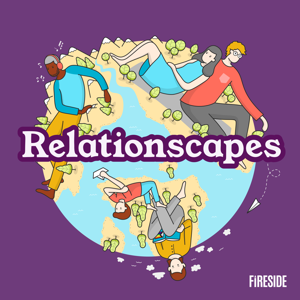
Your identity is a landscape, shaped by countless connections and crossroads with other people. Relationscapes explores our shared terrain—how we make each other who we are, often in ways we don't easily recognize.
Journalist Blair Hodges ventures into this terrain with fascinating people whose expertise and experiences reveal unexpected things about who we are and how we connect. Join us to explore gender, race, sexuality, ability, friendship, family, culture, and more. Expand your map of what it means to be human in turbulent times.

38,014 Listeners

43,324 Listeners
26,169 Listeners

111,874 Listeners

56,435 Listeners

335 Listeners
1,724 Listeners
5,116 Listeners

16,352 Listeners
37 Listeners

130 Listeners

15,917 Listeners

19,270 Listeners
1,882 Listeners
6,167 Listeners