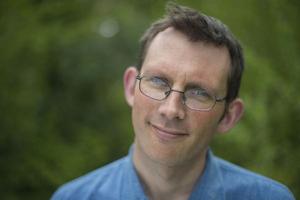
Rob Hopkins

Rob Hopkins

By Rob HopkinsSociety & Culture
Download on the App Store

Rob Hopkins episodes

  • Stephen Duncombe on imagination, spectacle and desire.
    One of the best books I read this summer was Stephen Duncombe’s ‘Dream: re-imagining progressive politics in an age of fantasy’.  Written during the last days of the presidency of George W. Bush, it was a plea for progressive politics to embrace imagination, spectacle, wit, sensuality and what one reviewer called “a joyful aesthetic of dissent”. I loved the book’s assertion that “unless progressives acknowledge and accept a politics of imagination, desire and spectacle, and, most important, make it ethical and make it our own, we will bring about our “ruin rather than preservation”.
    28 min
  • Kyung Hee Kim on 'The Creativity Crisis'
    The initial spark that set me off thinking that I needed to write a book about imagination was reading a study by a professor at College of William and Mary, in Williamsburg, Virginia, whose name is Kyung Hee Kim, known as ‘K’ to her friends (because they kept getting her full name wrong).  K is originally from Korea, and came to the US in 2000. She already had a Masters and a PhD from her time in Korea, but when she came to the US she did a second PhD under the supervision of Dr Ellis Paul Torrance, known as the ‘Father of Creativity’.  Torrance created the famous Torrance Test for Creative Thinking, known as ‘the gold standard of creativity testing’.  He passed away in 2003, but K has since continued her research into creativity.
    47 min
  • When imagination meets Brexit: the story of the Totnes Passport
    One of the highlights of my summer was collecting my Totnes Passport.  The whole Brexit debacle from inception to its current state of woeful ineptitude and brazen jingoism has been one entirely bereft of imagination.  Neither side has presented any kind of an imaginative story, either as to the wonderful things Brexit might enable, or the wonderful possibilities that remaining in the EU might present.  The whole thing has felt like an imagination vacuum.  I was delighted then to hear that in my town, a local solicitor, Jonathan Cooper, had decided to start issuing passports for the ‘City State of Totnes’ - a member of the European Union, and that within just a few days, the story had spread around the world.
    22 min
  • Hilary O'Shaughnessy on the Playable City
    What happens when play disappears from our cities?  In a report for the National Trust, Stephen Moss writes "a potential impact is that children who don't take risks become adults who don't take risks".  One response is the Playable City movement.  It defines a Playable City as "a city where people, hospitality and openness are key, enabling its residents and visitors to reconfigure and rewrite its services, places and story".  It's a movement that started in Bristol, and believes that "by encouraging public activities that actively bring joy, we can create a happier, more cohesive urban future".  Examples thus far, in Bristol, have included a 300ft waterslide on one of the city's steepest shopping streets, a zombie chase around the city centre, and lampposts you can interact with.  The idea has since spread around the world to cities including Tokyo, Seoul, Lagos and Austin.  I spoke to Hilary O’Shaughnessy, Producer for Playable City, who leads on the delivery of Playable City projects, based at the Watershed in Bristol.  I started by asking her what is a Playable City?
    18 min
  • Drew Dellinger: “If we had more imagination, we could have less capitalism”
    Listening to Drew Dellinger’s poetry regularly gives me goosebumps. Very shortly it will give you goosebumps too. He is a US-based writer, poet, speaker and teacher whose passions revolve around ecology, social justice, cosmology, social change and transformation. He uses arts activism to build movements, such as ‘Planetise the Movement’ which he founded. He is fascinated by the big stories that operate in our culture and the power of arts education and activism. He lives in the San Francisco Bay Area and is a deeply thoughtful and powerfully eloquent man. It was my great honour that he gave me an hour of his time to talk imagination, an hour that I found moving, inspiring and deeply thought-provoking. You’re going to love this one. I started by asking him what, for him, is imagination? When he thinks of the word imagination, what does it bring up for him?
    42 min
  • Stuart Candy on imagination and being a futurist
    Stuart Candy is a professional futurist and is an Associate Professor in the School of Design at Carnegie Melon University in Pittsburgh, Pennsylvania. His collaborative Experiential Futures practice brings possible scenarios to life through the creation of tangible artifacts and immersive situations which give people a very real taste of how different versions of the future might turn out. As you’ll hear he playfully brings future scenarios alive in the present, through collaborations with designers, artists, actors, activists, businesses and more, and he has worked in many different places. He was recently at the Transition Design Symposium at Dartington, and I took the opportunity to sit under a tree in the shade on a gloriously sunny day for the following fascinating conversation with Stuart about the future, the imagination and the creative approaches he has developed.
    47 min
  • Michel Bauwens on P2P, the commons and the imagination
    Last week, close to my home, was the Transition Design Symposium. It brought together people from around the world interested in what design can bring to the need for an urgent societal Transition, and for 2 days its attendees basked in glorious sunshine and fascinating interactions. I managed to catch up with Michel Bauwens who was attending and speaking at the conference, and we took some time for a short chat sitting under a tree in sunshine.
    Michel spends half his time in Belgium and half in Thailand, and is the founder of the P2P Foundation, a global organisation of researchers working in collaboration to explore peer production, governance and property. He is a writer, researcher and speaker on the subjects of technology, culture and business innovation. “It’s about Open Source communities”, he told me. “A lot of it is like what you are doing with Transition, perhaps a bit of a difference would be that I try to look more at the trans-local, trans-national levels, and how we can build counter-power to trans-national capital”.
    14 min
  • Tom Hirons and Rima Staines on Hedgespoken, ‘a Vehicle for the Imagination’
    Rima Staines is an artist, musician and illustrator, puppet-maker, stop-frame animator, clock-maker, theatre designer and one half of Hedgespoken with her partner Tom Hirons.  Tom is a writer of poetry and prose and teller of traditional folk tales.  Together they created ‘Hedgespoken’, a travelling off-grid storytelling theatre run from a 1966 Bedford RL lorry, converted to be a home and a go-anywhere stage.  On one bumper it says ‘Vehicle for the Imagination’ and on the other ‘Imagination, Liberation’.  They travel, present stories, share artworks, having raised the money to convert the vehicle through a crowdfunder. We met one morning at a local café with, as you'll hear, their energetic young son, and over the space of a couple of cups of tea we talked imagination, storytelling, the visual arts and much more.  I started by asking them to tell me more about Hedgespoken, and how, for them, it acts as a focal point for their work around imagination.

    52 min
  • Chris Parsons on Landworks, imagination and moving beyond prison
    Close to where I live is a project called Landworks. Landworks describes itself as "an independent charity providing a supported route back into employment and community for those in prison or at risk of going to prison".  I often walk my dog past it, and from the road you can see their polytunnels, a beautiful cob wall with roundwood pole roof, their vegetable beds, and many of the things they make are for sale in their beautiful roadside shop. Landworks began in 2013, and over that time 60 men and 4 women have spent up to 9 months there, learning new skills and taking part in their programme.  
    In our last post here, Robert Macfarlane suggested that "in some ways imagination is a function of privilege".  So what are the links between trauma, anxiety, poverty and the imagination? What does prison do to the imagination?  How might cultivating the imagination play a role in rehabilitating people in prison?  What might more imaginative approaches to prison look like, approaches which are land-based, practical and creative?  I popped along to Landworks to chat to Chris Parsons who started Landworks 5 years ago, and who still runs it.  I started by asking him to give me an introduction to Landworks and what it does.
    36 min

About Rob Hopkins

From the publisher's feed

Podcast by Rob Hopkins

More shows like Rob Hopkins

Tara Brach by Tara Brach

Tara Brach

10,526 Listeners

Jacobin Radio by Jacobin

Jacobin Radio

1,460 Listeners

Les Pieds sur terre by France Culture

Les Pieds sur terre

226 Listeners

Science Weekly by The Guardian

Science Weekly

414 Listeners

Politics Weekly UK by The Guardian

Politics Weekly UK

268 Listeners

Where Should We Begin? with Esther Perel by Esther Perel Global Media

Where Should We Begin? with Esther Perel

14,903 Listeners

Today in Focus by The Guardian

Today in Focus

966 Listeners

Accidental Gods - The Thrutopian Podcast by Accidental Gods

Accidental Gods - The Thrutopian Podcast

151 Listeners

The Knepp Wilding Podcast by Knepp.co.uk

The Knepp Wilding Podcast

18 Listeners

Sense-Making in a Changing World by Morag Gamble: Permaculture Education Institute

Sense-Making in a Changing World

23 Listeners

From What If to What Next by Rob Hopkins

From What If to What Next

16 Listeners

Planet: Critical by Rachel Donald

Planet: Critical

88 Listeners

The Great Simplification with Nate Hagens by Nate Hagens

The Great Simplification with Nate Hagens

435 Listeners

The Rest Is Politics by Goalhanger

The Rest Is Politics

3,017 Listeners

Rare Earth by BBC Radio 4

Rare Earth

13 Listeners