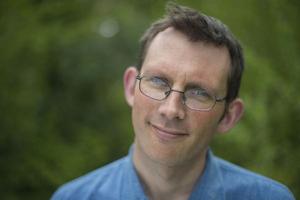
Rob Hopkins

Rob Hopkins

By Rob HopkinsSociety & Culture
Download on the App Store

Rob Hopkins episodes

  • Clodagh Harris on how Citizens' Assemblies rekindle the imagination
    There’s a lot of talk about Citizen’s Assemblies these days. Some people say, as the UK flounders to try and find a way through the wreckage of Brexit, that it should have done Citizens’ Assemblies in advance of any vote. Some say they should happen now, to decide the next steps forward. Citizens Assemblies are a powerful tool for hearing the thoughts of a population without the filter of political interference, lack of understanding, and the polarity that has been driven by social media and surveillance capitalism. But what are they, and how might Citizens Assemblies be a vital tool for creating the spaces that allow imagination back into our public life?
    33 min
  • "We decided to create a school": talking imagination with Andrew Brewerton.
    This post is the first of two that will be exploring the story of Plymouth School of Creative Arts, a remarkable new school in the south west of England. It is a fascinating example of a school designed around the nurturing of imagination, right in the heart of one of the UK's most deprived cities. In this post, I speak to Andrew Brewerton, Principal at Plymouth College of Art, one of the key people behind the creation of the school, where he also chairs the Board of Governors. In the next post we'll hear from Dave Strudwick, the school's Head Teacher. As you'll see, Andrew Brewerton is a leading thinker in terms of how education can build, or crush, the imagination, and I started our conversation in his office at the College of Art by asking him to tell me how the school came about, and what was the gap, the hole, it was trying to fill:

    56 min
  • Helen Marriage on The Sultan's Elephant and large acts of public imagination
    I would like to think that when I reach the end of my life that I will have very few regrets. I know that I will have one though, which is that I was not in London on Thursday May 4th 2006, and for the days that followed. For those 4 days, a huge puppet elephant and an 8 metre-tall girl, walked around the city, entrancing and charming the million or so people who came to see them. It was a magical event that moved people deeply, and which brought the city together in an amazing way, just 9 months after the 7/7 bombings. It brought the imagination into the heart of one of Europe's largest cities, and is one of the best examples of that that I've been able to find. One of the people central to it happening was Helen Marriage of creative company 'Artichoke'.  She very kindly agreed to speak to me, so I started by asking her, for anyone who didn't see 'The Sultan's Elephant', as the project was known, to tell us a bit more about it.
    17 min
  • Cllr Matthew Brown on the Preston Model and the economics of the imagination.
    The scholar Richard Sennett once wrote, “modern capitalism works by colonizing people’s imagination of what is possible”. If it is the case that our current economic model thrives by creating the conditions that suppress rather than unleash the imagination, and if we recognise that now, more than any other time, we need a mass re-nourishing of the collective imagination, then where might we spot examples of 'the economics of the imagination'? Eight years ago, the economy of Preston was crocked. Then its Council decided to take a new approach. Today I'm speaking to Cllr Matthew Brown, the recently-elected leader of Preston City Council. What Preston have achieved should be a model for everywhere else. "Let’s have a bit of imagination about how to get out of this mess" he tells me. I last interviewed him in June 2015, so I started by asking him, when we spoke just before Christmas, what has changed since then?
    34 min
  • Tasha Bassingthwaighte on imagination, meditation and wifi-free retreats.
    Earlier in this series of interviews, I spoke to Dr Larry Rosen who told me, "I would say that our imagination is probably on the decline, exactly in the opposite trend of our time spent on our smart phone". If, as I've been recently musing, our imaginations need time and space, and much of that time and space is currently being sucked up by smartphones, social media and  our online lives, then what happens when people stop, turn these devices off, and deliberately make time to reflect? To explore the answers to this questio, I headed out to The Barn Retreat on the Sharpham Estate, close to where I live, to talk to Tasha Bassingthwaighte who is The Barn's Manager.  I arrived just as participants in one of their week-long retreats were heading indoors for some fine-smelling soup. Tasha and I sat in The Barn's library, and I started by asking her to explain what happens at The Barn.
    34 min
  • Alexandra Rowland on hopepunk, grimdark, story and imagination
    “It’s about how the first step to slaying a dragon is for one person to say, probably drunk in a bar somewhere, “I bet it can be done, though”.  These are the words of fantasy author Alexandra Rowland, whose novel ‘A Conspiracy of Truths’ was published late last year. The quote captures the essence of an idea, a genre, which she coined, called ‘hopepunk’. Fantasy and sci-fi is a world rich in different genres, but as soon as I read how she described what the term meant to her, I realised she had important things to contribute to our ongoing discussion about imagination, in particular to the question of how our storytelling can help to bring to life in the here and now the kind of future we want to create.  Are you ‘hopepunk’? You’re about to find out. I started our fascinating conversation by asking her to tell me what hopepunk means, and how the term came about...
    36 min
  • Jackie Andrade and Jon May on imagination, lemons and Functional Imagery Training
    Welcome to our last blog of 2018.  I'd like to thank you for joining me on this journey over the year and for your support and enthusiasm. Jackie Andrade is a Professor of Psychology at the University of Plymouth whose work focuses on imagination and how we can imagine different futures for ourselves and use that to help change our behaviour. Jon May is also a Professor in the School of Psychology at the University of Plymouth and his work also focuses on imagination and how it affects decision making, motivation and creativity. Over the last 20 years they have developed an approach called Functional Imagery Training which has many insights to offer to our exploration of imagination and its ability to change the real world around us.  I took the train to Plymouth and we sat in Jackie's office and had a fascinating conversation that, as Jackie later put it after reviewing the transcript, is "almost a whole manifesto for behaviour change".  I started by asking them to get us an outline of Functional Imagery Training. What is it, and what does their research tell us about how it works?
    48 min
  • Karen MacLean on Den Grøenne Friskole, where imagination flourishes
    In their book ‘Imagination First’, Eric Liu & Scott Noppe-Brandon wrote “it is pretty clear what makes young humans allergic to imagination: school”.  In my search for schools or approaches to education that truly place the imagination at their heart, and which avoid this kind of allergy, I was fascinated to hear about Den Grøenne Friskole (‘The Green Free School’) in Copenhagen. They are a school that values imagination, Transition and sustainability above everything else, and have developed something very powerful.  To find out more I spoke to Danish American Karen MacLean, one of the people who started the school.  She had originally trained to be a university teacher, but never actually taught, ending up initially working as a translator, but then more recently as one of the people running the school.
    23 min
  • Ruth Sapsed on Cambridge Curiosity and Imagination
    Ruth Sapsed is the Director of an arts and well-being charity called Cambridge Curiosity and Imagination.  She set it up 15 years ago with the artist Idit Nathan.  It grew out of a group who started meeting because they were concerned about the creative opportunities that education was offering their kids, the group creating a coming together of artists, educators, academics and parents.  Their conversations led them to start cultivating a relationship with the Faculty of Education at the University of Cambridge. Over time, Cambridge Curiosity and Imagination was formed, and 10 years ago it became a charity.  I first heard about them from Robert Macfarlane when I interviewed him recently, and on further investigation fell in love with their approach and their work.  It was therefore a great privilege to be able to talk to Ruth, and I started by asking her to give us a sense of what CCI does...
    39 min
  • Nicolas Clerc on ‘Télescope’, a café without smartphones
    I recently put out a call looking for places, events or venues that are creating wifi-free spaces, places where people can intentionally get away from smartphones and the distraction they bring into our lives, some time to cultivate the attention.  One of the suggestions I received was a café in Paris called ‘Télescope’.  On a recent visit to the city I headed over to Télescope, a small but rather lovely café in the first Arrondissement, near the Louvre.  It is a place which clearly cherishes coffee, and the art of creating it.  It has been run for the past 7 years by Nicolas Clerc, who sat down with me in a quiet moment to tell me more about he came to be running a wi-fi-free café.
    15 min

About Rob Hopkins

From the publisher's feed

Podcast by Rob Hopkins

More shows like Rob Hopkins

Tara Brach by Tara Brach

Tara Brach

10,526 Listeners

Jacobin Radio by Jacobin

Jacobin Radio

1,460 Listeners

Les Pieds sur terre by France Culture

Les Pieds sur terre

226 Listeners

Science Weekly by The Guardian

Science Weekly

414 Listeners

Politics Weekly UK by The Guardian

Politics Weekly UK

268 Listeners

Where Should We Begin? with Esther Perel by Esther Perel Global Media

Where Should We Begin? with Esther Perel

14,903 Listeners

Today in Focus by The Guardian

Today in Focus

966 Listeners

Accidental Gods - The Thrutopian Podcast by Accidental Gods

Accidental Gods - The Thrutopian Podcast

151 Listeners

The Knepp Wilding Podcast by Knepp.co.uk

The Knepp Wilding Podcast

18 Listeners

Sense-Making in a Changing World by Morag Gamble: Permaculture Education Institute

Sense-Making in a Changing World

23 Listeners

From What If to What Next by Rob Hopkins

From What If to What Next

16 Listeners

Planet: Critical by Rachel Donald

Planet: Critical

88 Listeners

The Great Simplification with Nate Hagens by Nate Hagens

The Great Simplification with Nate Hagens

435 Listeners

The Rest Is Politics by Goalhanger

The Rest Is Politics

3,017 Listeners

Rare Earth by BBC Radio 4

Rare Earth

13 Listeners