
Sign up to save your podcasts
Or

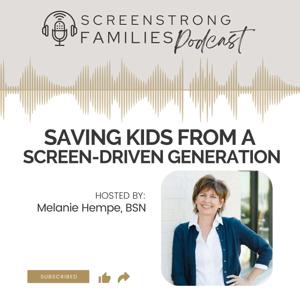


What does it look like to raise ScreenStrong kids for 10 years—and stick with it all the way through high school?
In this episode, Melanie reconnects with Jodie, a mom who attended a ScreenStrong workshop a decade ago and has been putting these principles into practice ever since. Now, her daughter is in high school and is just getting a flip phone—not a smartphone!
Jodie shares what it has been like to raise both her daughter and son with a different approach to technology, navigate the pressures of a screen-saturated culture, and stay committed to her family's values as her kids have grown. She reflects on the challenges, the lessons she's learned, and what she wishes more parents understood about raising kids who can thrive without constant screen access.
If you've ever wondered whether it's possible to raise teenagers without handing them a smartphone—or felt like you're swimming upstream trying to do things differently—this conversation offers encouragement, perspective, and a glimpse of what the long game of ScreenStrong parenting can look like.
You don't have to follow the crowd. You can raise your kids differently—and you don't have to do it alone.
Support the show
Don't forget to subscribe, rate, and leave a review if you enjoy the episode. Your feedback helps us bring you more of the content you love. Stay Strong!
ScreenStrong Tech Recommendations
Production Team:
What if one of the best ways to help your teen spend less time gaming and scrolling is to give them something meaningful to do in the real world?
In this episode, Melanie Hempe and Dr. Stacey explore why teens may benefit from having a part-time job—and what the research says about structured activities, screen use, executive function, confidence, responsibility, academics, and long-term outcomes.
You'll learn:
The goal isn't simply to keep your teen busy or take away their screens.
It's to help them build a life they don't want to escape from.
Listen in—and then start the conversation with your teen about getting a job.
Support the show
Don't forget to subscribe, rate, and leave a review if you enjoy the episode. Your feedback helps us bring you more of the content you love. Stay Strong!
ScreenStrong Tech Recommendations
Production Team:
In Part 1, Andrew Hempe explained what he gained from growing up without smartphones or video games. In Part 2, he answers the questions parents and teens ask him most.
Andrew starts by admitting the obvious: he did miss out on some things—easy access to pornography, the anxiety and depression tied to social media, and screen addiction itself. His point: not all missing out is bad, and there's a real difference between protecting a child from permanent harm and sheltering them from healthy difficulty.
He also walks through what happened when he finally got a smartphone after high school, on his own terms, as a tool rather than a "toy." No social media. No gaming console. Because the habits, hobbies, and delayed-gratification mindset were already in place, the phone never became a crutch.
From there, Andrew tackles the arguments parents hear constantly:
He closes with a direct message to teens listening—that the friendships worth keeping don't depend on a screen—and a reminder to parents that conversations alone won't solve a screen problem; only removing access will.
Support the show
Don't forget to subscribe, rate, and leave a review if you enjoy the episode. Your feedback helps us bring you more of the content you love. Stay Strong!
ScreenStrong Tech Recommendations
Production Team:
What if growing up without a smartphone or video games didn’t mean missing out—but actually meant gaining more?
In this episode of the ScreenStrong Families Podcast, 22-year-old Andrew Hempe shares what it was really like to grow up without the addictive screens that are now considered a normal part of childhood. After seeing his older brother struggle with severe gaming addiction, Andrew’s parents made the difficult decision to raise their younger children without smartphones or video games.
Andrew explains why he believes he didn’t miss out at all. Instead, he gained four things that have shaped who he is today: strong family relationships, the ability to be comfortable with boredom and discomfort, real-world skills, and deep friendships.
He shares personal stories about family dinners, sports, music, school, and friendships—and explains how having more time away from screens gave him the opportunity to develop communication skills, creativity, confidence, perseverance, and meaningful relationships.
Andrew also addresses one of parents’ biggest fears: What if my child is the only one without a smartphone or video games? Will they be left out? Will they have friends?
His experience offers a powerful perspective for parents who wonder whether protecting childhood from addictive technology means their kids will miss out. Andrew's answer is clear: there is so much more to gain when screens aren't taking up the space meant for childhood.
This is Part 1 of a two-part series. In Part 2, Andrew answers the questions he hears most often about growing up this way—including what he actually missed out on, what happened when he eventually got a smartphone, and why some things are worth missing.
Support the show
Don't forget to subscribe, rate, and leave a review if you enjoy the episode. Your feedback helps us bring you more of the content you love. Stay Strong!
ScreenStrong Tech Recommendations
Production Team:
How much technology should kids really be using at school? In this episode of the ScreenStrong Families Podcast, Melanie Hempe and Dr. Stacey explore the growing use of screens, Chromebooks, tablets, educational apps, and AI in schools—and ask the question every parent should be asking: Is technology actually helping our children learn?
You’ll learn why the issue isn’t simply “technology is good or bad,” but what technology is replacing. Are screens replacing books, handwriting, play, movement, teacher interaction, conversation, or creative problem-solving?
Melanie and Dr. Stacey discuss:
Technology is a tool—not the foundation. The child is the foundation.
If you're concerned about kids and screens, technology in schools, digital learning, or AI in education, this episode will give you practical insights and questions you can take to your child's school.
Support the show
Don't forget to subscribe, rate, and leave a review if you enjoy the episode. Your feedback helps us bring you more of the content you love. Stay Strong!
ScreenStrong Tech Recommendations
Production Team:
Originally aired: March, 2022
Melanie welcomes back Dr. Richard Freed, author of Wired Child and a practicing Clinical Psychologist and supervisor studying the effects of technology on children. He is on the advisory board of ScreenStrong and is a contributor to many well-respected publications. A link to Dr. Freed’s article, The Tech Industry’s War on Kids, is included in the show notes.
Melanie asks Richard to provide our listeners his perspective on frequently asked questions from parents related to screens in the classroom, how to modify and/or request help with reducing screen use for homework, how to request a support letter for an in-school accommodation for your child, and one of the most difficult questions to answer, what to say to your child that is struggling with addictive behaviors.
Their discussion addresses how technology has changed the school experience and learning opportunities for our children, which have significantly impacted children's development of Social Emotional Learning (SEL), which encompasses the growth of personal identity, communication, empathy, and healthy connections with parents, teachers, and coaches within the overall community setting. Lastly, Melanie and Richard provide an overview of tips pulled from their conversation today with an emphasis on strong parenting, reducing screens in schools, and re-establishing the strong guidance and love our kids need from us from elementary through high school and beyond.
REFERENCES: The Tech Industry’s War on Kids by Dr. Richard Freed
Support the show
Don't forget to subscribe, rate, and leave a review if you enjoy the episode. Your feedback helps us bring you more of the content you love. Stay Strong!
ScreenStrong Tech Recommendations
Production Team:
In this episode, Melanie and Dr. Stacey explore how teachers and parents can collaborate to create a phone-free school environment. Teachers can support the policy by using research-backed education, setting an example with their own phone use, and staying alert to signs of phone overuse, like distracted behavior and declining grades. Parents play a crucial role by supporting the school’s efforts, limiting contact with kids during school hours, and encouraging phone-free days.
For parents wanting to go further, we’ll also discuss becoming a Phone-Free Champion in your school, organizing fun, tech-free activities that encourage socializing and new hobbies.
Tune in to learn how phone-free schools can help students stay focused, build friendships, and feel more connected.
Download our Phone-Free School Resource Guide.
Support the show
Don't forget to subscribe, rate, and leave a review if you enjoy the episode. Your feedback helps us bring you more of the content you love. Stay Strong!
ScreenStrong Tech Recommendations
Production Team:
Originally aired November 8, 2023.
In this episode, Melanie has a very special guest—her daughter, Melissa! In this episode, we will hear how Melissa feels about growing up without social media or a smartphone. They discuss an overview of teen brain science, what makes social media irresistible for teens, the risks for teen girls, and end with some practical tips for parents. You will enjoy the candid nature of this conversation and will be inspired to make some changes in your home!
Support the show
Don't forget to subscribe, rate, and leave a review if you enjoy the episode. Your feedback helps us bring you more of the content you love. Stay Strong!
ScreenStrong Tech Recommendations
Production Team:
Today we welcome back Dr. Adriana Stacey, a Board Certified Psychiatrist, for part two of her discussion with Melanie. In this episode they cover why going cold-turkey with screen removal may be the best option for your family and offer tips and tricks for handling addictive behavior.
Dr. Stacey's areas of specialty include female mental health treatment, including treatment of depression, anxiety, adult ADHD, insomnia, and sports psychiatry.
Support the show
Don't forget to subscribe, rate, and leave a review if you enjoy the episode. Your feedback helps us bring you more of the content you love. Stay Strong!
ScreenStrong Tech Recommendations
Production Team:
Do you want to prevent your middle Schooler from becoming dependent on screen time this summer? Join Melanie as she offers practical strategies to Emily, a ScreenStrong Ambassador and concerned middle school mom, to keep tweens engaged and social without resorting to video games or social media.
Get inspired and discover how to make this summer a ScreenStrong success for your family!
Support the show
Don't forget to subscribe, rate, and leave a review if you enjoy the episode. Your feedback helps us bring you more of the content you love. Stay Strong!
ScreenStrong Tech Recommendations
Production Team:
From the publisher's feed
After her oldest son, Adam, dropped out of college due to his video game addiction, Melanie Hempe, BSN, put her nursing degree and training from Emory University to good use and founded…
Host of the popular weekly ScreenStrong Families Podcast, Melanie has been featured in Psychology Today, Thrive-Global, The Wall Street Journal, A&E Network, CBS, CNN, NPR, the documentary Screened Out, and various news and television outlets. Her ScreenStrong Kids’ Brains and Screens Courses are available for parents and students. Her four books include, “Kids’ Brains & Screens: A ScreenStrong Student Course,” “Will Your Gamer Survive College?” “Can Your Teen Survive—and Thrive—Without a Smartphone?” and “The ScreenStrong Solution: How to Free Your Child from Addictive Screen Habits.”

3,760 Listeners

3,362 Listeners

2,971 Listeners

528 Listeners

517 Listeners
894 Listeners

327 Listeners

2,214 Listeners

269 Listeners

352 Listeners

2,018 Listeners

399 Listeners

40 Listeners

312 Listeners

1,251 Listeners