
Sign up to save your podcasts
Or



Nārada said, “O dear father Brahmā, with your mind fixed on Śiva, you are blessed indeed. Please explain this again still more precisely.” Brahmā said, “I, the lotus-born, once called together all the sages and all the Gods and addressed them lovingly with these good words. ‘If you have faith in permanent happiness, if you desire the achievement of the same, all of you shall come along with me to the shores of the milk ocean.’ On hearing these words, they accompanied me to the place where lord Viṣṇu, the benefactor of everyone, was stationed. O sage, on reaching the place, the Gods bowed down with palms joined in reverence and prayed to the lord of the universe Janārdana, lord of the Gods. On seeing Brahmā and other deities standing there, Viṣṇu remembered the lotus-like feet of Śiva and spoke these noble words.
The sages said, “O Sūta the fortunate, O Sūta the disciple of Vyāsa, obeisance be to you. This wonderfully sanctifying story of Śiva has been narrated today. The wonderful and highly divine origin of the liṅga has been heard. Listening to its efficacy causes destruction of misery. O storehouse of mercy, please tell us the mode of the worship of Śiva, in accordance with the conversation of Brahmā and Nārada, whereby Śiva becomes satisfied. Brāhmāṇas, kṣatriyas, vaiśyas and śūdras worship Śiva. How shall the worship be performed? Please tell us in accordance with what you have heard from Vyāsa.” On hearing their words, Sūta narrated everything in answer to the question of the sages, everything conducive to welfare and in accordance with the Vedas.
For the last five years at least, we have been aware of a very dangerous movement called neo-Advaita. It is a counterfeit version of authentic Advaita, teaching an offensive nihilistic, atheistic philosophy that rejects the worship of God. I will no longer allow neo-Advaita posts on this channel. Anyone making posts based on neo-Advaita philosophy will immediately lose their posting privileges.
These chapters deal with Śiva-tattva, the principle and nature of Śiva. Understanding Śiva is so important because He is the bridge between nondual Brahman and the duality of the creation. Actually Śiva is incomprehensible to the mind, but can be understood to a certain extent through bhakti. Notably, Śiva can bestow perfect knowledge, jñāṇa n the conditioned beings, liberating them from materialistic consciousness, suffering and rebirth. Hehe chapters also reveal how Śiva empowered Viṣṇu and Brahmā to create and protect the universe.
Lord Śiva said: “O Viṣṇu of good rites, O Hari, listen to another pronouncement of Mine. You will be worthy of honour and worship in all the worlds forever. Whenever a misery befalls the world created by Brahmā, you shall be eager for the destruction of all miseries. In all difficult and unbearable activities, I shall help you. I shall kill your indefatigable and fierce enemies. O Viṣṇu, spread your glory in the worlds far and wide by taking up various incarnations. Strive for their succour. I am always saguṇa when I become Rudra with this body. Certainly I shall perform your activities for the sake of the worlds if they are impossible for you. You are to be meditated upon by Rudra, and Rudra is to be meditated upon by you. There is no difference between you and Rudra. O great Viṣṇu, your identity is due to inherent nature, the boons conferred and your divine sports. True, it is certainly true.”
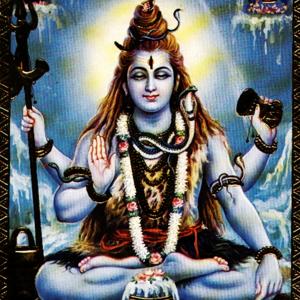
Brahmā said, “On hearing His eulogy from the mouth of Viṣṇu, the delighted Śiva, the storehouse of kindness, revealed Himself to us along with His consort. He had five faces and three eyes, and the crescent moon on His forehead. He wore matted hair. He was white-complexioned and had wide eyes. His body had been dusted with bhasma. He had ten arms. His neck was blue in colour. He was bedecked with all ornaments. He was very handsome with respect to every limb. Three lines of bhasma marked His forehead. On seeing Lord Śiva accompanied by His beautiful consort, Viṣṇu along with me eulogised Him again with appropriate words. Śiva, the merciful, who was delighted, breathed the Vedas into Viṣṇu and conferred Perfect Knowledge on him, the secret of the supreme Ātman. O sage, thereafter, out of sympathy, the supreme Ātman conferred these on me too. After receiving the Vedas, Viṣṇu was satisfied, and bowing to Him with palms joined in reverence along with me, he asked Lord Śiva:
These chapters continue the story of creation from Lord Brahmā's point of view. Lord Siva's nature is incomprehensible, but we can understand certain aspects of His nirguṇa and saguṇa manifestations. Especially interesting is Chapter 8's description of the form of Śiva in letters, the akṣāra-mūrti.
Brahmā said, “O most excellent sage, we were eager to have a vision of the Lord. Our haughtiness had been curbed. O sage, we waited there patiently. Śiva, the protector of the distressed, remover of the haughtiness of the haughty and the undecaying Lord of everything, took mercy on us. There arose the sound ĀŪṀ in the prolated accent. The prolated vowel contains three mātrās or syllabic instants in pronouncing it. It was very clear. The divine sound in the form of a word came out from the most excellent of Gods. ‘What is this great sound?’ thinking like this I stood perplexed. Viṣṇu who is worthy of respect from all the Gods, who is free from all inimical thoughts, saw with a delightful heart, the eternal being’s manifestation on the right side of the liṅga.
Brahmā said, “When lord Nārāyaṇa continued to sleep, an excellent lotus of huge size came out of his navel as desired by Śiva. It was many yojanas wide and high. It had an endless stalk. The pericarp was of a brilliant hue. It was very beautiful with the brilliance of ten million suns. It was wonderful, excellent and worthy of vision, containing tattvas. Exerting Himself as before, Śiva the great Lord, with Pārvatī as His better half, created me from His right limb. O sage, having deluded me with His illusion immediately, Śiva in the course of His sport, produced me through the umbilical lotus of Viṣṇu. Thus it was that I came to be known as lotus-born and conceived in a golden womb. I had four faces, red complexion and Tripuṇḍra-marked forehead. Deluded by His illusion and weakened in knowledge, O dear one, I did not know who the progenitor of my body was, other than the lotus.
The spiritual value in these chapters is the penetrating questions that Nārada asks his father Lord Brahmā, and Brahmā's answers. Specifically, Brahmā's description of the early stages of creation reveal deep insights about the nature of the material universe: basically, it's Māyā.
From the publisher's feed