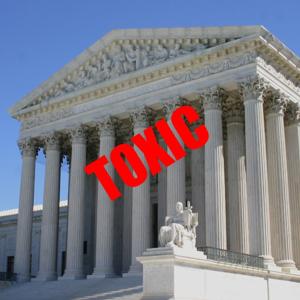
Supreme Betrayal:  How the Supreme Court and Constitutional Law Have Failed America

Supreme Betrayal: How the Supreme Court and Constitutional Law Have Failed America

By Mark Tushnet, Louis Michael SeidmanNewsGovernmentHistory
Download on the App Store

Supreme Betrayal: How the Supreme Court and Constitutional Law Have Failed America episodes

  • US Military Intervention Abroad--The Relevance of Statutes, the Constitution, and International Law
    Pretty much everyone who looks into the matter knows that courts don’t enforce statutory, constitutional, or international law limits on the deployment of US military forces overseas. What are we to make of that fact? That we don’t need judicially enforceable limits on this sort of policy choice to get along reasonably well? That the limits work “behind the scenes” to affect the choices political actors make? Or, perhaps more disturbingly, that legal limits in this area are pretty much like legal limits everywhere: they effectively limit exercises of power by powerful people who want to comply with the law? Is it really true that, as Plato’s character Thrasymachus might be taken to suggest, law is merely the interest of the powerful?
    57 min
  • ICE and the Constitution (in the Courts and on the Streets)
    After telling the semi-salacious story of the attempted assassination of Supreme Court Justice Stephen Field in 1889 we explore the implications of the Supreme Court case that dealt with the attempt for the possibility of state prosecutions of ICE and CBP officers for the killings of Renee Nicole Good and Alex Pretti. That leads us to a discussion of the costs and benefits of using the rhetoric of “unconstitutionality” in political protests against ICE, in which we elaborate on some of the disagreements between us that we introduced in earlier episodes.
    53 min
  • Sedition and the Democrats' Video on Refusing to Obey Unlawful Orders
    Could Senator Mark Kelly successfully be prosecuted for sedition? Not under current law as developed by the Supreme Court. Tushnet presses Seidman on his opposition to the Court’s invocation of the Constitution to prevent democratically elected governments from enacting whatever policies the people want—even in connection with speech restrictions. Seidman sticks to his guns and says that, though prosecuting Kelly would be profoundly unwise the Supreme Court shouldn’t block a prosecution by invoking the First Amendment. From there we clarify our long-standing disagreements, ending with Tushnet’s observation that when the Supreme Court is hitting on all cylinders it contributes to democratic self-governance and Seidman’s contention that the Court misfires so often that we ought to junk the car.
    1 hr 10 min
  • A Conversation with David Luban
    Our guest is David Luban, a distinguished legal philosopher who has written widely about military law and ethics. We use the Trump administration's drone strikes on "drug boats" as the vehicle for talking about the tension--such as it may be--between law and hierarchical authority, for example when ordinary soldiers are instructed that they must disregard unlawful orders. As usual with us, we try to show that the issues are much more complicated than they are typically presented as being--to the point that we end with a brief (and inadequate) discussion of Joseph Raz's ideas about law as offering "exclusionary reasons" for acting without regard to your own evaluation of the rightness of what you're being told to do.
    1 hr 1 min
  • A Conversation with Genevieve Lakier
    We have a conversation with Genevieve Lakier about the First Amendment and the courts in our current situation. She defends recourse to the courts; we are as usual more skeptical. We go into some aspects of the political economy of major media, emphasizing the problems created by media consolidation and the difficulty of dealing with those problems not merely because of the normative issues we raised in discussing Jimmy Kimmel but also because the political-economic causes of consolidation play out as well in structuring the Supreme Court. And we talk about the distinction between the First Amendment as law and the First Amendment as a component of a general political culture that shapes both what the courts do and how ordinary politics plays itself out in expression-sensitive contexts.
    59 min
  • The Voting Rights Case and the Constitution After Trump
    After some reflections on how the oral arguments in the tariff case affect our expectations about what the Court might do, we turn to the Court’s pending decision in a case challenging the constitutionality of the key remaining provision of the 1965 Voting Rights Act. We offer what we hope are some more in-depth and analytic comments on the doctrines in play in the case and (as usual!) highlight the ways in which the arguments against the statute are rife with internal tensions. We conclude with some unoriginal observations about the political implications of a decision to invalidate the Act and with what we hope are some more original observations about how to situate the Court’s likely action in the kind of broader account of American political development that we’ve offered sporadically in the podcast and in a more focused way in our episodes on the Constitution after Trump.
    40 min
  • Constitutionalism After Trump Part Two
    We continue our speculation about constitutionalism after Trump (after some mundane observations about the 2025 elections), by broadening our lens to include some thoughts about what progressives might do to present appealing visions of an egalitarian and multicultural society that’s part of our heritage. We disagree a bit about the level at which the conversation should be pitched and then turn to some suggestions about “principled compromises” that progressives could offer to appeal to some people who at present find MAGA-ism the best thing available to them. The compromises deal with public support for education in religiously affiliated schools and some aspects of trans rights. We disagree about what the proposed compromises, with Tushnet arguing that they either don’t give MAGA supporters anything they can’t get from the Supreme Court or mistakenly treat issues as serious policy proposals when they are, in the jargon, performative. We don’t resolve our disagreements but promise to come back to them later!
    1 hr 2 min
  • Conversation with Richard Re
    Our conversation with Richard Re focuses on his Foreword to the Harvard Law Review’s annual Supreme Court Review. The Foreword argues that the Roberts Court today is a conservative version of the Warren Court whose decisions are as supported today or perhaps even better supported today by a political majority as were the Warren Court’s decisions. We suggest that his argument is a domesticated version of the more politically engaged analysis of Supreme Court decisions offered by people associated with Critical Legal Studies—and that the domestication can’t conceal the fundamentally political nature of the Court’s decisions (today or during the Warren Court era). Re in turn disagrees!
    54 min
  • Constitutionalism After Trump Part One
    If we manage to extricate ourselves from our current constitutional plight, what might things look like? Or, alternatively, what sorts of constitutionally inflected policies should Democrats offer as part of their political effort to defeat Trumpism? We argue pretty forcefully against what we call “restorationism,” a program that would simply reinstitute the constitutional agenda that MAGA constitutionalism rejects. This episode focuses on the role that skepticism about expertise plays in MAGA constitutionalism. After describing how that skepticism is tied to the extremely strong theory of the unitary executive that the Trump administration advances, we offer some thoughts about how progressive policies—particularly with respect to the design of the institutions of the administrative state—could combine some degree of justified skepticism with greater popular participation in lawmakng in ways that some MAGA voters as well as many progressives might find appealing.
    44 min
  • The Jimmy Kimmel Kerfuffle and How to Think About It
    We talk about the Jimmy Kimmel episode, a small victory in the fight against Trumpism. We range more widely, though, in identifying no fewer than five groups who have competing First Amendment interests in having Kimmel on or off the airwaves, which makes figuring out what the First Amendment “means” in this setting. We emphasize the interests of broadcasters in choosing what to air and the interests of potential listeners in hearing—and preventing others from hearing—what they want. Any government intervention supports the free-speech interests of one or another group and undermines the free-speech interests of other groups. After discussing the way in which New Deal constitutional doctrine tried to separate economic regulation from regulation of fundamental rights, we discuss the relation between property rights and the ability to exercise your right to free expression, we end with a discussion of the possibility of antitrust regulation of large media corporations, which was implicated in the Kimmel episode. Reconciling antitrust regulation of the sort progressives want with existing constitutional doctrine takes some serious analytic work, which progressives ought to be doing now.

    31 min

About Supreme Betrayal: How the Supreme Court and Constitutional Law Have Failed America

From the publisher's feed

Sitting in their marble palace, dressed in their black robes, Supreme Court Justices would like us to believe that they are wise and disinterested oracles dispensing words of truth and justice. …

More shows like Supreme Betrayal: How the Supreme Court and Constitutional Law Have Failed America

The Political Scene | The New Yorker by The New Yorker

The Political Scene | The New Yorker

4,051 Listeners

Amicus With Dahlia Lithwick | Law, justice, and the courts by Slate Podcasts

Amicus With Dahlia Lithwick | Law, justice, and the courts

3,473 Listeners

We the People by National Constitution Center

We the People

1,099 Listeners

The Lawfare Podcast by The Lawfare Institute

The Lawfare Podcast

6,273 Listeners

Pod Save America by Pod Save America

Pod Save America

87,200 Listeners

Stay Tuned with Preet by Preet Bharara

Stay Tuned with Preet

32,243 Listeners

The Bulwark Daily by The Bulwark

The Bulwark Daily

12,487 Listeners

Know Your Enemy by Matthew Sitman

Know Your Enemy

2,067 Listeners

Strict Scrutiny by Strict Scrutiny

Strict Scrutiny

5,727 Listeners

Advisory Opinions by The Dispatch

Advisory Opinions

3,925 Listeners

The Ezra Klein Show by New York Times Opinion

The Ezra Klein Show

16,033 Listeners

Amarica's Constitution by Akhil Reed Amar

Amarica's Constitution

388 Listeners

Divided Argument by Will Baude & Dan Epps

Divided Argument

743 Listeners

The Weekly Show with Jon Stewart by Comedy Central

The Weekly Show with Jon Stewart

10,703 Listeners

The Interview by The New York Times

The Interview

1,644 Listeners