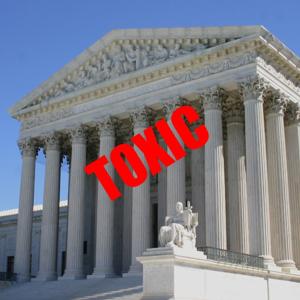
Supreme Betrayal:  How the Supreme Court and Constitutional Law Have Failed America

Supreme Betrayal: How the Supreme Court and Constitutional Law Have Failed America

By Mark Tushnet, Louis Michael SeidmanNewsGovernmentHistory
Download on the App Store

Supreme Betrayal: How the Supreme Court and Constitutional Law Have Failed America episodes

  • Current Events Again--and Some Theory Too
    This current events episode uses the Alien Enemies Act case before Judge Boasberg as our vehicle for examining what constitutional theory can contribute to understanding fast-moving current events. We argue about how nervous we should be about Seidman’s arguments for constitutional disobedience in our current context and about the contributions, if any, constitutional litigation can make to alleviating—or exacerbating—what’s going on. We conclude with a description of what commentators might mean when they describe Trump’s actions as “illegal,” and discuss why such descriptions might not be as helpful as you might initially think.
    50 min
  • Still More on Constitutional Foundations
    With the idea of constitutional "workarounds” as a focal point, we describe the quite large areas of agreement between us about democratic constitutions in general and about the US Constitution specifically and try to clarify where our disagreements lie. The disagreements are mostly about how the US constitutional system functions today and partly about what a good democratic constitution building upon actual US experience would look like.
    1 hr 11 min
  • The Foundations of the US Constitution--Seidman's Approach
    This episode lays out a different way of thinking about the US Constitution as of 2025. (How different it is from Tushnet’s is something we discuss in the episode and will continue to worry over.) Seidman begins by describing what the Constitution as written in 1789 was designed to do then—set up a government, set out some compromises between then-important political forces in a sort of peace treaty, and state some general aspirations the new government might hope to advance. He then asks whether adhering to the Constitution of 1789, particularly by treating it as in general enforceable by the courts, is necessary—or even useful—as a way of keeping the government running, maintaining social order in the face of disagreement, and guiding the nation toward implementing attractive values. His answer is, “Decidedly not.” Along the way Tushnet offers some support and some criticisms, and the discussion opens the way to exploring our differences in more detail in a subsequent episode.

    49 min
  • Why Have a Constitution--An Introduction to Tushnet's Take
    After our discussion of the first month of the Trump administration and constitutional law, we return to our exploration of constitutional theory—this time turning away from theories of interpretation to theories about constitutional foundations: What’s the best story about why people adopt constitutions? This episode begins to examine stories that say that constitutions are good ways—maybe the only way—to work out how to peacefully resolve their disagreements about what ought to be done through what we call ordinary politics. We look at some reasons for (and against) entrenching the “rules about ruling”—and expose some disagreements about constitutional foundations that we’ll get into in later episodes.
    54 min
  • The Trump Administraton One Month In--Crisis, Revolution, What?
    This is a “current events” episode. We discuss whether, one month in, we should think about the Trump administration as initiating a constitution crisis or a constitutional revolution--regime change at home. Should we think of courts as the opposition’s Obi-Wan Kenobi—its only hope—or as doing nothing more than putting speed bumps in Trump’s way (and doing that might be good enough). Moving outside our wheelhouse we also offer some amateur political analysis of the conditions for Trump’s political success or failure with a project of political transformation.
    52 min
  • Back to Theory--Living Constitutionalism and Eclectic Approachs
    This episode discusses living constitutionalism and what we call eclectic approaches to constitutional interpretation such as Phillip Bobbitt’s “modalities” approach. We argue that such approaches have some virtues—including greater descriptive accuracy than originalism and democracy-focused approaches—but significant weaknesses. We also begin to introduce Tushnet’s “craft” account of constitutional interpretation, to be developed in more detail in later episodes.
    56 min
  • Current Events--The Trump Administration Arrives
    This episode deals with "current events"--some of the constitutional issues swirling around the arrival of the second Trump Administration. We discuss the use of the presidential power to pardon by Biden and Trump (and disagree a bit about whether there are legal limits on that power), the implications of the collapse of the criminal cases against Trump, the TikTok case and the effort to eliminate birthright citizenship and their relationship to originalist constitutional theory.
    54 min
  • Democratic Theories Two
    We continue our discussion of theories of judicial review that say it should enforce--and reinforce--democracy: footnote 4 theories and John Hart Ely. We argue that these theories run up against contradictions when they try to specify particular forms of democracy that they're trying to reinforce. As many have argued these theories can be quite narrow, leaving untouched forms of democratic failure that ought to be remedied, or quite broad, giving courts the power to displace ordinary legislation across extremely wide swathes of public policy. We also discuss Bruce Ackerman's effort to distinguish between constitutional politics, whose outcomes the courts should enforce, and ordinary politics, interest group politics whose outcomes judges should accept. And we renew our disagreement about whether or how we should respect decisions made years ago by people quite different from us.
    36 min
  • Democratic Theories One
    We now begin to explore alternatives to originalism as a theory of constitutional interpretation. This episode and the next deal with approaches that say that courts can promote democracy through constitutional review. This time we take up an old and mostly abandoned approach advocated by James Bardley Thayer in 1892, that courts should invalidate statutes only if they are obviously unreasonable. Thayer said that was the right approach because legislators should and did take their responsibility to adhere to the Constitution seriously. Most of discussion challenges that assumption.
    28 min
  • Originalism Take Two
    We continue our discussion of originalism, developing two
    themes: defenses and criticisms of the original constitution articulated by prominent African American thinkers--Barbara Jordan, Thurgood Marshall, and Frederick Douglass--that bring out the distinction between the Constitution as enforceable law and as symbol of aspirations; and historians' critiques of originalism as developed most prominently recently by Jonathan Gienapp. The two of us disagree about some important details, but end up agreeing that at the very least originalism doesn't accurately describe the way even purported originalists among the justices actually seek to justify their decisions.
    52 min

About Supreme Betrayal: How the Supreme Court and Constitutional Law Have Failed America

From the publisher's feed

Sitting in their marble palace, dressed in their black robes, Supreme Court Justices would like us to believe that they are wise and disinterested oracles dispensing words of truth and justice. …

More shows like Supreme Betrayal: How the Supreme Court and Constitutional Law Have Failed America

The Political Scene | The New Yorker by The New Yorker

The Political Scene | The New Yorker

4,052 Listeners

Amicus With Dahlia Lithwick | Law, justice, and the courts by Slate Podcasts

Amicus With Dahlia Lithwick | Law, justice, and the courts

3,473 Listeners

We the People by National Constitution Center

We the People

1,099 Listeners

The Lawfare Podcast by The Lawfare Institute

The Lawfare Podcast

6,273 Listeners

Pod Save America by Pod Save America

Pod Save America

87,212 Listeners

Stay Tuned with Preet by Preet Bharara

Stay Tuned with Preet

32,244 Listeners

The Bulwark Daily by The Bulwark

The Bulwark Daily

12,490 Listeners

Know Your Enemy by Matthew Sitman

Know Your Enemy

2,068 Listeners

Strict Scrutiny by Strict Scrutiny

Strict Scrutiny

5,722 Listeners

Advisory Opinions by The Dispatch

Advisory Opinions

3,926 Listeners

The Ezra Klein Show by New York Times Opinion

The Ezra Klein Show

16,044 Listeners

Amarica's Constitution by Akhil Reed Amar

Amarica's Constitution

388 Listeners

Divided Argument by Will Baude & Dan Epps

Divided Argument

743 Listeners

The Weekly Show with Jon Stewart by Comedy Central

The Weekly Show with Jon Stewart

10,691 Listeners

The Interview by The New York Times

The Interview

1,643 Listeners