
Sign up to save your podcasts
Or

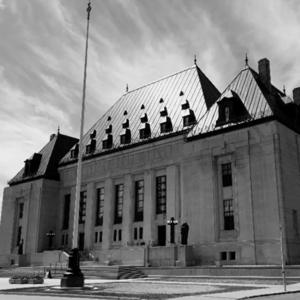


In 2016, the respondent Ms. Sharma, an Indigenous woman, pled guilty to importing two kilograms of cocaine, contrary to s. 6(1) of the Controlled Drugs and Substances Act (“CDSA”). Ms. Sharma sought a conditional sentence of imprisonment, and challenged the constitutional validity of the two year mandatory minimum sentence under s. 6(3)(a.1) of the CDSA and of ss. 742.1(b) and 742.1(c) of the Criminal Code, which make conditional sentences unavailable in certain situations. The sentencing judge found that the two year mandatory minimum sentence under s. 6(3)(a.1) of the CDSA violated s. 12 of the Charter and could not be saved under s. 1. The judge therefore declined to address the constitutional challenge to s. 742.1(b), and he dismissed the s. 15 challenge to s. 742.1(c). Ms. Sharma was sentenced to 18 months’ imprisonment, less one month for pre sentence custody and other factors.
Ms. Sharma appealed and, with the Crown’s consent, also brought a constitutional challenge to s. 742.1(e)(ii) of the Criminal Code. A majority of the Court of Appeal allowed the appeal. Sections 742.1(c) and 742.1(e)(ii) were found to infringe both ss. 7 and 15(1) of the Charter, and the infringement could not be justified under s. 1. The majority held that the appropriate sentence would have been a conditional sentence of 24 months less one day, but as the custodial sentence had already been completed, a sentence of time served was substituted. Miller J.A., dissenting, would have dismissed the appeal and upheld the sentence of imprisonment.
Argued Date
2022-03-23
Keywords
Canadian charter (Criminal) - Right to life, liberty and security of person, Right to equality, Discrimination based on race, Criminal law, Sentencing - Charter of rights — Right to life, liberty and security of the person — Right to equality — Discrimination based on race — Criminal law — Sentencing — Whether ss. 742.1(c) and 742.1(e)(ii) of the Criminal Code infringe the right to equality of Indigenous offenders under s. 15 of the Charter — Whether the introduction of conditional sentences in the 1996 amendments to the Criminal Code created a “benefit” for Indigenous offenders from which Parliament cannot derogate without violating s. 15 of the Charter — Whether limiting the availability of conditional sentences for serious offences as defined by their maximum penalty is overbroad in violation of s. 7 of the Charter — Whether any breach of ss. 7 or 15 can be justified under s. 1 — Criminal Code, R.S.C. 1985, c. C 46, ss. 742.1(c) and 742.1(e)(ii).
Notes
(Ontario) (Criminal) (By Leave)
Disclaimers
This podcast is created as a public service to promote public access and awareness of the workings of Canada's highest court. It is not affiliated with or endorsed by the Court. The original version of this hearing may be found on the Supreme Court of Canada's website. The above case summary was prepared by the Office of the Registrar of the Supreme Court of Canada (Law Branch).
Following a trial by jury, the respondent, Craig Pope, was convicted of second degree murder. A majority of the Court of Appeal allowed Mr. Pope’s appeal from conviction and ordered a new trial. In its view, the trial judge erred by failing to properly instruct the jury on the included offence of manslaughter. The majority was of the view that the difference between murder and manslaughter, particularly regarding the question of intent, was not explained with sufficient clarity. In dissent, Goodridge J.A. would have dismissed the appeal. First, he rejected the respondent’s argument that the decision tree prepared by the trial judge for the jury failed to define the included offence of manslaughter. Second, he rejected the argument that the example of manslaughter given to the jury by the trial judge in response to a question was misleading. Finally, he disagreed that the jury charge failed to alert the jury or provide a limiting instruction that the respondent’s flight from the scene was of no probative value in choosing between second degree murder and manslaughter.
Argued Date
2022-03-21
Keywords
Criminal law - Charge to jury - Criminal law — Charge to jury — Second degree murder — Lesser and included offence of manslaughter — Whether the Court of Appeal erred in law by finding that the position taken by counsel at trial is not a factor to be considered in assessing the trial judge’s instructions to the jury — Whether the Court of Appeal erred in law by finding that the trial judge’s jury instructions, including the decision tree, were deficient in relation to the elements of manslaughter — Whether the Court of Appeal erred in law by finding the trial judge’s answer to the jury’s question, and the example of manslaughter given to the jury, was deficient — Whether the Court of Appeal erred in law by overturning the second degree murder conviction and ordering a new trial.
Notes
(Newfoundland & Labrador) (Criminal) (As of Right)
Disclaimers
This podcast is created as a public service to promote public access and awareness of the workings of Canada's highest court. It is not affiliated with or endorsed by the Court. The original version of this hearing may be found on the Supreme Court of Canada's website. The above case summary was prepared by the Office of the Registrar of the Supreme Court of Canada (Law Branch).
The respondent was charged with assault, aggravated assault, uttering a threat, and damage to property. On June 5, 2018, the Crown elected to proceed summarily on three hybrid offences, and the charge of aggravated assault was electable as to mode of trial. On the same date, the respondent’s counsel stated that the election was trial in the Provincial Court. The trial judge found the respondent guilty. The respondent appealed his convictions on the basis that his trial counsel had failed to obtain his informed instructions regarding his election as to the mode of his trial. He alleged that he had not been informed that he had a right to elect the mode of trial, resulting in a miscarriage of justice. A majority of the Court of Appeal for Newfoundland and Labrador allowed the appeal, set aside the convictions, and ordered a new trial. In dissent, Hoegg J.A. would have dismissed the appeal.
Argued Date
2022-03-18
Keywords
Criminal law - Procedure - Criminal law — Procedure — Trial fairness — Election of mode of trial — Accused alleging he was not informed of his right to elect mode of trial — Whether appellate court can overturn trial verdict on procedural fairness grounds alone without proof of prejudice.
Notes
(Newfoundland & Labrador) (Criminal) (As of Right)
Disclaimers
This podcast is created as a public service to promote public access and awareness of the workings of Canada's highest court. It is not affiliated with or endorsed by the Court. The original version of this hearing may be found on the Supreme Court of Canada's website. The above case summary was prepared by the Office of the Registrar of the Supreme Court of Canada (Law Branch).
In the Court of Québec, the respondent, Daniel Brunelle, was convicted of aggravated assault, assault with a weapon and possession of a weapon for a dangerous purpose. The offences arose out of an episode of road rage. The trial judge found that the respondent had not acted in self defence. With regard to the second condition for self defence, she did not believe the respondent’s claim that he had used force for the purpose of defending himself. She found that he had instead retaliated and taken revenge.
The Quebec Court of Appeal allowed the appeal, set aside the guilty verdicts and ordered a new trial. In the majority’s view, the trial judge had erred in analyzing the second condition for self defence by finding that the accused had sought to take revenge and had done more than defend himself. The judge had not taken account of how quickly everything happened and had not considered all the evidence. Bachand J.A., dissenting, would have dismissed the appeal on the basis that there was no reason to intervene. In his view, the issue was whether the trial judge’s finding that the respondent had acted out of vengeance was sufficiently supported by the evidence and involved no palpable and overriding error. He found that this was the case.
Argued Date
2022-03-15
Keywords
Criminal law - Appeals, Evidence, Unreasonable verdict, Defences, Self-defence - Criminal law — Appeals — Evidence — Unreasonable verdict — Defence — Self defence — Whether majority erred in law in holding that verdict was unreasonable even though trial judge’s findings of fact were supported by evidence.
Notes
(Quebec) (Criminal) (As of Right)
Disclaimers
This podcast is created as a public service to promote public access and awareness of the workings of Canada's highest court. It is not affiliated with or endorsed by the Court. The original version of this hearing may be found on the Supreme Court of Canada's website. The above case summary was prepared by the Office of the Registrar of the Supreme Court of Canada (Law Branch).
In June 2008, Roger Matern consulted the appellant, Mitra Javanmardi, a naturopath. Ms. Javanmardi administered an intraveous injection treatment. Mr. Matern died not long after the treatment. Ms. Javanmardi was charged, in connection with his death, with criminal negligence causing death and manslaughter.
The Court of Québec found on the basis of the evidence that the cause of Mr. Matern’s death was the injection administered by Ms. Javanmardi. But it acquitted her on both counts on the basis that, amoung other things, Ms. Javanmardi’s conduct had not involved a marked departure and her actions had not been objectively dangerous.
The Court of Appeal was of the opinion that errors of law had been made at trial. It found that all the essential elements of the offence of manslaughter had been established beyond a reasonable doubt and found Ms. Javanmardi guilty on that count. As for the count of criminal negligence, it found that a reassessment of the whole of the evidence was necessary and ordered a new trial for that purpose.
Argued Date
2019-05-15
Keywords
Criminal law - Criminal law - Manslaughter - Criminal negligence causing death - Naturopath charged with manslaughter of patient and with causing patient’s death by criminal negligence - Patient dying as result of endotoxic shock caused by bacterium in substance injected into him by naturopath during treatment - Whether ss. 234 and 236 of Criminal Code, R.S.C. 1985, c. C 46, infringe rights guaranteed by ss. 6, 7 and 15 of Canadian Charter of Rights and Freedoms and, if so, whether infringements justified under s. 1 of Charter - Whether Court of Appeal made legal errors.
Notes
(Quebec) (Criminal) (As of Right / By Leave) (Publication ban in case) (Sealing order) (Certain information not available to the public)
Disclaimers
This podcast is created as a public service to promote public access and awareness of the workings of Canada's highest court. It is not affiliated with or endorsed by the Court. The original version of this hearing may be found on the Supreme Court of Canada's website. The above case summary was prepared by the Office of the Registrar of the Supreme Court of Canada (Law Branch).
Charter of Rights and Freedoms - Criminal law – Charge to jury – Right to silence – Consideration of s. 4(6) of the Canada Evidence Act - Whether Court of Appeal erred in concluding that the trial judge was not required to specifically caution the jury on the improper use of the Applicant’s decision not to testify at trial – Charter of Rights and Freedoms ss. 7, 11(c) and 11(d).
The Applicant and his co-accused, Peter Solty, were charged with one count of conspiracy to defraud the Government of Canada and one count of defrauding the Government of Canada of about $3.25 million. The Crown alleged that both accused participated in a fraudulent scheme involving the fictitious sale of heavy equipment to generate harmonized Sales Tax (“HST”) that was then not remitted to the federal government as required. The fraudulent nature of the scheme was never challenged. The involvement of the applicant and Mr. Solty in the scheme was also conceded. The question for the jury was whether either or both accused were aware of the fraudulent nature of the scheme. The applicant did not testify. The applicant was convicted and sentenced and his appeals were dismissed.
Argued Date
2011-11-08
Keywords
Criminal law.
Notes
(Ontario) (Criminal) (By Leave)
Disclaimers
This podcast is created as a public service to promote public access and awareness of the workings of Canada's highest court. It is not affiliated with or endorsed by the Court. The original version of this hearing may be found on the Supreme Court of Canada's website. The above case summary was prepared by the Office of the Registrar of the Supreme Court of Canada (Law Branch).
Annapolis Group Inc. seeks to develop lands that it owns. The lands lie within the boundary of Halifax Regional Municipality. Council of Halifax Regional Municipality declined to commence a planning process and to amend a by-law, both of which are required to permit development of the lands. Annapolis Group Inc. alleges Halifax Regional Municipality encourages members of the public to use the lands as a public park. It commenced an action seeking damages for alleged de facto expropriation, abuse of public office and unjust enrichment. Halifax Regional Municipality filed a motion for summary judgment dismissing the claim of de facto expropriation. The motions judge dismissed the motion. The Court of Appeal allowed an appeal and dismissed the claim of de facto expropriation.
Argued Date
2022-02-16
Keywords
Expropriation - Municipal law - Expropriation - Municipal law - Municipal council declines to initiate planning process required by developer to develop lands - Public uses lands as a park - Whether exercise of a zoning power which deprives a landowner of the reasonable uses of its land in favour of creating a public park carries an implied obligation to pay compensation - Whether test for de facto expropriation should be revisited - Whether motive of government authority is a relevant consideration in considering whether a de facto taking occurred?.
Notes
(Nova Scotia) (Civil) (By Leave)
Disclaimers
This podcast is created as a public service to promote public access and awareness of the workings of Canada's highest court. It is not affiliated with or endorsed by the Court. The original version of this hearing may be found on the Supreme Court of Canada's website. The above case summary was prepared by the Office of the Registrar of the Supreme Court of Canada (Law Branch).
The appellants were convicted of manslaughter in relation to the death of their roommate. After being initially detained by officers at the scene under a non-existent law, they were arrested by detectives for murder two hours later at the police station. Following a lengthy interview, Lambert confessed to their involvement in the death of the roommate; when confronted with the confession, Beaver admitted his participation as well. At trial, the appellants sought the exclusion of all evidence which derived from alleged violations of their rights protected by ss. 7, 9, 10(a) and 10(b) of the Canadian Charter of Rights and Freedoms. They also alleged that the detective who arrested them at the station did not have reasonable and probable grounds to do so. The Crown conceded that the appellants’ Charter rights had been breached when they were detained under a non-existent law, but argued that the arrest at the station constituted a “fresh start” which insulated the confessions from the previous breaches. The trial judge dismissed the application, finding that the police had reasonable and probable grounds to arrest the appellants for murder at the police station, and that the arrests constituted a “fresh start” which cured the previous breaches. He concluded that the appellants’ subsequent confessions had not been tainted by the breaches. Nevertheless, the trial judge conducted a s. 24(2) analysis as set out in R. v. Grant, 2009 SCC 32, and concluded that the confessions would have been admitted, in any event. The Court of Appeal unanimously dismissed the appellants’ appeals.
Argued Date
2022-02-14
Keywords
Criminal law - Charter of Rights, Evidence, Admissibility - Criminal law - Charter of Rights - Evidence - Admissibility - Reasonable and probable grounds for arrest - Under what circumstances can police attempts at a “fresh start” insulate evidence from admissibility consideration pursuant to s. 24(2) of the Charter - Should judicial scrutiny of reasonable and probable grounds be more stringent in circumstances where the arrestee was unlawfully detained and police have no notes regarding the grounds for arrest or the information relied upon - What information must be imparted to a detainee to permit them to make a meaningful choice about whether or not to speak with police?.
Notes
(Alberta) (Criminal) (By Leave)
Disclaimers
This podcast is created as a public service to promote public access and awareness of the workings of Canada's highest court. It is not affiliated with or endorsed by the Court. The original version of this hearing may be found on the Supreme Court of Canada's website. The above case summary was adapted from one prepared by the Office of the Registrar of the Supreme Court of Canada (Law Branch).
Following an investigation into cocaine trafficking, the appellant was arrested and subjected to a strip search, which yielded three small bags of cocaine. At trial, the appellant applied to exclude the evidence on the basis that the strip search had not been justified at law. The trial judge concluded that the police had the requisite reasonable and probable grounds to conduct the search and admitted the evidence, and the appellant was convicted of possession of cocaine for the purposes of trafficking.
A majority of the Court of Appeal for Alberta dismissed the appellant’s appeal, holding that the trial judge had not erred in concluding that the police had reasonable and probable grounds to conduct the search, in accordance with R. v. Golden, 2001 SCC 83, [2001] 3 S.C.R. 679. In dissent, Veldhuis J.A. was of the view that the appellant’s s. 8 Charter right had been breached. She would have allowed the appeal and entered an acquittal.
Argued Date
2022-01-14
Keywords
Criminal law - Search and seizure (s. 8) - Criminal law — Search and seizure — Search incident to arrest — Strip search — Whether the trial judge considered the correct test for a strip search — Whether the trial judge was permitted to consider hearsay evidence in her assessment of the grounds for conducting a strip search — Whether the trial judge erred in finding no violation of s. 8 of the Canadian Charter of Rights and Freedoms — Whether acquittal proper relief.
Notes
(Alberta) (Criminal) (As of Right)
Disclaimers
This podcast is created as a public service to promote public access and awareness of the workings of Canada's highest court. It is not affiliated with or endorsed by the Court. The original version of this hearing may be found on the Supreme Court of Canada's website. The above case summary was prepared by the Office of the Registrar of the Supreme Court of Canada (Law Branch).
From the publisher's feed

111,841 Listeners

429 Listeners

5,740 Listeners

3,360 Listeners

15,605 Listeners

15,905 Listeners

1,325 Listeners
0 Listeners