
Sign up to save your podcasts
Or



Send us Fan Mail
There is a need to address the bias or imbalance in the design of the curriculum in an architecture school in 2022. How are we teaching sustainability? Have we relegated architecture theory and philosophy, cultural and social contexts to the end zone of our architecture curriculum? Are we regurgitating the same knowledge again and again and students will not be well equipped and confident enough to face the realities of practice and society in general? Have we left out the essential skill of critical thinking?
We had been dealing with this topic in the last year, interviewed individuals, even had our clubhouse room sessions but we haven't really dug deep enough to make a difference in our architecture curriculum. We have only been skimming the surface and kidding ourselves.
Let's be honest. So let's dig deeper. Part 1, this episode, we ask questions again and conclude with some issues.
© 2022 Talk Architecture, Author: Naziaty Mohd Yaacob
Photo (artwork): "Site visit by the second year at Kampung Baru, Kuala Lumpur" by Low Pey Sien
Support the show
Do subscribe for premium content and special features which will help to support and sustain Talk Architecture podcast on a more in-depth explanation on design thesis and processes. These special commentaries and ‘how to’ explanations are valuable insights and knowledge not found elsewhere!
Send us Fan Mail
What are the biases that we have when finding a solution for a disabled person? Would a physically disabled person be able to work as a farmer or a mechanic? Would a blind person be able to practice architecture?
Referring to the article (link below) at ideo.org popularly advocating design thinking, one of the authors did research on this topic of 'disabled persons and livelihood' and conducted a participant workshop on brainstorming possibilities on how a disabled person can do the work which people perceived to be impossible.
https://www.ideo.org/perspective/creative-inclusion-and-bias-breaking
© 2022 Talk Architecture, Author: Naziaty Mohd Yaacob
Photo (artwork): Suntrack Development Showroom Unit (Naziaty Mohd Yaacob)
Support the show
Do subscribe for premium content and special features which will help to support and sustain Talk Architecture podcast on a more in-depth explanation on design thesis and processes. These special commentaries and ‘how to’ explanations are valuable insights and knowledge not found elsewhere!
Send us Fan Mail
Happy New Year - 2022!
In the last 9 weeks, students came back to the campus and tutors conducted hybrid learning with a mixture of online and face-to-face interactions. Despite the fears of getting Covid-19, we, both students and tutors relied on our trust and instinct, with SOPs (standard operating procedures) to conduct the latter mode especially.
I discussed how I developed a new perspective on the difference between online and face-to-face interactions in the architecture design studio, what makes the difference, and why face-to-face interactions are important. No one told me this before and somehow we made our group interactions much better, in smaller groups of 3-4 students together for an hour. I see the desired outcomes from the students' progress and also improved on the integration of theory in the studio projects.
© 2021 Talk Architecture, Author: Naziaty Mohd Yaacob
Photo (artwork): "Crit space for a small group with SOPs" by Naziaty Mohd Yaacob
Support the show
Do subscribe for premium content and special features which will help to support and sustain Talk Architecture podcast on a more in-depth explanation on design thesis and processes. These special commentaries and ‘how to’ explanations are valuable insights and knowledge not found elsewhere!
Send us Fan Mail
Using my second-year students as an example, I explained how I am teaching my students to design to come up with the scheme. This is the batch where they did online learning for the whole of the first year and had only been at the campus in the last 9 weeks. Focusing on the use of precedents and the critical part before getting the narrative and concept. This gives a sense of what a student deals at the beginning of an introduction to the design process.
© 2021 Talk Architecture, Author: Naziaty Mohd Yaacob
Photo (artwork): "Notes on a whiteboard" by Naziaty Mohd Yaacob
Support the show
Do subscribe for premium content and special features which will help to support and sustain Talk Architecture podcast on a more in-depth explanation on design thesis and processes. These special commentaries and ‘how to’ explanations are valuable insights and knowledge not found elsewhere!
Send us Fan Mail
Designing for disability helps everyone
We refer to Elise Roy's talks and an article that stated why accessibility is important, not only from a moral and legal standpoint but also from a business perspective that gives value to the product and solution.
"I believe that losing my hearing was one of the greatest gifts I've ever received," says Elise Roy. As a disability rights lawyer and design thinker, she knows that being Deaf gives her a unique way of experiencing and reframing the world -- a perspective that could solve some of our largest problems. As she says: "When we design for disability first, you often stumble upon solutions that are better than those when we design for the norm."
https://www.ted.com/talks/elise_roy_when_we_design_for_disability_we_all_benefit?utm_campaign=tedspread&utm_medium=referral&utm_source=tedcomshare
https://www.interaction-design.org/literature/article/3-reasons-why-accessible-design-is-good-for-all
© 2021 Talk Architecture, Author: Naziaty Mohd Yaacob
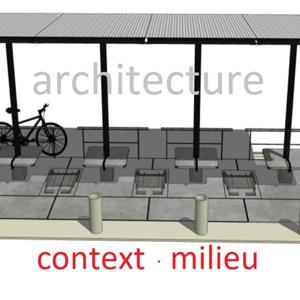
Photo (artwork): Universal Design Bus Stop Version 1, University of Malaya, Kuala Lumpur (Naziaty Mohd Yaacob)
Support the show
Do subscribe for premium content and special features which will help to support and sustain Talk Architecture podcast on a more in-depth explanation on design thesis and processes. These special commentaries and ‘how to’ explanations are valuable insights and knowledge not found elsewhere!
Send us Fan Mail
Part 2 review of an article by Zach Mortice found at the AIA website (American Institute of Architecture), which told a story of the current phenomenon on disability access and inclusion practice by architects. The idea that the 'design intent' of architecture is based on inclusion, is the most ideal situation for any buildings.
“Accessibility is a topic that should be brought to the very beginning of any project,” Braitmayer said.
Link to the article: https://www.aia.org/articles/6215411-design-for-all-requires-a-culture-change-i
For further information, do join the Facebook Group: Smart Design with Disabled Access in Mind
© 2021 Talk Architecture, Author: Naziaty Mohd Yaacob
Photo (artwork): Universal Design Bus Stop Version 1, University of Malaya, Kuala Lumpur (Naziaty Mohd Yaacob)
Support the show
Do subscribe for premium content and special features which will help to support and sustain Talk Architecture podcast on a more in-depth explanation on design thesis and processes. These special commentaries and ‘how to’ explanations are valuable insights and knowledge not found elsewhere!
Send us Fan Mail
In conjunction with the International Day for Disabled Persons on 3rd December, this is a special podcast focusing on 'what is embracing disability and designing for accessibility for an architect and designer?' Why is it important to design for accessibility as part of any design approach from the beginning?
For further information, do join the Facebook Group: Smart Design with Disabled Access in Mind
© 2021 Talk Architecture, Author: Naziaty Mohd Yaacob
Support the show
Do subscribe for premium content and special features which will help to support and sustain Talk Architecture podcast on a more in-depth explanation on design thesis and processes. These special commentaries and ‘how to’ explanations are valuable insights and knowledge not found elsewhere!
Send us Fan Mail
What happens when an architect meets a biologist and chat about "Genius Loci" [Sense of Place]? However, Dr. N. Hashim has been around architects most of her life and is familiar with architectural terms. As a keen geographer and writer herself, the discussion revolved around the kind of design approach needed and learning experience necessary to even understand what 'genius loci' is, in the context of Kampung Baru (Urban Village) in Kuala Lumpur, the site of the second year students' project. Some insights were given for this podcast under Theory of Architecture.
© 2021 Talk Architecture, Author: Naziaty Mohd Yaacob
Photo: Dr. N. Hashim
Support the show
Do subscribe for premium content and special features which will help to support and sustain Talk Architecture podcast on a more in-depth explanation on design thesis and processes. These special commentaries and ‘how to’ explanations are valuable insights and knowledge not found elsewhere!
Send us Fan Mail
This two-part commentary and part review of an article by Zach Mortice found at the AIA website (American Institute of Architecture), tells a story of the current phenomenon on disability access and inclusion practice by architects and provides insights on how architects still need to 'own the process' of designing for inclusion from the beginning or as part of the design and not an additive layer.
Quote: "Disability occurs at the intersection of the person and their environment. Architecture, in all its forms, also occurs at the intersection of the person and their environment, making it a vital player in any evaluation of inclusion", says Valerie Fletcher.
Thus, architecture = disability access, and is not an additional aspect to take into account later or a 'code burden'.
Link to the article: https://www.aia.org/articles/6215411-design-for-all-requires-a-culture-change-i
For further information, do join the Facebook Group: Smart Design with Disabled Access in Mind
© 2021 Talk Architecture, Author: Naziaty Mohd Yaacob
Photo (artwork): Suntrack Development SB multi-generational homes view of the shower for Type B Showroom Unit at Setia Alam, Selangor, Malaysia (photo by James Tan)
Support the show
Do subscribe for premium content and special features which will help to support and sustain Talk Architecture podcast on a more in-depth explanation on design thesis and processes. These special commentaries and ‘how to’ explanations are valuable insights and knowledge not found elsewhere!
Send us Fan Mail
Welcome to the 1st in a new series of podcasts on the topic: Architecture Design with Design Empathy, Accessibility, and Universal Design.
We start off with an introduction on:
Understanding Barriers
Understanding Disability
For further information, do join the Facebook Group: Smart Design with Disabled Access in Mind
© 2021 Talk Architecture, Author: Naziaty Mohd Yaacob
Photo (artwork): Suntrack Development SB multi-generational homes view of kitchen for Type B Showroom Unit at Setia Alam, Selangor, Malaysia (photo by James Tan)
Support the show
Do subscribe for premium content and special features which will help to support and sustain Talk Architecture podcast on a more in-depth explanation on design thesis and processes. These special commentaries and ‘how to’ explanations are valuable insights and knowledge not found elsewhere!
From the publisher's feed
Hosted by Naziaty Mohd Yaacob, Ph.D.
Malaysian Architect | Universal Design & Accessibility Expert (MS 1184 Specialist) | Former Associate Professor (28+ years) | Advocate for…
Launched in April 2020, Talk Architecture delivers intimate, reflective conversations on architecture education, practice, and human impact—hosted solely by Naziaty Mohd Yaacob. Rooted in Malaysia yet resonating globally, the podcast connects local insights with universal challenges faced by architects worldwide.
Every episode centres inclusivity, empathy, and equity, drawing on Naziaty’s expertise in universal design, ageing-in-place, sensory architecture, and professional well-being. Global listeners value candid critiques of education models, graduate employability hurdles, and practice realities.
Essential listening for architecture students, professionals, educators, and thought leaders everywhere who are shaping inclusive, resilient built environments in an era of technological and demographic change.
Subscribe on most available platforms, such as Spotify, Apple Podcast, Buzzsprout, Podcaster, Amazon Music etc.