
Sign up to save your podcasts
Or

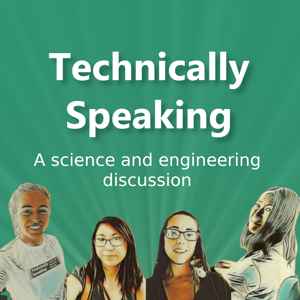


The UK has been severly affected by storms Dudley, Eunice and Franklin in less than seven days, which were predicted with startling accuracy for much of the UK. The weather forecast isn't always so accurate though. Ghalia, Aneeqa, Jennifer and Antonia discuss what weather predictions mean for transport, heating and air conditioning (AC) and why it may not always be accurate. Ghalia explains how the water industry needs to forecast the weather decades into the future so that agriculture and sanitation can be supported while Antonia references how renewable sources of electricity are dependent on wind and gas. The team also discuss how geoengineering can be used to control the weather and climate, and debate whether such control is good for humans and the environment.
Read about this episode here.
It's more than just the transfer of heat, thermodynamics explains a lot of things about life as we know it and leads to advances in technology that change society. Laura, Ghinwa, Antonia and Emma talk about how this fundamental set of principles influence their understanding of the world, and use their diverse backgrounds to illustrate these principles. They discuss heat pumps and refrigeration (aided by a diagram), hot potatoes and eggs, why we sweat, Captain America, probability, and a mind-bending movie about the arrow of time. The incredible importance of the Gibbs free energy (ΔG=ΔH-TΔS) for predicting things like what happens inside futuristic Small Modular Reactors (SMRs) is explained. A handy guide to statistical mechanics also helped them out.
Read all about this conversation.
Modern skyscrapers often reach heights taller than some mountains and some are built in places that are technically challenging. Laura and Rwayda discuss how it's possible to build such tall structures and why they are built. They also touch on future trends for building materials that are climate friendly and sustainable, and speculate on what the future might hold. The notable buildings that they mention are the Empire State Building in New York, the Buri Kalifa in Dubai, Taipei 101 and Voll Arkitekter’s Mjøstårne in Norway. They also discuss how to make a building that could withstand King Kong, and talk about 'Spook Central' from Ghostbusters.
You can now find the team on Instagram: technicallyspeaking.podcast
Read about this episode here.
The fusion of atoms to create energy is actively being researched as a future, low carbon technology. It also features in the Spider-man films. Antonia, Laura and Aneeqa discuss the portayal of this technology in the movies and how this compares to real life. Aneeqa explains what a self-sustaining fusion reaction is and what the challenges are to achieving one. The team also discusses the scale of the technology and how the very energetic neutrons (14 MeV means they're moving at about 17% of the speed of light) that are produced as a by-product of the fusion reaction can lead to extra challenges for this, ahem, hot topic.
Read an article based on this episode which sumarises the conversation and gives some extra information.
The last James Bond film to star Daniel Craig centred around the villain using nanobots to harm very specific people. Scary stuff! Although the film made them seem terrifying they can be used in medicine to do loads of helpful things. Emma S, Hara and Priyanka share their knowledge of biochemistry and pharmaceutical production with Aneeqa to explain what this technology is and what it can do for us.
Read an article based on this conversation.
Coding helps make so many complex tasks in science and engineering easy. Laura, and Ghinwa are joined by Emma and Clea from The University of Manchester's society for Women in Science and Engineering to talk about how they learned to code. They discuss some coding skills as well as how they use coding in chemical engineering, computational chemistry, physics and robotics. They also discuss how coding gave them confidence in their work, how they built up their own confidence in coding, and how it helped them in their careers.
Read an article based on this episode by Laura Leay on medium.com
Decades of climate science have led to a critical moment where decisions must be made at COP26. Laura and Rwayda are joined by Rebecca, who will be an official observer at the conference. Rebecca explains how COP26 will run, and how it is influenced by science and engineering as well as by society, politics and economics. The team also talks about how science might feature in the negotiations, how it can be part of the actions that are agreed at the climate conference, and how you can become an influencer too.
Read a brilliant summary of this conversation on medium.com
We've heard a lot about single use plastic and pollution from microplastics but are there any benefits to this material? Laura, Ghalia, Antonia and Ghinwa discuss plastic in the water industry, some chemistry and plastic engineering, and recycling.
Read a summary of this episode.
Questions? Comments? Email us [email protected]
We may have stopped hearing about the carbon dioxide shortage, but its not gone away and its curiously at odds with what we hear about having too much of it in the atmosphere. Laura, Antonia and Ghinwa discuss some chemistry behind separating carbon dioxide from other gases, some industries that produce carbon dioxide and why they don't make use of it, buses that run on methane, home-brewed beer and popping candy(!)
Read an article based on this episode, by Laura Leay on medium.
Continuing from the previous episode, Laura, Cara and Antonia discuss zero waste as one idea behind a concept known as the circular economy. The discussion dives straight into what might happen to a product once its no longer useful and then broadens out to talk about the need for a profound shift in how we do things. Are businesses and policy makers asking the right questions of scientists and engineers?
Read an article based on this two part episode on medium.com
From the publisher's feed

78,309 Listeners

31,898 Listeners

10,941 Listeners

26,175 Listeners

7,593 Listeners

611 Listeners

6,435 Listeners

111,814 Listeners
166 Listeners

9,968 Listeners

3,212 Listeners

15,606 Listeners

10,679 Listeners

283 Listeners