
Sign up to save your podcasts
Or

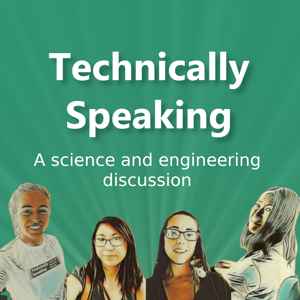


Ever wondered what society would look like if we lose our entire infrastructure? Antonia, Jasmin and Ellie discuss how they might survive based on their own science and engineering knowledge combined with inspiration from film and TV. They discuss movies such as Water World, consider where they would look for information if the internet were affected, and examine how global society could be rebuilt in the absence of modern infrastructure that many of us take for granted. It turns out there isn’t a lot of science or engineering to learn from fiction so, perhaps consider this a review of how not to rebuild society.
Do you ever think about how technology like your smartphone has improved with time and wonder how science made it happen? In this episode with an audience from the Engineering Development Trust, Antonia, Laura and Jasmin talk about metals needed in clean energy technology as well other technologies such as hard disk drives and display screens. They debate whether we're replacing fossil fuels with other finite resources and consider efforts to start mining on the moon.
Antonia refers to a report from the International Energy Agency. Laura mentions critical elements identified by the American Chemical Society and by Birmingham University.
Read more about ruthenium used to increase data storage density at Science Daily, Tanaka Precious Metals and a metals trading company. For other uses, see Johnson Matthey's excellent overview,
For uses of indium, see the Royal Society of Chemistry, an overview from a coatings company, and research published in the journals ACS Nano and Nature Electronics.
To find out more about yttrium, read research published in the journal Nanoscale Advances.
They're used in lots of things but you don't often hear about it. Antonia, Laura and Emma discuss their use in medicine for radiation therapy, electronics and sun screen. They also explain why these tiny particles are so interesting to scientists.
References:
The study about zinc nanoparticles and lung cells was summarised for the media in 2012 but advice from experts explains why you should wwar suncreen.
The Antibacterial Mechanism of Silver Nanoparticles and Its Application in Dentistry, published in the International Journal of Nanomedicine in 2020
The fascinating world of nanoparticle research, published in Materials Today in 2013
Nanoparticle-based radiosensitization strategies for improving radiation therapy, published in Frontiers In Pharmacology in 2023
A review on nanoparticles: characteristics, synthesis, applications, and challenges, published in Frontiers in Microbiology in 2023
Gold Nanoparticles as Radiosensitizers in Cancer Radiotherapy, published in the International Journal of Nanomedicine in 2020
Biological mechanisms of gold nanoparticle radiosensitization, published in Cancer Nanotechnology in 2017
Do you find activists like Extinction Rebellion and Just Stop Oil annoying or do you support their fervour? Laura, Antonia and Jasmin discuss whether there is any evidence that their disruptive tactics will convince companies and governments to take more drastic action to curb the climate emergency. They look at why people might join a cause and whether facts or emotion are the most powerful tool an activist can use to persuade.
The team mention a report from the Tyndall Centre for Friends of the Earth which shows that plans for expansion of air travel contradicted targets for greenhouse gas emissions and became the basis for a peer-reviewed journal publication and was also used by protestors at the Heathrow Airport Climate Camp in 2007.
They also mention expert insight from social scientists shared in a news article, a commentary in a journal and analysis of the anti-vaccination movement as well as how celebrities like Joe Lycett hold organisations to account.
We've seen lots of news stories about a global sand shortage but what's really going on? Ellie, Antonia and Laura (joined by Ellie's cat Sparkles) analyse the facts, look at what sand is used for, discuss the effect that sand supplies have on people and the environment and speculate on what should be done next.
Read some of the news coverage, digest some sandy facts explained using handy graphics, read the most recent report from the United Nations, or read the research that uncovers how sand mining is affecting porpoise.
Many breakthroughs in medicine have been made from studying rats. Antonia, Laura and Ellie discuss several studies of rat behaviour that have mapped how parts of the brain work and discuss how the results could be applied to humans to develop prosthetic limbs or help recover memory after a brain injury. They look at studies where rats are tickled until they laugh, learn to drive cars, navigate virtual reality and perform a Jedi mind trick.
Ever watch an action movie where someone is hurled across the screen during an explosion and wondered how likely that is? Antonia, Laura, Nick and Ellie talk about movie portrayals, nuclear weapons, disaster investigations, and exploding animals.
In an earlier episode on apex predators we had a bit of a tech fail! Here's a big chunk of speculative conversation from Antonia, Ellie and Jasmin that that follows some sort of weird logic but somehow arrives at a sensible conclusion.
To help tackle the climate crisis, we'll need a lot of new technology to reduce the concentration of greenhouse gases in the atmosphere. Ellie, Jasmin and Laura share a load of facts about the chemicals, energy requirements and land use involved in technology to capture carbon dioxide from the air. They also look at how planting trees compares to this technology and answer questions from a live audience from the Engineering Development Trust about Taylor Swift's private jet and why we're spending money on projects that aren't tackling the climate emergency.
Read the review article that Laura mentions in the journal MRS Energy & Sustainability.
If you could take a pill to halt ageing and become immortal, would you? Laura, Jasmin and Ellie take a look at some long-lived species, discuss just some of the science behind ageing and decide, if they could, whether they'd want to stay in their biological bodies forever or upload themselves to live digitally.
Read more about the science stories they discuss:
Read some of the books they've read:
From the publisher's feed

78,309 Listeners

31,898 Listeners

10,941 Listeners

26,175 Listeners

7,593 Listeners

611 Listeners

6,435 Listeners

111,814 Listeners
166 Listeners

9,968 Listeners

3,212 Listeners

15,606 Listeners

10,679 Listeners

283 Listeners