
Sign up to save your podcasts
Or



Based on Podcast App listening data
This week, we’re exploring three archaeology articles in the news this week. First, we head to Rapa Nui, where new research into the mysterious Rongorongo script could reshape our understanding of when and how writing developed on the island. Then, we examine an Etruscan ritual well filled with offerings to the goddess Uni—and later, human remains. Finally, we travel to Denmark, where plans for an underground parking garage led archaeologists to the unexpected discovery of a long-lost medieval convent.
Chris Webster
Rachel Roden
Hosted by Simplecast, an AdsWizz company. See pcm.adswizz.com for information about our collection and use of personal data for advertising.
Today we’re reviewing Voyage to the Planet of Prehistoric Women (1968), the story of a cool Russian sci-fi movie about an exploratory mission to Venus which an American studio dubbed and re-cut to include telepathic “prehistoric” women, for some reason. In truth there’s very little prehistory in this one, so we get to talk about space travel for forty minutes! (Astronomers and engineers, please send your complaints and corrections to [email protected])
Hosted by Simplecast, an AdsWizz company. See pcm.adswizz.com for information about our collection and use of personal data for advertising.
In this episode of Ethnocynology, I sit down with dog science communicator Alexandra the Average for a wide-ranging conversation about dogs, science, identity, and the ways our own cultural biases shape how we understand dogs themselves.
Alexandra discusses her approach to navigating misinformation in the dog and animal-welfare world, including why she relies on multiple studies rather than individual papers. But also the importance of reading beyond the abstract, and how scientific findings can become messy once they reach social media.
The conversation dives into some of the most persistent debates surrounding dogs, including pit bull stereotypes, breed and temperament, dog-bite statistics, veterinary bias, and how race and socioeconomic inequality can affect people's experiences with animal welfare and adoption.
We also explore the deeper history behind our relationships with dogs, like the use of dogs as status symbols to the effects of colonialism on Indigenous dog populations. We discuss how dogs can become wrapped up in human identity, prejudice, politics, and even colonial violence, illustrating why the history of dogs can never really be separated from the history of people.
Alexandra also discusses her upcoming podcast, Pod Reviewed Research, which explores the human-animal connection, animal welfare, legislation, history, and culture through detailed, research-heavy conversations.
For a rough transcript head over to: https://www.archaeologypodcastnetwork.com/ethnocynology/43
Hosted by Simplecast, an AdsWizz company. See pcm.adswizz.com for information about our collection and use of personal data for advertising.
Part one of my Archaeologist commentary on the 2013 Tomb Raider game. The working title is Tomb Raider vs The Storm Queen: The Yamatai Cage Grudge Match. Let’s dive in as we cross the Dragon’s Triangle and raid some tombs to save our friends.
LinksHosted by Simplecast, an AdsWizz company. See pcm.adswizz.com for information about our collection and use of personal data for advertising.
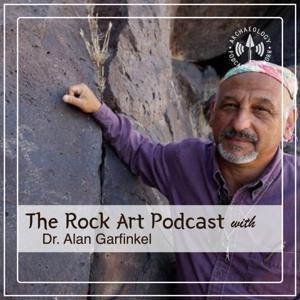
Dr. Alan Garfinkel talks with archaeologist Robert Yohe about their long collaboration and new insights from Yohe’s work at the Rose Spring site. Yohe describes using many radiocarbon dates from a deep, stratified deposit to refine local chronology and estimate the bow-and-arrow’s introduction around 1,600 years ago, along with a rare ritual feature involving a bighorn sheep skull. They also discuss challenges and progress in dating rock art, including AMS radiocarbon dating of a South Fork Kern River painting to about 1,000 years old, and Yohe previews a major upcoming Rose Spring monograph that revises earlier views on subsistence, settlement, and stone tool reuse.
For a rough transcript head over to: https://www.archaeologypodcastnetwork.com/rockart/170
Dr. Alan Garfinkel
Hosted by Simplecast, an AdsWizz company. See pcm.adswizz.com for information about our collection and use of personal data for advertising.
Join the APN crew for a monthly discussion of recent news articles. This month we look into two very different questions about archaeology and how we interpret the past. First, we dig into the growing role of AI and large language models in archaeological research, discussing hallucinations, data ownership, consent, open access, and why critical thinking is more important than ever. Then, we examine the case of a man who survived a severe facial injury roughly 100,000 years ago—and ask whether the more interesting story is really ancient violence, or the care and community that allowed him to survive.
Chris Webster
Rachel Roden
Hosted by Simplecast, an AdsWizz company. See pcm.adswizz.com for information about our collection and use of personal data for advertising.
In this episode of the Great Plains Archaeology Podcast, Carlton welcomes Magdalena Lewandowska to discuss her article, “Trade, Conflict, and Alliance – Relationship Between the Southern Plains and the Rio Grande Pueblos in the Protohistoric Period.” Together they explore the dynamic relationships that connected Indigenous communities across the Southern Plains and the Rio Grande during the fifteenth and sixteenth centuries. The conversation examines how trade in goods such as bison hides and Pueblo pottery fostered economic partnerships while also creating competition, political alliances, and occasional conflict. Drawing on archaeological and historical evidence, Lewandowska explains why Plains–Pueblo interactions cannot be understood as simply peaceful exchange or persistent warfare, but instead reflect a complex network of diplomacy, adaptation, and shifting relationships that shaped the Indigenous history of the Great Plains and the Southwest before European colonization.
Article Citation:
Lewandowska, M. (2025). Trade, conflict, and alliance – relationship between the Southern Plains and the Rio Grande Pueblos in the protohistoric period. Plains Anthropologist, 70(273), 64–94.
For rough transcripts of this episode go to https://www.archaeologypodcastnetwork.com/great-plains-archaeology/47
Hosted by Simplecast, an AdsWizz company. See pcm.adswizz.com for information about our collection and use of personal data for advertising.
Can what we face as a discipline now be an opportunity for reflection and growth that leads to a transformation? Could this period lead to a revolution of understanding? There are a lot of opinions, information, interpretations, and assumptions swirling but above all, the most effective and impactful strategy is a measured mission of action based on facts unencumbered by the emotions of the moment.
For rough transcripts of this episode go to https://www.archpodnet.com/crmarchpodcast/337
Hosted by Simplecast, an AdsWizz company. See pcm.adswizz.com for information about our collection and use of personal data for advertising.
This week we cover three new archaeology news stories! First up, a new LiDAR study in Brazil is revealing that the Amazonian ancient civilization of Aquiry may have been much larger than previously known. Then, a tomb in Poland that was opened in 1973 harbored a deadly fungus that caused the deaths of many of the researchers that worked on it, like a modern day Mummy’s Curse! And finally, archaeologists at Pompeii are reconstructing a ceiling mosaic piece by painstaking piece.
Segment 1
Segment 2
Segment 3
Chris Webster
Rachel Roden
Hosted by Simplecast, an AdsWizz company. See pcm.adswizz.com for information about our collection and use of personal data for advertising.
In this episode, host Stephanie Rice kicks off a series on landscape archaeology, beginning with the study of what could be seen from ancient tombs and where those tombs were visible from within the surrounding region.
Journey across three distinct ancient landscapes: The Neolithic passage tombs of Newgrange, Knowth, and Dowth at Brú na Bóinne in Ireland; Norse burial cairns of late Iron Age Norway and Iceland; and the Ojoka Kofun (おじょかこふん/王女丘古墳) from the Yamato Period in Japan.
Through these sacred sites, discover how ancient people viewed and interacted with their funerary landscape.
Offline sources used:
Dowling, Ger. "Exploring the hidden depths of Tara’s hinterland: geophysical survey and landscape investigations in the Meath–north Dublin region, eastern Ireland." Proceedings of the Prehistoric Society. Vol. 81. Cambridge University Press, 2015.
Gjerland, Berit, and Christian Keller. 2009. Graves and Churches of the Norse in the North Atlantic: A Pilot Study. Journal of the North Atlantic:161–177.
Shima City Board of Education, 2016, "Shima City Buried Cultural Properties Survey Report 4: Excavation Report of Ojoka Tumulus (Shijima Tumulus Group No. 11)," Shima City Board of Education
von Hackwitz, Kim, and Karl-Johan Lindholm. 2015. Landscapes of Mortuary Practices. ANCIENT DEATH WAYS:143.
Wheatley, David. 2022. Cumulative Viewshed Analysis: A GIS-Based Method for Investigating Intervisibility, and Its Archaeological Application. In Archaeology and Geographic Information Systems, pp. 171–185. CRC Press.
For transcripts of this episode head over to: https://archpodnet.com/tpm/36
Hosted by Simplecast, an AdsWizz company. See pcm.adswizz.com for information about our collection and use of personal data for advertising.
From the publisher's feed

78,356 Listeners

43,817 Listeners

23,753 Listeners

6,869 Listeners

3,196 Listeners

297 Listeners
10 Listeners
151 Listeners
15 Listeners
19 Listeners
116 Listeners

31 Listeners

2 Listeners
2 Listeners

4 Listeners

19 Listeners
741 Listeners

6,227 Listeners

24,533 Listeners

4,524 Listeners
2 Listeners

904 Listeners

16 Listeners
0 Listeners
15 Listeners

5,074 Listeners
127 Listeners

3 Listeners

3,368 Listeners
27 Listeners

2,322 Listeners

0 Listeners
0 Listeners
164 Listeners