
Sign up to save your podcasts
Or



Michael, an Associate Professor in Reproductive Science, joins us for a wide-ranging dive into the history of reproductive science. From ancient Galenic theories and Leonardo da Vinci's anatomical drawings, through the gradual unravelling of how sperm and eggs work, to the breakthroughs that ultimately made IVF possible.
We trace the key milestones: sperm capacitation, early animal studies, and the pioneering work of Edwards, Steptoe, and Purdy that led to the birth of Louise Brown in 1978, and the 12 million IVF babies who have followed since.
Support the show
Support the show: buymeacoffee.com/completehistoryofscience
Contact: [email protected]
BlueSky: https://bsky.app/profile/gethinrichards.bsky.social
Music Credit: Folk Round Kevin MacLeod (incompetech.com) Licensed under Creative Commons: By Attribution 3.0 License
In 1610 reports reached Prague that Galileo had discovered new planets, and Kepler felt compelled to find out for himself what had actually been seen. Reading Starry Messenger and later observing through a borrowed telescope, he became one of Galileo’s earliest and most important defenders. Kepler not only confirmed the existence of Jupiter’s moons but also argued publicly for the reliability of telescopic observations, and went further by explaining, for the first time, how the telescope worked in theory through his optical treatise Dioptrice.
Alongside this defence of new instruments, the episode follows Kepler’s search for harmony in the structure of the cosmos, culminating in the discovery of his third law of planetary motion. It then traces his long and difficult effort to complete the Rudolphine Tables, based on Tycho Brahe’s observations. Published in 1627, the tables proved vastly more accurate than anything before them and made possible the successful prediction of planetary transits. Though Kepler did not live to see their full impact, the tables ensured that his astronomy could no longer be ignored.
Support the show
Support the show: buymeacoffee.com/completehistoryofscience
Contact: [email protected]
BlueSky: https://bsky.app/profile/gethinrichards.bsky.social
Music Credit: Folk Round Kevin MacLeod (incompetech.com) Licensed under Creative Commons: By Attribution 3.0 License
Merry Christmas!
Answering listener questions as well as some long standing FAQs. Enjoy!
Support the show
Support the show: buymeacoffee.com/completehistoryofscience
Contact: [email protected]
BlueSky: https://bsky.app/profile/gethinrichards.bsky.social
Music Credit: Folk Round Kevin MacLeod (incompetech.com) Licensed under Creative Commons: By Attribution 3.0 License
Planning on doing a Q and A about the show as an Xmas special. If you have any questions about the show or the history of science in general send them to the below address.
This episode will self destruct in two weeks time.
Support the show
Support the show: buymeacoffee.com/completehistoryofscience
Contact: [email protected]
BlueSky: https://bsky.app/profile/gethinrichards.bsky.social
Music Credit: Folk Round Kevin MacLeod (incompetech.com) Licensed under Creative Commons: By Attribution 3.0 License
After years of struggle, Johannes Kepler finally had the tools and data to wage what he called his “War with Mars.” Rejecting ancient assumptions he used Tycho Brahe’s observations to discover his first two laws of planetary motion. His New Astronomy not only redefined celestial mechanics but transformed astronomy from a geometric art into a true physical science.
Support the show
Support the show: buymeacoffee.com/completehistoryofscience
Contact: [email protected]
BlueSky: https://bsky.app/profile/gethinrichards.bsky.social
Music Credit: Folk Round Kevin MacLeod (incompetech.com) Licensed under Creative Commons: By Attribution 3.0 License
In 1600, Johannes Kepler arrived at Tycho Brahe’s castle hoping to escape religious persecution and gain access to the most precise astronomical data in Europe. Their relationship was strained by clashing temperaments — Tycho’s secrecy and pride meeting Kepler’s impatience and ambition — yet their collaboration began to bear fruit as Kepler tackled problems of planetary motion and optical theory. Despite constant uncertainty, Kepler’s time at Benátky marked the beginning of a partnership that would reshape astronomy and set him on the path toward his greatest discoveries.
Support the show
Support the show: buymeacoffee.com/completehistoryofscience
Contact: [email protected]
BlueSky: https://bsky.app/profile/gethinrichards.bsky.social
Music Credit: Folk Round Kevin MacLeod (incompetech.com) Licensed under Creative Commons: By Attribution 3.0 License
Johannes Kepler rose from a difficult childhood to become a brilliant but unconventional student, deeply influenced by his Lutheran faith, Copernican astronomy, and a belief in divine harmony within the cosmos. In Graz he developed his bold first theory, published in Mysterium Cosmographicum, which linked the orbits of the planets to the five Platonic solids and made him one of the earliest open defenders of heliocentrism. Facing religious persecution and desperate for accurate data, Kepler set out to join Tycho Brahe in Prague, convinced that Tycho’s observations were the key to uncovering the universe’s hidden order.
Support the show
Support the show: buymeacoffee.com/completehistoryofscience
Contact: [email protected]
BlueSky: https://bsky.app/profile/gethinrichards.bsky.social
Music Credit: Folk Round Kevin MacLeod (incompetech.com) Licensed under Creative Commons: By Attribution 3.0 License
Quick update on the show.
Support the show
Support the show: buymeacoffee.com/completehistoryofscience
Contact: [email protected]
BlueSky: https://bsky.app/profile/gethinrichards.bsky.social
Music Credit: Folk Round Kevin MacLeod (incompetech.com) Licensed under Creative Commons: By Attribution 3.0 License
Tycho Brahe’s observations of the Great Comet of 1577 and his discovery of atmospheric refraction led him to reject solid celestial spheres and reassess the structure of the cosmos. Seeking an alternative to both the Ptolemaic and Copernican systems, he developed a geo-heliocentric model in which the Sun orbited the Earth while the planets orbited the Sun, a theory he supported with years of precise measurements, including a (mistaken) parallax for Mars. Though he failed to find definitive proof, Tycho’s tireless pursuit of accuracy and his revolutionary instruments laid the groundwork for the astronomical breakthroughs that would follow.
Support the show
Support the show: buymeacoffee.com/completehistoryofscience
Contact: [email protected]
BlueSky: https://bsky.app/profile/gethinrichards.bsky.social
Music Credit: Folk Round Kevin MacLeod (incompetech.com) Licensed under Creative Commons: By Attribution 3.0 License
In 1576, Tycho Brahe was offered something no astronomer had ever received before: an island of his own. On the remote Baltic isle of Hven, Tycho set out to build the most advanced observatory in Europe. But just as construction began, a brilliant comet appeared in the night sky. For Tycho, it was more than a celestial spectacle: it was a chance to test Aristotle, challenge old ideas, and prove that careful observation could overturn centuries of dogma. This episode traces Tycho’s transformation from wandering scholar to scientific institution, as he turns a lonely island into the centre of the astronomical world.
Support the show
Support the show: buymeacoffee.com/completehistoryofscience
Contact: [email protected]
BlueSky: https://bsky.app/profile/gethinrichards.bsky.social
Music Credit: Folk Round Kevin MacLeod (incompetech.com) Licensed under Creative Commons: By Attribution 3.0 License
From the publisher's feed
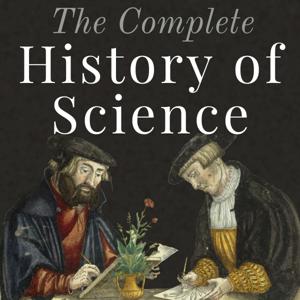
A podcast exploring the history of science from the beginning. We will cover all of the most important scientific discoveries from Archimedes to Newton to Einstein. The aim is to give a…
Support the show and keep it going:
https://buymeacoffee.com/completehistoryofscience
Website:
https://thecompletehistoryofscience.com/
Follow me on BlueSky for updates:
https://bsky.app/profile/gethinrichards.bsky.social
YouTube:
https://youtube.com/@thecompletehistoryofscience
Music credit:Folk Round Kevin MacLeod (incompetech.com)
Licensed under Creative Commons: By Attribution 3.0
http://creativecommons.org/licenses/by/3.0/
Photo credit: "L0015096EB" by Wellcome Library, London is licensed under CC BY 4.0. Image has been cropped.

78,434 Listeners

14,348 Listeners
5,665 Listeners

5,486 Listeners
1,603 Listeners

823 Listeners
5,234 Listeners
16,382 Listeners
3,377 Listeners

2,209 Listeners
15,743 Listeners
2,058 Listeners

3,041 Listeners

2,460 Listeners

1,124 Listeners