
Sign up to save your podcasts
Or



The provided text explores the interconnected fields of bioacoustics and soundscape ecology, highlighting their role in environmental monitoring and conservation. It begins by defining these disciplines, explaining how bioacoustics focuses on animal sound production and reception, while soundscape ecology studies the entire acoustic environment, categorizing sounds into biophony (biological), geophony (geophysical), and anthrophony (human-generated). The text then details the revolution in Passive Acoustic Monitoring (PAM), utilizing automated recording units and hydrophones, and the crucial role of spectrograms for visual sound analysis. Finally, it discusses the essential application of machine learning and AI in processing the vast amounts of acoustic data, enabling automated species identification, biodiversity assessment, and the quantification of noise pollution's impact, ultimately aiming for a planetary stethoscope for global ecosystem health.
Research done with the help of artificial intelligence, and presented by two AI-generated hosts.
The provided source offers a comprehensive overview of synthetic biology, highlighting its evolution from basic molecular discoveries to a global bioeconomy driver by 2025. It examines the field's engineering principles, such as Design-Build-Test-Learn (DBTL) cycles, standardization, and abstraction, distinguishing it from traditional genetic engineering. The text details the core enabling technologies—DNA synthesis, advanced genome editing (like CRISPR), biological circuit design, and the increasing integration of automation and AI—and their impact on various high-impact applications in human health, food & agriculture, and industrial biotechnology. Finally, the overview addresses the complex challenges of global governance, intellectual property, biosafety and biosecurity, and the critical need for public trust and engagement to ensure the field's responsible and sustained growth.
Research done with the help of artificial intelligence, and presented by two AI-generated hosts.
The provided text offers a comprehensive overview of agricultural biotechnology as of August 2025, highlighting its technological advancements, global impacts, and future trajectory. It details revolutionary tools like CRISPR-based genome editing, alongside established methods like transgenesis and marker-assisted selection, emphasizing their role in creating crops and livestock with enhanced traits for climate resilience, nutrition, and animal welfare. The report also examines the economic benefits for farmers, particularly smallholders, and the environmental advantages such as reduced pesticide use and greenhouse gas emissions. However, it equally addresses significant challenges, including the fragmented global regulatory landscape, persistent public skepticism fueled by socio-ethical concerns, and the market concentration within the industry.
Research done with the help of artificial intelligence, and presented by two AI-generated hosts.
The provided text explores the fundamental nature of reality through the lens of quantum physics, highlighting how quantum mechanics challenges classical intuitions. It explains core quantum principles such as wave-particle duality, superposition, the Heisenberg Uncertainty Principle, and quantum entanglement, each of which reveals a bizarre and interconnected reality unlike our everyday experience. A central focus is the measurement problem, which describes the unexplained transition from a probabilistic quantum state to a definite classical outcome, leading to various interpretations of quantum mechanics. These interpretations, including Copenhagen, Many-Worlds, and de Broglie-Bohm, offer contrasting views on the wave function's reality, determinism, and the role of the observer. Finally, the text discusses quantum decoherence as a mechanism explaining the appearance of classical reality from quantum phenomena, while emphasizing that it doesn't fully resolve the measurement problem itself, leaving the ultimate nature of reality an open question.
Research done with the help of artificial intelligence, and presented by two AI-generated hosts.
The provided sources offer a comprehensive analysis of the competitive landscape in the generative music market as of August 2025, primarily focusing on the rivalry between Suno and Udio. They explain that Suno has achieved a significant lead due to a superior funding strategy that enabled rapid growth, a product philosophy prioritizing mass-market accessibility, and effective ecosystem partnerships with major tech companies like Microsoft and Amazon. In contrast, Udio, despite its strong technical foundation from Google DeepMind, has been strategically outmaneuvered due to more conservative funding and a focus on a niche "prosumer" market, which resulted in a higher-friction user experience. The sources also highlight that while both companies face existential copyright infringement lawsuits from the music industry, Suno's substantial financial resources provide a critical defensive advantage, allowing it to better withstand prolonged legal battles compared to the less-capitalized Udio.
Research done with the help of artificial intelligence, and presented by two AI-generated hosts.
The provided source explores the gendered impacts of artificial intelligence (AI) on the workforce, highlighting how AI's transformative power poses disproportionate risks to women's employment. It explains that occupational segregation places women in roles highly susceptible to automation while also concentrating them in low-wage "safe" jobs that offer little economic advancement. Furthermore, the text details how a gender gap in AI adoption and skills, coupled with algorithmic bias in AI systems, creates compounding barriers for women in the evolving job market. The source concludes by advocating for proactive policy, corporate responsibility, and inclusive upskilling frameworks to ensure a more equitable AI-powered future, emphasizing the need to move from a narrative of displacement to one of augmentation and human-AI collaboration.
Research done with the help of artificial intelligence, and presented by two AI-generated hosts.
The provided text examines the "male-female health-survival paradox," where women generally live longer but experience more chronic illnesses and disability in later life. It proposes that cellular senescence, a state where damaged cells stop dividing but remain active and secrete inflammatory molecules (SASP), is a key mechanism behind this phenomenon. The report attributes the paradox in females to three main pillars: their unique genetic makeup involving the second X chromosome, the dynamic influence of estrogen throughout their lives, and their distinctly reactive immune system. Furthermore, the text explores how this biological interplay contributes to common female late-life conditions like osteoporosis, frailty, autoimmune diseases, and neurodegenerative disorders, ultimately suggesting that future therapeutic strategies targeting senescence must consider these sex-specific differences for optimal efficacy and safety.
Research done with the help of artificial intelligence, and presented by two AI-generated hosts.
The provided sources offer a comprehensive overview of endometriosis and Polycystic Ovary Syndrome (PCOS), two distinct yet sometimes overlapping gynecological disorders. They establish the pathophysiology of each condition, detailing their definitions, clinical subtypes, and various theories of origin, from retrograde menstruation for endometriosis to insulin resistance and hyperandrogenism in PCOS. A significant portion of the text explores the intriguing "Diametric Disorder Hypothesis," which posits these conditions as biological opposites influenced by prenatal testosterone exposure, while also acknowledging potential comorbidity. Furthermore, the sources examine emerging etiological factors like genetics, the microbiome, and environmental endocrine-disrupting chemicals, concluding with a discussion of mechanism-based therapeutic strategies and future directions for personalized medicine.
Research done with the help of artificial intelligence, and presented by two AI-generated hosts.
The provided text, "Mirrors to Ourselves: An Inquiry into Animal Minds, Their Perception of Humanity, and the Nature of the Human-Animal Divide," explores the complex world of animal cognition and emotion. It traces the historical debate from early philosophical views to modern scientific understanding, asserting that many animals possess consciousness and sentience, challenging the idea of human uniqueness. The report examines how different types of animals perceive humans—from co-evolved companions to wild creatures—influenced by sensory experiences and social interactions. It further investigates the "inner citadel" of animal minds, discussing evidence for joy, grief, empathy, and self-awareness through various tests like the mirror test. Finally, it addresses the distinction between human and animal intelligence, highlighting human cognitive architecture, language, tool use, and cumulative culture while recognizing the unifying principle of convergent evolution in the animal kingdom, ultimately arguing for an increased ethical responsibility toward animals.
Research done with the help of artificial intelligence, and presented by two AI-generated hosts.
The provided text offers a comprehensive overview of biotechnology's role in medical diagnostics, emphasizing its evolution from foundational techniques to cutting-edge platforms. It categorizes these advancements into nucleic acid-based methods like PCR and next-generation sequencing, immunoassay-based platforms such as ELISA and Western blotting, and miniaturized systems including microarrays and biosensors. The sources further explore frontier technologies like CRISPR-based diagnostics, liquid biopsy for cancer detection, and the integration of artificial intelligence for data analysis. Throughout, the discussion highlights the clinical applications of these technologies across infectious diseases, oncology, and genetic disorders, while also addressing the regulatory oversight by bodies like the FDA and the complex ethical, legal, and social implications of genetic information.
Research done with the help of artificial intelligence, and presented by two AI-generated hosts.
From the publisher's feed
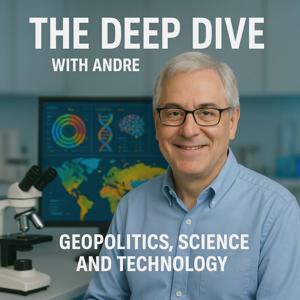
This podcast channel delivers in-depth, educational content across a broad range of topics. A large collection of episodes are available to you, the oldest being as relevant as the newest since this channel is not about daily news. Each episode runs between 30 and 120 minutes and is intentionally designed to go beyond casual listening. The research behind every episode is conducted with the support of advanced artificial intelligence and presented by two AI-generated hosts.
If you’re uncomfortable with the use of cutting-edge AI as both researcher and presenter, this podcast may not be for you. Its mission is to provide access to expert-level knowledge—insights that are typically out of reach through simple web searches or general-purpose AI tools.
“The Deep Dive with Andre” is not about connecting with the personality and voice of a human podcaster — it’s about connecting with expert-level knowledge, for those who value insight over persona. At times, the generated virtual hosts may exhibit an inappropriate voice tone, which can be disconcerting. The technology is still evolving.
Unlike traditional Text-to-Speech (TTS) services, the experimental AI powering the virtual hosts develops an independent understanding of the input information before generating speech. While the resulting voices do not match the quality of those produced by services like ElevenLabs, the AI’s ability to generate dynamic dialogues between two virtual hosts is a distinctive feature. Also, the cost of high-quality voiceovers would be astronomical, given the length of each episode (30 to 120 minutes). Quantity takes precedence over voice quality, given the vast knowledge conveyed by the episodes.
Note: When the hosts mention the “report,” “sources,” or “text,” they are unknowingly referring to the in-depth research and analysis generated by the first-stage AI. That output is then passed on to the second-stage AI, which handles the virtual hosts.
Disclaimer: This content is intended for educational purposes only and should not be construed as professional advice. It is derived exclusively from publicly available sources. No proprietary, confidential, or non-public information has been used in their preparation. However, through deep analytical synthesis, it is possible that some insights or conclusions presented here represent emergent interpretations that have not yet been formally published or broadly disseminated within the scientific and technological communities.
Please share your comments here:
https://the-deep-dive-with-andre.podbean.com
That would help improving this podcast show. Some podcast apps give direct access to the episode website.
Available on Amazon Music, Apple Podcasts, Audible, Castbox, Castro, Deezer, Goodpods, iHeartRadio, MyTuner, Overcast, Player FM, Pocket Casts, Podbean, Podcast Addict, Spotify, TuneIn Radio and others.

14,358 Listeners

5,520 Listeners

12,165 Listeners

4,168 Listeners

1,621 Listeners

19 Listeners

16,062 Listeners