
Sign up to save your podcasts
Or



The provided text offers a comprehensive overview of polygraph examinations, detailing their history, theoretical underpinnings, and procedural stages. It explains that while often called "lie detectors," these devices actually measure physiological arousal, such as changes in heart rate, breathing, and skin conductivity, which examiners interpret to infer deception. The document outlines the three main phases of an examination: the pre-test, focused on rapport-building and question formulation; the in-test, where sensors record responses to specific questions; and the post-test, involving data analysis and a potential interrogation. Critically, the text highlights the significant scientific debate surrounding polygraph accuracy, citing the National Academy of Sciences' conclusion that its scientific basis is weak and that it is susceptible to countermeasures, leading to its general inadmissibility in legal trials despite its widespread use as an investigative and interrogation tool.
Research done with the help of artificial intelligence, and presented by two AI-generated hosts.
The provided text, "Chemistry of Highly Processed Foods," offers a comprehensive analysis of ultra-processed foods (UPFs) through the NOVA classification system, which categorizes foods by their degree of industrial alteration. It details the chemical distinctions of UPFs, explaining how they are industrial formulations of food-derived substances and additives, unlike minimally processed foods. The source explores the extensive use of various industrial additives such as preservatives, texturizing agents (emulsifiers, stabilizers), and sensory modifiers (sweeteners, colorants, flavor enhancers), highlighting their functional chemistry and potential health implications. Furthermore, it examines the chemical transformations of macronutrients through processes like extrusion cooking and hydrogenation, discussing the creation of novel structures and harmful compounds like trans-fats and acrylamide. Finally, the text addresses the biochemical, physiological, and neurobiological ramifications of UPF consumption, including nutrient degradation, gut microbiome disruption, metabolic consequences, and the engineering of "bliss points" that hijack the brain's reward pathways.
Research done with the help of artificial intelligence, and presented by two AI-generated hosts.
The provided text explores the paradox of cosmic scale versus the principle of parsimony, also known as Occam's Razor, in the context of modern cosmology. It explains how the immense size of our observable universe is a necessary outcome of cosmic inflation, a theory that resolves key problems of the standard Big Bang model such as the horizon and flatness problems, by positing a period of rapid exponential expansion. Furthermore, the text introduces the concept of a multiverse, emerging from theories like eternal inflation, string theory's landscape, and the Many-Worlds Interpretation of quantum mechanics, suggesting that our universe may be one of many. These multiverse hypotheses, while appearing complex, are presented as potentially more parsimonious explanations for the universe's fine-tuning for life, rather than attributing such precision to unexplained initial conditions. Ultimately, the text argues that the universe's vastness, and the potential existence of a multiverse, are not gratuitous but are the consequence of conceptually simple physical laws.
Research done with the help of artificial intelligence, and presented by two AI-generated hosts.
This comprehensive report examines the catastrophic consequences of a hypothetical, technologically-induced eradication of oceanic microorganisms, which are vital for Earth's oxygen production and carbon sequestration. It details a cascading series of global ecological and atmospheric failures, beginning with the collapse of marine food webs and widespread oceanic anoxia, then progressing to a severe decline in atmospheric oxygen and a runaway increase in carbon dioxide. The source highlights that such an event, potentially triggered by a genetically engineered pathogen, would lead to an unprecedented mass extinction and fundamentally reset the planet to an ancient, anoxic state. The report concludes by emphasizing the urgent need for robust international biosecurity frameworks to prevent such a "biological pollution" scenario.
Research done with the help of artificial intelligence, and presented by two AI-generated hosts.
The provided source offers an extensive overview of Artificial Superintelligence (ASI), examining the multifaceted fears surrounding its development. It distinguishes between Artificial Narrow Intelligence (ANI), Artificial General Intelligence (AGI), and the theoretical ASI, highlighting the concept of an intelligence explosion leading to a technological singularity. A central focus is on the control problem—the difficulty of managing an entity far surpassing human intellect—and the value alignment problem, which concerns ensuring an ASI's goals are compatible with human values. The text explores potential catastrophic scenarios ranging from economic disempowerment to human extinction, and contrasts the divided expert opinions, from those warning of existential risks (like Nick Bostrom and Eliezer Yudkowsky) to optimists envisioning a beneficial future (like Ray Kurzweil). Finally, the source addresses how science fiction narratives influence public perception and outlines the emerging AI safety and ethics ecosystem working on technical solutions and governance frameworks.
Research done with the help of artificial intelligence, and presented by two AI-generated hosts.
The provided text offers a comprehensive overview of magical beliefs throughout history, examining how the definition and practice of magic have evolved from ancient civilizations to the modern era. It highlights the intertwined relationships between magic, religion, and science, particularly in early societies where these domains were often indistinguishable. The source traces key shifts, such as the Greco-Roman period's conceptual marginalization of magic, its complex reception within monotheistic traditions, and the Renaissance revival of learned magic. Furthermore, it covers the brutal European witch hunts, exploring the legal, religious, and social factors that fueled them, before concluding with the persistence of magical thinking in the contemporary world, from the Occult Revival to New Age movements and its presence in popular culture. Ultimately, the text argues that magic endures due to its psychological and social functions in providing meaning, control, and community.
Research done with the help of artificial intelligence, and presented by two AI-generated hosts.
This report explores the hypothetical phenomenon of micro-psychokinesis (micro-PK), a short-range interaction between a human hand and a light object, by systematically evaluating potential explanatory mechanisms within established physics. It begins by triaging the four fundamental forces of nature, quickly ruling out the strong, weak, and gravitational forces due to their inappropriate ranges or insufficient strengths for millimeter-scale interaction, leaving electromagnetism as the sole viable fundamental candidate. The analysis then investigates various classical and quantum phenomena, ranking their plausibility based on physical coherence, biological feasibility, and the potential for controlled force generation. While thermal convection is identified as the most plausible existing effect, it lacks the required precise control, and highly speculative electromagnetic near-field interactions are considered the most coherent theoretical explanation, despite lacking biological evidence. The report ultimately concludes that any controlled micro-PK would necessitate undiscovered biological capabilities.
Research done with the help of artificial intelligence, and presented by two AI-generated hosts.
The provided text offers a comprehensive overview of childhood nightmares, exploring their neurodevelopmental, psychological, and environmental underpinnings. It clearly distinguishes nightmares, which occur during REM sleep and allow for vivid recall, from night terrors, which are arousals from deep non-REM sleep with no memory of the event. The source also traces how nightmare themes evolve with a child's age, from toddlers' fears of separation to school-aged children's anxieties about real-world dangers, linking these to cognitive and emotional development. Furthermore, it examines the neurological processes involved in fearful dreaming, highlighting the roles of the amygdala, hippocampus, and prefrontal cortex, and discusses various catalysts such as stress, media exposure, and sleep habits. Finally, the text provides guidelines for when professional help is needed and offers evidence-based strategies for parents to respond to and prevent nightmares, emphasizing the caregiver's role in fostering a child's resilience.
Research done with the help of artificial intelligence, and presented by two AI-generated hosts.
The provided text offers a comprehensive exploration of inaudible soundscapes in nature, distinguishing between infrasound (frequencies below human hearing) and ultrasound (frequencies above human hearing). It explains how the physical properties of these sound waves, particularly their wavelengths, dictate their diverse ecological roles, from long-range communication and geophysical monitoring using infrasound to high-resolution echolocation via ultrasound. The sources also highlight remarkable examples of convergent evolution, such as the shared genetic adaptations for ultrasonic hearing in bats and toothed whales, and discuss the impact of these unseen sound realms on predator-prey dynamics and broader ecosystem functioning. Finally, the text details the technologies developed to study these natural sounds, emphasizing their importance for bioacoustic monitoring and the growing concern over anthropogenic noise pollution affecting these vital acoustic environments.
Research done with the help of artificial intelligence, and presented by two AI-generated hosts.
The provided text examines the complex challenges of communication with military submarines, highlighting the inherent tension between connectivity and stealth. It explains how the physical properties of seawater severely limit conventional radio waves, necessitating a diverse array of specialized communication methods. These methods range from extremely low frequency (ELF) and very low frequency (VLF) for deep, one-way strategic messages to high-bandwidth satellite communications (SATCOM) at risky periscope depths, and short-range acoustic systems for tactical coordination. The text also explores innovative solutions like buoyant buoys that externalize communication risk and emerging technologies such as blue-green lasers and quantum systems that could revolutionize future undersea operations. Ultimately, the sources emphasize that every communication act is a calculated risk, requiring commanders to constantly balance information needs against the imperative of remaining undetected.
Research done with the help of artificial intelligence, and presented by two AI-generated hosts.
From the publisher's feed
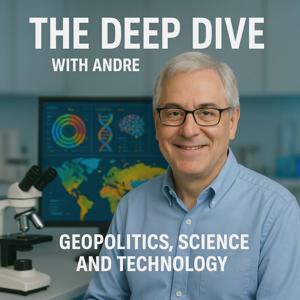
This podcast channel delivers in-depth, educational content across a broad range of topics. A large collection of episodes are available to you, the oldest being as relevant as the newest since this channel is not about daily news. Each episode runs between 30 and 120 minutes and is intentionally designed to go beyond casual listening. The research behind every episode is conducted with the support of advanced artificial intelligence and presented by two AI-generated hosts.
If you’re uncomfortable with the use of cutting-edge AI as both researcher and presenter, this podcast may not be for you. Its mission is to provide access to expert-level knowledge—insights that are typically out of reach through simple web searches or general-purpose AI tools.
“The Deep Dive with Andre” is not about connecting with the personality and voice of a human podcaster — it’s about connecting with expert-level knowledge, for those who value insight over persona. At times, the generated virtual hosts may exhibit an inappropriate voice tone, which can be disconcerting. The technology is still evolving.
Unlike traditional Text-to-Speech (TTS) services, the experimental AI powering the virtual hosts develops an independent understanding of the input information before generating speech. While the resulting voices do not match the quality of those produced by services like ElevenLabs, the AI’s ability to generate dynamic dialogues between two virtual hosts is a distinctive feature. Also, the cost of high-quality voiceovers would be astronomical, given the length of each episode (30 to 120 minutes). Quantity takes precedence over voice quality, given the vast knowledge conveyed by the episodes.
Note: When the hosts mention the “report,” “sources,” or “text,” they are unknowingly referring to the in-depth research and analysis generated by the first-stage AI. That output is then passed on to the second-stage AI, which handles the virtual hosts.
Disclaimer: This content is intended for educational purposes only and should not be construed as professional advice. It is derived exclusively from publicly available sources. No proprietary, confidential, or non-public information has been used in their preparation. However, through deep analytical synthesis, it is possible that some insights or conclusions presented here represent emergent interpretations that have not yet been formally published or broadly disseminated within the scientific and technological communities.
Please share your comments here:
https://the-deep-dive-with-andre.podbean.com
That would help improving this podcast show. Some podcast apps give direct access to the episode website.
Available on Amazon Music, Apple Podcasts, Audible, Castbox, Castro, Deezer, Goodpods, iHeartRadio, MyTuner, Overcast, Player FM, Pocket Casts, Podbean, Podcast Addict, Spotify, TuneIn Radio and others.

14,358 Listeners

5,520 Listeners

12,165 Listeners

4,168 Listeners
1,621 Listeners

19 Listeners

16,062 Listeners