
Sign up to save your podcasts
Or



Based on Podcast App listening data
The war in Ukraine is a humanitarian crisis. It is also an economic problem. Sanctions from the US and Europe are meant to make war too expensive for Russia to continue. President Vladimir Putin claims those sanctions have failed and his economy is strong. But what is propaganda and what is reality? Today on the show, host Martin Sandbu poses these questions to Sergei Guriev, dean of the London Business School, and an economic adviser to Russian opposition figures, as they try to figure out what is really going on in Russia’s economy.
Martin Sandbu is a columnist for the Financial Times, and writes the Free Lunch newsletter. You can find it here: https://www.ft.com/free-lunch.
Subscribe to Soumaya's show on Apple, Spotify, Pocket Casts or wherever you listen.
Read a transcript of this episode on FT.com
Hosted on Acast. See acast.com/privacy for more information.
Productivity growth in the developed world has been on a downward trend since the 1960s. Meanwhile, gains in life expectancy have also slowed. And yet the number of dollars and researchers dedicated to R&D grows every year. In today’s episode, the FT’s Chief Data Reporter, John Burn-Murdoch, asks whether western culture has lost its previous focus on human progress and become too risk-averse, or whether the problem is simply that the low-hanging fruit of scientific research has already been plucked. He does so in conversation with innovation economist Matt Clancy, who is the author of the New Things Under the Sun blog, and a research fellow at Open Philanthropy, a non-profit foundation based in San Francisco that provides research grants.
John Burn-Murdoch writes a column each week for the Financial Times. You can find it here
Subscribe on Apple, Spotify, Pocket Casts or wherever you listen.
Presented by John Burn-Murdoch. Produced by Edith Rousselot. The editor is Bryant Urstadt. Manuela Saragosa is the executive producer. Audio mix and original music by Breen Turner. The FT’s head of audio is Cheryl Brumley.
Read a transcript of this episode on FT.com
Hosted on Acast. See acast.com/privacy for more information.
Tariffs have historically been an important tool of industrial policy. They were used in the last century by east Asian nations to promote infant industries, and are being used today by the EU to help spur the energy transition. But do Donald Trump’s threats to impose a 25% across-the-board tariff on imports from Canada and Mexico, or his actual 10% tax rise on all imports from China, have any kind of thought-out policy rationale behind them? And should other countries respond in kind?
To find out, the FT’s European economics commentator Martin Sandbu speaks to Dani Rodrik, professor of international political economy at Harvard. Rodrik is one of the world’s most acclaimed experts on industrial policy, and someone Martin first got to know as a PhD student in the 1990s.
Martin Sandbu writes a regular column for the Financial Times. You can find it here
Subscribe on Apple, Spotify, Pocket Casts or wherever you listen.
Presented by Martin Sandbu. Produced by Laurence Knight and Edith Rousselot. Manuela Saragosa is the executive producer. Audio mix and original music by Breen Turner. The FT’s head of audio is Cheryl Brumley.
Read a transcript of this episode on FT.com
Hosted on Acast. See acast.com/privacy for more information.
In an interview recorded before President Trump hit China, Mexico and Canada with steep tariffs that disrupt the global trading system, Ngozi Okonjo-Iweala, the director-general of the World Trade Organisation, speaks to the FT’s Senior Trade Writer, Alan Beattie, and defends her record and the WTO’s achievements. She outlines how she hopes to engage with the new US administration and how globalisation has been remarkably resilient despite shocks such as the Covid-19 pandemic and the rise of US protectionism in Trump's first term and under former president Joe Biden.
Alan writes the Trade Secrets newsletter. You can sign up here. He is on Bluesky at @alanbeattie.bsky.social.
Subscribe on Apple, Spotify, Pocket Casts or wherever you listen.
Presented by Alan Beattie. Produced by Laurence Knight. The editor is Bryant Urstadt. Manuela Saragosa is the executive producer. Audio mix and original music by Breen Turner. The FT’s head of audio is Cheryl Brumley.
Read a transcript of this episode on FT.com
Hosted on Acast. See acast.com/privacy for more information.
India is the world’s most populous nation, and since the 1990s it has maintained almost Chinese levels of rapid economic growth. Prime Minister Narendra Modi aims to make India a high income country and, by implication, an economic superpower by 2047. But is that achievable? This week’s guest, Arvind Subramanian, is a former chief economic adviser to Modi’s government. He is sceptical that the necessary growth rate can be sustained. Instead, he tells Martin Wolf how he thinks the government has scared off the necessary business investment, and how a serious miscalculation by the country’s central bank may be about to plunge India into a currency crisis.
Martin Wolf is chief economics commentator at the Financial Times. You can find his column here
Subscribe to The Economics Show on Apple, Spotify, Pocket Casts or wherever you listen.
Read a transcript of this episode on FT.com
Hosted on Acast. See acast.com/privacy for more information.
Sam Fleming is the FT’s Economics Editor, and this week he is reporting from the World Economic Forum at Davos, where much of the talk is about protectionism and industrial policy. Today on the show, Sam speaks to Beata Javorcik, the chief economist of the European Bank for Reconstruction and Development. They discuss the history of industrial policy -- and what it takes to get it right.
Subscribe to The Economics show on Apple, Spotify, Pocket Casts or wherever you listen.
Read a transcript of this episode on FT.com
Hosted on Acast. See acast.com/privacy for more information.
Doug Irwin is a professor at Dartmouth College and the author of several books on trade. Today on The Economics Show, he joins the FT’s Senior Trade Writer Alan Beattie to discuss the history of tariffs in the US, and what that history might tell us about the next round of tariffs.
Alan writes the Trade Secrets newsletter. You can sign up here. He is on Bluesky at @alanbeattie.bsky.social.
Subscribe on Apple, Spotify, Pocket Casts or wherever you listen.
Read a transcript of this episode on FT.com
Hosted on Acast. See acast.com/privacy for more information.
Increasingly elderly populations seen in countries such as Japan and Italy are set to become the norm everywhere in the coming decades. But will a more senior demographic make the cost of state pensions and healthcare unaffordable? And will it kill economic growth? Not necessarily so, according to today’s guest, Andrew J Scott, director of economics at the Ellison Institute of Technology Oxford. He believes that the rapidly growing cohort of over-65s is something to celebrate. But he also warns that we need to radically rethink many of the policies that delivered this widespread longevity in the first place.
Martin Wolf is chief economics commentator at the Financial Times. You can find his column here
Subscribe to The Economics Show on Apple, Spotify, Pocket Casts or wherever you listen.
Read a transcript of this episode on FT.com
Hosted on Acast. See acast.com/privacy for more information.
In 1962, then US president John F Kennedy committed his nation to reaching the Moon before the decade was up. It was a huge undertaking, but one that ultimately succeeded, and also produced technologies such as camera phones and baby formula along the way. But have governments today lost the confidence and knowhow needed to undertake such ambitious challenges? That’s the contention of today’s guest, Mariana Mazzucato, professor in the economics of innovation and public value at University College London. She believes states need to rediscover mission-purpose and take the lead in solving problems such as climate change, pandemics or water scarcity.
Martin Wolf is chief economics commentator at the Financial Times. You can find his column here
Subscribe to The Economics Show on Apple, Spotify, Pocket Casts or wherever you listen.
Read a transcript of this episode on FT.com
Hosted on Acast. See acast.com/privacy for more information.
The Eurozone’s economic recovery from Covid-19 has been anaemic compared with America’s, despite achieving a soft landing from double-digit inflation. Indeed, Europe’s relative underperformance stretches back even longer, perhaps 30 years, in terms of productivity and GDP growth. Christine Lagarde, president of the European Central Bank, gives her assessment of the past few turbulent years of monetary policy and explains what she thinks Europe needs to do next if it is to close the gap with the US. She also gives her view on how the EU can negotiate its way out from between the rock of the incoming Trump administration and the hard place of another Chinese export glut.
Martin Wolf is chief economics commentator at the Financial Times. You can find his column here
Subscribe to The Economics Show on Apple, Spotify, Pocket Casts or wherever you listen.
Read a transcript of this episode on FT.com
Hosted on Acast. See acast.com/privacy for more information.
From the publisher's feed
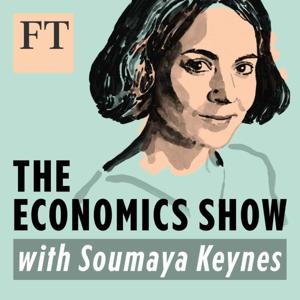
The Economics Show with Soumaya Keynes is a new weekly podcast from the Financial Times packed full of smart, digestible analysis and incisive conversation. Soumaya Keynes digs deep into the…
Soumaya Keynes is an economics columnist for the Financial Times. Prior to joining the FT she worked at The Economist for eight years as a staff writer, where as well as covering trade, the US economy and the UK economy she co-hosted the Money Talks podcast. She also co-founded the Trade Talks podcast.
Hosted on Acast. See acast.com/privacy for more information.
Ranked by our users in the last 21 days

4,104 Listeners

923 Listeners

285 Listeners

54 Listeners
351 Listeners
153 Listeners

99 Listeners

198 Listeners

638 Listeners

222 Listeners

2,545 Listeners
1,066 Listeners
136 Listeners
38 Listeners

85 Listeners

139 Listeners

194 Listeners

7 Listeners
18 Listeners