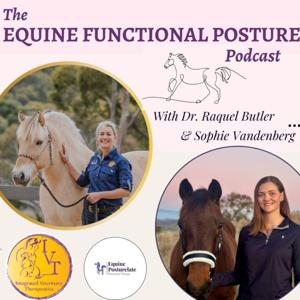
The Equine Functional Posture Podcast

The Equine Functional Posture Podcast

By Dr. Raquel Butler & Sophie VandenbergHealth & FitnessEducationKids & FamilyPets & Animals
Download on the App Store

The Equine Functional Posture Podcast episodes

  • Episode 100: Degenerative Suspensory Ligament Desmitis... Or Something Else?

    A dropped fetlock is often associated with Degenerative Suspensory Ligament Desmitis (DSLD), but does a sinking fetlock always indicate this degenerative disease?

    Today we explore the current research around DSLD, discuss where the evidence is strong, where it remains uncertain, and why whole-body posture and loading may be an important part of the picture.

    We discuss

    • Suspensory ligament, pelvic and spinal function influences on distal limb loading
    • Diagnostic limitations, training surfaces, hoof balance and inflammation
    • Practical ways to support a horse who has sinking fetlocks
    • A key question throughout the episode: are we sometimes diagnosing a degenerative ligament disorder when we are actually seeing the consequences of chronic postural dysfunction and inappropriate loading?

      To learn more about Dr Raquel Butler visit:

      Facebook: Integrated Veterinary Therapeutics
      Website: https://www.integratedvettherapeutics.com.au

      To learn more about Sophie Vandenberg:

      Facebook: Equine Posturelate – Sophie Vandenberg

      Have any questions or topics you’d love us to cover?

      Email us at: [email protected]

      54 min
    • Episode 99: Growth Plates: More than just an age - Part 2: Loading vs Overloading

      When should we start riding a young horse?

      There are strong opinions at both ends of the spectrum: start them young so the body adapts to load, or wait until the growth plates have closed before riding. In Part 2 of our growth plate series, we look at why the answer is much more individual than simply choosing an age.

      We discuss the difference between loading and overloading, and why skeletal maturity alone doesn’t necessarily mean a horse is physically prepared to carry a rider.

      In this episode we explore:

      • How young horses can be conditioned before they are ridden
      • Straight lines, proprioceptive exercises, transitions and varied surfaces
      • Building core strength, joint stability and body awareness
      • Recognising fatigue and changes in posture under load
      • Why recovery time matters as bone adapts to exercise
      • The importance of hoof care, saddle fit, bodywork and the horse’s environment
      • Exercises and loading patterns to be cautious with during growth
      •  

        To learn more about Dr Raquel Butler visit:

        Facebook: Integrated Veterinary Therapeutics
        Website: https://www.integratedvettherapeutics.com.au

        To learn more about Sophie Vandenberg:

        Facebook: Equine Posturelate – Sophie Vandenberg

        Have any questions or topics you’d love us to cover?

        Email us at: [email protected]

        53 min
      • Episode 98: Growth Plates: More Than Just an Age – Part 1: Understanding the Growing Horse

        Growth plates are central to skeletal development, but there is much more to them than simply knowing when they “close”.

        Today we are explaining what growth plates are, how bones grow, and the factors that influence healthy development.

        We discuss:

        • When different parts of the equine skeleton mature
        • What “open” and “closed” growth plates really mean
        • Nutrition, growth rate and developmental orthopaedic diseases
        • The importance of hoof balance, appropriate loading and posture
        • How bone continues to remodel after growth plates close
        • In Part 2, we’ll apply this information specifically to starting and training horses.

          To learn more about Dr Raquel Butler visit:

          Facebook: Integrated Veterinary Therapeutics
          Website: https://www.integratedvettherapeutics.com.au

          To learn more about Sophie Vandenberg:

          Facebook: Equine Posturelate – Sophie Vandenberg

          Have any questions or topics you’d love us to cover?

          Email us at: [email protected]

          42 min
        • Episode 97: Transitioning horses to barefoot - GUEST Annette Kaitinis

           Transitioning a horse from metal shoes to barefoot can be incredibly rewarding, but it is rarely as simple as removing the shoes and hoping for the best.

          Guest  Annette Kaitinis, co-founder of Scoot Boot, joins us to discuss what makes for a successful transition, and how she believes nearly all horses can have a comfortable booted or barefoot lifestyle with enough patience and a well-planned management approach. 

          Together, they discuss:

          • Where to begin when considering a barefoot transition
          • Why the condition of the hoof can influence how long the process takes
          • The importance of working with a qualified barefoot professional
          • How nutrition, movement, terrain and trimming cycles affect hoof health
          • Why some horses require boots or additional cushioning throughout the transition
          • Common hoof boot fitting mistakes and how fit can change during a trimming cycle
          • How hoof comfort can influence stride length, posture and tension throughout the body
          • Whether hoof boots can provide suitable long-term protection
          • How Scoot Boot’s sizing app and fitting support can help owners select the right boot
          • This conversation is a practical reminder that successful barefoot management is not about leaving a horse unprotected. It is about providing the trimming, nutrition, movement, environment and protection the individual horse needs to remain comfortable and functional.


            To learn more about Dr Raquel Butler visit:

            Facebook: Integrated Veterinary Therapeutics
            Website: https://www.integratedvettherapeutics.com.au

            To learn more about Sophie Vandenberg:

            Facebook: Equine Posturelate – Sophie Vandenberg

            Have any questions or topics you’d love us to cover?

            Email us at: [email protected]

            57 min
          • Episode 96: ECVM Guest & Horse Owner Kate Schreiber

            Bronson was a striking and successful performance horse, but behind his appearance and achievements was a long history of unusual behaviour, sensory changes, recurring injuries and physical challenges that escalated over 10 years. In this episode, we speak with Bronson’s dedicated owner, Kate Schreiber, about his Grade 4 ECVM diagnosis and recent dissection. Kate shares Bronson's story and his legacy of ECVM awareness and advocacy for horses everywhere. 

            We discuss:

            • Aggression, bolting and difficulty interacting within a herd
            • Persistent ulcers that remained despite extensive management
            • Unusual reactions to grooming, needles, hosing, rugging
            • The rehab, farriery and management strategies that appeared to support him
            • The difficulty Kate faced when pursuing an ECVM diagnosis
            • Knowing when to keep encouraging a horse and when it is time to stop
            • Bronson’s story is also an important reminder: you know your horse’s normal, their quirks and the small changes that others may not see. Those observations matter, and your advocacy makes a difference for your horse. 

              To learn more about Dr Raquel Butler visit:

              Facebook: Integrated Veterinary Therapeutics
              Website: https://www.integratedvettherapeutics.com.au

              To learn more about Sophie Vandenberg:

              Facebook: Equine Posturelate – Sophie Vandenberg

              Have any questions or topics you’d love us to cover?

              Email us at: [email protected]

              1 hr 6 min
            • Episode 95: ECVM: What does it mean for our horses?

              ECVM: What does it mean for our horses?

              Equine Complex Vertebral Malformation, or ECVM, is a congenital variation in the vertebrae at the base of the horse’s neck. While some affected horses may show few obvious signs, others can experience changes in stability, limb awareness, movement and behaviour that have serious implications for both horse and rider safety - this often correlates to whether the malformation is on one side of the neck, both sides of the neck or other structres such as the first rib are also malformed.

              In this interview style episode, Sophie asks Dr Raquel Butler to explain:

              • What ECVM is and how it can affect the surrounding muscles, nerves and blood vessels
              • How ECVM is currently diagnosed and why specific radiographic views are needed
              • Subtle signs such as stumbling, unusual limb placement, asymmetrical movement and unexplained paddock accidents
              • More advanced signs, including unpredictable behaviour, loss of body awareness and sudden episodes of flight
              • What a diagnosis may mean for riding, training, competition, breeding and long-term management
              • How postural strength, proprioception and careful observation may help support affected horses
              • This is a complex and sometimes confronting subject, but awareness gives owners, riders and professionals a better chance of recognising when something does not feel right, investigating further and making informed decisions for both the horse and the people around them.

                To learn more about Dr Raquel Butler visit:

                Facebook: Integrated Veterinary Therapeutics
                Website: https://www.integratedvettherapeutics.com.au

                To learn more about Sophie Vandenberg:

                Facebook: Equine Posturelate – Sophie Vandenberg

                Have any questions or topics you’d love us to cover?

                Email us at: [email protected]

                34 min
              • Episode 94: Assessing Postural Muscles: Controlled or Compensating?

                Assessing Postural Muscles: Controlled or Compensating?

                Today we’re talking about how to recognise whether your horse is developing true postural control through the spine. Deep spinal muscles can be difficult to assess directly, but we can begin to understand how well they are functioning by observing our horse's movement.

                In this episode, we explore:

                • Why postural control is often the limiting factor in all kinds of training
                • How balance and stability show up in small everyday movements
                • What limb placement and weight shifting can tell us
                • How you can watch and understand spinal control in deceleration and upward transitions
                • How watching paddock postures can reveal whether training is improving everyday function
                • Signs of spinal muscle fatigue; including brace and reduced co-orination
                • Why functional spinal motion needs to come before more advanced exercises
                •  

                  To learn more about Dr Raquel Butler visit:

                  Facebook: Integrated Veterinary Therapeutics
                  Website: https://www.integratedvettherapeutics.com.au

                  To learn more about Sophie Vandenberg:

                  Facebook: Equine Posturelate – Sophie Vandenberg

                  Have any questions or topics you’d love us to cover?

                  Email us at: [email protected]

                  50 min
                • Episode 93: The Nuchal Ligament

                  The Nuchal Ligament - Could you describe it's function?

                  Today we’re unpacking the nuchal ligament: what it does, how it works, and why it is often misunderstood for it's role in body mechanics. We also share insights from dissections about where issues can occur and how ribcage position is paramount!

                  The nuchal ligament is a passive recoil support system that helps reduce the effort required to move and support the head and neck -which can be up to 90kg combined weight! But it does not actively lift the horse’s neck or back. That job still belongs to the muscles, thoracic sling, abdominals and deeper stabilising systems.

                  In this episode, we explore:

                  • The anatomy and function of the nuchal ligament
                  • Why it acts as an energy-saving recoil system, not a “head holder”
                  • Signs the nuchal ligament system may be under strain or dysfunctional
                  • What we see clinically and in dissections
                  • How better posture, bodywork, saddle fit, feeding positions and training choices can support healthier function
                  • To learn more about Dr Raquel Butler visit:

                    Facebook: Integrated Veterinary Therapeutics
                    Website: https://www.integratedvettherapeutics.com.au

                    To learn more about Sophie Vandenberg:

                    Facebook: Equine Posturelate – Sophie Vandenberg

                    Have any questions or topics you’d love us to cover?

                    Email us at: [email protected]

                    49 min
                  • Episode 92: Un-Bridled Conversations- Horse Wellbeing and Biomechanics

                    Un-Bridled Conversations- Horse Wellbeing and Biomechanics 

                    In this episode, we explore bridleless and bitless riding as more than just an impressive training goal. We discuss what changes when the horse is no longer connected through the mouth, and how this can reveal important information about posture, balance, expression and comfort.

                    We reflect on recent bridleless competition footage, the positive reception it received, and what it showed us about collection, jumping technique, stride regularity and self-carriage without relying on the bit.

                    In this episode, we unpack:

                    • Why bitless and bridleless riding deserve a place as valid riding and competition options
                    • What a horse’s expression can tell us about comfort, pressure and conflict
                    • How the head, neck and mouth can influence stride length, rhythm and hind-end function
                    • Why bridleless riding still needs thoughtful, peaceful training foundations
                    • How removing the bridle can reveal a horse’s true neutral posture
                    • Anatomical considerations when using neck ropes or bridle-less aids. 
                    • To learn more about Dr Raquel Butler visit:

                      Facebook: Integrated Veterinary Therapeutics
                      Website: https://www.integratedvettherapeutics.com.au

                      To learn more about Sophie Vandenberg:

                      Facebook: Equine Posturelate – Sophie Vandenberg

                      Have any questions or topics you’d love us to cover?

                      Email us at: [email protected]

                      40 min
                    • Episode 91: Who's responsibility is your horse's posture?

                      Master the essential, proven, science-based tools to understand posture, movement and behaviour from the inside out - so you can create real, lasting change without overwhelm, pressure or confusion. 

                      Enrol now and transform how you support your horse’s body, balance and wellbeing: Equine Functional Posture Course 


                      WHO's responsibility is your horse's posture?

                      Your horse’s posture is not something that can be fully outsourced. While your vet, bodyworker, trainer, hoof care provider and saddle fitter all play important roles, the daily observations and small consistent inputs from the owner are often what create lasting change.

                      In this episode, we unpack:

                      • Why the horse owner’s role is irreplaceable in postural change
                      • How behaviour, posture and movement are forms of communication
                      • What parts of your horse’s progress cannot be outsourced
                      • Why bodywork creates opportunity, but the owner helps maintain change
                      • How daily exercises, warm-ups and observations support the “positive posture bank”
                      • How the Equine Functional Posture Course helps owners recognise, support and advocate for their horse
                      •  

                        To learn more about Dr Raquel Butler visit:

                        Facebook: Integrated Veterinary Therapeutics
                        Website: https://www.integratedvettherapeutics.com.au

                        To learn more about Sophie Vandenberg:

                        Facebook: Equine Posturelate – Sophie Vandenberg

                        Have any questions or topics you’d love us to cover?

                        Email us at: [email protected]

                        41 min

                      About The Equine Functional Posture Podcast

                      From the publisher's feed

                      This podcast is created by Dr. Raquel Butler from Integrated Veterinary Therapeutics and Sophie Vandenberg from Equine Posturelate. Dr. Raquel is a Biomechanical Medicine Veterinarian and Educator. Sophie is an Equine Science graduate and has studied Equine Osteopathy. This podcast is your ultimate source for insights into the influences of functional posture on biomechanics, health and overall well-being of horses . Tune in each week as we discuss practical tips, delve into expert interviews and explore the latest research in the impact of static and dynamic posture on your horse journey.

                      More shows like The Equine Functional Posture Podcast

                      Conversations by ABC Australia

                      Conversations

                      813 Listeners

                      The Diary Of A CEO with Steven Bartlett by DOAC

                      The Diary Of A CEO with Steven Bartlett

                      8,319 Listeners

                      The Horse First: A Veterinary Sport Horse Podcast by Audrey DeClue, DVM

                      The Horse First: A Veterinary Sport Horse Podcast

                      210 Listeners

                      The Humble Hoof by Alicia Harlov

                      The Humble Hoof

                      130 Listeners

                      The Journey On Podcast by Warwick Schiller

                      The Journey On Podcast

                      25 Listeners

                      Horse Training in Harmony by Karen Rohlf

                      Horse Training in Harmony

                      214 Listeners

                      Equine Energy Medicine by Audrey Mclaughlin

                      Equine Energy Medicine

                      30 Listeners

                      The Mel Robbins Podcast by Mel Robbins

                      The Mel Robbins Podcast

                      18,833 Listeners

                      The Rest Is Politics: US by Goalhanger

                      The Rest Is Politics: US

                      2,305 Listeners

                      The NOËLLE FLOYD Podcast by NOËLLE FLOYD

                      The NOËLLE FLOYD Podcast

                      49 Listeners