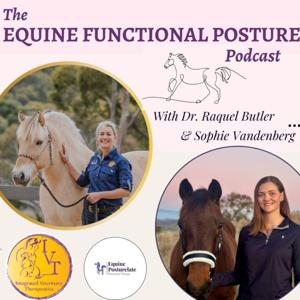
The Equine Functional Posture Podcast

The Equine Functional Posture Podcast

By Dr. Raquel Butler & Sophie VandenbergHealth & FitnessEducationKids & FamilyPets & Animals
Download on the App Store

The Equine Functional Posture Podcast episodes

  • Episode 90: Activations: Waking Up Better Movement

    Master the essential, proven, science-based tools to understand posture, movement and behaviour from the inside out - so you can create real, lasting change without overwhelm, pressure or confusion. 

    Enrol now and transform how you support your horse’s body, balance and wellbeing: Equine Functional Posture Course 


    Activations: Waking Up Better Movement

    Activations are one of the ways we can help prepare the horse’s body for better posture, stability and movement. They are not just exercises to “switch muscles on”, but a way to improve awareness, motor control and the quality of muscle recruitment before and during work.

    In this episode, we unpack:

    • What activations are and why they matter in postural rehabilitation
    • How we carry out activations with specificity to target specific muscles
    • How activations prime nerves and muscles for co-ordination and balance
    • The difference between true activation and bracing
    • Why rest, release and time under tension are so important
    • Examples of activations including tail shifts, belly lifts and carrot stretches
    • How activations fit into the bigger picture of assessment, exercise and reassessment
    •  

      To learn more about Dr Raquel Butler visit:

      Facebook: Integrated Veterinary Therapeutics
      Website: https://www.integratedvettherapeutics.com.au

      To learn more about Sophie Vandenberg:

      Facebook: Equine Posturelate – Sophie Vandenberg

      Have any questions or topics you’d love us to cover?

      Email us at: [email protected]

      58 min
    • Episode 89: Collaborative Rehab; Conversations With Your Veterinarian

      Discover The Hidden Physical Issues Behind 5 Common “Behavioural” Problems And How To Solve Them - Without More Pressure, Treatments Or Training Techniques  

      Register for my FREE Online Masterclass - Sunday June 14th  https://www.integratedvettherapeutics.com/registrationpbmc  

      Collaborative Rehab; Conversations with Your Veterinarian!

      Today we are empowering you with the skills to create better conversations with your vet around rehabilitation, especially once a diagnosis has been made. We explore why a rest alone is not the same as rehab, how controlled loading and functional posture can support healing, and how owners can respectfully advocate for a more collaborative recovery plan.

      In this episode, we explore

      • Questions you can ask your vet to guide the rehab conversation respectfully 
      • How being proactive and taking responsibility as an owner allows your vet to help you the best they can
      • How rest can reduce strength, stability and core function
      • Why rehabilitation is about more than just walking the horse
      • What therapeutic tools, exercises and knowledge you can access to have an excellent recovery journey
      • When it may be appropriate to seek a second opinion or a vet with rehab experience
      •  

        To learn more about Dr Raquel Butler visit:

        Facebook: Integrated Veterinary Therapeutics
        Website: https://www.integratedvettherapeutics.com.au

        To learn more about Sophie Vandenberg:

        Facebook: Equine Posturelate – Sophie Vandenberg

        Have any questions or topics you’d love us to cover?

        Email us at: [email protected]

        44 min
      • Episode 88: Healthy Head and Neck Posture

         Healthy Head and Neck Posture

        Head and neck position alone does not create self-carriage, collection, or correct biomechanics. Today we are discussing how the poll, jaw, neck muscles, cranial nerves, hyoid, nuchal ligament, back, and pelvis can all be affected when the head and neck are held in position rather than responding freely to whole-body posture.

        In this episode, we unpack:

        • Why head position should be the result of whole-body organisation
        • How thoracic sling, core, and hindlimb engagement support healthy flexion
        • What can happen through the jaw, poll, throat latch, and upper neck when flexion is manufactured
        • Why tension through the nuchal ligament can affect the back, neck, and hind end
        • How fatigue can show up as heaviness, bracing, rushing, or loss of adjustability
        • What owners can look for before, during, and after work
        • Healthy head and neck posture is not about holding the horse in a shape. It is about supporting the body so the head and neck can become soft, adjustable, and free. 

          To learn more about Dr Raquel Butler visit:

          Facebook: Integrated Veterinary Therapeutics
          Website: https://www.integratedvettherapeutics.com.au

          To learn more about Sophie Vandenberg:

          Facebook: Equine Posturelate – Sophie Vandenberg

          Have any questions or topics you’d love us to cover?

          Email us at: [email protected]

          37 min
        • Episode 87: Brain Breaks - The Pause Matters!

          What if the most valuable part of your training session is not the exercise itself, but the pause that follows it?

          In this episode, we explore why brain breaks are such an important part of training, learning, emotional regulation, and postural change. A pause is never wasted time; it is the moment where the horse processes, integrates, softens, reorganises. You also have the opportunity to slow down and be present. 

          In this episode, we unpack:

          • What a brain break can look like during groundwork, ridden work, or rehabilitation
          • Why pauses help support nervous system regulation and learning
          • The physical signs that a horse is processing and softening
          • How fatigue, tension, and repetition can lead to bracing and compensation
          • Why brain breaks can build confidence, curiosity, and emotional safety
          • How to recognise when your horse needs more time, not more pressure
          • To learn more about Dr Raquel Butler visit:

            Facebook: Integrated Veterinary Therapeutics
            Website: https://www.integratedvettherapeutics.com.au

            To learn more about Sophie Vandenberg:

            Facebook: Equine Posturelate – Sophie Vandenberg

            Have any questions or topics you’d love us to cover?

            Email us at: [email protected]

            51 min
          • Episode 86: Abdominal Muscle Injuries

            Do you know how to recognise an abdominal muscle injury??

            The horse’s abdominals are one of the most important support systems in the body. In this episode, we explore the anatomy and function of the abdominal muscles, how abdominal injuries can occur, and why these injuries are so commonly missed. We also discuss how abdominal dysfunction can influence posture, spinal stability, thoracic sling function, pelvic mechanics, and movement quality throughout the entire body.

            In this episode, we unpack:

            • The role of the abdominal muscles in spinal support, posture, breathing, urination, defecation, and movement
            • The four abdominal muscles and how their different fibre directions help stabilize and coordinate the body
            • Common causes of abdominal injuries, including slips, falls, getting caught in fences, mud, float injuries, kicks, and compensation patterns
            • Why abdominal injuries often do not present as obvious lameness, making them easy to overlook
            • Signs of abdominal dysfunction, including shortened stride length, difficulty cantering, poor back lift, altered posture, instability, and difficulty picking up limbs for the farrier
            • How abdominal injuries can influence the thoracic sling, pelvis, lumbar spine, multifidi, and whole-body biomechanics
            • Why rehabilitation must focus on restoring whole-body function rather than just treating one isolated area
            • This episode highlights how interconnected the horse’s body truly is and why understanding abdominal function can completely change the way you assess posture, movement, performance, and rehabilitation. It also reinforces the importance of observation, palpation, and recognising subtle compensations before they develop into larger problems.

              To learn more about Dr Raquel Butler visit:

              Facebook: Integrated Veterinary Therapeutics
              Website: https://www.integratedvettherapeutics.com.au

              To learn more about Sophie Vandenberg:

              Facebook: Equine Posturelate – Sophie Vandenberg

              Have any questions or topics you’d love us to cover?

              Email us at: [email protected]

              45 min
            • Episode 85: Your Horse's Back - Pre and Post Work Checks

              Do you know how to observe your horse's back to know whether the work you do is improving or detracting from your horse's back health? 

              Your horse’s back can give valuable clues about how they are coping with work, carrying a rider, and managing tension or fatigue through the body. This episode is about creating simple, purposeful checks you can use before and after riding. We also discuss causeso f back discomfort - so that if anything goes awry you can begin a process of elimination!

              In this episode, we unpack:

              • Why the back can act as a window into whole-body function and compensation
              • What to observe : we cover shape, comfort, texture/tone, function
              • How back tension may relate to saddle fit, rider function, workload, fatigue, limb discomfort, or hoof balance
              • Why knowing what is normal for your horse can help you pick up small changes earlier
              • This episode is a practical guide to making your pre and post work observations more intentional, so you can recognise change earlier and have more useful conversations with the professionals supporting your horse.

                To learn more about Dr Raquel Butler visit:

                Facebook: Integrated Veterinary Therapeutics
                Website: https://www.integratedvettherapeutics.com 

                To learn more about Sophie Vandenberg:

                Facebook: Equine Posturelate – Sophie Vandenberg

                Have any questions or topics you’d love us to cover?

                Email us at: [email protected]  


                37 min
              • Episode 84: 3 Key Paddock Posture Observations

                What does your horses paddock posture reveal?

                What if you could learn more about your horse’s posture, comfort, and biomechanics just by watching them in the paddock? Your horse spends the majority of their time in their paddock or living arrangement, and observing how they are loading through their body in these spaces is important information.

                In this episode, we unpack:

                • What grazing posture can reveal about balance, stability, and compensation
                • How hard feed posture may show tension, offloading, or discomfort
                • Why urination and defecation positions can give clues about the pelvis, lumbar spine, stifles, abdominals, and tail
                • What balanced, effortless paddock posture should look like
                •  

                  To learn more about Dr Raquel Butler visit:

                  Facebook: Integrated Veterinary Therapeutics
                  Website: https://www.integratedvettherapeutics.com 

                  To learn more about Sophie Vandenberg:

                  Facebook: Equine Posturelate – Sophie Vandenberg

                  Have any questions or topics you’d love us to cover?

                  Email us at: [email protected]  


                  36 min
                • Episode 83: Rope Walking (Listener Request)

                  Rope Walking and What It Reveals About Your Horse’s Body

                  Rope Walking in horses (walking as if on a tightrope) is more than just an unusual gait, it’s a clue that something deeper is going on within the body. We break down why alignment should be balanced rather than narrow, and why this change in movement and loading can indicate instability, compensation, or pain. 

                  We draw on real clinical cases and practical experience and guide you through the most common causes, how to assess your horse, and simple strategies to begin improving movement, stability, and comfort.

                  In this episode, we unpack

                  • What ropewalking vs correct limb alignment should look like during movement and standing
                  • Common causes in the forelimbs, including pectoral injury, shoulder instability, saddle or girth discomfort, and neurological issues
                  • Common contributors in the hindlimbs, including groin tension, abdominal weakness, pelvic dysfunction, and lumbar discomfort
                  • Why downhill surfaces can highlight instability and make rope walking more obvious
                  • When to consider neurological involvement and seek veterinary assessment
                  • Practical ways to assess your horse, and rehabilitation strategies that gently recalibrate the system
                  • This is an important conversation for horse owners because rope walking is not a training issue and therefore training is not a primary solution - rather a structural and postural one! 

                    To learn more about Dr Raquel Butler visit:

                    Facebook: Integrated Veterinary Therapeutics
                    Website: https://www.integratedvettherapeutics.com 

                    To learn more about Sophie Vandenberg:

                    Facebook: Equine Posturelate – Sophie Vandenberg

                    Have any questions or topics you’d love us to cover?

                    Email us at: [email protected]  


                    31 min
                  • Episode 82: Sleep Deprivation and Posture

                    Sleep Deprivation and Posture

                    Sleep deprivation in horses is a serious welfare issue, and one that can easily be missed or mistaken for something else. In this episode, we unpack what normal sleep looks like in the horse, why REM sleep matters so much, and some of the reasons a horse may not be getting the rest they need.

                    We talk through the difference between standing rest, laying sleep, and REM sleep, and why the ability to comfortably get down to the ground and back up again matters more than many people realise. We also explore how pain, physical dysfunction, group housing dynamics, space, footing, and environmental stress can all influence whether a horse feels safe and able to sleep properly.

                    In this episode, we unpack:

                    • What normal sleep patterns look like in horses, including standing rest, recumbent sleep, and REM sleep
                    • Why foals and young horses need much more sleep, and why REM sleep is essential for recovery and nervous system function
                    • Common causes of sleep deprivation, including pain, chronic discomfort, difficulty lying down or getting up, and environmental stress
                    • How sleep deprivation can show up through collapse episodes, fatigue, reduced focus, stress, pain sensitivity, and emotional dysregulation
                    • Why whole-body posture is so important for the horse's stay apparatus - providing stability during standing sleep and rest
                    • What owners can do to improve comfort, safety, and sleep opportunities for their horse
                    • This is an important conversation for horse owners because sleep deprivation is not just a behaviour issue. It is a welfare issue, and one that deserves attention when a horse is not coping physically or emotionally.


                      To learn more about Dr Raquel Butler visit:

                      Facebook: Integrated Veterinary Therapeutics

                      Website: https://www.integratedvettherapeutics.com

                      To learn more about Sophie Vandenberg:

                      Facebook: Equine Posturelate - Sophie Vandenberg

                       Have any questions? Have a topic you would like to hear about?


                      Email us at: [email protected]

                      34 min
                    • Episode 81: Rebuilding Well: Bringing a Horse Back Into Work

                      Rebuilding Well: Bringing a Horse Back Into Work

                      Strap yourself in - this is an episode where you are going to want to take notes!

                      Today we are talking through how to bring a horse back into work without rushing the process and risking injury. Within 3 months of no work a horse's body looses their fitness. Fitness and strength is represented by physiological changes in the muscles and cells that increase energy storage, oxygen delivery and energy use efficiency. This lack of fitness means a loss of endurance, loss of strength, and reduced capacity to handle work safely. Today we aim to give you a specific roadmap including session length, intensity, frequency to bring your horse back into work safely!

                      This conversation is especially relevant for broodmares after a foal, or any horse coming back into work without an injury but with a body that still needs thoughtful reconditioning. It will be useful resource for every single person who rides a horse.

                      In this episode, we unpack:

                      • Why 6 to 8 weeks is a realistic minimum timeline for rebuilding baseline fitness and why it is integral for injury prevention and your horse's wellbeing
                      • What to assess before you begin, including posture, core strength, laterality, and old compensations
                      • How to structure the first few weeks with stability, balance, neuromuscular control, and short, effective sessions
                      • When and how to introduce more trot, canter, and higher intensity work without overdoing it (including how long your increases in intensity should be)
                      •  

                        To learn more about Dr Raquel Butler visit:

                        Facebook: Integrated Veterinary Therapeutics

                        Website: https://www.integratedvettherapeutics.com

                        To learn more about Sophie Vandenberg:

                        Facebook: Equine Posturelate - Sophie Vandenberg

                         Have any questions? Have a topic you would like to hear about?


                        Email us at: [email protected]

                        45 min

                      About The Equine Functional Posture Podcast

                      From the publisher's feed

                      This podcast is created by Dr. Raquel Butler from Integrated Veterinary Therapeutics and Sophie Vandenberg from Equine Posturelate. Dr. Raquel is a Biomechanical Medicine Veterinarian and Educator. Sophie is an Equine Science graduate and has studied Equine Osteopathy. This podcast is your ultimate source for insights into the influences of functional posture on biomechanics, health and overall well-being of horses . Tune in each week as we discuss practical tips, delve into expert interviews and explore the latest research in the impact of static and dynamic posture on your horse journey.

                      More shows like The Equine Functional Posture Podcast

                      Conversations by ABC Australia

                      Conversations

                      813 Listeners

                      The Diary Of A CEO with Steven Bartlett by DOAC

                      The Diary Of A CEO with Steven Bartlett

                      8,319 Listeners

                      The Horse First: A Veterinary Sport Horse Podcast by Audrey DeClue, DVM

                      The Horse First: A Veterinary Sport Horse Podcast

                      210 Listeners

                      The Humble Hoof by Alicia Harlov

                      The Humble Hoof

                      130 Listeners

                      The Journey On Podcast by Warwick Schiller

                      The Journey On Podcast

                      25 Listeners

                      Horse Training in Harmony by Karen Rohlf

                      Horse Training in Harmony

                      214 Listeners

                      Equine Energy Medicine by Audrey Mclaughlin

                      Equine Energy Medicine

                      30 Listeners

                      The Mel Robbins Podcast by Mel Robbins

                      The Mel Robbins Podcast

                      18,833 Listeners

                      The Rest Is Politics: US by Goalhanger

                      The Rest Is Politics: US

                      2,305 Listeners

                      The NOËLLE FLOYD Podcast by NOËLLE FLOYD

                      The NOËLLE FLOYD Podcast

                      49 Listeners