
Sign up to save your podcasts
Or

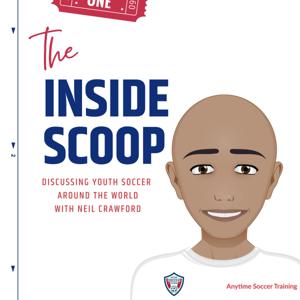


Every coach will tell you the answer “depends.” I’m not buying it. In this episode of The Inside Scoop, I ask a question that makes a lot of people uncomfortable: if a team can’t string passes together, what is that telling you about the coaching?
I break down why anything you want players to do consistently can be measured, and why those of us with a fiduciary duty to player development owe parents clear numbers and film, not vague answers.
You may not like where this goes, but you’ll never watch a youth game the same way again. I’m also sharing a free PDF on what to look for at the individual and team level, so check the show notes.https://www.anytime-soccer.com/soccer-development-scorecard
I'll admit it: my approach goes against common youth coaching practice. When I started coaching, I believed kids could grasp tactical concepts much earlier than we give them credit for. So instead of giving young players endless options, I limit their choices, like requiring the goalkeeper to touch the ball before a team can score, or restricting how a player can release the ball. In this episode, I explain how constraint-led coaching can teach players to pass wide, build up play, and dribble with real bravery.
As players learn, I gradually remove the constraints. I've used this in 3v3 games and recreational leagues, and I believe it can work in official matches too, where opponents and spectators create pressure you can't replicate in training. I also share why I became a youth coach in the first place. Could fewer choices be the fastest path to better decisions?
I wish someone had shared this with me when I was 16. In this short episode, I sit down with my son Adam, who's at an MLS academy, and give him his first task in our mental skills series. I introduce the "magic wand" method: imagine your ideal life a year or two from now, with no limits on money, time, or practical obstacles.
Taking those limits away is how you find out what you truly want. Then I walk Adam through turning that vision into a simple board with three to five images, each paired with a short phrase. It doesn't need to be elaborate. My other son and I will make our own boards at home, and I'll bring Adam's to Charlotte on my next visit. This is about life skills that will serve him whatever he chooses after soccer. Want to try it with your child?
I've spent years focused on technical training. My 16-year-old son has reached the advanced academy level, and he's learning something I didn't prepare him for: performance alone is not enough. In this short episode, I announce a 30-day journey to build mental fortitude and adaptability, with short podcasts and simple daily exercises that take no more than five minutes each.
Academy environments are full of adversity, and that's exactly where resilience and coping skills get built, skills that carry over to business and life. I'll explain why I'm asking my sons to commit with a simple "yes," and why you might want to do the same with your child. Some exercises may push you outside your comfort zone, and you can opt out anytime. Will you join us?
Last weekend, a parent on the sideline criticized my son's team for not keeping the ball after scoring. That got me thinking: what if the game itself were designed to demand it? What if neither team could win by more than one goal? Coaches already use constraints like this in small-sided games, but touch the "real" match and suddenly it's heresy.
In this short episode, I ask why we treat official matches as sacred, what we might be missing, and what Norway's decision to stop keeping score for young players tells us. Is a rigid game holding our players back? Or is the pressure of a real match something no constraint can replace? My answer might surprise you: I want both.
In this episode, I respond to a comment from the Anytime Soccer Training Facebook group about whether being paid is what makes a player or a program professional. The commenter's point is that unpaid means amateur and paid means professional, and I understand the concern about "smoke and mirrors" in youth soccer, especially with so little structure in U.S. soccer. But I make the case that classification depends on goals, structure, and industry standards, not just payment.
The same goes for programs. How a program is funded shouldn't determine its standards. Some recreational programs run with high standards, and some fully funded academies don't. What matters is quality and conduct, not who pays the bills. I also share why descriptive labels like "volunteer-based" or "privately paid" are more useful than funding-based classifications. If you're a parent choosing a program, look for one that holds itself to professional standards no matter how it's financed.
A rec program can have high standards and an elite one can have low ones.
I explain how standards can fall short at the regional, national, or international level, why reform gets pushback, and why any fix, like pro-rel, has to consider supply, demand, and culture.
Most parents can skip this debate, but the "everything is rec" argument keeps coming up.
I break down what recreational really means and why the real conversation is about standards and organizational discipline.
Everyone's arguing about whether all US youth soccer is "just rec." But what if that's the wrong question?
In this episode of The Inside Scoop, I break down why the loudest voices in youth soccer content keep missing the point, and why their moralistic tone and "we're the exception" claims push parents away from a legitimate concern.
Instead, I share the four layers of standards I use to evaluate any club: industry, organizational, team, and personal. You'll learn why a recreational program can hold high standards, why a top-level badge can hide low ones, and which layer may matter most for your player.
Before you sign your kid up, or stay another season, ask the questions in this episode.
I take on the debate over whether young players should focus on dribbling or tactical awareness first.
My take: you can sharpen technical skills later, but tactical understanding gets much harder to teach past 14. I break down how structured scrimmages with specific constraints — like restricting certain passes or touches — can push players to build both creativity and game sense at the same time, using my son Matthew as a real example.
From the publisher's feed
3,643 Listeners

78 Listeners
158 Listeners

273 Listeners
1,145 Listeners

38 Listeners

214 Listeners
5 Listeners

350 Listeners

220 Listeners
8 Listeners

44 Listeners

405 Listeners
8 Listeners