
Sign up to save your podcasts
Or

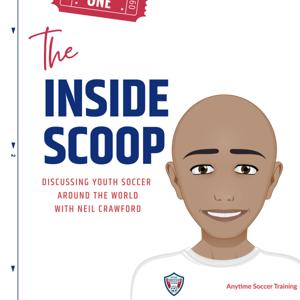


Welcome to the Inside Scoop. I’m Neil Crawford, founder of Anytime Soccer Training.
We help players develop their skills with over 5,000 training videos. I also run a Facebook group, Youth Soccer Guest Playing Opportunities, connecting parents with clubs for guest playing options.
A recent question in the group got me thinking: Does playing with the same team limit player development?
My answer: It depends. While diversity of experience can help, the key to development is what a player does outside of team training.
Personal effort, focused on improving ball control, passing, and decision-making, is crucial.
A good coach can create game-like situations and offer feedback that accelerates improvement. While variety in playing experiences can be valuable, consistency within a solid team environment is more important for development.
Balance is the key—combining consistent team training with new experiences for well-rounded growth.
In this episode, I sit down with Greg Rubendall, Director of Coaching at Livermore Fusion Soccer Club, to explore his journey in coaching and his passion for player development. Greg shares how his club navigates California’s unique soccer landscape, the lessons learned from overcoming COVID challenges, and the influence of his experiences abroad in countries like the Netherlands and Hungary.
We dive deep into the philosophy and practical approaches behind Livermore Fusion’s player development, from aligning coaches with club values to creating strong partnerships with parents. Greg also reflects on big-picture challenges in U.S. soccer, offering his perspective on what needs to change to improve the game at every level.
Whether you’re a coach, parent, or soccer enthusiast, this conversation is packed with insights you won’t want to miss!
After listening to a leading podcast on soccer development that completely overlooked the role of brain science, I felt compelled to share my perspective. In this episode, I dive into neuroplasticity—the brain's ability to adapt and grow—and explain why it's crucial for mastering soccer skills.
Drawing from my experience training my sons, Adam and Matthew, I discuss how I balance structured drills with free play to help them thrive. If you're a parent or coach looking to understand how the brain influences player development, this one’s for you. Let's challenge the myths and focus on what truly works!
In this episode, I answer the most common questions parents have about guest player opportunities in youth soccer. From navigating the paperwork to understanding the role of carding bodies and international transfers, I provide clarity on how guest playing can give your child more exposure and experience.
I’ll also introduce the Youth Soccer Guest Player Opportunities Facebook group, a resource I created to connect families with coaches and tournament directors offering these valuable opportunities.
Article
When it comes to youth soccer in the U.S., one question keeps coming up: why does it cost so much? It’s a topic that sparks a lot of strong opinions, and honestly, I’ve wrestled with it myself.
Is it the clubs? Are they taking advantage of parents? Or is there something bigger happening here—something cultural, structural, or maybe even about what we, as parents, expect from the game?
I’ve heard stories of volunteer-run clubs charging just a few hundred dollars and competing at high levels. I’ve also seen clubs charging $6,000 a year, and it’s hard not to wonder where all that money goes. Between fields, referees, insurance, leagues, and coaches, are we paying for what we really value?
And here’s the kicker—do parents even want less expensive, volunteer-driven soccer? Or have we, in a way, created the demand for this “luxury soccer experience” without even realizing it?
I don’t have all the answers, but I do think the conversation has to shift. It’s not just about costs—it’s about what’s missing. Affordable options, transparent pathways, a middle ground between rec and elite—it feels like we’re stuck in a system that doesn’t leave much room for choice.
What do you think? Are we part of the problem, or is the system broken? Let’s talk about it in the Anytime Soccer Training Facebook group—I’d love to hear your perspective.
In this episode, we break down an important idea: the practice deficit and how it shapes the development of youth soccer players. Many players, especially at the average level, don’t accumulate enough deliberate practice hours early on, leading to technical deficiencies as they grow.
We discuss the importance of starting structured technical training early—a method not embraced by most. While unstructured play is valuable, committing to focused, unopposed drills at home can create a degree of technical refinement that many players miss out on. Think of it like becoming a classically trained chef—you develop a wide-ranging skillset that serves you in any setting.
I also share insights on the 80-18-2 rule, which I see in highly competitive environments like MLS academies. About 80% of players are solid but average, 18% stand out with stronger technical or physical abilities, and only 2% are the truly gifted ones—the players who seem destined to shine at the highest levels.
If your child dreams of playing professionally, you need to realize that the competition is fierce. It’s not just about raw talent. It’s about controlling what you can—like the volume and quality of touches they get on the ball.
Here’s what that looks like in my house:
These efforts added up to an extra 200-300 hours of deliberate practice over 5-6 years. And while many families hire private trainers, I found DIY coaching more flexible and affordable. Paying for that kind of volume would be prohibitive for most.
But let’s be real—this approach isn’t without risks:
This is why I emphasize listening to your child’s body and being mindful of risks. Diversify activities, slow down when needed, and always seek medical advice if something seems off.
At the end of the day, this level of commitment isn’t for everyone. But if you decide it’s the right path for your family, you can minimize the practice deficit and build a technical foundation that gives your child an edge.
Let’s keep sharing our experiences—both successes and setbacks—so we can all learn and grow together. As always, there’s no ego here, just a desire to help each other improve.
Let’s get better together.
In this interview, James Jordan, founder of River City FC, shares his insights on a key question for aspiring soccer players:
From the publisher's feed

3,640 Listeners

78 Listeners
158 Listeners

273 Listeners

1,145 Listeners

38 Listeners

214 Listeners

5 Listeners

351 Listeners

220 Listeners
8 Listeners

44 Listeners

405 Listeners

8 Listeners