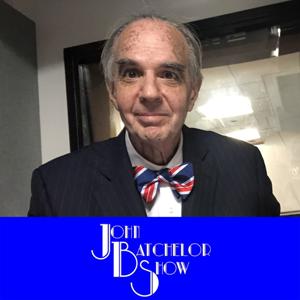
The John Batchelor Show

The John Batchelor Show

By John Batchelor Show.Society & CultureNewsArtsBooks
Download on the App Store
  • Ranking

    36th

    on Books

  • Favorites

    578

    Followers

  • Typical duration

    18 min

    per episode

  • If it hooks

    62%

    finish an episode

Based on Podcast App listening data

The John Batchelor Show episodes

  • 5. Evaluating Economic Challenges Facing Modern China - ANDREW COLLIER & GORDON CHANG 092126

    1898
    Evaluating Economic Challenges Facing Modern China
    Andrew Collier, co-host Gordon Chang: Collier and Chang evaluate China's economic headwinds ahead of an upcoming bilateral summit between President Trump and Xi Jinping. Collier highlights China's slowing economy, growing isolationism, exit bans, and severe youth unemployment officially reported above nineteen percent. Describing China as an I-shaped economy where technology dominates while broader consumer sectors struggle, Collier notes that economic recovery faces significant hurdles. Both analysts express skepticism about major breakthroughs from the Trump-Xi meeting. Meanwhile, impending European Union tariff threats against Chinese electric vehicle exports pose a far greater long-term risk to Beijing's primary economic export engine moving forward. (5)
    10 min
  • 4. Investigating Rumors Surrounding Xi Jinping's Health - BILL GERTZ & GORDON CHANG 092126

    1966
    Investigating Rumors Surrounding Xi Jinping's Health
    Bill Gertz, co-host Gordon Chang: Gertz and Chang discuss intense speculation regarding Chinese leader Xi Jinping's health following unusual behavior at the BRICS summit in New Delhi. Reports indicate Xi grimaced during sessions, missed a major banquet, and prompted rumors of medical treatment at Hospital 301 in Beijing. Chang notes that senior leadership health remains strictly guarded, with periodic disappearances historically used to gauge political loyalty. The uncertainty unfolds shortly before a planned high-stakes summit in Washington between Xi and President Trump. Discussions are expected to cover trade truce extensions, artificial intelligence, rare earth minerals, and ongoing cross-strait tensions regarding Taiwan. (4)
    10 min
  • 3. Analyzing Public Discontent Within RegimeVIran - JANATYN SAYEH 092126
    1953 TEHRAN

    Analyzing Public Discontent Within RegimeVIran
    Janatyn Sayeh and Edmund Fitton-Brown examine the internal state of Iran amidst ongoing public discontent and economic hardship. Sayeh notes that state-sponsored rallies rely on a small regime support base, often utilizing basic incentives to bus participants into Tehran. Despite severe repression, daily demonstrations persist across multiple societal sectors, including workers, students, and retirees. Severe economic degradation, power grid failures, high unemployment, and inflation continue to fuel widespread resentment against the government. As President Pezeshkian addresses the United Nations, the regime struggles to project control while facing an increasingly alienated and frustrated population across the entire nation. (3)
    9 min
  • 2. Honoring Pearl Harbor Hero Doris Miller - TOM MODLY 092126

    1941 PEARL HARBOR
    Honoring Pearl Harbor Hero Doris Miller
    Tom Modly discusses his decision as Acting Secretary of the Navy to name a Gerald R. Ford-class supercarrier after Doris Miller, a Pearl Harbor hero. During the 1941 attack, Miller, an untrained African American messman serving in a segregated Navy, heroically operated a machine gun to defend his ship. Awarded the Navy Cross, Miller later died in combat in 1943 aboard the USS Liscome Bay. Modly emphasizes the importance of preserving Miller's enduring example for future sailors. He expresses deep concern over recent rumors suggesting a potential renaming of the vessel by naval authorities in the coming months ahead. (2)
    10 min
  • 1. Examining Houthi Resilience And Arabian History - EDMUND FITTON-BROWN 092126


    1800 YEMEN
    Examining Houthi Resilience And Arabian History
    Edmund Fitton-Brown analyzes the escalating offensive by Houthi forces as they push to control the Yemen highlands. President Trump reportedly halted planned American airstrikes while Houthis targeted Riyadh and threatened key Saudi Arabian infrastructure. Fitton-Brown emphasizes that the Houthis represent a Zaydi revivalist movement with revolutionary ambitions extending from Mecca to Hormuz. Their expansion presents an existential threat to Saudi Arabia, which remains vulnerable due to deep internal divisions among anti-Houthi coalition partners and the withdrawal of Emirati forces. Furthermore, historical precedents highlight North Yemen's longstanding resistance to external domination, while security concerns continue to grow across the entire region. (1)
    38 min
  • Chinese Strategy And Global Energy Crises Examined In Autumn Londinium

    1900 PEKING POSTCARD
    Chinese Strategy And Global Energy Crises Examined In Autumn Londinium
    Gaius and Germanicus: In the final segment from their Londinium sanctuary, the hosts discuss managing formidable adversaries through accommodation rather than direct confrontation. Drawing an analogy to Godzilla, Germanicus argues that intractable opponents like Russia or the Houthis are best neutralized by turning them into non-hostile allies. The hosts then analyze Beijing's foreign policy terminology, specifically the phrase "constructive strategic stability" crafted by China's Ministry of Foreign Affairs. Germanicus highlights that while this diplomatic rhetoric appears non-threatening, it represents a calculated strategy to restrain American aggression while securing vital economic interests. Specifically, China requires four million barrels of oil daily and demands an end to trade disruptions surrounding Iranian petroleum. Meanwhile, Ukraine faces financial collapse, requiring twenty-five billion dollars immediately to survive daily war expenditures of two hundred million dollars. Germanicus asserts that Washington will ultimately grant Russia its strategic demands, enabling joint economic exploitation of Ukrainian energy reserves and restoring Russian gas supplies to an energy-deprived Europe. As Germany reopens coal plants amidst skyrocketing domestic fuel prices, President Xi Jinping holds unprecedented leverage over the American emperor. The episode concludes with gladiators arriving in Londinium with exotic beasts as the Roman orchestra plays for the Friends of History Debating Society. (3)
    13 min
  • 2. Debating Saudi Kingdom Fragility And Houthi Rise Discussed In Autumn Londinium
    1920 bedouins

    Saudi Kingdom Fragility And Houthi Rise Discussed In Autumn Londinium
    Gaius and Germanicus: Continuing their dialogue at the Londinium wine bar, the hosts evaluate the impending collapse of Saudi Arabian legitimacy. Germanicus emphasizes that the House of Saud's authority remains inherently fragile, historically dependent on buying tribal loyalty and maintaining guardianship over Mecca and Medina. Citing the fourteenth-century historian Ibn Khaldun, Germanicus observes that urban luxury and extravagant wealth have rendered Saudi leadership soft and decadent, contrasting them sharply with the formidable North Yemeni Houthi insurgents. Described as authentic ghazi holy warriors, thirty-five million Houthis pose an existential threat to seventeen million native Saudis, whose society relies heavily on millions of disenfranchised immigrant laborers. Meanwhile, American imperial leadership displays a profound ignorance of foreign cultural realities and historical precedents, ignoring Egypt's disastrous 1962 military campaign in North Yemen. Attempts by Riyadh to form defense pacts with Pakistan and Turkey are deemed ineffective, as neither nation possesses the logistical capacity or willingness to deploy troops into Yemen. With American military assets retreating across the Persian Gulf and Washington granting strategic advantages to China, the Saudi regime faces imminent destabilization without external salvation. Consequently, sacred cities like Mecca and Medina face severe vulnerability as Saudi rulers fail to secure reliable military protection. (2)
    20 min
  • 1. American imperial strategy, drawing comparisons between potential U.S. diplomacy toward Russia and Richard Nixon's opening to China
    1955

    In The Londinium Chronicles, Gaius (John Batchelor) and Germanicus (Michael Vlahos) explore the intersections of Roman history and modern geopolitics.Germanicus and Gaius Debate American Strategy In Rainy Autumn Londinium

    Gaius and Germanicus: Gathered at their expanded Londinium wine bar on a rainy autumn evening in 92 AD, the hosts reflect on municipal regulations, building codes, and upcoming gladiator games before analyzing modern geopolitical parallels. The discussion focuses on American imperial strategy, drawing comparisons between potential U.S. diplomacy toward Russia and Richard Nixon's historic opening to China during the Vietnam War. Germanicus explains that the U.S. has exhausted its initial policy options regarding the Ukrainian conflict, leaving Washington inclined to offer Russia economic incentives and territorial concessions to secure a peacetime transition. Such an agreement could facilitate a 40 percent drawdown of American troops in Europe, shift strategic burdens onto a stagnant European Union, and enlist Moscow as a mediating influence regarding Iran. In exchange, Vladimir Putin seeks a neutral, military-free Ukrainian buffer state to guarantee Russian security against European aggression. Reflecting on historical precedent, Gaius cites Queen Boudicca's catastrophic accommodation with Rome, warning that financial and development deals with an empire inevitably erode national sovereignty. However, Germanicus notes that unlike ancient Rome or modern peer competitors, contemporary America lacks the military doctrine, industrial capacity, and political fortitude required to prevail in prolonged peer conflicts. Consequently, Germany and Japan remain national security satellites following decades of post-war subjugation. (1)

    21 min
  • 2. Revolutionary Mythmaking Transforms Controversial Frontier Figures -ROBERT-PARKINSON
    1805 MARIETTA OHIO

    Revolutionary Mythmaking Transforms Controversial Frontier Figures
    Robert G. Parkinson, Part Two: In 1775, Michael Cresap led Maryland riflemen on the "Beeline March" to Boston. Sick with malaria, Cresap died in New York, where patriots staged a lavish funeral that transformed the controversial frontiersman into a revolutionary hero. Meanwhile, Logan was murdered around 1780 by his nephew Todkahdos, who deemed Logan's oratorical influence too dangerous amidst ongoing frontier conflict. Thomas Jefferson published Logan's speech in Notes on the State of Virginia to refute European claims of American degeneracy, falsely elevating Logan as a classic hero while vilifying Cresap. Attorney Luther Martin fought for years to rehabilitate Cresap's reputation. Later popularized in McGuffey Readers, Logan's Lament reinforced the "vanishing Indian" narrative, culminating in early 20th-century monument battles between the Cresap and Logan families. (2)
    38 min
  • 1. Yellow Creek Massacre Triggers Frontier Bloodshed - ROBERT-PARKINSON
    1799 OHIO RIVER
    Yellow Creek Massacre Triggers Frontier Bloodshed
    Robert G. Parkinson, author of Heart of American Darkness: Bewilderment and Horror on the Early Frontier, Part One: In April 1774, settlers murdered eight Mingo men, women, and children at Baker's Bottom near Yellow Creek. Mingo Chief James Logan wrongly blamed Colonel Thomas Cresap and his son Michael for the massacre, though neither was present. Speculation over the Ohio River country by Virginia elites like George Washington and the Cresap family, combined with boundary disputes between Pennsylvania and Virginia, created power vacuums on the frontier. Following the brutal murders—which included Logan's mother, brother, and pregnant sister—Logan launched retaliatory raids across the region, killing nearly twenty settlers. After Lord Dunmore's War forced native groups to sue for peace, Logan delivered his famous "Logan's Lament" via translator John Gibson, declaring his personal vengeance satisfied and offering peace. (1)
    38 min

About The John Batchelor Show

From the publisher's feed

The John Batchelor Show is a hard news-analysis radio program on current events, world history, global politics and natural sciences. Based in New York City for two decades, the show has travelled…

Best of The John Batchelor Show

Ranked by our users in the last 21 days

More shows like The John Batchelor Show

Mark Levin Podcast by Cumulus Podcast Network

Mark Levin Podcast

22,891 Listeners

THE SAVAGE NATION by Michael Savage

THE SAVAGE NATION

11,899 Listeners

Hillsdale Dialogues by Hillsdale College

Hillsdale Dialogues

2,117 Listeners

Bill O’Reilly’s No Spin News and Analysis by Bill O'Reilly

Bill O’Reilly’s No Spin News and Analysis

12,598 Listeners

The Mark Simone Show by iHeartRadio and Mark Simone

The Mark Simone Show

732 Listeners

The Radio Free Hillsdale Hour by Hillsdale College

The Radio Free Hillsdale Hour

675 Listeners

Newt's World by Gingrich 360

Newt's World

6,550 Listeners

John Solomon Reports by John Solomon

John Solomon Reports

6,494 Listeners

The Hugh Hewitt Show: Highly Concentrated by Salem Podcast Network

The Hugh Hewitt Show: Highly Concentrated

713 Listeners

DINESH Podcast by Salem Podcast Network

DINESH Podcast

6,838 Listeners

The Big Ben Show by Fox News Podcasts

The Big Ben Show

557 Listeners

The Victor Davis Hanson Show by Victor Davis Hanson and Jack Fowler

The Victor Davis Hanson Show

8,402 Listeners

Kudlow by Fox News Podcasts

Kudlow

215 Listeners

Victor Davis Hanson: In His Own Words by Victor Davis Hanson | The Daily Signal

Victor Davis Hanson: In His Own Words

1,154 Listeners

Pod Force One by New York Post

Pod Force One

1,182 Listeners