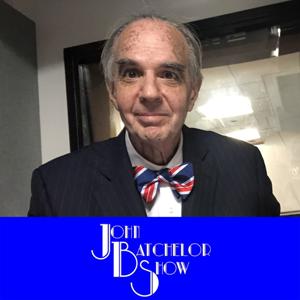
The John Batchelor Show

The John Batchelor Show

By John Batchelor Show.Society & CultureNewsArtsBooks
Download on the App Store
  • Ranking

    36th

    on Books

  • Favorites

    578

    Followers

  • Typical duration

    18 min

    per episode

  • If it hooks

    62%

    finish an episode

Based on Podcast App listening data

The John Batchelor Show episodes

  • 1. American imperial strategy, drawing comparisons between potential U.S. diplomacy toward Russia and Richard Nixon's opening to China
    1955

    In The Londinium Chronicles, Gaius (John Batchelor) and Germanicus (Michael Vlahos) explore the intersections of Roman history and modern geopolitics.Germanicus and Gaius Debate American Strategy In Rainy Autumn Londinium

    Gaius and Germanicus: Gathered at their expanded Londinium wine bar on a rainy autumn evening in 92 AD, the hosts reflect on municipal regulations, building codes, and upcoming gladiator games before analyzing modern geopolitical parallels. The discussion focuses on American imperial strategy, drawing comparisons between potential U.S. diplomacy toward Russia and Richard Nixon's historic opening to China during the Vietnam War. Germanicus explains that the U.S. has exhausted its initial policy options regarding the Ukrainian conflict, leaving Washington inclined to offer Russia economic incentives and territorial concessions to secure a peacetime transition. Such an agreement could facilitate a 40 percent drawdown of American troops in Europe, shift strategic burdens onto a stagnant European Union, and enlist Moscow as a mediating influence regarding Iran. In exchange, Vladimir Putin seeks a neutral, military-free Ukrainian buffer state to guarantee Russian security against European aggression. Reflecting on historical precedent, Gaius cites Queen Boudicca's catastrophic accommodation with Rome, warning that financial and development deals with an empire inevitably erode national sovereignty. However, Germanicus notes that unlike ancient Rome or modern peer competitors, contemporary America lacks the military doctrine, industrial capacity, and political fortitude required to prevail in prolonged peer conflicts. Consequently, Germany and Japan remain national security satellites following decades of post-war subjugation. (1)

    21 min
  • 2. Revolutionary Mythmaking Transforms Controversial Frontier Figures -ROBERT-PARKINSON
    1805 MARIETTA OHIO

    Revolutionary Mythmaking Transforms Controversial Frontier Figures
    Robert G. Parkinson, Part Two: In 1775, Michael Cresap led Maryland riflemen on the "Beeline March" to Boston. Sick with malaria, Cresap died in New York, where patriots staged a lavish funeral that transformed the controversial frontiersman into a revolutionary hero. Meanwhile, Logan was murdered around 1780 by his nephew Todkahdos, who deemed Logan's oratorical influence too dangerous amidst ongoing frontier conflict. Thomas Jefferson published Logan's speech in Notes on the State of Virginia to refute European claims of American degeneracy, falsely elevating Logan as a classic hero while vilifying Cresap. Attorney Luther Martin fought for years to rehabilitate Cresap's reputation. Later popularized in McGuffey Readers, Logan's Lament reinforced the "vanishing Indian" narrative, culminating in early 20th-century monument battles between the Cresap and Logan families. (2)
    38 min
  • 1. Yellow Creek Massacre Triggers Frontier Bloodshed - ROBERT-PARKINSON
    1799 OHIO RIVER
    Yellow Creek Massacre Triggers Frontier Bloodshed
    Robert G. Parkinson, author of Heart of American Darkness: Bewilderment and Horror on the Early Frontier, Part One: In April 1774, settlers murdered eight Mingo men, women, and children at Baker's Bottom near Yellow Creek. Mingo Chief James Logan wrongly blamed Colonel Thomas Cresap and his son Michael for the massacre, though neither was present. Speculation over the Ohio River country by Virginia elites like George Washington and the Cresap family, combined with boundary disputes between Pennsylvania and Virginia, created power vacuums on the frontier. Following the brutal murders—which included Logan's mother, brother, and pregnant sister—Logan launched retaliatory raids across the region, killing nearly twenty settlers. After Lord Dunmore's War forced native groups to sue for peace, Logan delivered his famous "Logan's Lament" via translator John Gibson, declaring his personal vengeance satisfied and offering peace. (1)
    38 min
  • Norse Voyages Traversed Atlantic To America - MARTYN WHITTOCK

    1904 VIKINGS
    Norse Voyages Traversed Atlantic To America
    Martyn Whittock, author of American Vikings: How the Norse Sailed into the Lands and Imaginations of America: Eighth-century Norse expansion was fueled by population growth, royal ambitions, and an Islamic silver shortage resulting from Caliphate shifts to Baghdad. The Norse expanded across Britain to Iceland in the 870s and Greenlandunder Erik the Red in the 980s. Around 1000 AD, Leif Erikson ventured west, sighting Helluland, Markland, and Vinland. Excavations at L'Anse aux Meadows in Newfoundland confirm an 11th-century Norse base camp where timber was felled in 1021 AD. Butternut wood and wild grapes indicate explorations extended south toward New Brunswick or New England. Although sagas record trade and violent conflicts with indigenous "Skraelings," small population numbers prevented permanent colonization. The Maine penny highlights regional trade networks, while Whittock critiques alt-right groups who misappropriate Vinland legends for modern racial ideologies. (1)

    This episode includes AI-generated content.
    38 min
  • 2. Royal Arrest Attempt Triggers English War - JONATHAN HEALEY
    1642 HOUSES DURING CHARLES I

    Royal Arrest Attempt Triggers English War
    Jonathan Healey, Part Two: On January 4, 1642, King Charles I attempted to arrest five MPs and Lord Mandeville for treason. Pushed by Queen Henrietta Maria, Charles personally entered the House of Commons with armed cavaliers. However, Lady Carlisle had leaked the plot, enabling the members to escape by boat down the Thames into London. Hostile crowds surrounded Charles's coach, throwing pamphlets with the biblical call "To your tents, O Israel." Fearing for their safety, Charles and Henrietta Maria fled Whitehall for Hampton Court. The Queen departed for continental Europe to raise funds and troops, while Charles established a royalist court in York. Parliament passed the radical Militia Ordinance without royal assent, claiming sovereign control over the military. When the governor of Hull barred Charles from accessing his armory, both sides began mobilizing armed forces, plunging England into civil war. (2)
    38 min
  • 1.      Parliament Challenges King Charles During Crisis - JONATHAN HEALEY

    1940 BLACKOUT PARLIAMENT
        Parliament Challenges King Charles During Crisis
    Jonathan Healey, author of The Blood in Winter: England on the Brink of Civil War, 1642, Part One: In October 1641, King Charles I backed "The Incident," a failed plot in Edinburgh to arrest Scottish Covenanter leaders Argyll and Hamilton, forcing Charles to make major constitutional concessions to the Scottish Parliament. Returning to London, Charles confronted the Long Parliament, which had forced the execution of his key minister, the Earl of Strafford, via a Bill of Attainder under intense crowd pressure. Power shifted toward the parliamentary Junto led by John Pym in the House of Commons and Lord Mandeville in the House of Lords. Pym skillfully managed debates and coordinated reformist strategy alongside Puritans who opposed Charles's High Church religious policies and arbitrary taxation. Tensions peaked during late-night debates illuminated by candles over the Grand Remonstrance, a document detailing royal misrule. Despite fierce royalist opposition, Parliament passed the Remonstrance to rally popular public support. (1)
    38 min
  • 2. Postwar Reconstruction And Contntal Expansion Conflicts - ALAN TAYLOR

    1900 MEXICO CITY
    Postwar Reconstruction And Contntal Expansion Conflicts
    Alan Taylor, Part Two: In Canada, gregarious politician John A. Macdonald teamed with Thomas D'Arcy McGee and engineered Queen Victoria's selection of Ottawa as the capital to resolve regional rivalry. Following the American Civil War's destruction, President Benito Juárez's Mexican forces, backed by covert United States munitions, successfully ousted Emperor Maximilian's French-backed regime. In the United States, President Andrew Johnson issued thousands of pardons to former Confederates, allowed Southern states to enact restrictive Black Codes, and narrowly avoided removal following impeachment. Grant's administration demobilized federal troops, leaving freed Black citizens vulnerable to violence. Out West, the United States military brutally forced Native Americans onto reservations and into boarding schools to eradicate indigenous culture. Simultaneously, three hundred thousand Chinese railroad workers faced intense racial hostility and were explicitly denied American citizenship despite their labor contributions. (2)
    38 min
  • 1. Antebellum Struggles Reshape Nineteenth Century Nations - ALAN TYLOR

    BLACKFEET.
    Antebellum Struggles Reshape Nineteenth Century Nations
    Alan Taylor, author of American Civil Wars: A Continental History, 1850–1873, Part One: Jane Maria Eliza McManus, educated in New York and associated with Aaron Burr, advocated for Manifest Destiny and expanding southern slaveholding society into the Caribbean and Mexico to "whiten" America. Her expansionist vision contrasted sharply with Jane Swisshelm, an abolitionist and feminist journalist who operated a newspaper in St. Cloud, Minnesota, clashing with local political bosses. Meanwhile, Harriet Tubman navigated runaways along the Underground Railroadinto Canada to escape federal fugitive slave laws. Harriet Beecher Stowe's novel Uncle Tom's Cabin generated widespread empathy across the North. National politics fractured following Stephen Douglas's Kansas-Nebraska Act, which promoted popular sovereignty and sparked border violence in Kansas. Extremes widened as John Brown executed broadsword attacks at Pottawatomie. In Mexico, Melchor Ocampo led the Liberal Party against Conservatives in a devastating civil war over church power, land reform, and constitutional rights. (1)
    38 min
  • 3. England Reaches Top T20 Cricket Ranking - JEREMY ZAKIS

    1920 LEONARD BATES

    England Reaches Top T20 Cricket RankingOld Trafford, securing the number one world ranking. Though pundits expected Sri Lanka to win, England dominated using highly aggressive "Bazball" tactics. Named after coach Brendon McCullum, Bazball emphasizes rapid, high-energy offensive gameplay, hitting balls over boundaries, bowling fast, and applying psychological pressure on opponents to disrupt traditional strategy. While physically demanding over long matches, this strategy has proven highly effective in short-format T20 games. Although Australian T20 performance currently lags behind, England's bold tactical style receives notable praise from local cricket supporters today. (3)

    6 min
  • 2. Early Snake Activity Spike Across Australia - JEREMY ZAKIS

    AUSTRALIA SNAKES.
    Early Snake Activity Spike Across Australia
    Jeremy Zakis reports venomous snakes have emerged a month earlier than expected, with Brisbane becoming a major epicenter. A young boy notably relocated a python off a public path, illustrating increased public comfort with reptile encounters due to extensive school education and media warnings. Snakes often enter homes seeking dry warmth, squeeze through narrow cracks, and nest near soft plush toys. Because brown snakes live in family units within a one-mile radius, nearby family members usually remain close. Queensland's humid weather encourages indoor sightings compared to Sydney. Meanwhile, intense suburban bird dogfights break out between aggressive local cockatoos, magpies, and miner birds. (2)
    14 min

About The John Batchelor Show

From the publisher's feed

The John Batchelor Show is a hard news-analysis radio program on current events, world history, global politics and natural sciences. Based in New York City for two decades, the show has travelled…

Best of The John Batchelor Show

Ranked by our users in the last 21 days

More shows like The John Batchelor Show

Mark Levin Podcast by Cumulus Podcast Network

Mark Levin Podcast

22,891 Listeners

THE SAVAGE NATION by Michael Savage

THE SAVAGE NATION

11,899 Listeners

Hillsdale Dialogues by Hillsdale College

Hillsdale Dialogues

2,117 Listeners

Bill O’Reilly’s No Spin News and Analysis by Bill O'Reilly

Bill O’Reilly’s No Spin News and Analysis

12,598 Listeners

The Mark Simone Show by iHeartRadio and Mark Simone

The Mark Simone Show

732 Listeners

The Radio Free Hillsdale Hour by Hillsdale College

The Radio Free Hillsdale Hour

675 Listeners

Newt's World by Gingrich 360

Newt's World

6,550 Listeners

John Solomon Reports by John Solomon

John Solomon Reports

6,494 Listeners

The Hugh Hewitt Show: Highly Concentrated by Salem Podcast Network

The Hugh Hewitt Show: Highly Concentrated

713 Listeners

DINESH Podcast by Salem Podcast Network

DINESH Podcast

6,838 Listeners

The Big Ben Show by Fox News Podcasts

The Big Ben Show

557 Listeners

The Victor Davis Hanson Show by Victor Davis Hanson and Jack Fowler

The Victor Davis Hanson Show

8,402 Listeners

Kudlow by Fox News Podcasts

Kudlow

215 Listeners

Victor Davis Hanson: In His Own Words by Victor Davis Hanson | The Daily Signal

Victor Davis Hanson: In His Own Words

1,154 Listeners

Pod Force One by New York Post

Pod Force One

1,182 Listeners