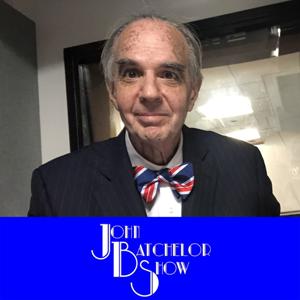
The John Batchelor Show

The John Batchelor Show

By John Batchelor Show.Society & CultureNewsArtsBooks
Download on the App Store
  • Ranking

    35th

    on Books

  • Favorites

    578

    Followers

  • Typical duration

    18 min

    per episode

  • If it hooks

    62%

    finish an episode

Based on Podcast App listening data

The John Batchelor Show episodes

  • California Swells Weather And Nevada Casinos
    Jeff Bliss discusses a massive southern ocean swell creating rare surfing conditions at Newport Harbor's channel. Driven by an intense tropical storm off Mexico, California is experiencing unprecedented humidity and a nearly five-degree Fahrenheit rise in ocean temperatures, prompting a surge in marine life including hammerhead and great white sharks. Turning to Nevada, Bliss describes the K-shaped economy, where Las Vegas strip casinos profit from wealthy international tourists, while local traffic declines. He details In-N-Out's slow, quality-controlled eastward expansion and concludes with Berkeley's controversial, permissive approach toward housing campus homeless encampments, noting they receive government-funded clean needles and glass pipes. (1)
    18 min
  • CONTENTS JOHN BATCHELOR SHOW 8-27-2026. Anatol Lieven warns that foreign policy establishments in both the United States and Britain have e
    CONTENTS JOHN BATCHELOR SHOW 8-27-2026.

    Anatol Lieven warns that foreign policy establishments in both the United States and Britain have embraced a dangerous militarism. He highlights how the Biden administration failed to rejoin the nuclear deal with Iran, seeking instead a harder bargain. Furthermore, Europe faces acute escalation risks over Ukraine; Russia has warned of retaliation against Britain for authorizing the use of Storm Shadow missiles inside Russian territory. Lieven cautions that British Prime Minister Burnham's domestic agenda could be destroyed if a stray British missile strikes a Russian civilian target, triggering a direct, retaliatory attack on British soil. (1)

    Peter Huessy argues that nuclear deterrence remains vital but requires continuous modernization of missiles, submarines, bombers, and command systems to match Russian and Chinese advancements. He explains that conventional defense fails against nuclear attacks in military war games. Huessy advocates for "counterforce" strategies—targeting an enemy's weapons and leadership rather than innocent civilian cities ("countervalue"). He also supports adding theater nuclear systems to deter Russia's "escalate to win" doctrine, which utilizes low-yield battlefield nuclear weapons to force a NATO stand-down. (2)

    Andrea Stricker discusses the concerning US-Saudi bilateral nuclear agreement, which triggers a 90-day congressional review. This pact opens the door to uranium enrichment on Saudi soil, setting a dangerous precedent that could spark a regional "domino effect." Additionally, Stricker highlights unresolved risks in Syria. Despite a US-brokered deal to turn over natural uranium metal, Syria's al-Qaeda-linked leadership intends to rebuild its civil nuclear program. She urges the US to enforce the complete removal of all nuclear material from Syria rather than giving extremists a pass. (3)

    Mary Anastasia O'Grady explains how the US is aggressively targeting Cuban regime elites by freezing assets and revoking visas. To facilitate the regime's collapse, O'Grady stresses that the US must present a viable post-collapse plan for "Day Zero" to avoid chaos, bloodshed, or oligarchic asset-grabbing. She advocates for securing property rights to encourage external investments and suggests using multilateral peacekeepers to maintain order. She supports a transitional board of Cuban-Americans and Americans to manage investments and prevent former military elites from seizing privatized state assets. (4)

    Conrad Black analyzes the impending trade dispute between Canada and the United States, labeled "the dumbest trade war ever." President Trump's comments describing Canada as a "51st state" and calling the Prime Minister "governor" have sparked deep resentment across Canada. Prime Minister Carney has ended negotiations and threatened retaliatory tariffs, securing tentative public support. However, the political opposition is demanding that Carney publish the underlying negotiation documents and recall parliament to build an all-party policy. Black argues this represents a moment of great risk but also a Churchillian opportunity. (5)

    Jane Rogoyska explores the history of Paris's Hôtel Lutetia, which served as a haven for fleeing Weimar intellectuals before becoming a Nazi military intelligence headquarters in 1940. Rogoyska traces waves of refugees fleeing Nazi persecution, including writers Heinrich Mann and Lion Feuchtwanger. These figures struggled to warn an indifferent Europe about the dangers of fascism. Despite personal tragedies and bureaucratic challenges, literary giants like James Joyce, Samuel Beckett, and Arthur Koestler frequented the hotel, carrying poison just in case they were captured. (6)

    Evan Ellis details how an unprecedented "super El Niño" is battering the Americas, causing floods in Peru and severe droughts affecting the Panama Canal. He outlines political developments, including Chile's struggle to finance aging copper mining infrastructure despite high global prices. In Venezuela, the "Rodrigato" gang leadership continues to slow-walk democratic reforms while benefiting from US-supervised oil sales. Colombia's new conservative president, de la Espriella, has prioritized security and pro-business reforms. Finally, in Panama, the US is expanding security efforts to counter persistent Chinese commercial and diplomatic encirclement. (7)


    7 min
  • Evan Ellis details how an unprecedented "super El Niño" is battering the Americas, causing floods in Peru and severe droughts affecting the
    Evan Ellis details how an unprecedented "super El Niño" is battering the Americas, causing floods in Peru and severe droughts affecting the Panama Canal. He outlines political developments, including Chile's struggle to finance aging copper mining infrastructure despite high global prices. In Venezuela, the "Rodrigato" gang leadership continues to slow-walk democratic reforms while benefiting from US-supervised oil sales. Colombia's new conservative president, de la Espriella, has prioritized security and pro-business reforms. Finally, in Panama, the US is expanding security efforts to counter persistent Chinese commercial and diplomatic encirclement. (7)
    38 min
  • Jane Rogoyska explores the history of Paris's Hôtel Lutetia, which served as a haven for fleeing Weimar intellectuals before becoming a Nazi
    Jane Rogoyska explores the history of Paris's Hôtel Lutetia, which served as a haven for fleeing Weimar intellectuals before becoming a Nazi military intelligence headquarters in 1940. Rogoyska traces waves of refugees fleeing Nazi persecution, including writers Heinrich Mann and Lion Feuchtwanger. These figures struggled to warn an indifferent Europe about the dangers of fascism. Despite personal tragedies and bureaucratic challenges, literary giants like James Joyce, Samuel Beckett, and Arthur Koestler frequented the hotel, carrying poison just in case they were captured. (6)
    38 min
  • Conrad Black analyzes the impending trade dispute between Canada and the United States, labeled "the dumbest trade war ever." President Trum
    Conrad Black analyzes the impending trade dispute between Canada and the United States, labeled "the dumbest trade war ever." President Trump's comments describing Canada as a "51st state" and calling the Prime Minister "governor" have sparked deep resentment across Canada. Prime Minister Carney has ended negotiations and threatened retaliatory tariffs, securing tentative public support. However, the political opposition is demanding that Carney publish the underlying negotiation documents and recall parliament to build an all-party policy. Black argues this represents a moment of great risk but also a Churchillian opportunity. (5)
    10 min
  • Mary Anastasia O'Grady explains how the US is aggressively targeting Cuban regime elites by freezing assets and revoking visas. To facilitat
    Mary Anastasia O'Grady explains how the US is aggressively targeting Cuban regime elites by freezing assets and revoking visas. To facilitate the regime's collapse, O'Grady stresses that the US must present a viable post-collapse plan for "Day Zero" to avoid chaos, bloodshed, or oligarchic asset-grabbing. She advocates for securing property rights to encourage external investments and suggests using multilateral peacekeepers to maintain order. She supports a transitional board of Cuban-Americans and Americans to manage investments and prevent former military elites from seizing privatized state assets. (4)
    11 min
  • Andrea Stricker discusses the concerning US-Saudi bilateral nuclear agreement, which triggers a 90-day congressional review.
    Andrea Stricker discusses the concerning US-Saudi bilateral nuclear agreement, which triggers a 90-day congressional review. This pact opens the door to uranium enrichment on Saudi soil, setting a dangerous precedent that could spark a regional "domino effect." Additionally, Stricker highlights unresolved risks in Syria. Despite a US-brokered deal to turn over natural uranium metal, Syria's al-Qaeda-linked leadership intends to rebuild its civil nuclear program. She urges the US to enforce the complete removal of all nuclear material from Syria rather than giving extremists a pass. (3)
    18 min
  • Peter Huessy argues that nuclear deterrence remains vital but requires continuous modernization of missiles, submarines, bombers, and comman
    Peter Huessy argues that nuclear deterrence remains vital but requires continuous modernization of missiles, submarines, bombers, and command systems to match Russian and Chinese advancements. He explains that conventional defense fails against nuclear attacks in military war games. Huessy advocates for "counterforce" strategies—targeting an enemy's weapons and leadership rather than innocent civilian cities ("countervalue"). He also supports adding theater nuclear systems to deter Russia's "escalate to win" doctrine, which utilizes low-yield battlefield nuclear weapons to force a NATO stand-down. (2)
    20 min
  • Anatol Lieven warns that foreign policy establishments in both the United States and Britain have embraced a dangerous militarism.
    Anatol Lieven warns that foreign policy establishments in both the United States and Britain have embraced a dangerous militarism. He highlights how the Biden administration failed to rejoin the nuclear deal with Iran, seeking instead a harder bargain. Furthermore, Europe faces acute escalation risks over Ukraine; Russia has warned of retaliation against Britain for authorizing the use of Storm Shadow missiles inside Russian territory. Lieven cautions that British Prime Minister Burnham's domestic agenda could be destroyed if a stray British missile strikes a Russian civilian target, triggering a direct, retaliatory attack on British soil. (1)
    18 min
  • S8 Ep1367: CONTENTS JOHN BATCHELOR SHOW, 8-26-2026. 832Greenwich Observatory (Robert Chambers, p.200, 1832) - Copy.png John Batchelor and
    CONTENTS JOHN BATCHELOR SHOW, 8-26-2026.832Greenwich Observatory (Robert Chambers, p.200, 1832) - Copy.pngJohn Batchelor and Michael Bernstam analyze the revenue-sharing deal between Iran and Oman over the Strait of Hormuz, which does not resolve the critical global refinery shortage. Decades of zero Western refinery expansion, alongside Ukrainian drone strikes disabling Russian capacity, has left a global deficit of 5.6 to 6 million barrels per day of refined products. This is especially severe for diesel, which requires heavy crude unlike the light sweet crude produced by the US shale revolution. With U.S. refineries running at maximum capacity, the threat of mechanical failures risks a full-blown supply crisis. (1)Richard Reinsch discusses the Democratic Socialists of America (DSA) and their principles, which advocate for economic collectivism, nationalizing private industries, and dismantling the U.S. constitutional republic in favor of a unicameral legislature. Reinsch contrasts this with a historical 1922 Kremlin conversation where Soviet leader Joseph Stalin accused American communist Jay Lovestone of "heresy" for arguing "American exceptionalism"—the idea that American working-class prosperity made them resistant to Marxism. Today, Reinsch views the DSA as an overeducated, white, urban phenomenon failing to win working-class or minority voters. (2)Rogier Windhorst and David Livingston: Professor Windhorst warns that the Hubble Space Telescope's orbit will begin to decay uncontrollably by September 2033 due to solar maximum atmospheric expansion. To prevent a hazardous, uncontrolled re-entry, Windhorst advocates for a robotic servicing mission to boost Hubble's orbit. As the only remaining telescope with precise blue-ultraviolet capabilities, Hubble's data remains critical and heavily in demand. Windhorst urges NASA to fund a $100 million rescue mission and eventually construct the Habitable Worlds Observatory to search for Earth-like exoplanets starting in 2040. (3)David Hebert discusses the fiscal debates surrounding Social Security's impending 2032 shortfall. Hebert refutes the idea that raising tax rates increases treasury revenue, noting that tax revenue historically remains constant at 17–18% of GDP because high rates prompt tax avoidance. Instead of "starving the beast" of resources, Hebert advocates for "starving the beast of responsibility" by decentralizing programs through federalism to cut administrative costs. He urges structural reforms to Social Security, highlighting that the ratio of workers supporting each retiree has plummeted from 40-to-1 down to 2-to-1. (4)Captain James Fanell (US Navy, retired), co-host Gordon Chang: Fanell warns that China is nearing completion of a military installation on Triton Island in the Paracels, expanding its "ring of control" in the South China Sea. He cautions that China may soon fortify Scarborough Shoal, threatening to block the northern South China Sea and degrade U.S. naval operations. In response to this rising coercion, the Philippines is boosting its 2027 defense budget by 6.3%, allocating $800 million for modernization with a heavy focus on intelligence, surveillance, and reconnaissance drones. Fanell urges more assertive naval cooperation to deter further Chinese expansion. (5)Dean Cheng, co-host Gordon Chang: Cheng analyzes China's space program and its pursuit of reusable booster technology to match SpaceX's cost-saving launch cadences. Although China has successfully recaptured first-stage boosters, it has not yet demonstrated refurbishing or reusing them. Cheng notes that China seeks space dominance to deploy six mega-constellations and establish moon colonies. He suggests that a delay in China's lunar south pole probe—officially blamed on solar exposure—is likely due to the ongoing accident investigation of the Long March 7 rocket failure. Cheng predicts a Chinese astronaut will walk on the moon by December 31, 2030. (6)Charles Burton, co-host Gordon Chang: Burton discusses the escalating trade war between Canada and the Trumpadministration, which triggered $20 billion in Canadian retaliatory tariffs and a 7.5 billion CAD business support package. The dispute has sparked public anti-Trump sentiment and personal mudslinging between Donald Trump and Ontario Premier Doug Ford. Stalled negotiations, compounded by unacceptable U.S. demands regarding French labeling laws, have shattered bilateral trust. Burton warns that Canada is prepared to pivot away from MAGA toward free trade with Europe and China, despite severe risks of Chinese economic coercion. (7)Jack Burnham outlines China's persistent military coercion campaign targeting Taiwan, noting that Beijing separates economic trade truces from its aggressive goal to subjugate the island. China's provocations, including Coast Guardpatrols east of Taiwan and flights over the median line, are designed to establish a "new normal." In December 2025, China responded to an $11 billion U.S. arms package by launching "Justice Mission 2025," an expansive military exercise simulating blockades and practicing "all-dimensional deterrence" to discourage U.S. intervention and test regional capabilities. (8)Doug Messier details SpaceX's plans to build "Starbase Louisiana," a massive $100 billion, 125,000-acre spaceport designed as the world's largest launch facility. Scheduled for construction in 2027 and launches by 2029, the facility will feature ten launch pads supporting thousands of annual, airline-style Starship flights. While bringing thousands of jobs, the coastal development raises environmental concerns regarding wetland habitats, which SpaceX has pledged to help restore. Messier also highlights Space Force's startup funding arm, SpaceWERX, which is fostering new aerospace innovators like Antares Nuclear and Muon Space. (9)Jeremy Zakis reports on the unprecedented rainfall sweeping across Australia, driven by a super El Niño cycle interacting with the Indian Ocean Dipole. South Australia and Adelaide experienced the heaviest downpours, breaking monthly rainfall records in a single day, while Sydney's infrastructure coped with several inches of rain. Victoria and Melbourne were largely spared due to the Great Dividing Range acting as a barrier. Zakis warns that weekly spring rains are highly unusual and threaten to fuel rapid forest undergrowth, which could dry out and create a dangerous bushfire hazard during future droughts. (10)

    6 min

About The John Batchelor Show

From the publisher's feed

The John Batchelor Show is a hard news-analysis radio program on current events, world history, global politics and natural sciences. Based in New York City for two decades, the show has travelled…

Best of The John Batchelor Show

Ranked by our users in the last 21 days

More shows like The John Batchelor Show

Mark Levin Podcast by Cumulus Podcast Network

Mark Levin Podcast

22,898 Listeners

THE SAVAGE NATION by Michael Savage

THE SAVAGE NATION

11,901 Listeners

Hillsdale Dialogues by Hillsdale College

Hillsdale Dialogues

2,117 Listeners

Bill O’Reilly’s No Spin News and Analysis by Bill O'Reilly

Bill O’Reilly’s No Spin News and Analysis

12,599 Listeners

The Mark Simone Show by iHeartRadio and Mark Simone

The Mark Simone Show

732 Listeners

The Radio Free Hillsdale Hour by Hillsdale College

The Radio Free Hillsdale Hour

673 Listeners

Newt's World by Gingrich 360

Newt's World

6,549 Listeners

John Solomon Reports by John Solomon

John Solomon Reports

6,491 Listeners

The Hugh Hewitt Show: Highly Concentrated by Salem Podcast Network

The Hugh Hewitt Show: Highly Concentrated

714 Listeners

DINESH Podcast by Salem Podcast Network

DINESH Podcast

6,840 Listeners

The Big Ben Show by Fox News Podcasts

The Big Ben Show

557 Listeners

The Victor Davis Hanson Show by Victor Davis Hanson and Jack Fowler

The Victor Davis Hanson Show

8,404 Listeners

Kudlow by Fox News Podcasts

Kudlow

215 Listeners

Victor Davis Hanson: In His Own Words by Victor Davis Hanson | The Daily Signal

Victor Davis Hanson: In His Own Words

1,149 Listeners

Pod Force One by New York Post

Pod Force One

1,181 Listeners