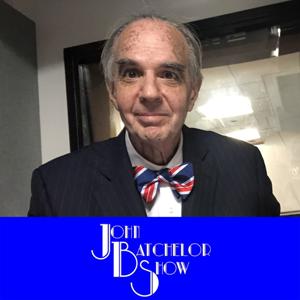
The John Batchelor Show

The John Batchelor Show

By John Batchelor Show.Society & CultureNewsArtsBooks
Download on the App Store
  • Ranking

    35th

    on Books

  • Favorites

    578

    Followers

  • Typical duration

    18 min

    per episode

  • If it hooks

    62%

    finish an episode

Based on Podcast App listening data

The John Batchelor Show episodes

  • S8 Ep1359: CONTENTS THE JOHN BATCHELOR SHOW, 8-25-2026 COVER OF FANTASTIC MAGAZINE OCTOBER 1961 Liz Peek, columnist for The Hill and Fox N
    CONTENTS THE JOHN BATCHELOR SHOW, 8-25-2026COVER OF FANTASTIC MAGAZINE OCTOBER 1961Liz Peek, columnist for The Hill and Fox News, discusses the surprising resilience of the American economy, noting that small businesses are reporting strong hiring and profitability growth based on broad National Federation of Independent Business and Bank of America data. While consumer spending remains robust, recent data reveals a K-shaped economy, where higher-income homeowners spend extensively on renovations while lower-income consumers trade down at Walmart. Rising interest rates present a critical challenge, slamming the housing market and significantly increasing interest payments on the massive national debt. Lastly, the administration's tariff conflict with Canada is criticized as a major, highly unfortunate, and economically damaging political mistake. (1)Jonathan Schanzer, Executive Director of the Foundation for Defense of Democracies, evaluates the Treasury's initial tranches of secondary sanctions targeting entities trading with Iran, including firms in China and the UAE. Although these measures stop short of targeting major Chinese banks, they provide President Trump with leverage ahead of his Washington summit with Xi Jinping. Within the Middle East, Schanzer warns that regional powers are hedging their bets. Saudi Arabia may be negotiating a separate peace with the Houthis and Iran, which could undermine US sanctions. Additionally, the US controversially rescinded Syria's state sponsor of terror status following the rapid rise of former al-Qaeda commander Ahmed al-Shara. (2)Mary Kissel, Senior Fellow at the Hudson Institute and former Senior Advisor to the Secretary of State, analyzes Trump's "maximum pressure" campaign against Iran, asserting that its success relies on penalizing large Chinesefinancial institutions. However, Beijing holds significant economic and military leverage over the US, including export controls on critical minerals. Regarding North America, Kissel describes the escalating trade war with Canada as a "loser's game" driven by domestic politics. She stresses that the 50% tariffs on essential materials like Canadianaluminum and auto parts disrupt deeply integrated supply chains. Consequently, this trade conflict severely harms ordinary consumers and threatens Republican control of key Senate seats in critical border states of Maine and Michigan. (3)Colonel Jeff McCausland, US Army (Retired) and Visiting Professor at Dickinson College, warns that the US foreign policy process has collapsed under President Trump, who relies on personal loyalty over expert advice. This is illustrated by Trump's sudden decision to reduce joint US-South Korea military exercises without notifying allies. McCausland argues this undercuts South Korea while offering concessions to a nuclear-armed dictator, Kim Jong-un, who actively supplies weapons to Russia for the Ukraine war. Furthermore, he criticizes the "economic D-Day" against Iran as highly insincere given key delays in sanctioning China, and strongly condemns the trade war against Canada, a loyal ally with a rich military history. (4)Gregory Copley, editor of Defense & Foreign Affairs, argues that the US sanctions regime against Iran is strategic signaling that makes Washington look weak, as it ignores China's trade dominance and threatens relations with India. He also views the Canadian trade dispute as a strategic failure that weakens the NORAD treaty and forces Canada to act independently in the Arctic. This unpredictability has alienated European allies, who are now bypassing the US to negotiate directly on Ukraine. Additionally, Copley analyzes post-Petro Colombia, detailing how the energetic new president faces massive domestic security issues, narco-trafficking networks, and the grounding of critical disaster relief aircraft under sanctions. (5)Thaddeus McCotter, former US Representative from Michigan and columnist for American Greatness, details the severe political and economic fallout of Trump's trade war with Canada, noting that insulting rhetoric like the "51st state" remark has politically boosted Canadian Prime Minister Mark Carney. He explains that border states like Michigan and Maine share deep commercial integration, meaning 50% tariffs will directly harm their local economies. This unvetted policy blindsided senior Republican legislators, including Susan Collins, who openly opposed the tariffs and avoided a campaign rally with Vice President Vance. Ultimately, McCotter warns that these tariffs jeopardize critical Senate seats in highly contested swing states, giving rival Democrats a very major campaign advantage. (6)Judy Dempsey, Senior Scholar in Berlin for the Carnegie Endowment for International Peace, with co-host Thaddeus McCotter: Dempsey describes European Baltic and Nordic leaders flocking to Kyiv, yet warns that "moral outrage" lacks a cohesive strategic plan to negotiate an end to the war. She highlights the rising prominence of the pro-Russian, far-right Alternative for Germany (AfD) party in state elections. Interestingly, an ideological rift has emerged as radical AfD factions in East Germany sour on MAGA due to Trump's policies on Iran. McCotter delivers a severe critique of the MAGA-AfD relationship, arguing MAGA should never have "played footsies" with neo-Nazis, and asserting the AfD is fundamentally aligned with Vladimir Putin rather than the United States—their temporary embrace of MAGA merely a superficial attraction. Although West Germans have abandoned historical sentiments toward Russiadue to the Ukraine invasion, East Germany remains deeply split, harboring lingering sentimental pro-Russian views and separate post-unification cultural dynamics. (7)Note: segment 7 came with a separate co-host block for McCotter, so I've folded his critique into the single paragraph after Dempsey's material — flag me if you'd rather run his commentary as its own standalone file.
    8 min
  • S8 Ep1358: Judy Dempsey, Senior Scholar in Berlin for the Carnegie Endowment for International Peace, with co-host Thaddeus McCotter: Dempse
    Judy Dempsey, Senior Scholar in Berlin for the Carnegie Endowment for International Peace, with co-host Thaddeus McCotter: Dempsey describes European Baltic and Nordic leaders flocking to Kyiv, yet warns that "moral outrage" lacks a cohesive strategic plan to negotiate an end to the war. She highlights the rising prominence of the pro-Russian, far-right Alternative for Germany (AfD) party in state elections. Interestingly, an ideological rift has emerged as radical AfD factions in East Germany sour on MAGA due to Trump's policies on Iran. McCotter delivers a severe critique of the MAGA-AfD relationship, arguing MAGA should never have "played footsies" with neo-Nazis, and asserting the AfD is fundamentally aligned with Vladimir Putin rather than the United States—their temporary embrace of MAGA merely a superficial attraction. Although West Germans have abandoned historical sentiments toward Russiadue to the Ukraine invasion, East Germany remains deeply split, harboring lingering sentimental pro-Russian views and separate post-unification cultural dynamics. (7)
    20 min
  • S8 Ep1357: Thaddeus McCotter, former US Representative from Michigan and columnist for American Greatness, details the severe political and
    Thaddeus McCotter, former US Representative from Michigan and columnist for American Greatness, details the severe political and economic fallout of Trump's trade war with Canada, noting that insulting rhetoric like the "51st state" remark has politically boosted Canadian Prime Minister Mark Carney. He explains that border states like Michigan and Maine share deep commercial integration, meaning 50% tariffs will directly harm their local economies. This unvetted policy blindsided senior Republican legislators, including Susan Collins, who openly opposed the tariffs and avoided a campaign rally with Vice President Vance. Ultimately, McCotter warns that these tariffs jeopardize critical Senate seats in highly contested swing states, giving rival Democrats a very major campaign advantage. (6)
    18 min
  • S8 Ep1356: Gregory Copley, editor of Defense & Foreign Affairs, argues that the US sanctions regime against Iran is strategic signaling that
    Gregory Copley, editor of Defense & Foreign Affairs, argues that the US sanctions regime against Iran is strategic signaling that makes Washington look weak, as it ignores China's trade dominance and threatens relations with India. He also views the Canadian trade dispute as a strategic failure that weakens the NORAD treaty and forces Canada to act independently in the Arctic. This unpredictability has alienated European allies, who are now bypassing the US to negotiate directly on Ukraine. Additionally, Copley analyzes post-Petro Colombia, detailing how the energetic new president faces massive domestic security issues, narco-trafficking networks, and the grounding of critical disaster relief aircraft under sanctions. (5)
    38 min
  • S8 Ep1356: Colonel Jeff McCausland, US Army (Retired) and Visiting Professor at Dickinson College, warns that the US foreign policy process
    Colonel Jeff McCausland, US Army (Retired) and Visiting Professor at Dickinson College, warns that the US foreign policy process has collapsed under President Trump, who relies on personal loyalty over expert advice. This is illustrated by Trump's sudden decision to reduce joint US-South Korea military exercises without notifying allies. McCausland argues this undercuts South Korea while offering concessions to a nuclear-armed dictator, Kim Jong-un, who actively supplies weapons to Russia for the Ukraine war. Furthermore, he criticizes the "economic D-Day" against Iran as highly insincere given key delays in sanctioning China, and strongly condemns the trade war against Canada, a loyal ally with a rich military history. (4)
    20 min
  • S8 Ep1355: Mary Kissel, Senior Fellow at the Hudson Institute and former Senior Advisor to the Secretary of State, analyzes Trump's "maximum
    Mary Kissel, Senior Fellow at the Hudson Institute and former Senior Advisor to the Secretary of State, analyzes Trump's "maximum pressure" campaign against Iran, asserting that its success relies on penalizing large Chinesefinancial institutions. However, Beijing holds significant economic and military leverage over the US, including export controls on critical minerals. Regarding North America, Kissel describes the escalating trade war with Canada as a "loser's game" driven by domestic politics. She stresses that the 50% tariffs on essential materials like Canadianaluminum and auto parts disrupt deeply integrated supply chains. Consequently, this trade conflict severely harms ordinary consumers and threatens Republican control of key Senate seats in critical border states of Maine and Michigan. (3)
    18 min
  • S8 Ep1354: Jonathan Schanzer, Executive Director of the Foundation for Defense of Democracies, evaluates the Treasury's initial tranches of
    Jonathan Schanzer, Executive Director of the Foundation for Defense of Democracies, evaluates the Treasury's initial tranches of secondary sanctions targeting entities trading with Iran, including firms in China and the UAE. Although these measures stop short of targeting major Chinese banks, they provide President Trump with leverage ahead of his Washington summit with Xi Jinping. Within the Middle East, Schanzer warns that regional powers are hedging their bets. Saudi Arabia may be negotiating a separate peace with the Houthis and Iran, which could undermine US sanctions. Additionally, the US controversially rescinded Syria's state sponsor of terror status following the rapid rise of former al-Qaeda commander Ahmed al-Shara. (2)
    20 min
  • S8 Ep1354: Liz Peek, columnist for The Hill and Fox News, discusses the surprising resilience of the American economy, noting that small bus
    Liz Peek, columnist for The Hill and Fox News, discusses the surprising resilience of the American economy, noting that small businesses are reporting strong hiring and profitability growth based on broad National Federation of Independent Business and Bank of America data. While consumer spending remains robust, recent data reveals a K-shaped economy, where higher-income homeowners spend extensively on renovations while lower-income consumers trade down at Walmart. Rising interest rates present a critical challenge, slamming the housing market and significantly increasing interest payments on the massive national debt. Lastly, the administration's tariff conflict with Canada is criticized as a major, highly unfortunate, and economically damaging political mistake. (1)
    18 min
  • S8 Ep1353: CONTENTS THE JOHN BATCHELOR SHOW, 8-24-2026. OTTAWA Conrad Black and co-host Edmund Fitton-Brown discuss the collapse of trade
    CONTENTS THE JOHN BATCHELOR SHOW, 8-24-2026.OTTAWAConrad Black and co-host Edmund Fitton-Brown discuss the collapse of trade negotiations and subsequent US tariff threats that have sparked a major political crisis in Canada, leading to opposition calls to immediately reconvene Parliament. Black describes a stark contrast in national attitudes, noting that President Trump's rhetoric effectively denies Canada's sovereignty. This perceived affront has deeply united Canadians across party lines, who view the tariffs as an assault on national identity rather than a mere commercial dispute. Black highlights potential Republican electoral fallout in key US Senate races like Maine and Michigan, and suggests a bilateral phone call could resolve the dispute. (1)Janatyn Sayeh and Edmund Fitton-Brown examine Iranian official Ghalibaf's public appearance in Iraq, signaling defiance to the US and Israel before secondary sanctions are revealed. Sayeh explains that Iran views Iraq as its backyard, using it to evade sanctions by blending Iranian oil with Iraqi exports. Under President Trump, US economic scrutiny on Iraq has increased to block this smuggling. While maximum pressure has devalued Iran's currency and caused hyperinflation, Iran aims to overwhelm Washington by utilizing its regional proxy networks across Yemen, Lebanon, and Iraq. The US must view these proxies as Iranian arms rather than local actors. (2)Ernesto Araújo and Alejandro Peña Esclusa, with Edmund Fitton-Brown: In Brazil, falling poll numbers have panicked President Lula, prompting him to call Donald Trump despite years of anti-American rhetoric. Araújo explains this reflects the US's central role in combating South American "narcosocialist" regimes. Meanwhile, in Venezuela, Delcyand Jorge Rodríguez are simulating cooperation with the US while delaying presidential elections to buy time. Peña Esclusa notes that Venezuelan opposition members are negotiating Supreme Court appointments rather than election dates or political prisoners. Both guests will attend Slovenia's Bled Strategic Forum to discuss Latin America's right-wing political shift and potential energy partnerships with Europe. (3)Malcolm Hoenlein and Edmund Fitton-Brown discuss rising security concerns in Israel after incendiary balloons from Gaza were discovered, potentially testing Israel's border preparedness. Concurrently, Turkey is expanding its regional footprint, occupying 5% of Syria and attempting to establish military bases, which Israel countered with airstrikes. In Gaza, Jared Kushner met with Hamas in Cairo, a move that critics argue bolsters the group's status despite declining local support. Meanwhile, the US Treasury has previewed secondary sanctions on Iranian trading partners, including China. Iran's economy is in collapse, with inflation skyrocketing and the currency reaching an all-time low. (4)David Daoud and Edmund Fitton-Brown examine UNIFIL's mandate, which restricts it to acting as an auxiliary to the Lebanese Armed Forces, preventing independent disarmament of Hezbollah. Consequently, Hezbollah operates freely near UN watchtowers and tunnel networks. Daoud argues that while new US Treasury sanctions expanding target parameters to include Iranian violations are positive, they fail to address Hezbollah's deep integration into Lebanon's socio-political fabric. To be effective, the West must treat Hezbollah as a Lebanese entity with sovereign responsibilities, rather than purely an Iranian proxy. True security requires targeting all of Hezbollah's activities, including its social and political wings. (5)Ivana Stradner and Edmund Fitton-Brown analyze Ukrainian President Zelenskyy's visit to Belgrade, which does not signal a split between Serbia and Russia. President Vučić's weapons sales to Ukraine are merely lucrative business deals. Serbia remains highly dependent on Russia, sharing deep intelligence ties and cooperating with the FSB to test crowd-control equipment. Vučić balances these relationships to survive domestic protests sparked by environmental concerns and a severe heatwave. Stradner, recently returning from Israel, reports that Israeli morale remains exceptionally high despite facing a multi-front threat from Iran's proxy network, which Russia continues to exploit through regional propaganda and strategic manipulation. (6)Edmund Fitton-Brown critiques the term "economic D-Day," explaining that Pakistan's mediation in Iran is self-interested, driven by fears of secondary US sanctions. These sanctions have suffocated Iran's economy, reducing oil exports and sparking hyperinflation. Iraq also struggles with contradictory policies, balancing its US alliance with pro-Iranian gestures, such as securing tanker passage through the Strait of Hormuz. In the Red Sea, the Houthis demand tribute from Saudi Arabia to halt attacks on tankers and pipelines. Fitton-Brown warns that paying the Houthis only delays their long-term expansionist goals against Saudi territory and Israel. (7)Samuel Ben-Ur and Edmund Fitton-Brown discuss how, following a temporary lull, Hamas has intensified attacks in Gaza, emboldened by disarmament frameworks proposed by Egyptian, Qatari, and Turkish mediators. Ben-Ur notes Hamas only accepted the deal under the pretense of disarming while intending to survive intact. However, following Jared Kushner's visit, the US aligned with Israel's stance, demanding total disarmament before military withdrawal. Fitton-Brown and Ben-Ur discuss the National Committee for the Administration of Gaza (ENCAG), a secular government planned to replace Hamas. Lacking military power, ENCAG's deployment depends on an international stabilization force, though troop commitments remain severely short. (8)Michael Sobolik and Edmund Fitton-Brown examine how Chinese AI company Moonshot bypassed US export controls by "distilling" technology from Anthropic's Claude Opus model to train its own system, Kimi K3. This intellectual property theft threatens American market dominance and national security. Sobolik recommends three policy actions: imposing crushing financial sanctions on violating Chinese firms, closing export control loopholes related to remote cloud access, and banning open CCP models in the United States. He warns that American tech companies prioritizing short-term profits over security risk losing the AI race, mirroring historical patterns of Chinese piracy. (9)John Hardie and Edmund Fitton-Brown outline Russia's military assistance to Iran via the Caspian Sea, a highly secure transit route. This collaboration benefits Moscow by raising energy prices and draining US munition stockpiles like Patriot interceptors, giving Russia a freer hand in Ukraine. Russia provides Iran with tactical intelligence, drone components to resist satellite jamming, and has agreed to deliver shoulder-launched air defense missiles. While Ukraine and Israel have attempted long-range strikes against trade vessels and ports to disrupt this flow, interdiction is difficult because the Caspian Sea operates as a protected, non-transparent Russian-Iranian military lake. (10)Standing corrections applied: Janatyn Sayeh, Ernesto Araújo, Alejandro Peña Esclusa, Delcy Rodríguez (and Jorge Rodríguez), Zelenskyy, Vučić with diacritics, and Kimi K3 (source again had "Kimmy"). One anomaly in the source: segment 7 listed Fitton-Brown as both guest and co-host, so I've formatted it as his solo segment — flag it if there was a second voice in that file.

    7 min
  • S8 Ep1352: John Hardie and Edmund Fitton-Brown outline Russia's military assistance to Iran via the Caspian Sea, a highly secure transit rou
    John Hardie and Edmund Fitton-Brown outline Russia's military assistance to Iran via the Caspian Sea, a highly secure transit route. This collaboration benefits Moscow by raising energy prices and draining US munition stockpiles like Patriot interceptors, giving Russia a freer hand in Ukraine. Russia provides Iran with tactical intelligence, drone components to resist satellite jamming, and has agreed to deliver shoulder-launched air defense missiles. While Ukraine and Israel have attempted long-range strikes against trade vessels and ports to disrupt this flow, interdiction is difficult because the Caspian Sea operates as a protected, non-transparent Russian-Iranian military lake. (10)
    10 min

About The John Batchelor Show

From the publisher's feed

The John Batchelor Show is a hard news-analysis radio program on current events, world history, global politics and natural sciences. Based in New York City for two decades, the show has travelled…

Best of The John Batchelor Show

Ranked by our users in the last 21 days

More shows like The John Batchelor Show

Mark Levin Podcast by Cumulus Podcast Network

Mark Levin Podcast

22,898 Listeners

THE SAVAGE NATION by Michael Savage

THE SAVAGE NATION

11,901 Listeners

Hillsdale Dialogues by Hillsdale College

Hillsdale Dialogues

2,117 Listeners

Bill O’Reilly’s No Spin News and Analysis by Bill O'Reilly

Bill O’Reilly’s No Spin News and Analysis

12,599 Listeners

The Mark Simone Show by iHeartRadio and Mark Simone

The Mark Simone Show

732 Listeners

The Radio Free Hillsdale Hour by Hillsdale College

The Radio Free Hillsdale Hour

673 Listeners

Newt's World by Gingrich 360

Newt's World

6,549 Listeners

John Solomon Reports by John Solomon

John Solomon Reports

6,491 Listeners

The Hugh Hewitt Show: Highly Concentrated by Salem Podcast Network

The Hugh Hewitt Show: Highly Concentrated

714 Listeners

DINESH Podcast by Salem Podcast Network

DINESH Podcast

6,840 Listeners

The Big Ben Show by Fox News Podcasts

The Big Ben Show

557 Listeners

The Victor Davis Hanson Show by Victor Davis Hanson and Jack Fowler

The Victor Davis Hanson Show

8,404 Listeners

Kudlow by Fox News Podcasts

Kudlow

215 Listeners

Victor Davis Hanson: In His Own Words by Victor Davis Hanson | The Daily Signal

Victor Davis Hanson: In His Own Words

1,149 Listeners

Pod Force One by New York Post

Pod Force One

1,181 Listeners