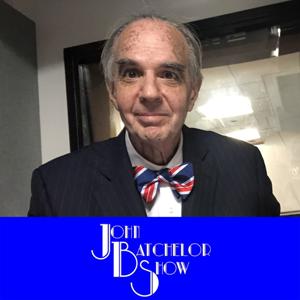
The John Batchelor Show

The John Batchelor Show

By John Batchelor Show.Society & CultureNewsArtsBooks
Download on the App Store
  • Ranking

    33rd

    on Books

  • Favorites

    578

    Followers

  • Typical duration

    18 min

    per episode

  • If it hooks

    62%

    finish an episode

Based on Podcast App listening data

The John Batchelor Show episodes

  • S8 Ep1256: Charles Burton: Charles Burton provides insight into the annual Beidaihe retreat, where Chinese leaders meet secretly to decide t
    Charles Burton: Charles Burton provides insight into the annual Beidaihe retreat, where Chinese leaders meet secretly to decide the party's direction. This year's focus is on a failing domestic economy, including a collapsed housing market and crushing local government debt. Burton notes that Xi Jinping's limited international travel may indicate internal instability. Additionally, the discussion touches on escalating trade tensions between Canada and the US over potential tariffs and disagreements regarding the financing of the new Gordie Howe International Bridge. (5)
    20 min
  • S8 Ep1255: Mark Clifford: Mark Clifford discusses the ongoing detention of British citizen and entrepreneur Jimmy Lai in Hong Kong. While Ch
    Mark Clifford: Mark Clifford discusses the ongoing detention of British citizen and entrepreneur Jimmy Lai in Hong Kong. While China recently released a Protestant pastor, Xi Jinping reportedly remains determined that Lai, a fervent Catholic and advocate for Western values, will die in prison. Clifford suggests Xi's animosity is personal, rooted in a belief that the survival of the Communist Party is paramount and that any dissent is an existential threat. Despite the UK's new leadership focusing on domestic issues, Clifford hopes the government continues to pressure Beijing for the release of its citizen. (4)
    10 min
  • S8 Ep1254: Captain James Fanell: Captain James Fanell reports on China's escalating campaign to annex international waters east of Taiwan. F
    Captain James Fanell: Captain James Fanell reports on China's escalating campaign to annex international waters east of Taiwan. For the first time, Chinese vessels are interrogating ships on the high seas, an outrageous violation of maritime norms. This aggression occurs as the US Navy is severely overstretched, with carrier deployments extending to nine months and the arsenal of democracy being depleted by conflicts in Ukraine and the Middle East. Fanell urges the US and partner navies to conduct joint maneuvers with Taiwan to counter Beijing's comprehensive national power strategy. (3)
    9 min
  • S8 Ep1253: Michael Lucchese: Michael Lucchese explores the history and modern return of isolationism within American politics, particularly
    Michael Lucchese: Michael Lucchese explores the history and modern return of isolationism within American politics, particularly the Republican Party. He characterizes isolationism as a short-sighted avoidance of global affairs that often coincides with political extremism. Lucchese argues that the West is currently in a civilizational contest against an axis of revisionist powers including China, Russia, Iran, and North Korea. He critiques recent administrations for showing a lack of civilizational confidence, which he believes has encouraged adversaries to be more aggressive on the world stage. (2)
    20 min
  • S8 Ep1252: Michael Bernstam: Michael Bernstam discusses a critical shortage of refined products such as diesel and gasoline, noting that glo
    Michael Bernstam: Michael Bernstam discusses a critical shortage of refined products such as diesel and gasoline, noting that global supply has dropped by 8.3 million barrels per day. While crude oil is available, refining capacity in the US and Europe has declined for decades. Recent Ukrainian drone strikes have further crippled Russia's refining capabilities, forcing it to import fuel. These disruptions, along with Houthi attacks in the Red Sea, contribute to a daily deficit of 2 million barrels. Bernstam warns that consumers worldwide will face higher energy and food prices indefinitely as a result. (1)
    18 min
  • S8 Ep1251: TABLE OF CONTENTS, JOHN BATCHELOR SHOW, 8-11-2-26 Mary Kissel discusses North Korea's transformation into a critical military su
    TABLE OF CONTENTS, JOHN BATCHELOR SHOW, 8-11-2-26Mary Kissel discusses North Korea's transformation into a critical military supplier for Russia's war in Ukraine, providing ballistic missiles and thousands of combat troops. This collaboration integrates Pyongyang into an "axis of tyranny" alongside Moscow, Beijing, and Tehran to challenge the West and NATO. Kissel notes that the Kim regime's involvement stems from a desire for cash, a need to demonstrate missile capabilities, and a shared goal of weakening U.S.global influence. This development highlights the long-term failure of U.S. diplomacy to prevent North Korean nuclear proliferation and serves as a warning regarding Iran. (1)Jonathan Schanzer addresses the mysterious absence of Iran's Supreme Leader and the resulting tightening grip of the IRGC on the government. The regime is characterized as sclerotic, relying on aging hardliners with "blood on their hands" to maintain power. Meanwhile, the Houthis have escalated attacks in the Red Sea, targeting Saudi infrastructure and shipping ports like Mocha and Jazan. Schanzer argues this is a strategic move by Iran to shut down trade on both sides of the Arabian Peninsula, exploiting a lack of unity between competitive regional powers like Saudi Arabia and the UAE. (2)Liz Peek analyzes the surprisingly vigorous U.S. economy, where consumer spending and small business optimism remain high despite elevated oil prices and stagnant job growth. While the Fed weighs interest rate hikes to curb inflation, a "wealth effect" from the stock market continues to buoy the economy. Politically, Peek highlights a "civil war" within the Democratic Party, where "revolutionary" candidates aligned with the Democratic Socialists of America (DSA) are challenging the establishment in key swing states like Michigan and Wisconsin. These far-left candidates struggle with electability among moderate voters in general elections. (3)Joseph Sternberg observes that the current midterm cycle has become an "election about nothing," with both parties failing to articulate clear policy agendas. He argues that Congress has outsourced its constitutional authority to the executive branch and regulatory agencies, losing the habit of legislating. This vacuum is being filled by "celebrity influencers" from the MAGA and DSA factions who prioritize social media attention over governing. Consequently, critical issues like Social Security reform and fiscal reality are being ignored until an inevitable crisis forces congressional action. (4)Gregory Copley evaluates the new "Mecca Joint Defense Agreement" between Saudi Arabia, Turkey, and Pakistan, which aims to counter Iranian influence despite mutual distrust among the members. The discussion also explores the massive transformation of global trade routes, including China's "Ice Silk Road" through the Arctic and Russia's International North-South Transport Corridor. Copley notes that these routes aim to bypass vulnerable maritime choke points like the Suez Canal and the Strait of Hormuz. Finally, he provides a report on King Charles III's summer activities and public engagements in Scotland. (5)Veronique de Rugy critiques the Trump administration's shift toward "socialism on the right," evidenced by the government taking ownership stakes in private companies like Intel. Often justified by national security, these interventions mirror European state-owned enterprise models that historically burden taxpayers and distort market competition. De Rugy argues that such moves make private companies hostage to government dictates, such as labor or diversity requirements. By adopting policies championed by far-left senators like Bernie Sanders, the administration risks damaging long-term economic efficiency and creating a "state enterprise" system similar to China's. (6)Ahmad Sharawi explains that Russia has secured its military foothold in Syria through a new memorandum of understanding with the Al-Shara government. Russia will maintain access to vital maritime and aerial bases for its operations in the Mediterranean and Africa, while Syria remains dependent on Russian grain and energy. Sharawi notes that the U.S. appears to be losing diplomatic leverage by removing sanctions without obtaining counterterrorism concessions or progress in neutralizing ISIS. The new Syrian administration is successfully playing major powers against each other to maintain domestic stability and maximize international benefits. (7)Samuel Ben-Ur and Bill Roggio discuss the "Board of Peace" plan for post-war Gaza, which proposes a civilian Palestinian government overseen by international forces. A significant impasse remains: Israel refuses to withdraw until Hamas is disarmed, while Hamas has endorsed the plan, likely hoping its allies—Turkey and Qatar—will oversee the verification process. The discussion reveals that Gaza's tunnel network is more extensive than previously believed, with only 40–50% cleared after years of war. One proposed solution to prevent Hamas from regrouping is filling the remaining tunnels with cement. (8)Thaddeus McCotter analyzes the Michigan Senate race between Mike Rogers and Abdul El-Sayed, a Rhodes Scholar supported by the far-left DSA. El-Sayed's primary victory over the Democratic establishment highlights the growing influence of "woke" ideology in college towns. While El-Sayed attempts to pivot to the center for the general election, his lack of a public voting record makes his true agenda difficult to pin down. McCotter suggests the race will test whether voters will reject the "Jacobin" manifestations of cancel culture and extreme progressive policies in favor of a more traditional candidate. (9)All nine files this time, with Gregory Copley in place at (5).

    6 min
  • S8 Ep1250: Thaddeus McCotter analyzes the Michigan Senate race between Mike Rogers and Abdul El-Sayed, a Rhodes Scholar supported by the far
    Thaddeus McCotter analyzes the Michigan Senate race between Mike Rogers and Abdul El-Sayed, a Rhodes Scholar supported by the far-left DSA. El-Sayed's primary victory over the Democratic establishment highlights the growing influence of "woke" ideology in college towns. While El-Sayed attempts to pivot to the center for the general election, his lack of a public voting record makes his true agenda difficult to pin down. McCotter suggests the race will test whether voters will reject the "Jacobin" manifestations of cancel culture and extreme progressive policies in favor of a more traditional candidate. (9)
    12 min
  • S8 Ep1249: Samuel Ben-Ur and Bill Roggio discuss the "Board of Peace" plan for post-war Gaza, which proposes a civilian Palestinian governme
    Samuel Ben-Ur and Bill Roggio discuss the "Board of Peace" plan for post-war Gaza, which proposes a civilian Palestinian government overseen by international forces. A significant impasse remains: Israel refuses to withdraw until Hamas is disarmed, while Hamas has endorsed the plan, likely hoping its allies—Turkey and Qatar—will oversee the verification process. The discussion reveals that Gaza's tunnel network is more extensive than previously believed, with only 40–50% cleared after years of war. One proposed solution to prevent Hamas from regrouping is filling the remaining tunnels with cement. (8)
    9 min
  • S8 Ep1248: V
    Ahmad Sharawi explains that Russia has secured its military foothold in Syria through a new memorandum of understanding with the Al-Shara government. Russia will maintain access to vital maritime and aerial bases for its operations in the Mediterranean and Africa, while Syria remains dependent on Russian grain and energy. Sharawi notes that the U.S. appears to be losing diplomatic leverage by removing sanctions without obtaining counterterrorism concessions or progress in neutralizing ISIS. The new Syrian administration is successfully playing major powers against each other to maintain domestic stability and maximize international benefits. (7)
    10 min
  • S8 Ep1247: Veronique de Rugy critiques the Trump administration's shift toward "socialism on the right," evidenced by the government taking
    Veronique de Rugy critiques the Trump administration's shift toward "socialism on the right," evidenced by the government taking ownership stakes in private companies like Intel. Often justified by national security, these interventions mirror European state-owned enterprise models that historically burden taxpayers and distort market competition. De Rugy argues that such moves make private companies hostage to government dictates, such as labor or diversity requirements. By adopting policies championed by far-left senators like Bernie Sanders, the administration risks damaging long-term economic efficiency and creating a "state enterprise" system similar to China's. (6)
    9 min

About The John Batchelor Show

From the publisher's feed

The John Batchelor Show is a hard news-analysis radio program on current events, world history, global politics and natural sciences. Based in New York City for two decades, the show has travelled…

Best of The John Batchelor Show

Ranked by our users in the last 21 days

More shows like The John Batchelor Show

Mark Levin Podcast by Cumulus Podcast Network

Mark Levin Podcast

22,898 Listeners

THE SAVAGE NATION by Michael Savage

THE SAVAGE NATION

11,901 Listeners

Hillsdale Dialogues by Hillsdale College

Hillsdale Dialogues

2,117 Listeners

Bill O’Reilly’s No Spin News and Analysis by Bill O'Reilly

Bill O’Reilly’s No Spin News and Analysis

12,599 Listeners

The Mark Simone Show by iHeartRadio and Mark Simone

The Mark Simone Show

732 Listeners

The Radio Free Hillsdale Hour by Hillsdale College

The Radio Free Hillsdale Hour

673 Listeners

Newt's World by Gingrich 360

Newt's World

6,549 Listeners

John Solomon Reports by John Solomon

John Solomon Reports

6,491 Listeners

The Hugh Hewitt Show: Highly Concentrated by Salem Podcast Network

The Hugh Hewitt Show: Highly Concentrated

714 Listeners

DINESH Podcast by Salem Podcast Network

DINESH Podcast

6,840 Listeners

The Big Ben Show by Fox News Podcasts

The Big Ben Show

557 Listeners

The Victor Davis Hanson Show by Victor Davis Hanson and Jack Fowler

The Victor Davis Hanson Show

8,404 Listeners

Kudlow by Fox News Podcasts

Kudlow

215 Listeners

Victor Davis Hanson: In His Own Words by Victor Davis Hanson | The Daily Signal

Victor Davis Hanson: In His Own Words

1,149 Listeners

Pod Force One by New York Post

Pod Force One

1,181 Listeners