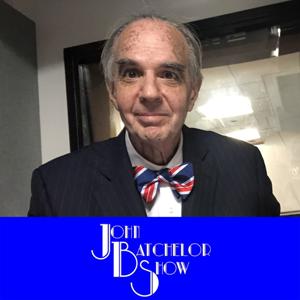
The John Batchelor Show

The John Batchelor Show

By John Batchelor Show.Society & CultureNewsArtsBooks
Download on the App Store
  • Ranking

    35th

    on Books

  • Favorites

    578

    Followers

  • Typical duration

    18 min

    per episode

  • If it hooks

    62%

    finish an episode

Based on Podcast App listening data

The John Batchelor Show episodes

  • S8 Ep1247: Gregory Copley evaluates the new "Mecca Joint Defense Agreement" between Saudi Arabia, Turkey, and Pakistan, which aims to counte
    Gregory Copley evaluates the new "Mecca Joint Defense Agreement" between Saudi Arabia, Turkey, and Pakistan, which aims to counter Iranian influence despite mutual distrust among the members. The discussion also explores the massive transformation of global trade routes, including China's "Ice Silk Road" through the Arctic and Russia's International North-South Transport Corridor. Copley notes that these routes aim to bypass vulnerable maritime choke points like the Suez Canal and the Strait of Hormuz. Finally, he provides a report on King Charles III's summer activities and public engagements in Scotland. (5)
    38 min
  • S8 Ep1246: Joseph Sternberg observes that the current election cycle lacks substantial policy agendas, as both major parties focus on politi
    Joseph Sternberg observes that the current election cycle lacks substantial policy agendas, as both major parties focus on political theater rather than governing. Congress has increasingly outsourced its legislative authority to the executive branch, leaving lawmakers to prioritize social media celebrity over constitutional responsibilities. This vacuum is filled by "influencer" politicians from both the MAGA and DSA factions who push extreme, non-consensus positions. Sternberg warns that this atrophy of the legislative process leaves critical national issues, such as Social Security reform and the mounting national debt, unaddressed until a fiscal crisis inevitably forces action. (4)
    20 min
  • S8 Ep1246: Liz Peek analyzes the resilience of the U.S. economy, where strong consumer spending and business optimism persist despite high o
    Liz Peek analyzes the resilience of the U.S. economy, where strong consumer spending and business optimism persist despite high oil prices and stagnant job growth. While the Fed weighs interest rate hikes to curb inflation, a "wealth effect" from a robust stock market continues to buoy higher-end consumers. Politically, a "civil war" is brewing within the Democratic Party as far-left candidates aligned with the Democratic Socialists of America (DSA) challenge the establishment in key swing states like Michigan and Wisconsin. These ideological divisions raise significant questions regarding the electability of progressive candidates in the upcoming general elections. (3)
    18 min
  • S8 Ep1245: Jonathan Schanzer discusses the opaque leadership within Iran, noting the Supreme Leader's prolonged absence and the IRGC's tight
    Jonathan Schanzer discusses the opaque leadership within Iran, noting the Supreme Leader's prolonged absence and the IRGC's tightening grip on power. The regime appears sclerotic, relying on aging loyalists while forcing the U.S. to remain engaged in regional conflicts to strain its economy. Simultaneously, the Houthis have escalated maritime attacks in the Red Sea and on Saudi infrastructure, effectively opening a new front in the conflict. This escalation exploits fractures between Arab states like Saudi Arabia and the UAE, who remain in competition rather than forming a unified front against Iranian proxy networks. (2)
    20 min
  • S8 Ep1245: Mary Kissel examines North Korea's emergence as a critical military supplier for Russia, providing ballistic missiles and combat
    Mary Kissel examines North Korea's emergence as a critical military supplier for Russia, providing ballistic missiles and combat troops to aid Vladimir Putin's war in Ukraine. This partnership integrates Pyongyang into a broader "axis of tyranny" alongside Moscow, Beijing, and Tehran. The discussion highlights the failure of past U.S. diplomatic efforts to prevent North Korea from becoming a nuclear power, which now serves as a warning for current dealings with Iran. Additionally, Kissel addresses the strategic complexities of Ukraine utilizing private technology like Starlink for strikes inside Russian territory and the intractable nature of negotiations with the ideological Iranian regime. (1)
    18 min
  • S8 Ep1244: TABLE OF CONTENTS JOHN BATCHELOR SHOW, 8-10-2026. John Hardie reports North Korea is deploying a specialized unit equipped with
    TABLE OF CONTENTS JOHN BATCHELOR SHOW, 8-10-2026.John Hardie reports North Korea is deploying a specialized unit equipped with KN-23 and KN-24 short-range ballistic missiles to assist Russia's war efforts. This shipment, potentially totaling 120 missiles, significantly bolsters Russia's magazine depth as it continues pounding Ukrainian cities. The relationship is mutually beneficial: Russia receives much-needed munitions and troops, while North Korea gains combat experience and technical assistance for its satellite and missile programs. Ukraine, facing a critical shortage of air defense interceptors, is seeking to use Starlink within Russian territory to hunt and strike these missile launchers before they can fire. (1)Ernesto Araújo and Alejandro Peña Esclusa report Venezuelan negotiators have established a timeline for a political transition, aiming to restore rights and select new electoral authorities by December. However, there are significant concerns regarding the lack of a firm election date and the ongoing militarization of the Bolivarian revolution. Simultaneously, diplomatic relations between Brazil and the U.S. have deteriorated, resulting in the U.S. revoking the credentials of Brazil's ambassador. In Colombia, new president Abelardo de la Espriella has launched a decisive military response against narco-terrorism, a move that regional leaders hope will dismantle the cross-border havens used by Venezuelan-linked criminal groups. (2)Malcolm Hoenlein discusses a new mutual defense pact between Saudi Arabia, Turkey, and Pakistan that has emerged to counter Iranian influence and the Muslim Brotherhood. Meanwhile, in Gaza, empirical data from UNICEF and the WHO challenges international narratives of famine, showing malnutrition rates are actually lower than in many neighboring countries. Theft of aid by Hamas remains a primary obstacle to relief efforts. In Iran, the regime faces severe domestic instability due to energy and water shortages, yet it continues to make extreme "non-negotiable" demands of the U.S., including $300 billion in reparations, while escalating public executions to silence internal dissent. (3)David Daoud explains Iran is currently leveraging negotiations with the U.S. to secure a ceasefire that protects Hezbollah from further Israeli military pressure while allowing the group to rebuild. Critics argue that U.S. security assistance to the Lebanese Armed Forces (LAF) is a poor investment, as the LAF lacks the political will to disarm Hezbollah within its own borders. While a fragile ceasefire has shifted active war toward localized "policing operations" and skirmishes, Hezbollah explicitly rejects any linkage between an Israeli withdrawal and its own disarmament. The Trump administration is reportedly prioritizing "quiet" in Lebanon, which has forced Israeli forces into a more reactive posture. (4)Mariam Wahba reports the Sudanese civil war between the Sudanese Armed Forces (SAF) and the Rapid Support Forces (RSF), now entering its fourth year, has left over 400,000 dead. The conflict has evolved into a complex proxy war; the UAE supports the RSF to gain access to gold mines, while Egypt and Turkey lean toward the SAF. Iran has further complicated the battlefield by selling drones and hardware to both factions. Although neither side is seen as morally superior, civilians frequently celebrate when the SAF liberates territory from the RSF. Sudanese activists continue to call for a transition to civilian government despite the ongoing violence. (5)Bridget Toomey reports the Houthis have escalated their regional campaign by striking Saudi Arabia's Jazan refinery, demonstrating their ability to disrupt global energy markets despite recent defense pacts. Within Yemen, the Houthis are intensifying attacks on government-held ports like Mocha and oil-rich regions like Marib to expand their territorial control. These strikes often target civilian displacement camps, using ballistic missiles and drones to sow terror and gain leverage in future negotiations. While Saudi Arabia pursues diplomatic off-ramps through Omani mediation, the Houthis continue to use military pressure to force an agreement favorable to their long-term dominance. (6)Edmund Fitton-Brown describes the Houthis' methodical campaign, likely coordinated with Iran, to intimidate Saudi Arabia and prevent its entry into the Abraham Accords. Recent strikes on Mocha and Jazan highlight a resurgence of the 12-year-old Yemeni civil war, which remains a primary source of regional instability. While a new Sunni alliance between Pakistan and Turkey offers symbolic support to the Saudis, it lacks the practical military "teeth" to intervene on the ground. Meanwhile, the UAE is asserting itself as an agile regional powerhouse, investing in high-tech infrastructure and maintaining an uncompromising stance against the Muslim Brotherhood. (7)Janatyn Sayeh analyzes the appointment of Mohsen Rezaei, an original IRGC veteran, to the Supreme National Security Council, signaling a return to hardline, ideologically driven decision-making in Tehran. Rezaei, linked to past international terrorism, reinforces the regime's aggressive stance against the U.S. and Israel. Iran currently refuses to engage in talks until the U.S. meets extreme demands, including unfreezing all assets and paying billions in reparations. The regime utilizes a "good cop, bad cop" strategy between factions to maximize leverage, but remains unified in its goals of expanding its nuclear program and securing regional dominance through its "resistance axis." (8)Conrad Black reports Prime Minister Mark Carney is under pressure to revitalize Canada's economy 16 months after his election. Despite being a "treasure house" of resources, Canada suffers from lengthy project delays caused by redundant provincial regulations and indigenous land claims. Black notes that Canada's public sector workforce is disproportionately large, representing 12% of the population, and calls for corporate tax cuts to foster competitiveness. While Carney is exploring diversified trade, the U.S. remains Canada's indispensable partner, accounting for roughly 64% of its trade. Carney's political survival depends on achieving the kind of robust growth seen south of the border. (9)Scott Harold explains the U.S. and Japan are adopting a "walking quietly and carrying a big stick" approach to deter a Chinese attack on Taiwan. This strategy involves creating a "hellscape" of thousands of drones and missiles to make an amphibious assault impossibly risky for Beijing. While Japan's official documents avoid explicitly naming Taiwan to prevent escalation, its leadership views a conflict as a survival-endangering situation. China's attempts to annex portions of the Western Pacific as domestic waters pose a direct threat to the global economy. Persistent deterrence remains essential, as the Chinese military currently lacks high-end operational experience and faces leadership purges. (10)Bill Gertz reports a Pentagon official's attendance at a People's Liberation Army (PLA) celebration has sparked fears of a "defeatist" accommodation policy toward Beijing. Critics argue that seeking "respectful relations" with a Leninist regime is interpreted as subservience and weakness. This shift is reportedly influenced by concerns over Chinese control of rare earth minerals. China continues its global expansion and military bullying against neighbors like the Philippinesand Japan. Gertz warns that the U.S. education system is failing to inform the public about the threats of China's high-tech totalitarian system, which seeks to dominate through economic and military coercion. (11)

    8 min
  • S8 Ep1243: Bill Gertz reports a Pentagon official's attendance at a People's Liberation Army (PLA) celebration has sparked fears of a "defea
    Bill Gertz reports a Pentagon official's attendance at a People's Liberation Army (PLA) celebration has sparked fears of a "defeatist" accommodation policy toward Beijing. Critics argue that seeking "respectful relations" with a Leninist regime is interpreted as subservience and weakness. This shift is reportedly influenced by concerns over Chinese control of rare earth minerals. China continues its global expansion and military bullying against neighbors like the Philippinesand Japan. Gertz warns that the U.S. education system is failing to inform the public about the threats of China's high-tech totalitarian system, which seeks to dominate through economic and military coercion. (11)
    11 min
  • S8 Ep1242: Scott Harold explains the U.S. and Japan are adopting a "walking quietly and carrying a big stick" approach to deter a Chinese at
    Scott Harold explains the U.S. and Japan are adopting a "walking quietly and carrying a big stick" approach to deter a Chinese attack on Taiwan. This strategy involves creating a "hellscape" of thousands of drones and missiles to make an amphibious assault impossibly risky for Beijing. While Japan's official documents avoid explicitly naming Taiwan to prevent escalation, its leadership views a conflict as a survival-endangering situation. China's attempts to annex portions of the Western Pacific as domestic waters pose a direct threat to the global economy. Persistent deterrence remains essential, as the Chinese military currently lacks high-end operational experience and faces leadership purges. (10)
    10 min
  • S8 Ep1242: Conrad Black reports Prime Minister Mark Carney is under pressure to revitalize Canada's economy 16 months after his election. De
    Conrad Black reports Prime Minister Mark Carney is under pressure to revitalize Canada's economy 16 months after his election. Despite being a "treasure house" of resources, Canada suffers from lengthy project delays caused by redundant provincial regulations and indigenous land claims. Black notes that Canada's public sector workforce is disproportionately large, representing 12% of the population, and calls for corporate tax cuts to foster competitiveness. While Carney is exploring diversified trade, the U.S. remains Canada's indispensable partner, accounting for roughly 64% of its trade. Carney's political survival depends on achieving the kind of robust growth seen south of the border. (9)
    9 min
  • S8 Ep1241: Janatyn Sayeh analyzes the appointment of Mohsen Rezaei, an original IRGC veteran, to the Supreme National Security Council, sign
    Janatyn Sayeh analyzes the appointment of Mohsen Rezaei, an original IRGC veteran, to the Supreme National Security Council, signaling a return to hardline, ideologically driven decision-making in Tehran. Rezaei, linked to past international terrorism, reinforces the regime's aggressive stance against the U.S. and Israel. Iran currently refuses to engage in talks until the U.S. meets extreme demands, including unfreezing all assets and paying billions in reparations. The regime utilizes a "good cop, bad cop" strategy between factions to maximize leverage, but remains unified in its goals of expanding its nuclear program and securing regional dominance through its "resistance axis." (8)
    V
    9 min

About The John Batchelor Show

From the publisher's feed

The John Batchelor Show is a hard news-analysis radio program on current events, world history, global politics and natural sciences. Based in New York City for two decades, the show has travelled…

Best of The John Batchelor Show

Ranked by our users in the last 21 days

More shows like The John Batchelor Show

Mark Levin Podcast by Cumulus Podcast Network

Mark Levin Podcast

22,898 Listeners

THE SAVAGE NATION by Michael Savage

THE SAVAGE NATION

11,901 Listeners

Hillsdale Dialogues by Hillsdale College

Hillsdale Dialogues

2,117 Listeners

Bill O’Reilly’s No Spin News and Analysis by Bill O'Reilly

Bill O’Reilly’s No Spin News and Analysis

12,599 Listeners

The Mark Simone Show by iHeartRadio and Mark Simone

The Mark Simone Show

732 Listeners

The Radio Free Hillsdale Hour by Hillsdale College

The Radio Free Hillsdale Hour

673 Listeners

Newt's World by Gingrich 360

Newt's World

6,549 Listeners

John Solomon Reports by John Solomon

John Solomon Reports

6,491 Listeners

The Hugh Hewitt Show: Highly Concentrated by Salem Podcast Network

The Hugh Hewitt Show: Highly Concentrated

714 Listeners

DINESH Podcast by Salem Podcast Network

DINESH Podcast

6,840 Listeners

The Big Ben Show by Fox News Podcasts

The Big Ben Show

557 Listeners

The Victor Davis Hanson Show by Victor Davis Hanson and Jack Fowler

The Victor Davis Hanson Show

8,404 Listeners

Kudlow by Fox News Podcasts

Kudlow

215 Listeners

Victor Davis Hanson: In His Own Words by Victor Davis Hanson | The Daily Signal

Victor Davis Hanson: In His Own Words

1,149 Listeners

Pod Force One by New York Post

Pod Force One

1,181 Listeners