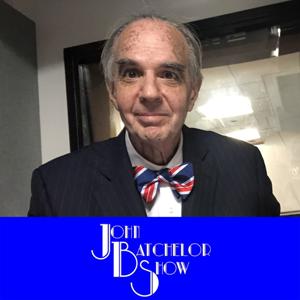
The John Batchelor Show

The John Batchelor Show

By John Batchelor Show.Society & CultureNewsArtsBooks
Download on the App Store
  • Ranking

    33rd

    on Books

  • Favorites

    578

    Followers

  • Typical duration

    18 min

    per episode

  • If it hooks

    62%

    finish an episode

Based on Podcast App listening data

The John Batchelor Show episodes

  • S8 Ep1159: Evan Ellis notes former Honduran President Juan Orlando Hernández returned to Honduras following a pardon by President Trump, des
    Evan Ellis notes former Honduran President Juan Orlando Hernández returned to Honduras following a pardon by President Trump, despite previous US convictions for cocaine trafficking. In Venezuela, the US has collected over $13 billion in oil revenue, yet economic recovery remains muted following recent earthquakes. The lack of transparency regarding these funds raises concerns about their management under the Rodríguez regime. Simultaneously, Colombia's new leader faces the challenge of dismantling entrenched cocaine cartels. (3)
    1900 MEXICO
    17 min
  • S8 Ep1159: Evan Ellis reports Cuba faces a severe humanitarian crisis with failing electricity, yet the communist regime maintains tight con
    Evan Ellis reports Cuba faces a severe humanitarian crisis with failing electricity, yet the communist regime maintains tight control. A recent State Department report labels Cuba the "capital of 21st-century communism," citing its subversion of Latin American democracies and involvement in left-wing political terrorism. Meanwhile, in Nicaragua, Daniel Ortega and Rosario Murillo have officially abolished future elections, claiming the opposition seeks to "capture power" through voting. This moves the country toward becoming a "hermit kingdom." (2)
    1880
    7 min
  • S8 Ep1159: Evan Ellis examines Mexico's economy, increasingly integrated into the American market and moving beyond oil into diverse manufac
    Evan Ellis examines Mexico's economy, increasingly integrated into the American market and moving beyond oil into diverse manufacturing sectors. Despite Trump administration objections to the USMCA, the treaty includes provisions requiring a ten-year exit process. Current negotiations reflect tensions over Chinese inputs, automotive tariffs, and labor standards. President Claudia Sheinbaum manages these diplomatic challenges while cooperating with the US on extradition, drug lab seizures, and stemming illegal immigration through Mexican territory. (1)
    1900 MEXICO
    12 min
  • S8 Ep1156: STREAMING MAKING JOHN BATCHELOR SHOW, 7-22-2026. 1900 CALDWELL IDAHO The provided transcript captures a behind-the-scenes and l
    STREAMING MAKING JOHN BATCHELOR SHOW, 7-22-2026.1900 CALDWELL IDAHOThe provided transcript captures a behind-the-scenes and live broadcast dialogue from The John Bachelor Show, where the host and guests analyze global geopolitical instability and economic shifts. A primary focus is the emergence of the World Artificial Intelligence Cooperation Organization (WAICO), which the participants characterize as a strategic attempt by China to dominate international technological standards despite its own internal economic struggles. The conversation further examines a legislative push by the Democratic Socialists of America to reduce the United States nuclear triad, a move the guests label as dangerous unilateral disarmament. Additionally, the experts discuss the escalating conflict in the Middle East, specifically focusing on Houthi threats to maritime trade and the complex maneuvers of global superpowers in the region. Throughout the recording, the speakers emphasize the deteriorating state of the Chinese economy and the necessity for the United States to maintain its competitive edge in both military and technological sectors. This comprehensive overview illustrates the interconnected nature of modern warfare, emerging AI governance, and international energy markets.
    1 hr 1 min
  • S8 Ep1157: SCHEDULE FOR THE JOHN BATCHELOR SHOW, 7-22-2026. 1740 BATAVIA MASSACRE Gordon Chang and Rick Fisher examine Xi Jinping's introd
    SCHEDULE FOR THE JOHN BATCHELOR SHOW, 7-22-2026.1740 BATAVIA MASSACREGordon Chang and Rick Fisher examine Xi Jinping's introduction of the World Artificial Intelligence Cooperation Organization (WAICO), designed to establish Chinese dominance in setting global AI rules. Headquartered in Shanghai, the group aims to make international partners dependent on Chinese technology while promoting anti-democratic values. Meanwhile, China's economy is struggling, with real growth potentially near zero. Despite manufacturing strengths, China remains vulnerable due to a critical lack of high-end Nvidia chips required for advanced AI development. (1)Gordon Chang and Peter Huessy discuss the Democratic Socialists of America (DSA) bill to drastically reduce the U.S. nuclear triad, including cutting ICBMs from 400 to 150. Supported by Senators Bernie Sanders and Elizabeth Warren, the plan effectively promotes unilateral disarmament. Critics argue this trashes the concept of nuclear deterrence just as China and Russia expand their arsenals. Furthermore, there is a widespread "miseducation" of Americans regarding the necessity of a modernized nuclear deterrent. (2)Gordon Chang and Victoria Coates report that Iran has activated the Houthis to attack the Bab el-Mandeb strait, a critical choke point for Saudi Arabian oil exports. This escalation has pushed oil prices past $95 as the Houthis use Iranian-supplied missiles and drones to harass shipping. While the House of Saud is targeted, internal frictions between Saudi Arabia and the UAE complicate a unified regional response. The conflict represents a major humanitarian and economic disaster for global commerce. (3)Gordon Chang and Victoria Coates continue: China benefits from discounted Iranian oil but views the regime's economic instability as a "bad debt." Simultaneously, Saudi Arabia is deepening its partnership with the U.S. through a landmark nuclear cooperation deal. Iraq has also signaled a shift toward Washington, signing $60 billion in energy deals with American companies like Chevron. While Russia seeks to sell extra capacity to Asia, Ukrainian strikes on refineries may hinder Putin's ability to remain a reliable energy supplier. (4)Peter Earle traces how the word "trillion" entered the economic lexicon in 1981 when the U.S. passed $1 trillion in public debt. Today, the U.S. national debt approaches $40 trillion, with annual interest payments exceeding $1 trillion. Unlike 19th-century millionaires who faced high risks, modern trillion-dollar figures are often a product of government monetary expansion. We have entered "Trillionstan," where massive quantities of money are common, yet their long-term significance is often overlooked by the public. (5)Peter Earle argues that not all trillions are equal; some represent genuine wealth creation, such as SpaceX's $2 trillion valuation based on future technological potential. However, inflation and government borrowing have also inflated nominal values, potentially leading to a fiscal reckoning. If creditors lose faith in U.S. debt, the government may be forced to print more money, further devaluing the currency. Maintaining prosperity requires ensuring that economic forces focus on creating new wealth rather than merely redistributing it. (6)Henry Sokolski warns that the Trump administration's nuclear deal with Saudi Arabia allows the kingdom to enrich uranium, a process that can easily be diverted for bomb-making. Saudi Arabia has rejected the "additional protocol" for rigorous UN inspections, raising concerns about their true intentions. This "black box" arrangement lacks sufficient safeguards to prevent a rapid diversion of nuclear materials. Critics warn that providing enrichment technology to an ally involved in regional warfare is inherently delusional and dangerous. (7)Henry Sokolski continues: the Saudi nuclear deal could trigger a proliferation race, with nations like Egypt, Turkey, and the UAE demanding similar enrichment rights. Furthermore, allies such as South Korea and Poland may reconsider their own nuclear ambitions if they view American security guarantees as insufficient. Proliferation is no longer "old news" but a growing threat as nations seek their own deterrents. The result is a destabilized global order where multiple states hover on the verge of nuclear weapon status. (8)Michael Bernstam explains how Ukrainian drone strikes have destroyed 30% of Russia's refining capacity, causing the "crack spread"—the profit margin for refining oil—to triple worldwide. While Russia exports crude, it now suffers from severe domestic shortages of gasoline and jet fuel. Consequently, Russia is forced to buy back its own refined oil from India at premium prices. Putin has been "hoist on his own petard," creating a global energy weapon that has ultimately turned against the Russian economy. (9)Michael Bernstam reports that Ukrainian drones recently destroyed major distribution hubs for Wildberries, the Russian equivalent of Amazon, causing $2 billion in damage. These strikes have devastated small businesses and middle-class consumers, fueling internal resentment against the Kremlin. Simultaneously, 18 local Russian officials signed a petition calling for Putin's resignation as economic conditions worsen. The loss of consumer infrastructure and rising fuel costs are creating a constituency for ending the war to prevent a total economic collapse. (10)Bob Zimmerman reports that SpaceX is preparing for its 13th Starship flight, a prototype featuring major upgrades for future orbital missions and in-orbit refueling. In India, the startup Skyroot achieved a landmark success with the Vikram-1 rocket, signaling the rise of a private, capitalist space sector. However, the Indian government has counterproductively restricted ISRO employees from leaving for private firms. These contrasting approaches highlight the tension between state-run agencies and the efficiency of private enterprise in the global space race. (11)Bob Zimmerman surveys new discoveries: astronomers have detected a helium atmosphere on a terrestrial exoplanet located 48 light-years away in its star's habitable zone. Closer to home, archival data from Pluto reveals massive landslides, proving the dwarf planet is geologically active rather than dormant. Meanwhile, new images of Valles Marineris on Mars illustrate the canyon's staggering scale, with depths equivalent to the height of Mount McKinley. These discoveries emphasize that planetary bodies across our solar system are dynamic and evolving. (12)Simon Constable notes European energy prices are skyrocketing, with Brent crude hitting $95 and natural gas up 47% in a single month. In France, a heatwave and suspicious forest fires have added environmental stress to the economic crisis. A political movement in the U.S. is targeting data centers for their high energy consumption, which now exceeds 4% of usage. Surprisingly, the United Kingdom hosts the second-highest number of data centers globally, despite its historical association with "Luddite" skepticism. (13)Simon Constable observes that new British Prime Minister Andy Burnham faces immediate skepticism, with polls indicating nearly half of voters feel his government lacks direction. Burnham's focus on domestic issues like capping bus prices is criticized as a "tax and spend" policy that might alienate the wealthy. While he has emphasized national security, his early days have been defined by local populist initiatives. Critics worry his leadership style mimics a "Lord Mayor" rather than a strategic global prime minister. (14)Brandy Shufutinsky details how Qatar has provided extensive grants for Arabic language and culture programs in U.S.K-12 schools. These programs often utilize textbooks that omit Israel from maps and glorify extremist ideologies. Qatar Foundation International (QFI) even funds teacher salaries and work visas, raising concerns about who these educators truly report to. This funding creates a "pipeline" from elementary school to higher education, potentially instilling foreign-influenced perspectives in future generations of American citizens. (15)Conrad Black argues that Canada's economic growth has stalled due to high corporate taxes and "climate alarmist" policies under the Trudeau government. He suggests that new leadership under Mark Carney could revitalize the nation by making it more tax-competitive with the U.S. Canada's vast resources and skilled workforce provide the potential for a rapid rebound. For Canada to succeed, it must pivot back to pro-capitalist policies and attract foreign investment to drive future growth. (16)Two spelling corrections applied: Peter Earle (5, 6 — transcribed as "Pete Earl"; the AIER economist) and Brandy Shufutinsky (15 — transcribed as "Shubatinsky"). Both added to the log unless you'd prefer otherwise.

    7 min
  • S8 Ep1156: Conrad Black argues that Canada's economic growth has stalled due to high corporate taxes and "climate alarmist" policies under t
    Conrad Black argues that Canada's economic growth has stalled due to high corporate taxes and "climate alarmist" policies under the Trudeau government. He suggests that new leadership under Mark Carney could revitalize the nation by making it more tax-competitive with the U.S. Canada's vast resources and skilled workforce provide the potential for a rapid rebound. For Canada to succeed, it must pivot back to pro-capitalist policies and attract foreign investment to drive future growth. (16)
    1945
    10 min
  • S8 Ep1156: Brandy Shufutinsky details how Qatar has provided extensive grants for Arabic language and culture programs in U.S. K-12 schools.
    Brandy Shufutinsky details how Qatar has provided extensive grants for Arabic language and culture programs in U.S.K-12 schools. These programs often utilize textbooks that omit Israel from maps and glorify extremist ideologies. Qatar Foundation International (QFI) even funds teacher salaries and work visas, raising concerns about who these educators truly report to. This funding creates a "pipeline" from elementary school to higher education, potentially instilling foreign-influenced perspectives in future generations of American citizens. (15)
    SEPTEMBER 1932
    11 min
  • S8 Ep1156: Simon Constable observes that new British Prime Minister Andy Burnham faces immediate skepticism, with polls indicating nearly ha
    Simon Constable observes that new British Prime Minister Andy Burnham faces immediate skepticism, with polls indicating nearly half of voters feel his government lacks direction. Burnham's focus on domestic issues like capping bus prices is criticized as a "tax and spend" policy that might alienate the wealthy. While he has emphasized national security, his early days have been defined by local populist initiatives. Critics worry his leadership style mimics a "Lord Mayor" rather than a strategic global prime minister. (14)
    JULY 1930
    5 min
  • S8 Ep1156: Simon Constable notes European energy prices are skyrocketing, with Brent crude hitting $95 and natural gas up 47% in a single mo
    Simon Constable notes European energy prices are skyrocketing, with Brent crude hitting $95 and natural gas up 47% in a single month. In France, a heatwave and suspicious forest fires have added environmental stress to the economic crisis. A political movement in the U.S. is targeting data centers for their high energy consumption, which now exceeds 4% of usage. Surprisingly, the United Kingdom hosts the second-highest number of data centers globally, despite its historical association with "Luddite" skepticism. (13)
    DECEMBER 1931
    14 min
  • S8 Ep1156: Bob Zimmerman surveys new discoveries: astronomers have detected a helium atmosphere on a terrestrial exoplanet located 48 light-
    Bob Zimmerman surveys new discoveries: astronomers have detected a helium atmosphere on a terrestrial exoplanet located 48 light-years away in its star's habitable zone. Closer to home, archival data from Pluto reveals massive landslides, proving the dwarf planet is geologically active rather than dormant. Meanwhile, new images of Valles Marineris on Mars illustrate the canyon's staggering scale, with depths equivalent to the height of Mount McKinley. These discoveries emphasize that planetary bodies across our solar system are dynamic and evolving. (12)
    OCTOBER 1958
    7 min

About The John Batchelor Show

From the publisher's feed

The John Batchelor Show is a hard news-analysis radio program on current events, world history, global politics and natural sciences. Based in New York City for two decades, the show has travelled…

Best of The John Batchelor Show

Ranked by our users in the last 21 days

More shows like The John Batchelor Show

Mark Levin Podcast by Cumulus Podcast Network

Mark Levin Podcast

22,896 Listeners

THE SAVAGE NATION by Michael Savage

THE SAVAGE NATION

11,893 Listeners

Hillsdale Dialogues by Hillsdale College

Hillsdale Dialogues

2,118 Listeners

Bill O’Reilly’s No Spin News and Analysis by Bill O'Reilly

Bill O’Reilly’s No Spin News and Analysis

12,600 Listeners

The Mark Simone Show by iHeartRadio and Mark Simone

The Mark Simone Show

731 Listeners

The Radio Free Hillsdale Hour by Hillsdale College

The Radio Free Hillsdale Hour

672 Listeners

Newt's World by Gingrich 360

Newt's World

6,550 Listeners

John Solomon Reports by John Solomon

John Solomon Reports

6,484 Listeners

The Hugh Hewitt Show: Highly Concentrated by Salem Podcast Network

The Hugh Hewitt Show: Highly Concentrated

713 Listeners

DINESH Podcast by Salem Podcast Network

DINESH Podcast

6,838 Listeners

The Big Ben Show by Fox News Podcasts

The Big Ben Show

557 Listeners

The Victor Davis Hanson Show by Victor Davis Hanson and Jack Fowler

The Victor Davis Hanson Show

8,406 Listeners

Kudlow by Fox News Podcasts

Kudlow

215 Listeners

Victor Davis Hanson: In His Own Words by Victor Davis Hanson | The Daily Signal

Victor Davis Hanson: In His Own Words

1,149 Listeners

Pod Force One by New York Post

Pod Force One

1,180 Listeners