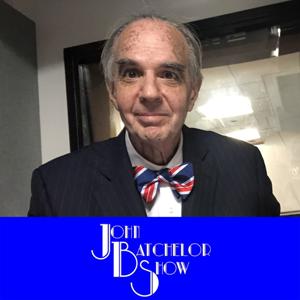
The John Batchelor Show

The John Batchelor Show

By John Batchelor Show.Society & CultureNewsArtsBooks
Download on the App Store
  • Ranking

    33rd

    on Books

  • Favorites

    578

    Followers

  • Typical duration

    18 min

    per episode

  • If it hooks

    62%

    finish an episode

Based on Podcast App listening data

The John Batchelor Show episodes

  • S8 Ep1156: Gordon Chang and Rick Fisher examine Xi Jinping's introduction of the World Artificial Intelligence Cooperation Organization (WAI
    Gordon Chang and Rick Fisher examine Xi Jinping's introduction of the World Artificial Intelligence Cooperation Organization (WAICO), designed to establish Chinese dominance in setting global AI rules. Headquartered in Shanghai, the group aims to make international partners dependent on Chinese technology while promoting anti-democratic values. Meanwhile, China's economy is struggling, with real growth potentially near zero. Despite manufacturing strengths, China remains vulnerable due to a critical lack of high-end Nvidia chips required for advanced AI development. (1)
    1923 TOKYO EARTHQUAKE
    9 min
  • S8 Ep1155: SCHEDUKE JBS 7-21-26
    SCHEDUKE JBS 7-21-26Elizabeth Peek joins John Batchelor to discuss how rising gasoline prices act as a talisman for consumer sentiment and presidential approval. Despite low unemployment and rising real wages, the public remains fixated on energy costs. Peek criticizes Republican messaging and highlights the massive AI-driven investment boom currently occurring. (1)Elizabeth Peek discusses New York mayoral candidate Zohran Mamdani's inability to define the "working class." She argues the Democratic Socialists of America (DSA) primarily represent white, college-educated liberals rather than manual laborers. They also discuss Kevin Warsh as a potential Fed chairman and the independence of interest rate decisions. (2)Peter Berkowitz examines Vice President JD Vance's views on restoring Christianity in America. Berkowitz highlights the ambiguity in Vance's stance regarding government involvement in religion. They contrast Vance's rhetoric with James Madison's historical opposition to state-funded religion, emphasizing the constitutional separation of church and state. (3)Ahmad Sharawi reports on Syria's interception of sophisticated Iranian weapons—including cruise missile components—destined for Hezbollah. The weapons were concealed in Iraqi oil tankers. This move is seen as Al-Shara's attempt to gain international trust and investment by demonstrating a commitment to containing Hezbollah's rearmament. (4)Mary Kissel discusses the ongoing conflict with Iran in the Strait of Hormuz. She argues there is no diplomatic overlap because Iran views nuclear weapons as essential for survival. Kissel notes the lack of a broad international coalition and warns that regional allies might seek accommodation with Tehran. (5)Mary Kissel turns to NATO's lack of unity regarding the Ukraine war. Kissel argues that while Eastern Europeannations feel the threat, Western Europe focuses on domestic politics. She highlights the emergence of a "new alliance" of Russia, Iran, and China, which poses a significant hybrid threat. (6)Joseph Sternberg analyzes China's struggling economy, noting that official growth targets are likely overstated. Facing a real estate crater and demographic decline, China is reverting to an export-heavy model. Unlike Japan's past recovery, China's adversarial stance makes trading partners less willing to absorb its gluts. (7)Joseph Sternberg discusses the transition to Prime Minister Andy Burnham in the UK. Burnham, who took office without an election mandate, faces a heavily taxed economy and bond market skepticism. Sternberg critiques Burnham's big-government agenda and resistance to market reforms, suggesting it may drive away wealth. (8)Gregory Copley evaluates Prime Minister Andy Burnham's new cabinet, specifically John Healey as Chancellor and Wes Streeting as Defense Secretary. While the government aims to boost defense spending and support Ukraine, Copley questions its legitimacy without a fresh mandate and notes a lack of long-term global strategic planning. (9)Gregory Copley covers the alienation of Canada under the Trump administration. Copley explains how Canada is diversifying its defense procurement—buying Swedish aircraft and Australian radar—rather than relying on the US. This shift threatens the NORAD partnership and results in billions of dollars lost for US aerospace industries. (10)Gregory Copley explores the "balance of ignorance," where declining literacy and social media lead to a loss of national identity. He argues that governments make poor strategic decisions because they no longer understand their own history or adversaries, citing the current US conflict with Iran as a primary example. (11)Gregory Copley explains King Charles III's role in forming Andy Burnham's government. The King's "blessing" provides constitutional legitimacy to the transition. Copley notes Burnham is the first practicing Roman Catholic Prime Minister and highlights the King's departure to Glasgow to open the Commonwealth Games. (12)Former Congressman Thaddeus McCotter discusses how rising gas prices and inflation hurt Republicans in swing states. They also examine the Trump administration's use of the Smoot-Hawley Act to threaten tariffs on Canada. McCotter views these as punitive measures that weaken the broader argument for necessary trade protections. (13)Thaddeus McCotter comments on a recent presidential address regarding the 2020 election. He argues that claiming the system is "rigged" is counterproductive for Republican turnout. McCotter suggests that voters care far more about the "price of gas" and groceries than relitigating past elections that the party lost. (14)John Batchelor and Peter Huessy review classic nuclear war films like Godzilla, On the Beach, and Dr. Strangelove. Huessy argues that while these films highlight the horrors of nuclear use, real-world focus has evolved toward deterrence and sophisticated safety systems designed to prevent accidental or unauthorized missile launches. (15)Peter Huessy continues the discussion of nuclear films like Fail Safe and The Day After. Huessy disputes claims that The Day After motivated Ronald Reagan's arms control efforts, noting Reagan was a committed advocate for nuclear reductions long before the movie's massive 1983 television broadcast. (16)Corrections applied silently: Ahmad Sharawi (4) and Thaddeus McCotter (13, 14) per the log.

    10 min
  • S8 Ep1154: STREAMING THE MAKING OF The JOHM BATCHELOR SHOW, 7-21-26 1903 This transcript captures a discussion between John Batchelor and
    STREAMING THE MAKING OF The JOHM BATCHELOR SHOW, 7-21-261903This transcript captures a discussion between John Batchelor and former Congressman Thaddeus McCarter regarding the geopolitical and domestic challenges facing the United States as it nears a midterm election. Internationally, the dialogue covers a variety of crises, including the outbreak of Ebola in Africa, military tensions with Iran and Hezbollah, and brewing trade disputes involving Canadian tariffs. Domestically, the speakers analyze how rising gasoline prices and inflation are shaping voter sentiment and impacting Republican strategy. They also address the internal fractures within both major parties, specifically the influence of MAGA loyalists on the right and Democratic Socialists on the left. Finally, the conversation critiques President Trump’s fixation on the 2020 election, questioning whether such rhetoric hinders the party’s future viability.
    51 min
  • S8 Ep1153: Peter Huessy. The discussion continues with a focus on films like Fail-Safe and The Day After. Huessy highlights how these movies
    Peter Huessy. The discussion continues with a focus on films like Fail-Safe and The Day After. Huessy highlights how these movies influenced public perception and presidential policy, including Ronald Reagan's drive for arms reduction. They reflect on the devastating human and economic consequences of a potential nuclear exchange. (16)
    2945 NAGASAKI
    9 min
  • S8 Ep1153: Peter Huessy. Peter Huessy and John Batchelor review classic films like Godzilla, On the Beach, and Dr. Strangelove to discuss cu
    Peter Huessy. Peter Huessy and John Batchelor review classic films like Godzilla, On the Beach, and Dr. Strangelove to discuss cultural fears of nuclear war. They contrast cinematic depictions of accidental launches with modern safeguards, emphasizing the importance of maintaining a credible nuclear deterrent in a complex geopolitical landscape. (15)
    1940
    11 min
  • S8 Ep1153: Thaddeus McCotter. McCotter analyzes the president's recent address regarding the 2020 election, calling it a strategic narrative
    Thaddeus McCotter. McCotter analyzes the president's recent address regarding the 2020 election, calling it a strategic narrative designed to insulate himself against potential midterm losses. He argues that focusing on past grievances rather than current economic concerns like gas prices and inflation may be counterproductive for the Republican Party's success. (14)
    1950 STORK CLUB
    8 min
  • S8 Ep1153: Thaddeus McCotter. Thaddeus McCotter discusses how high gasoline prices and affordability issues weigh on the upcoming U.S. midte
    Thaddeus McCotter. Thaddeus McCotter discusses how high gasoline prices and affordability issues weigh on the upcoming U.S. midterms. The conversation also covers the Trump administration's use of punitive tariffs against Canada, drawing parallels to the Smoot-Hawley Act, which historically exacerbated the Great Depression by triggering international trade wars. (13)
    11 min
  • S8 Ep1153: Gregory Copley. This segment highlights the transition of power in the UK, where King Charles III invited Andy Burnham to form a
    Gregory Copley. This segment highlights the transition of power in the UK, where King Charles III invited Andy Burnham to form a government. Copley explains the King's role as the symbolic representative of the nation, providing constitutional legitimacy and "blessing" the transition without direct political interference or leaving fingerprints on policy. (12)
    1936 JERUSALEM
    6 min
  • S8 Ep1153: Gregory Copley. The discussion centers on the fraying relationship between the U.S. and Canada. Copley explains how Canada is ass
    Gregory Copley. The discussion centers on the fraying relationship between the U.S. and Canada. Copley explains how Canada is asserting its sovereignty by moving away from U.S. defense procurement, opting for Australian and Swedish technologies over American systems like the F-35, largely due to political alienation felt under the current administration. (10)
    1890 AUSTRALIA
    6 min

About The John Batchelor Show

From the publisher's feed

The John Batchelor Show is a hard news-analysis radio program on current events, world history, global politics and natural sciences. Based in New York City for two decades, the show has travelled…

Best of The John Batchelor Show

Ranked by our users in the last 21 days

More shows like The John Batchelor Show

Mark Levin Podcast by Cumulus Podcast Network

Mark Levin Podcast

22,896 Listeners

THE SAVAGE NATION by Michael Savage

THE SAVAGE NATION

11,893 Listeners

Hillsdale Dialogues by Hillsdale College

Hillsdale Dialogues

2,118 Listeners

Bill O’Reilly’s No Spin News and Analysis by Bill O'Reilly

Bill O’Reilly’s No Spin News and Analysis

12,600 Listeners

The Mark Simone Show by iHeartRadio and Mark Simone

The Mark Simone Show

731 Listeners

The Radio Free Hillsdale Hour by Hillsdale College

The Radio Free Hillsdale Hour

672 Listeners

Newt's World by Gingrich 360

Newt's World

6,550 Listeners

John Solomon Reports by John Solomon

John Solomon Reports

6,484 Listeners

The Hugh Hewitt Show: Highly Concentrated by Salem Podcast Network

The Hugh Hewitt Show: Highly Concentrated

713 Listeners

DINESH Podcast by Salem Podcast Network

DINESH Podcast

6,838 Listeners

The Big Ben Show by Fox News Podcasts

The Big Ben Show

557 Listeners

The Victor Davis Hanson Show by Victor Davis Hanson and Jack Fowler

The Victor Davis Hanson Show

8,406 Listeners

Kudlow by Fox News Podcasts

Kudlow

215 Listeners

Victor Davis Hanson: In His Own Words by Victor Davis Hanson | The Daily Signal

Victor Davis Hanson: In His Own Words

1,149 Listeners

Pod Force One by New York Post

Pod Force One

1,180 Listeners