
Sign up to save your podcasts
Or

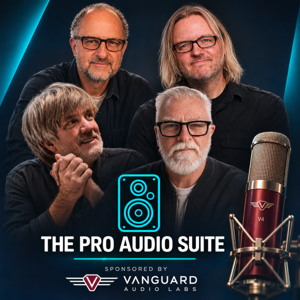


This week on The Pro Audio Suite, the crew dives into the weirdly perfect world of AI fixing AI.
Robert shares a corporate video job about AI adoption that was, rather beautifully, rescued by AI audio cleanup. Robbo jumps in with his own tale of a big corporate shoot where the lapel mics were fitted, but somehow the camera mic was what got recorded. Enter Source Elements ReGen.
The team talks through where tools like ReGen sit in the real world of audio post. Not as a first choice, not as a magic button, but as a serious get out of jail option when the recording is so far gone that traditional noise reduction is not really the answer anymore.
From there, things take a sharp left into AI watermarking, audio disclosure, stealth metadata, digital rights management, and whether AI voices on radio should be clearly labelled. Is the problem AI itself, or is it the lack of honesty around how it is being used?
There is also a brief but important discussion about using AI cleanup for auditions, why bad audio can affect casting decisions before anyone even realises it, and whether Robbo should launch his own service called RoboGen.
In this episode:
• Source Elements ReGen in real post-production jobs • Fixing badly recorded corporate audio • Why ReGen is different from normal noise reduction • AI audio cleanup for voiceover auditions • Watermarking AI images and audio • Disclosure around AI voices on radio • Why honesty may matter more than the tool itself • The birth of RoboGen, unfortunately
Thanks to our sponsors Austrian Audio, making passion heard.
Got your own audio issues? Just Ask Robbo.
This week on The Pro Audio Suite, George brings out a little show and tell with the SSL One, SSL's compact single mic preamp interface aimed squarely at the same world as the Scarlett Solo and other simple home studio boxes.
The team gets into what actually matters for voice actors and home studio users, including physical gain knobs, direct monitoring, high pass filters, 4K mode, USB-C connections, headphone control, auto gain, clip protection, and why simple interfaces are sometimes the best interfaces.
There is also a little live testing with Twisted Wave, a quick look at Source Elements Recorder on mobile, some PASport VO phone patch chat, and the usual collection of detours involving Jack FM, trap doors, yacht rock, and turntables that apparently survive being moved while playing.
If you are a voice actor, producer, podcaster, or home studio owner trying to choose an audio interface without accidentally buying a puzzle box, this one is worth a watch.
Thanks to our sponsors, Austrian Audio.
Recorded using Source-Connect, edited by Andrew Peters, and mixed by Voodoo Sound.
This week on The Pro Audio Suite, the crew dives into one of the biggest traps in audio production: trusting what you think you're hearing.
Robbo talks about working in an unfamiliar studio and being reminded how much your room, routing, monitoring chain, headphones, templates and habits shape the way you work. The conversation moves into headphone mixing, crossfeed, SPL monitoring, virtual control rooms, Sonarworks, Waves room emulation, EQ Mac, old school graphic EQs, and the fine art of not destroying your mix because your room has a 120Hz attitude problem.
There's also a proper old school tangent involving INXS, cassettes, car checks, Chernobyl, 1980s hi fi EQs, and the horror of someone flattening your carefully rung out live sound graphics.
If you've ever mixed in a strange room, questioned your headphones, or wondered whether your monitors are telling the truth, this one's for you.
Thanks to our sponsors, Austrian Audio.
What actually counts as acceptable audio when you're recording voiceover from home?
That question came up after Robbo spoke with a group of aspiring voice actors in Perth. The advice was simple enough, don't overprocess, don't gate everything, and send clean raw audio when asked. But one student asked the thing every beginner wants to know: how do I know if what I'm recording is actually good enough?
In this episode, Robbo, Robert, George and eventually AP unpack the answer. They talk about why reflections are often a bigger problem than background noise, why "boxy" booth sound is so hard to fix, and why a great recording is usually more about the room than the microphone.
The crew also gets into mic technique, the danger of editing yourself into oblivion, clothing noise, hair rustle, inconsistent recording levels, portable booths, the value of reference recordings, and why sometimes "consistent but flawed" is much easier to work with than audio that keeps changing from take to take.
There's also a detour into rare microphones, a surprise AP entrance, and Robbo discovering that the PASport VO may have just made phone patching easier than expected.
Thanks to our sponsors, Austrian Audio, making passion heard.
Apple has not always been known as the bargain option, but the latest Apple Silicon Macs might be changing that conversation.
In this episode, the team gets into the surprising value of the M4 Mac Mini, why even a base model can be serious overkill for many voice actors, and how smaller machines like the MacBook Air and MacBook "Neo" style systems compare for remote sessions, Source Connect, Pro Tools, and travel rigs.
The conversation also wanders into classic Pro Audio Suite territory, including old Macs that refuse to die, running Linux or Windows on ageing Apple hardware, right to repair, weird manufacturer lockouts, obsolete cables, Shure MV88 bargain hunting, Pro Tools archiving disasters, and why keeping your sessions self contained still matters.
There is also a very important chainsaw story. Obviously.
Thanks to our sponsors, Austrian Audio, making passion heard for supporting the show.
00:00 Intro and sponsor mention 00:33 Talking Macs before the show 01:20 The M4 Mac Mini and Apple's surprising value 02:29 Apple Silicon price to performance 03:38 Why older M1 machines still hold up 04:02 Using a Mac Mini as a road computer 05:22 Is the Mac Mini overkill for VO work? 06:38 MacBook Air, external monitors, and display quirks 09:04 Apple cables, chips, and control 10:04 The end of Lightning and the move to USB C 12:09 Audio interfaces on iPhone and iPad 12:30 Shure MV88 bargains for older iPhones 14:43 Right to repair 16:11 Robbo's old chainsaw story 18:21 Repair restrictions and replacement culture 19:29 Mac longevity 20:18 Running Windows on an old iMac 22:03 Linux on old Apple hardware 25:29 Old drives, CDs, DVDs, and lost archives 26:12 Mezzo and old Pro Tools backups 27:13 Missing Pro Tools audio files 28:33 Pro Tools archiving tip, sort by file path 29:54 Wrap up and creditsThis week on The Pro Audio Suite, things go gloriously off the rails.
AP has been rebuilding his studio, and is talking reclaimed timber and custom desks, George is showing off weird vintage Apple gear, and somewhere in the middle, the boys fall down a rabbit hole involving Korg M1s, old ISDN boxes, retro synths, ancient Macs, and why audio people can never throw anything away.
There's also a surprisingly deep discussion about why the physical studio environment matters creatively, why a tidy desk changes your mindset, and how modern workflows are reshaping how studios are built and used.
Plus: • Studio rebuild ideas and workflow tweaks • Reclaimed timber stories from Australia and the US • Vintage synths and old gear suddenly becoming valuable again • Apple Neos, fanless laptops, and remote session setups • PASport VO in real world workflows • Why old Macs refuse to die • The weird psychology of creative spaces • 80s and 90s music production nostalgia • Why nobody seems to jam together anymore
It's part studio therapy session, part gear archaeology dig, and part pub chat between audio nerds.
Thanks to our sponsors: Tri-Booth and Austrian Audio.
What happens when audio is so bad… even the best plugins can't save it?
In this episode of The Pro Audio Suite, we're joined by Michael "Gomez" Pearce-Adams from Waves Audio to talk about Voice Regeneration, a new AI-driven tool designed to rebuild poor-quality dialogue into something actually usable.
And this isn't just noise reduction or EQ… it's a complete rethink of how broken audio gets fixed.
We dig into:
There's also a bigger conversation here about where the industry is heading, and whether tools like this are helping or hurting the craft.
If you've ever been handed unusable audio and told "can you fix this?", this one's for you.
🎙️ What You'll Hear in This EpisodeThanks to our mates at:
TwistedWave has dropped updates that feel like they were built for anyone smashing through a pile of auditions or VO edits every day.
George walks through what's new in 32.3 and 32.4, including the ability to apply a Batch directly to your currently open file and map that Batch to a single keystroke. That means you can normalise to a target level, then apply a processing stack, all in one hit, without the old multi step workflow.
Then there's the new Repair tool, a quick "auto heal" style fix for little clicks, mouth noises, and short waveform anomalies. Select the problem area, hit a key, and TwistedWave smooths it out. No fiddly sample drawing required.
Also included, a friendly rant about software developers changing things that don't need changing, and why options matter.
Sponsors, Tribooth and Austrian Audio, Making Passion Heard.
Recorded using Source Connect. Edited by Andrew Peters. Mixed by Robbo.
Loopback is one of the most common and misunderstood problems in home studios.
In this episode of The Pro Audio Suite, the team breaks down how the new Nexus Suite, specifically Nexus Review, makes it dramatically easier to capture system audio, create proper mix-minus setups, and send playback to clients without complicated routing.
If you have ever wrestled with UA Console routing, virtual drivers, Chrome output quirks, or Mac system audio conflicts, this one is for you.
We cover:
• Why traditional loopback setups get messy fast • The UA console routing method and its limitations • How Nexus Review captures system audio automatically • Why this eliminates feedback loops • Whether you still need an Apollo • Chrome finally fixing its output bug • What this means for USB interfaces and simpler setups
If you are podcasting, live streaming, directing voice talent, or running remote sessions, this episode will save you time and headaches.
Thanks to our sponsors:
Tri-Booth Professional vocal booths that keep your recordings clean and controlled. Use the code TRIPAP200 for $200 off yours...
Austrian Audio Makers of the OC818, OC18 and more. Making passion heard.
In this episode of The Pro Audio Suite, the team dives into some major shifts in the audio industry.
Audio Tonics has acquired DPA, Austrian Audio, SSL, Harrison and more. What does this wave of consolidation mean for boutique brands and the future of innovation?
Then we unpack the developing Native Instruments insolvency proceedings. With Kontakt, iZotope, Plugin Alliance and Brainworx under that umbrella, what could this mean for producers, composers and post professionals? And does this reignite the subscriptions versus perpetual debate?
We also wander into:
• Neumann U47 reissue rumours • The real value of vintage microphones • Why old music keeps resurfacing • 8-tracks, cassettes, DAT and the democratisation of audio • LimeWire confessions and plugin hoarding
A wide ranging conversation about where audio has been and where it might be heading.
Thanks to our sponsors:
🎧 Austrian Audio – Making Passion Heard 🎙 Tribooth – Use code TRIPAP200 for $200 off
Find out more at https://theproaudiosuite.com Watch on YouTube and subscribe for future episodes.
From the publisher's feed

227,660 Listeners
5,861 Listeners
13,024 Listeners
78 Listeners
10,317 Listeners

14 Listeners

176 Listeners
28 Listeners

21 Listeners

23 Listeners
262 Listeners

962 Listeners
14 Listeners

57 Listeners

150 Listeners