
Sign up to save your podcasts
Or

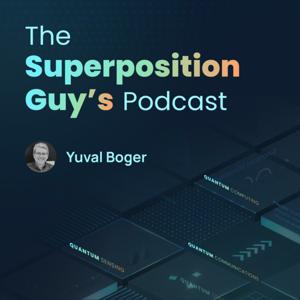


Yuval Boger interviews Walter Raquet, Chairman and CEO of Symmatrics, a company that has revived the one-time pad symmetric key encryption concept — once used exclusively by US intelligence agencies — and brought it to the modern times. Walter explained how their system eliminates passwords and reusable credentials by wrapping every transaction in unique keys that are used once and destroyed, making it fundamentally different from today's math-based asymmetric encryption. We discussed their key distribution center, their hardware-based "quantum protected network," their ongoing work with NIST to achieve certification ahead of the government's 2027 quantum-resistance deadline, and much more.
Yuval Boger interviews Steve Gibson, President of Americas at JIJ, a Japan-based optimization company whose founders came from Professor Nishimori's lab. Steve shared how JIJ spans the spectrum from classical to quantum-inspired to quantum computing, and discussed how the company is now using AI to make its optimization tools more accessible to customers who lack in-house quantum expertise. They explored the state of quantum readiness, and how organizations should start preparing now for the business and technical changes quantum will require. Steve also outlined his mission to bring JIJ's capabilities and deep research talent from Japan to the US and European markets, provided advice for US executives doing business with Japan, and much more.
Yuval Boger interviews Sumit Kapur, CEO of Zapata Quantum. They speak about the company's remarkable phoenix-from-the-ashes story — surviving a quantum winter and a failed SPAC to rebuild as a focused quantum applications company. They discuss Zapata's partnerships, their landmark cancer research published on the cover of Nature Biotech, and their work on using agentic AI to accelerate quantum resource estimation. Sumit walks us through the quantum journey for enterprises, from Quantum Application Intelligence to Quantum Application Engineering, shares his view on how the challenges in quantum have shifted, and much more.
In this episode, host Yuval Boger speaks with Steve Orrin, Chief Technology Officer for Intel Federal, about the sweeping post-quantum cryptography mandates confronting U.S. government agencies and their supply chains. Orrin breaks down the 2030-2031 migration deadlines, the January 2027 acquisition requirement for national security systems, and why a standard Windows laptop can contain 20,000 crypto assets — not all of which need immediate attention. The conversation covers Intel's multi-generational approach to embedding PQC in silicon, the importance of crypto agility for future algorithm changes, and practical advice for agencies beginning their cryptographic inventory, including the often-missed firmware and peripheral layers beneath the OS.
Rob Jesudason, CEO and founder of Serendipity Capital — a $1.3 billion permanent capital vehicle focused on critical technologies — joins the podcast to discuss quantum investing across modalities, the SPAC versus IPO debate, and how governments should allocate quantum funding. Jesudason argues that the quantum industry has entered a new phase where managerial execution and engineering scale matter as much as the underlying science, and that future winners will likely be multimodality companies that can ship systems at scale. He offers a nuanced perspective on government investment strategy, suggesting that while leading nations should pick winners in partnership with the private sector, smaller countries should focus on being the fastest integrators of winning technologies into their economies rather than trying to build world-leading hardware from scratch.
Stephen DiAdamo, co-founder and CTO of Qoro Quantum, is interviewed by Yuval Boger. DiAdamo discusses Qoro's position as a software middleware company that abstracts hardware away from applications, walking through the Divi SDK, circuit serialization and parallelization, and an orchestrator that automatically selects between 12 simulation methods on CPU and GPU or dispatches to QPUs from any vendor. They explore how Qoro plugs into HPC schedulers like SLURM rather than replacing them, the CESGA proof of concept built on the CUNQA platform, the "150,000 lines of code to 20" claim, and the argument that multi-QPU centers are needed today for fallback and resilience and for scaling applications. DiAdamo also reflects on developer experience for students learning QAOA and variational algorithms, and Qoro's two-year history.
Julien Camirand Lemire, co-founder and CEO of Nord Quantique, is interviewed by Yuval Boger. Julien discusses Nord Quantique's bosonic code approach, which uses microwave photons in superconducting cavities to achieve quantum error correction without large qubit overhead, including their GKP and Tesseract code demonstrations and a quantum error correction gain that has more than doubled since 2024. They explore the company's roadmap toward 10^-7 to 10^-9 error rates by 2032, the four-qubit system entering operation this year, and how Quebec's Sherbrooke ecosystem has enabled a capital-efficient build. They also discuss high-rate codes, transmon-based scaling challenges, and much more.
Yuval Boger interviews Corey O'Meara, Chief Quantum Scientist at E.ON Digital Technology. They discuss how E.ON’s five-person quantum team works with business units to find high-value use cases, especially where classical methods may hit bottlenecks in optimization and machine learning. Corey describes the company’s work on peer-to-peer energy trading and other grid-related applications, and shares his perspective on cloud access, hybrid deployment, and the accelerating progress toward fault-tolerant quantum computing.
Yuval Boger interviews Helmut Katzgraber, general partner at 55North and former quantum leader at AWS. They discuss Helmut’s view that the most promising near- to mid-term quantum applications are in quantum simulation for materials, chemicals, and pharma, rather than optimization. They also explore European competitiveness, venture opportunities across the quantum stack, cloud and on-prem deployment models, and the workforce and product skills needed to turn quantum ideas into successful companies.
Yuval Boger interviews Mehmet Sanliol, managing director at Evercore covering quantum technologies and semiconductors. They discuss how investors value public quantum companies, when private companies should consider IPOs or SPACs, and why consolidation may shape the next phase of the industry. Mehmet also shares his perspective on technical and market signals that could affect valuations, the outlook for quantum software, and the recent developments in quantum that caught his attention most.
From the publisher's feed

1,091 Listeners

538 Listeners

111,866 Listeners
85 Listeners

5,549 Listeners

15,908 Listeners
0 Listeners
21 Listeners
40 Listeners

31 Listeners