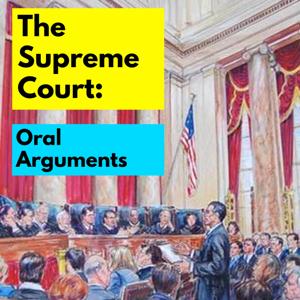
The Supreme Court: Oral Arguments

The Supreme Court: Oral Arguments

By Brad Neal
Download on the App Store

The Supreme Court: Oral Arguments episodes

  • Hain Celestial Group v. Palmquist
    Hain Celestial Group v. Palmquist | 11/04/25 | Docket #: 24-724
    24-724 HAIN CELESTIAL GROUP V. PALMQUIST
    DECISION BELOW: 103 F.4th 294
    CERT. GRANTED 4/28/2025
    QUESTION PRESENTED:
    Respondents, citizens of Texas, filed this products-liability suit in state court
    against Petitioners Hain Celestial Group, Inc., then a citizen of Delaware and New York,
    and Whole Foods, Inc., a citizen of Texas. Hain removed based on diversity jurisdiction,
    arguing that Whole Foods should be dismissed as fraudulently joined. The district court
    agreed, dismissing Whole Foods with prejudice. After two additional years of federal-
    court litigation and a two-week jury trial, the district court granted judgment as a matter
    of law to Hain. On appeal, without ruling on the merits, the Fifth Circuit held that the
    district court erred in dismissing Whole Foods, vacated the final judgment, and ordered
    the matter remanded to state court to start from scratch. Relying on Respondents' post-
    removal amended complaint, the panel held, in conflict with several other courts of
    appeals, that the district court lacked jurisdiction to enter judgment as to the completely
    diverse parties before it.
    The questions presented are:
    1.
    Whether a district court's final judgment as to completely diverse parties
    must be vacated when an appellate court later determines that it erred by dismissing a
    non-diverse party at the time of removal.
    2.
    Whether a plaintiff may defeat diversity jurisdiction after removal by
    amending the complaint to add factual allegations that state a colorable claim against a
    nondiverse party when the complaint at the time of removal did not state such a claim
    LOWER COURT CASE NUMBER: 23-40197

    43 min
  • Coney Island Auto Parts, Inc. v. Burton
    Coney Island Auto Parts, Inc. v. Burton | 11/04/25 | Docket #: 24-808
    24-808 CONEY ISLAND AUTO PARTS, INC. V. BURTON
    DECISION BELOW: 109 F.4th 438
    CERT. GRANTED 6/6/2025
    QUESTION PRESENTED:
    Well-settled legal principles dictate that a judgment entered in the absence of
    personal jurisdiction is void. Federal Rule of Civil Procedure 60(b)(4) authorizes federal
    courts to vacate a judgment when it is void. A motion seeking vacatur, however, "must
    be made within a reasonable time." Fed. R. Civ. P. 60(c)(1).
    Each of the United States Courts of Appeals other than the Sixth Circuit holds that
    there is effectively no time limit for moving to vacate a judgment, notwithstanding Rule
    60(c)(1)'s "reasonable time" requirement, when the judgment is obtained in the absence
    of personal jurisdiction. The common thinking among these circuits is that a judgment
    entered without personal jurisdiction is void ab initio.
    The United States Court of Appeals for the Sixth Circuit is the sole outlier. In this
    case, it held that Rule 60(c)(1) governs the timing of a motion seeking vacatur of a void
    judgment pursuant to Rule 60(b)(4).
    The question presented is:
    Whether Federal Rule of Civil Procedure 60(c)(1) imposes any time limit to set
    aside a void default judgment for lack of personal jurisdiction.
    LOWER COURT CASE NUMBER: 23-5881
    37 min
  • Hencely v. Fluor Corp.
    Hencely v. Fluor Corp. | 11/03/25 | Docket #: 24-924
    24-924 HENCELY V. FLUOR CORP.
    DECISION BELOW: 120 F.4th 412
    CERT. GRANTED 6/2/2025
    QUESTION PRESENTED:
    Former U.S. Army Specialist Winston T. Hencely was critically and permanently injured
    by a suicide bomber inside Bagram Airfield in Afghanistan. The bomber, Ahmad Nayeb, worked
    on base for a government contractor. An Army investigation found that the attack's primary
    contributing factor was the contractor's actions in breach of its Army contract and in violation
    of the military's instructions to supervise Nayeb. Hencely sued the government contractor for
    negligence under South Carolina law. He did not sue the military under the Federal Tort Claims
    Act.
    Even so, the Fourth Circuit held that Hencely's state claims are preempted by unspoken
    "federal interests" emanating from an FTCA exception. Invoking
    Boyle v. United Technologies
    Corp.
    , 487 U.S. 500 (1988), the court of appeals held that the FTCA's exception immunizing the
    government
    for "[a]ny claim arising out of the combatant activities of the military or naval
    forces ... during time of war," 28 U.S.C. §2680(j), barred Hencely's South Carolina claims against
    the
    contractor
    . The decision below reaffirmed a 3-1-1 split among the Second, Third, Fourth,
    Ninth and D.C. Circuits over
    Boyle
    's reach when contractors defend against state tort claims by
    invoking §2680(j).
    The question presented is:
    Should
    Boyle
    be extended to allow federal interests emanating from the FTCA's
    combatant-activities exception to preempt state tort claims against a government
    contractor for conduct that breached its contract and violated military orders?
    LOWER COURT CASE NUMBER: 21-1994
    1 hr 31 min
  • Rico v. United States
    Rico v. United States | 11/03/25 | Docket #: 24-1056
    24-1056 RICO V. UNITED STATES
    DECISION BELOW: 2025 WL 720900
    CERT. GRANTED 6/30/2025
    QUESTION PRESENTED:
    Whether the fugitive-tolling doctrine applies in the context of supervised release.
    LOWER COURT CASE NUMBER: 24-2662
    55 min
  • Case v. Montana
    Case v. Montana | 10/15/25 | Docket #: 24-624
    24-624 CASE V. MONTANA
    DECISION BELOW: 553 P.3d 985
    CERT. GRANTED 6/2/2025
    QUESTION PRESENTED:
    Whether law enforcement may enter a home without a search warrant based on
    less than probable cause that an emergency is occurring, or whether the emergency-aid
    exception requires probable cause.
    LOWER COURT CASE NUMBER: DA 23-0136
    1 hr 16 min
  • Louisiana v. Callais
    Louisiana v. Callais | 10/15/25 | Docket #: 24-109
    Background: Louisiana was ordered by federal courts to create a second majority-Black congressional district to comply with the Voting Rights Act. The Louisiana Legislature responded by passing S.B. 8, which created the required second majority-Black district. However, a different federal court then ruled that S.B. 8 was an unconstitutional racial gerrymander and blocked its implementation.
    The Core Issue: Can a state be required to create a majority-minority district under the Voting Rights Act, but then have that same district struck down as unconstitutional racial gerrymandering? Louisiana argues this creates an impossible legal bind.
    Questions Before the Court: Whether the lower court erred in finding that race predominated in drawing S.B. 8, whether the map fails strict scrutiny review, whether certain legal tests were properly applied, and whether courts should even be deciding these redistricting disputes.
    Current Status: The case has been restored for reargument. The Court has ordered supplemental briefing on whether intentionally creating majority-minority districts violates the Fourteenth or Fifteenth Amendments.
    Significance: This case could reshape how states balance Voting Rights Act compliance with constitutional requirements, potentially affecting redistricting nationwide.
    2 hr 31 min
  • Ellingburg v. United States
    Ellingburg v. United States | 10/14/25 | Docket #: 24-482
    24-482 ELLINGBURG V. UNITED STATES
    DECISION BELOW: 113 F.4th 839
    JOHN F. BASH, ESQUIRE, OF AUSTIN, TEXAS, IS INVITED TO BRIEF AND
    ARGUE THIS CASE, AS
    AMICUS CURIAE
    , IN SUPPORT OF THE JUDGMENT
    BELOW.
    CERT. GRANTED 4/7/2025
    QUESTION PRESENTED:
    Whether criminal restitution under the Mandatory Victim Restitution Act (MVRA) is
    penal for purposes of the Ex Post Facto Clause.
    LOWER COURT CASE NUMBER: 23-3129
    1 hr 5 min
  • Bowe v. United States
    Bowe v. United States | 10/14/25 | Docket #: 24-5438
    24-5438 BOWE V. UNITED STATES
    DECISION BELOW: CA 11 ORDER 6/27/2024
    KASDIN M. MITCHELL, ESQUIRE, OF DALLAS, TEXAS, IS INVITED TO BRIEF AND ARGUE
    THIS CASE, AS AMICUS CURIAE, IN SUPPORT OF THE JUDGMENT BELOW AS TO
    QUESTION 1 PRESENTED BY THE PETITION FOR A WRIT OF CERTIORARI.
    CERT. GRANTED 1/17/2025
    QUESTION PRESENTED:
    Under 28 U.S.C. § 2244(b)(1),
    “[
    a] claim presented in a second or successive
    habeas
    corpus application under section 2254
    that was presented in a prior application shall be
    dismissed.
    ”
    (emphasis added).
    The first question presented is:
    Whether 28 U.S.C. § 2244(b)(1) applies to a claim presented in a second or successive
    motion to vacate under 28 U.S.C. § 2255.
    *
    *
    *
    Under 28 U.S.C. § 2244(b)(3)(E),
    “[
    t]he grant or denial of an authorization by a court of
    appeals to file a second or successive
    application
    shall not be appealable and shall not be the
    subject of a petition . . . for a writ of certiorari.
    ”
    (emphasis added).
    The second question presented is:
    Whether 28 U.S.C. § 2244(b)(3)(E) deprives this Court of certiorari jurisdiction over the
    grant or denial of an authorization by a court of appeals to file a second or successive motion to
    vacate under 28 U.S.C. § 2255.
    LOWER COURT CASE NUMBER: 24-11704
    1 hr 32 min
  • USPS v. Konan
    USPS v. Konan | 10/08/25 | Docket #: 24-351
    24-351 UNITED STATES POSTAL SERVICE V. KONAN
    DECISION BELOW: 96 F.4th 799
    CERT. GRANTED 4/21/2025
    QUESTION PRESENTED:
    The Federal Tort Claims Act (FTCA), ch. 753, 60 Stat. 842 (28 U.S.C. 1346(b), 2671
    et
    seq
    .), generally waives the United States' sovereign immunity for suits seeking damages "for
    injury or loss of property, or personal injury or death caused by the negligent or wrongful act or
    omission" of an employee of the federal government "under circumstances where the United
    States, if a private person, would be liable to the claimant in accordance with the law of the
    place where the act or omission occurred." 28 U.S.C. 1346(b)(1). The FTCA, however, excepts
    from that waiver of immunity "[a]ny claim arising out of the loss, miscarriage, or negligent
    transmission of letters or postal matter." 28 U.S.C. 2680(b). The question presented is as
    follows:
    Whether a plaintiff's claim that she and her tenants did not receive mail because Postal
    Service employees intentionally did not deliver it to a designated address arises out of "the
    loss" or "miscarriage" of letters or postal matter. 28 U.S.C. 2680(b).
    LOWER COURT CASE NUMBER: 23-10179
    1 hr 8 min
  • Bost v. IL Bd. of Elections
    Bost v. IL Bd. of Elections | 10/08/25 | Docket #: 24-568
    24-568 BOST V. ILLINOIS BOARD OF ELECTIONS
    DECISION BELOW: 114 F.4th 634
    CERT. GRANTED 6/2/2025
    QUESTION PRESENTED:
    Federal law sets the first Tuesday after the first Monday in November as the
    federal Election Day. 2 U.S.C. §§ 1 and 7; and 3 U.S.C. § 1. Several states, including
    Illinois, have enacted state laws that allow ballots to be received and counted after
    Election Day. Petitioners contend these state laws are preempted under the Elections
    and Electors Clauses. Petitioners sued to enjoin Illinois' law allowing ballots to be
    received up to fourteen days after Election Day.
    The sole question presented here is whether Petitioners, as federal candidates,
    have pleaded sufficient factual allegations to show Article III standing to challenge state
    time, place, and manner regulations concerning their federal elections.
    LOWER COURT CASE NUMBER: 23-2644
    1 hr 45 min

About The Supreme Court: Oral Arguments

From the publisher's feed

A public good: every Supreme Court Oral Argument since 2010. Making the Highest Court more accessible for a modern audience. The DC Bar blog's piece about this podcast can be found here:…

Best of The Supreme Court: Oral Arguments

Ranked by our users in the last 21 days

More shows like The Supreme Court: Oral Arguments

Planet Money by NPR

Planet Money

30,652 Listeners

Amicus With Dahlia Lithwick | Law, justice, and the courts by Slate Podcasts

Amicus With Dahlia Lithwick | Law, justice, and the courts

3,471 Listeners

Bloomberg Law by Bloomberg

Bloomberg Law

381 Listeners

U.S. Supreme Court Oral Arguments by Oyez

U.S. Supreme Court Oral Arguments

662 Listeners

We the People by National Constitution Center

We the People

1,098 Listeners

Pod Save America by Pod Save America

Pod Save America

87,202 Listeners

The Daily by The New York Times

The Daily

111,832 Listeners

Up First from NPR by NPR

Up First from NPR

56,407 Listeners

Post Reports by The Washington Post

Post Reports

5,207 Listeners

Strict Scrutiny by Strict Scrutiny

Strict Scrutiny

5,731 Listeners

Advisory Opinions by The Dispatch

Advisory Opinions

3,924 Listeners

5-4 by Prologue Projects

5-4

3,531 Listeners

The Ezra Klein Show by New York Times Opinion

The Ezra Klein Show

16,026 Listeners

Amarica's Constitution by Akhil Reed Amar

Amarica's Constitution

388 Listeners

Divided Argument by Will Baude & Dan Epps

Divided Argument

742 Listeners