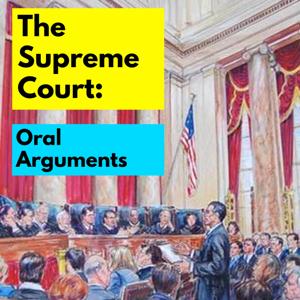
The Supreme Court: Oral Arguments

The Supreme Court: Oral Arguments

By Brad Neal
Download on the App Store

The Supreme Court: Oral Arguments episodes

  • Trump, President of U.S. v. Cook
    Trump, President of U.S. v. Cook | 01/21/26 | Docket #: 25A312
    25A312 TRUMP V. COOK
    DECISION BELOW: 2025 WL 2654786
    THE APPLICATION FOR STAY PRESENTED TO THE CHIEF JUSTICE AND BY HIM REFERRED TO THE
    COURT IS DEFERRED PENDING ORAL ARGUMENT IN JANUARY 2026.
    JURISDICTION NOTED 10/1/2025
    QUESTION PRESENTED:
    LOWER COURT CASE NUMBER:
    2 hr
  • M & K Employee Solutions v. Trustees of the IAM Pension Fund
    M & K Employee Solutions v. Trustees of the IAM Pension Fund | 01/20/26 | Docket #: 23-1209
    23-1209 M & K EMPLOYEE SOLUTIONS, LLC V. TRUSTEES OF THE IAM PENSION FUND
    DECISION BELOW: 92 F.4th 316
    QUESTION PRESENTED:
    The Employee Retirement Income Security Act imposes "withdrawal liability"
    when an employer withdraws from an underfunded multiemployer pension plan. This
    withdrawal liabilty covers the employer's share of the plan's underfunding. Because a
    plan's amount of underfunding hinges on projections about its projected liabilities and
    assets decades into the future, withdrawal liability computations are partly a product of
    actuarial assumptions about anticipated interest rates and other predictions. Withdrawal
    liability must be computed "as of the end of the plan year preceding the plan year in
    which the employer withdraws."
    E.g.,
    29 U.S.C. 1391(b)(2)(E)(i). The question
    presented is:
    Whether 29 U.S.C. 1391's instruction to compute withdrawal liability "as of the
    end of the plan year" requires the plan to base the computation on the actuarial
    assumptions to which its actuary subscribed at the end of the year, or allows the plan to
    use different actuarial assumptions that were adopted after the end of the year
    .
    LOWER COURT CASE NUMBER: 22-7157, 22-7158, 23-7028
    THE PETITION FOR A WRIT OF CERTIORARI IS GRANTED LIMITED TO THE
    FOLLOWING QUESTION: WHETHER
    29
    U. S. C. §
    1391
    ’
    S INSTRUCTION TO
    COMPUTE WITHDRAWAL LIABILITY
    “
    AS OF THE END OF THE PLAN YEAR
    ”
    REQUIRES THE PLAN TO BASE THE COMPUTATION ON THE ACTUARIAL
    ASSUMPTIONS TO WHICH ITS ACTUARY SUBSCRIBED AT THE END OF THE
    YEAR, OR ALLOWS THE PLAN TO USE DIFFERENT ACTUARIAL ASSUMPTIONS
    THAT WERE ADOPTED AFTER THE END OF THE YEAR.
    Order of July 3, 2025:
    The order granting the petition for a writ of certiorari is amended as follows. THE
    PETITION FOR A WRIT OF CERTIORARI IS GRANTED LIMITED TO THE
    FOLLOWING QUESTION: WHETHER 29 U. S. C. §1391
    ’
    S INSTRUCTION TO
    COMPUTE WITHDRAWAL LIABILITY
    “
    AS OF THE END OF THE PLAN YEAR
    ”
    REQUIRES THE PLAN TO BASE THE COMPUTATION ON THE ACTUARIAL
    ASSUMPTIONS MOST RECENTLY ADOPTED BEFORE THE END OF THE YEAR,
    OR ALLOWS THE PLAN TO USE DIFFERENT ACTUARIAL ASSUMPTIONS THAT
    WERE ADOPTED AFTER, BUT BASED ON INFORMATION AVAILABLE AS OF, THE
    END OF THE YEAR.


    CERT. GRANTED 6/30/2025
    59 min
  • Wolford v. Lopez
    Wolford v. Lopez | 01/20/26 | Docket #: 24-1046
    24-1046 WOLFORD V. LOPEZ
    DECISION BELOW: 116 F.4th 959
    LIMITED TO QUESTION 1 PRESENTED BY THE PETITION.
    CERT. GRANTED 10/3/2025
    QUESTION PRESENTED:
    New York State Rifle & Pistol Association, Inc. v. Bruen
    , 597 U.S. 1, 33 (2022), holds that
    "the Second Amendment guarantees a general right to public carry" of arms, meaning ordinary,
    law-abiding citizens may "'bear' arms in public for self-defense." In this case, the Ninth Circuit
    sustained a Hawaii law that makes it a crime for a concealed carry permit holder to carry a
    handgun on private property unless he has been "given express authorization to carry a firearm
    on the property by the owner, lessee, operator, or manager of the property." H.R.S. § 134-9.5.
    That holding is in acknowledged direct conflict with the Second Circuit's holding in
    Antonyuk v.
    James
    , 120 F.4th 941 (2d Cir. 2024), a decision that struck down an
    identical
    State law in the
    same procedural posture as this case.
    The Ninth Circuit also sustained a multitude of other location bans on carry by permit
    holders, relying solely on post-Reconstruction Era and later laws. That doctrinal approach is in
    direct conflict with the Third Circuit's decision
    in Lara v. Commissioner Pennsylvania State
    Police
    , 125 F.4th 428 (3d Cir. 2025), the Fifth Circuit's decision in
    United States v. Connelly
    , 117
    F.4th 269 (5th Cir. 2024), the Eighth Circuit's decision in
    Worth v. Jacobson
    , 108 F.4th 677 (8th
    Cir. 2024), and, most recently, the Eleventh Circuit's en banc decision in
    NRA v. Bondi
    , No. 21-
    12314, 2025 WL 815734 at *5 (11th Cir. March 14,2025) (en banc), all of which hold that
    primary focus must be on Founding generation laws and tradition in applying the text, history
    and tradition test
    Bruen
    mandates.
    The questions presented are:
    1. Whether the Ninth Circuit erred in holding, in direct conflict with the Second Circuit,
    that Hawaii may presumptively prohibit the carry of handguns by licensed concealed carry
    permit holders on private property open to the public unless the property owner affirmatively
    gives express permission to the handgun carrier?
    2. Whether the Ninth Circuit erred in solely relying on post-Reconstruction Era and later
    laws in applying
    Bruen
    's text, history and tradition test in direct conflict with the holdings of the
    Third, Fifth, Eighth and Eleventh Circuits?
    LOWER COURT CASE NUMBER: 23-16164

    1 hr 53 min
  • Galette v. NJ Transit Corp.
    Galette v. NJ Transit Corp. | 01/14/26 | Docket #: 24-1021
    24-1021 GALETTE V. NJ TRANSIT CORP.
    DECISION BELOW: 332 A.3d 776
    THE PETITIONS FOR WRITS OF CERTIORARI ARE GRANTED, LIMITED TO
    THE FOLLOWING QUESTION: WHETHER THE NEW JERSEY TRANSIT
    CORPORATION IS AN ARM OF THE STATE OF NEW JERSEY FOR INTERSTATE
    SOVEREIGN IMMUNITY PURPOSES.
    CONSOLIDATED FOR ONE HOUR ORAL ARGUMENT WITH
    24-1113
    .
    ORDER OF SEPTEMBER
    19,2025
    :
     THE TRIAL SCHEDULED FOR SEPTEMBER 
    15
    ,
    2025
    , IN THE SUPREME COURT OF THE STATE OF
    NEW YORK, NEW YORK COUNTY, IS THEREFORE STAYED PENDING THE ISSUANCE OF THE
    MANDATE OF THIS COURT IN
    NJ TRANSIT CORP., ET AL.
    V.
    COLT, JEFFREY, ET AL.
    , CASE NO.
    24-
    1113
    , AND
    GALETTE, CEDRIC
    V.
    NJ TRANSIT CORP.
    , CASE NO.
    24-1021
    .
     
    CERT. GRANTED 7/3/2025
    QUESTION PRESENTED:
    Whether the New Jersey Transit Corporation is entitled to interstate sovereign
    immunity under the Federal Constitution, as held by the highest court of Pennsylvania in
    square conflict with the highest court of New York.
    LOWER COURT CASE NUMBER: 4 EAP 2024
    1 hr 11 min
  • West Virginia v. B. P. J.
    West Virginia v. B. P. J. | 01/13/26 | Docket #: 24-43
    24-43 WEST VIRGINIA V. B.P.J.
    DECISION BELOW: 98 F.4th 542
    CERT. GRANTED 7/3/2025
    QUESTION PRESENTED:
    Like everywhere else, West Virginia schools offer separate sports teams for boys
    and girls. The West Virginia Legislature concluded that biological boys should compete
    on boys' and co-ed teams but not girls' teams. This separation made sense, the
    Legislature found, because of the "inherent physical differences between biological
    males and biological females."
    A parent sued on behalf of her child, B.P.J., arguing that the State must allow
    biological boys who identify as girls to compete on girls' teams. After extensive
    discovery, the district court disagreed, entering summary judgment for the State on
    claims under the Equal Protection Clause and Title IX. Yet a divided Fourth Circuit panel
    granted an injunction pending appeal. B.P.J. then beat and displaced hundreds of girls
    in track and field.
    Ultimately, the same divided panel ruled in B.P.J.'s favor on the Title IX claim and
    vacated the district court's judgment for the defendants on the equal-protection claim.
    Judge Agee dissented, criticizing the majority for "inappropriately expand[ing] the scope
    of the Equal Protection Clause and upend[ing] the essence of Title IX." App.44a. He
    hoped this Court would "take the opportunity with all deliberate speed to resolve these
    questions of national importance." App.74a
    The questions presented are:
    1.
    Whether Title IX prevents a state from consistently designating girls' and boys'
    sports teams based on biological sex determined at birth.
    2.
    Whether the Equal Protection Clause prevents a state from offering separate boys'
    and girls' sports teams based on biological sex determined at birth.
    LOWER COURT CASE NUMBER: 23-1078, 23-1130
    0 min
  • Little v. Hecox
    Little v. Hecox | 01/13/26 | Docket #: 24-38
    24-38 LITTLE, GOVERNOR OF IDAHO V. HECOX
    DECISION BELOW: 104 F.4th 1061
    ORDER OF OCTOBER 20, 2025:
    RESPONDENT'S REQUEST THAT THE COURT DISMISS THE CASE AS MOOT IS DEFERRED PENDING
    ORAL ARGUMENT. SEE
    ACHESON HOTELS, LLC v. LAUFER
    , 601 U. S. 1, 4 (2023).
    CERT. GRANTED 7/3/2025
    QUESTION PRESENTED:
    Women and girls have overcome decades of discrimination to achieve a more
    equal playing field in many arenas of American life-including sports. Yet in some
    competitions, female athletes have become bystanders in their own sports as male
    athletes who identify as female have taken the place of their female competitors-on the
    field and on the winners' podium.
    The Idaho Legislature addressed that injustice by enacting the Fairness in
    Women's Sports Act, which ensures that women and girls do not have to compete
    against men and boys no matter how those men and boys identify. The Act-one of 25
    such state laws around the country-is consistent with longstanding government policies
    preserving women's and girls' sports due to the "average real differences" between the
    sexes.
    Clark ex rel. Clark v. Ariz. Interscholastic Ass'n,
    695 F.2d 1126, 1131 (9th Cir.
    1982).
    Breaking with this Court's precedents, its own caselaw, other circuit decisions,
    and biological reality, the Ninth Circuit panel here upheld an injunction against the Act
    because it prevents "transgender women and girls"-meaning males who identify as
    women and girls-from competing in "women's student athletics." App.4a-5a.
    The question presented is:
    Whether laws that seek to protect women's and girls' sports by limiting
    participation to women and girls based on sex violate the Equal Protection Clause of the
    Fourteenth Amendment.
    LOWER COURT CASE NUMBER: 20-35813, 20-35815
    1 hr 54 min
  • Chevron USA Inc. v. Plaquemines Parish
    Chevron USA Inc. v. Plaquemines Parish | 01/12/26 | Docket #: 24-813
    24-813 CHEVRON USA INC. V. PLAQUEMINES PARISH
    DECISION BELOW: 103 F.4th 324
    January
    8
    ,
    2026
    JUSTICE ALITO WILL NOT CONTINUE TO PARTICIPATE IN THIS CASE.
    CERT. GRANTED 6/16/2025
    QUESTION PRESENTED:
    This petition arises from Louisiana parishes' efforts to hold petitioners liable in
    state court for,
    inter alia
    , production of crude oil in the Louisiana coastal zone during
    World War II. Petitioners removed these cases from state court under 28 U.S.C. §1442
    (a)(1), which as amended in 2011 provides federal jurisdiction over civil actions against
    "any person acting under [an] officer" of the United States "for or relating to any act
    under color of such office." The Fifth Circuit unanimously held that petitioners satisfy the
    statute's "acting under" requirement by virtue of their WWII-era contracts to supply the
    federal government with high-octane aviation gasoline ("avgas"). But the panel divided
    on the "relating to" requirement, with the two-judge majority holding that petitioners'
    wartime production of crude oil was "unrelated" to their contractually required refinement
    of that same crude into avgas because the contracts did not contain any explicit
    "directive pertaining to [petitioners'] oil production activities." App.38. Judge Oldham
    dissented, explaining that the majority's approach reinstates a variant of the "causal
    nexus" requirement that multiple circuits (and the U.S. Congress) have expressly
    rejected. The Fifth Circuit denied rehearing en banc by a vote of 7 to 6.
    The questions presented are:
    1.
    Whether a causal-nexus or contractual-direction test survives the 2011
    amendment to the federal-officer removal statute.
    2.
    Whether a federal contractor can remove to federal court when sued for
    oil-production activities undertaken to fulfill a federal oil-refinement contract.
    LOWER COURT CASE NUMBER: 23-30294, 23-30422
    1 hr 19 min
  • FS Credit Opportunities Corp. v. Saba Capital Master Fund
    FS Credit Opportunities Corp. v. Saba Capital Master Fund | 12/10/25 | Docket #: 24-345
    24-345 FS CREDIT CORP. V. SABA CAPITAL MASTER FUND, LTD.
    DECISION BELOW: 2024 WL 3174971
    CERT. GRANTED 6/30/2025
    QUESTION PRESENTED:
    The courts of appeals have split 2-1 over whether Congress created an implied
    private right of action in Section 47(b) of the Investment Company Act (ICA), which
    provides:
    (1) A contract that is made, or whose performance involves, a violation of this
    subchapter ... is unenforceable by either party ....
    (2) To the extent that a contract described in paragraph (1) has been performed, a
    court may not deny rescission at the instance of any party unless such court finds that
    under the circumstances the denial of rescission would produce a more equitable result
    than its grant and would not be inconsistent with the purposes of this subchapter.
    15 U.S.C. § 80a-46(b)(1)-(2).
    The Third and Ninth Circuits, relying on statutory text and structure, hold that
    Section 47(b) does
    not
    create an implied private right of action, and a panel of the
    Fourth Circuit has agreed in an unpublished opinion. Only the Second Circuit-where
    plaintiffs may be able to sue most investment funds subject to the ICA, given New York's
    and the New York Stock Exchange's roles in financial operations- holds the opposite
    based on an "inference": parties may bring a lawsuit under Section 47(b), even though
    Congress never said so.
    The question presented is whether Section 47(b) of the ICA, 15 U.S.C. § 80a-46
    (b), creates an implied private right of action.
    LOWER COURT CASE NUMBER: 23-8104, 24-79, 24-80, 24-82, 24-83, 24-116, 24-189
    1 hr 20 min
  • Hamm v. Smith
    Hamm v. Smith | 12/10/25 | Docket #: 24-872
    24-872 HAMM, COMMISSIONER AL DOC V. SMITH
    DECISION BELOW: 2024 WL 4793028
    THE PETITION FOR A WRIT OF CERTIORARI IS GRANTED LIMITED TO THE
    FOLLOWING QUESTION: WHETHER AND HOW COURTS MAY CONSIDER THE
    CUMULATIVE EFFECT OF MULTIPLE IQ SCORES IN ASSESSING AN ATKINS
    CLAIM.
    CERT. GRANTED 6/6/2025
    QUESTION PRESENTED:
    Like most States, Alabama requires that offenders prove an IQ of 70 or less to
    satisfy the intellectual-functioning prong of
    Atkins v. Virginia
    . This case was not close:
    Smith scored 75, 74, 72, 78, and 74 on five full-scale IQ tests. There is no way to
    conclude from these five numbers that Smith's true IQ is
    likely
    to be 70 or below. So the
    courts below required Smith to prove only that his IQ "
    could be
    " 70 and required the
    State to bring evidence "strong enough" to "foreclose" and "rule out the possibility" of
    intellectual disability. The first question presented is:
    1.
    Whether, under a proper application of
    Atkins
    , a State can require a claimant to
    prove an IQ of 70 or less by a preponderance of the evidence.
    Evaluating multiple IQ scores is "complicated," and "this Court has not specified
    how" to do it. In the State's view, five scores are more accurate than one, and there are
    ways to account for that fact. The courts below disagree. The district court relied on
    Smith's 72 ± 3 to find that his IQ "could be" 69. On remand, the Eleventh Circuit's
    "holistic approach" asked whether Smith had scores of "about" 75 or less. Counting four
    out of five scores between 72 and 75, the court found "consistent evidence" that Smith
    "may" qualify as mildly disabled. Thus, the court "followed the law's requirement," in its
    view, to "move on" to Smith's adaptive deficits. The second question presented is:
    2.
    Whether courts evaluating multiple IQ scores must find that every valid score of
    "about" 75 or less supports an
    Atkins
    claim.
    LOWER COURT CASE NUMBER: 21-14519
    2 hr 3 min
  • NRSC v. FEC
    NRSC v. FEC | 12/09/25 | Docket #: 24-621
    24-621 NRSC V. FEC
    DECISION BELOW: 117 F.4th 389
    Order of July 1, 2025:
    ROMAN MARTINEZ, ESQUIRE, OF WASHINGTON, D. C., IS INVITED TO BRIEF
    AND ARGUE THIS CASE, AS
    AMICUS CURIAE
    , IN SUPPORT OF THE JUDGMENT
    BELOW.
    Order of December
    5
    ,
    2025
    :
    THE MOTION OF COURT-APPOINTED AMICUS CURIAE IN SUPPORT OF THE JUDGMENT BELOW
    FOR LEAVE TO FILE A SUPPLEMENTAL BRIEF IS GRANTED.
    CERT. GRANTED 6/30/2025
    QUESTION PRESENTED:
    A political party exists to get its candidates elected. Yet Congress has severely
    restricted how much parties can spend on their own campaign advertising if done in
    cooperation with those very candidates. 52 U.S.C.
    § 30116(d).
    In an opinion by Chief Judge Sutton, a 10-judge majority of the en banc Sixth
    Circuit agreed that these so-called "coordinated party expenditure limits" stand in
    serious tension with recent First Amendment doctrine. App.10a-15a. It nevertheless
    upheld them as constitutional, both on their face and as applied to coordinated political
    advertising ("party coordinated communications"), believing the case to be controlled by
    FEC v. Colorado Republican Federal Campaign Committee
    , 533 U.S. 431 (2001)
    (
    Colorado II
    ). In doing so, the majority acknowledged that in the 23 years since
    Colorado II
    , this Court "has tightened the free-speech restrictions on campaign finance
    regulation," that "tension has emerged between the reasoning of
    Colorado II
    and the
    reasoning of later decisions of the Court," and that relevant facts have "changed, most
    notably with 2014 amendments" to the limits and "the rise of unlimited spending by
    political action committees." App.3a-4a, 11a. But it thought "any new assessment of the
    validity of the limits" remained this Court's "province, not ours." App.14a-15a.
    The question presented is:
    Whether the limits on coordinated party expenditures in 52 U.S.C. § 30116 violate
    the First Amendment, either on their face or as applied to party spending in connection
    with "party coordinated communications" as defined in 11 C.F.R. § 109.37.
    LOWER COURT CASE NUMBER: 24-3051
    0 min

About The Supreme Court: Oral Arguments

From the publisher's feed

A public good: every Supreme Court Oral Argument since 2010. Making the Highest Court more accessible for a modern audience. The DC Bar blog's piece about this podcast can be found here:…

Best of The Supreme Court: Oral Arguments

Ranked by our users in the last 21 days

More shows like The Supreme Court: Oral Arguments

Planet Money by NPR

Planet Money

30,652 Listeners

Amicus With Dahlia Lithwick | Law, justice, and the courts by Slate Podcasts

Amicus With Dahlia Lithwick | Law, justice, and the courts

3,471 Listeners

Bloomberg Law by Bloomberg

Bloomberg Law

381 Listeners

U.S. Supreme Court Oral Arguments by Oyez

U.S. Supreme Court Oral Arguments

662 Listeners

We the People by National Constitution Center

We the People

1,098 Listeners

Pod Save America by Pod Save America

Pod Save America

87,202 Listeners

The Daily by The New York Times

The Daily

111,832 Listeners

Up First from NPR by NPR

Up First from NPR

56,407 Listeners

Post Reports by The Washington Post

Post Reports

5,207 Listeners

Strict Scrutiny by Strict Scrutiny

Strict Scrutiny

5,731 Listeners

Advisory Opinions by The Dispatch

Advisory Opinions

3,924 Listeners

5-4 by Prologue Projects

5-4

3,531 Listeners

The Ezra Klein Show by New York Times Opinion

The Ezra Klein Show

16,026 Listeners

Amarica's Constitution by Akhil Reed Amar

Amarica's Constitution

388 Listeners

Divided Argument by Will Baude & Dan Epps

Divided Argument

742 Listeners