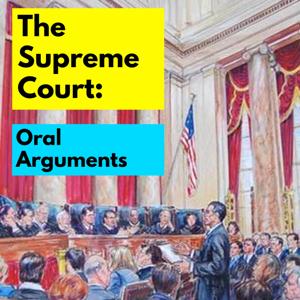
The Supreme Court: Oral Arguments

The Supreme Court: Oral Arguments

By Brad Neal
Download on the App Store

The Supreme Court: Oral Arguments episodes

  • Noem, Sec. of Homeland v. Al Otro Lado
    Noem, Sec. of Homeland v. Al Otro Lado | 03/24/26 | Docket #: 25-5
    25-5 NOEM V. AL OTRO LADO
    DECISION BELOW: 138 F.4th 1102
    CERT. GRANTED 11/17/2025
    QUESTION PRESENTED:
    The Immigration and Nationality Act, 8 U.S.C. 1101
    et seq
    . , provides that an alien who
    "arrives in the United States" may apply for asylum and must be inspected by an immigration
    officer. 8 U.S.C. 1158(b)(1)(A), 1225(a)(1) and (3). The question presented is whether an alien
    who is stopped on the Mexican side of the U.S.-Mexico border "arrives in the United States"
    within the meaning of those provisions.
    LOWER COURT CASE NUMBER: 22-55988, 22-56036
    1 hr 22 min
  • Keathley v. Buddy Ayers Construction, Inc.
    Keathley v. Buddy Ayers Construction, Inc. | 03/24/26 | Docket #: 25-6
    25-6 KEATHLEY V. BUDDY AYERS CONSTRUCTION, INC.
    DECISION BELOW: 2025 WL 673434
    CERT. GRANTED 10/20/2025
    QUESTION PRESENTED:
    Judicial estoppel is an equitable doctrine designed '"to protect the integrity of the
    judicial process' by 'prohibiting parties from deliberately changing positions"' to gain an unfair
    advantage.
    New Hampshire v. Maine
    , 532 U.S. 742, 749-50 (2001). The doctrine targets those
    who "'deliberately"' mislead courts, not those whose inconsistent positions stem from
    "inadvertence or mistake."
    Id
    . at 750, 753.
    Courts regularly apply judicial estoppel when a debtor-plaintiff pursues a claim he failed
    to disclose to the bankruptcy court. The Eleventh, Ninth, Seventh, Sixth, and Fourth Circuits
    require courts to look at the totality of the circumstances and find that a debtor subjectively
    intended to mislead the bankruptcy court before applying judicial estoppel to bar a claim
    outside of the bankruptcy. In stark contrast, the Fifth and Tenth Circuits have embraced a
    "rigid" and "unforgiving" judicial estoppel rule in the bankruptcy context that bars claims
    regardless of whether there is evidence that a plaintiff actually intended to mislead. App. 55a.
    In those circuits, a debtor's failure to disclose a lawsuit to a bankruptcy court triggers judicial
    estoppel whenever the debtor knew the facts relevant to the undisclosed claim and had a
    potential
    motive for concealment-which is virtually always present in the bankruptcy context.
    The question presented is:
    Whether the doctrine of judicial estoppel can be invoked to bar a plaintiff who fails to
    disclose a civil claim in bankruptcy filings from pursuing that claim simply because there is a
    potential
    motive for nondisclosure, regardless of whether there is evidence that the plaintiff in
    fact acted in bad faith.
    LOWER COURT CASE NUMBER: 24-60025
    1 hr 10 min
  • Watson v. RNC
    Watson v. RNC | 03/23/26 | Docket #: 24-1260
    24-1260 WATSON V. REPUBLICAN NATIONAL COMMITTEE
    DECISION BELOW: 120 F.4th 200
    CERT. GRANTED 11/10/2025
    QUESTION PRESENTED:
    The federal election-day statutes-2 U.S.C. § 7, 2 U.S.C. § 1, and 3 U.S.C. § 1-set the
    Tuesday after the first Monday in November in certain years as the "election" day for federal
    offices. Like all other States, Mississippi requires that ballots for federal offices be cast-marked
    and submitted to election officials-by that day. And like most other States, Mississippi allows
    some of those timely cast ballots (mail-in absentee ballots, in Mississippi's case) to be counted
    if they are received by election officials a short time after election day (in Mississippi, within 5
    business days after election day). Miss. Code Ann. § 23-15- 637(1)(a). In the decision below, the
    Fifth Circuit held that the federal election-day statutes require that ballots be both cast by
    voters and received by election officials by election day and thus preempt Mississippi's law.
    The question presented is whether the federal election-day statutes preempt a state law
    that allows ballots that are cast by federal election day to be received by election officials after
    that day.
    LOWER COURT CASE NUMBER: 24-60395
    2 hr 9 min
  • Montgomery v. Caribe Transport II, LLC
    Montgomery v. Caribe Transport II, LLC | 03/04/26 | Docket #: 24-1238
    24-1238 MONTGOMERY V. CARIBE TRANSPORT II, LLC
    DECISION BELOW: 124 F.4th 1053
    CERT. GRANTED 10/3/2025
    QUESTION PRESENTED:
    The common law permits a cause of action for negligent selection. For example, a
    person injured in a truck crash has a cause of action against someone that negligently selected
    the truck driver to transport property.
    A federal statute expressly preempts state laws "related to a price, route, or service of
    any motor carrier ... or any motor private carrier, broker, or freight forwarder with respect to
    the transportation of property." 49 U.S.C. § 14501(c)(1). The statute has a safety exception,
    providing that the statute "shall not restrict the safety regulatory authority of a State with
    respect to motor vehicles."
    Id
    . § 14501(c)(2)(A).
    The question presented is:
    Does§ 14501(c) preempt a state common-law claim against a broker for negligently
    selecting a motor carrier or driver?
    LOWER COURT CASE NUMBER: 24-1192
    1 hr 40 min
  • Hunter v. United States
    Hunter v. United States | 03/03/26 | Docket #: 24-1063
    24-1063 HUNTER V. UNITED STATES
    DECISION BELOW: 2025 WL 5003582
    CERT. GRANTED 10/10/2025
    QUESTION PRESENTED:
    This Court has recognized that "no appeal waiver serves as an absolute bar to all
    appellate claims."
    Garza v. Idaho
    , 586 U.S. 232, 238 (2019). But the Court has "ma[de] no
    statement ... on what particular exceptions [to appeal waivers] may be required."
    Id
    . at 238-39
    & n.6.
    In the decision below, the Fifth Circuit reaffirmed its precedent, holding that there are
    only two grounds on which defendants who sign general appeal waivers may challenge their
    sentence on appeal: (1) claims of ineffective assistance of counsel, and (2) claims that the
    sentence exceeds the statutory maximum. The Sixth, Tenth, and Eleventh Circuits adopt a
    similarly narrow view of the exceptions to general appeal waivers. In stark conflict, the First,
    Second, Fourth, and Ninth Circuits permit defendants who sign general appeal waivers to raise
    a broad range of constitutional challenges to their sentences beyond the limited exceptions
    recognized by the Fifth Circuit and the other courts on its side of the circuit split.
    The Fifth Circuit below also reaffirmed its precedent holding that an appeal waiver
    applies even when the sentencing judge advises the defendant that he has a right to appeal
    and the government does not object to that advice. Although other circuits agree with the Fifth
    Circuit, the Ninth Circuit squarely holds otherwise, releasing defendants from appeal waivers in
    identical circumstances.
    The questions presented are:
    1. Whether the only permissible exceptions to a general appeal waiver are for claims of
    ineffective assistance of counsel or that the sentence exceeds the statutory maximum.
    2. Whether an appeal waiver applies when the sentencing judge advises the defendant
    that he has a right to appeal and the government does not object.
    LOWER COURT CASE NUMBER: 24-20211

    1 hr 36 min
  • United States v. Hemani
    United States v. Hemani | 03/02/26 | Docket #: 24-1234
    24-1234 UNITED STATES V. HEMANI
    DECISION BELOW: 2025 WL 354982
    CERT. GRANTED 10/20/2025
    QUESTION PRESENTED:
    Whether 18 U.S.C. 922(g)(3), the federal statute that prohibits the possession of
    firearms by a person who "is an unlawful user of or addicted to any controlled substance,"
    violates the Second Amendment as applied to respondent.
    LOWER COURT CASE NUMBER: 24-40137
    1 hr 55 min
  • Pung v. Isabella County
    Pung v. Isabella County | 02/25/26 | Docket #: 25-95
    25-95 PUNG V. ISABELLA COUNTY, MICHIGAN
    DECISION BELOW: 2025 WL 318222
    CERT. GRANTED 10/3/2025
    QUESTION PRESENTED:
    Isabella County confiscated the Pung Estate's private home for approximately $2,200 in
    taxes and fees (that were never actually owed). The lower courts used the artificially depressed
    auction sale price rather than the property's fair market value as the starting point for its
    damages calculation. The Sixth Circuit and others have held that the "fair market value" taken
    is not what is owed to begin to fulfill the constitutional compensatory obligation imposed by
    the Fifth Amendment. That defies this Court's precedents. And if it is not taken within the
    meaning of the Fifth Amendment, it is otherwise an excessive fine under the Eighth
    Amendment by imposing a punishment by pilfering far more than ever needed to satisfy a
    small debt.
    The questions presented are:
    1.
    Whether taking and selling a home to satisfy a debt to the government, and
    keeping the surplus value as a windfall, violates the Takings Clause of the Fifth Amendment
    when the compensation is based on the artificially depressed auction sale price rather than the
    property's fair market value?
    2.
    Whether the forfeiture of real property worth far more than needed to satisfy a
    tax debt but sold for fraction of its real value constitutes an excessive fine under the Eighth
    Amendment, particularly when the debt was never actually owed?
    LOWER COURT CASE NUMBER: 22-1919, 22-1939
    1 hr 45 min
  • Enbridge Energy, LP v. Nessel
    Enbridge Energy, LP v. Nessel | 02/24/26 | Docket #: 24-783
    24-783 ENBRIDGE ENERGY, LP V. NESSEL
    DECISION BELOW: 104 F.4th 958
    CERT. GRANTED 6/30/2025
    QUESTION PRESENTED:
    Whether district courts have the authority to excuse the thirty-day procedural time
    limit for removal in 28 U.S.C. § 1446(b)(1).
    LOWER COURT CASE NUMBER: 23-1671
    0 min
  • Exxon Mobil Corp. v. Corporación Cimex, S.A.
    Exxon Mobil Corp. v. Corporación Cimex, S.A. | 02/23/26 | Docket #: 24-699
    24-699 EXXON MOBIL CORP. V. CORPORACION CIMEX
    DECISION BELOW: 111 F.4th 12
    CERT. GRANTED 10/3/2025
    QUESTION PRESENTED:
    In 1960, the Cuban government confiscated the property of American nationals and
    transferred it to state-owned enterprises. After years without a diplomatic resolution, Congress
    enacted the Helms-Burton Act, which created a damages action for American nationals against
    "any person ... that traffics in" such confiscated property. 22 U.S.C. § 6082(a)(1). The Act
    defines "person" to include "any agency or instrumentality of a foreign state," id. § 6023(11),
    and expressly contemplates "judgment[s] against an agency or instrumentality of the Cuban
    Government,"
    id
    . § 6082(d). The question presented is:
    Whether the Helms-Burton Act abrogates foreign sovereign immunity in cases against
    Cuban instrumentalities, or whether parties proceeding under that Act must also satisfy an
    exception under the Foreign Sovereign Immunities Act.
    LOWER COURT CASE NUMBER: 21-7127, 22-7019, 22-7020
    1 hr 32 min
  • Havana Docks Corp. v. Royal Caribbean Cruises
    Havana Docks Corp. v. Royal Caribbean Cruises | 02/23/26 | Docket #: 24-983
    24-983 HAVANA DOCKS CORP. V. ROYAL CARIBBEAN CRUISES
    DECISION BELOW: 119 F.4th 1276
    CERT. GRANTED 10/3/2025
    QUESTION PRESENTED:
    The LIBERTAD Act is an essential pillar of United States foreign policy toward Cuba's
    hostile and anti-American regime. Title III of that Act creates a private right of action for United
    States nationals who have a claim to property confiscated by that regime against persons who
    traffic in that property. 22 U.S.C. § 6082(a)(1). The Act specifies that such trafficking
    "undermines the foreign policy of the United States" by, among other things, "provid[ing] badly
    needed financial benefit" to the Cuban regime.
    Id
    . § 6081(6).
    The question presented here applies in every case brought under Title III, and will
    determine whether that provision continues to advance U.S. foreign policy toward Cuba:
    whether a plaintiff must prove that the defendant trafficked in property confiscated by the
    Cuban government as to which the plaintiff owns a claim (as the statute requires), or instead
    that the defendant trafficked in property that the plaintiff would have continued to own at the
    time of trafficking in a counterfactual world "as if there had been no expropriation" (as the
    divided Eleventh Circuit panel held below).
    LOWER COURT CASE NUMBER: 23-10151, 23-10171
    1 hr 33 min

About The Supreme Court: Oral Arguments

From the publisher's feed

A public good: every Supreme Court Oral Argument since 2010. Making the Highest Court more accessible for a modern audience. The DC Bar blog's piece about this podcast can be found here:…

Best of The Supreme Court: Oral Arguments

Ranked by our users in the last 21 days

More shows like The Supreme Court: Oral Arguments

Planet Money by NPR

Planet Money

30,652 Listeners

Amicus With Dahlia Lithwick | Law, justice, and the courts by Slate Podcasts

Amicus With Dahlia Lithwick | Law, justice, and the courts

3,471 Listeners

Bloomberg Law by Bloomberg

Bloomberg Law

381 Listeners

U.S. Supreme Court Oral Arguments by Oyez

U.S. Supreme Court Oral Arguments

662 Listeners

We the People by National Constitution Center

We the People

1,098 Listeners

Pod Save America by Pod Save America

Pod Save America

87,202 Listeners

The Daily by The New York Times

The Daily

111,832 Listeners

Up First from NPR by NPR

Up First from NPR

56,407 Listeners

Post Reports by The Washington Post

Post Reports

5,207 Listeners

Strict Scrutiny by Strict Scrutiny

Strict Scrutiny

5,731 Listeners

Advisory Opinions by The Dispatch

Advisory Opinions

3,924 Listeners

5-4 by Prologue Projects

5-4

3,531 Listeners

The Ezra Klein Show by New York Times Opinion

The Ezra Klein Show

16,026 Listeners

Amarica's Constitution by Akhil Reed Amar

Amarica's Constitution

388 Listeners

Divided Argument by Will Baude & Dan Epps

Divided Argument

742 Listeners