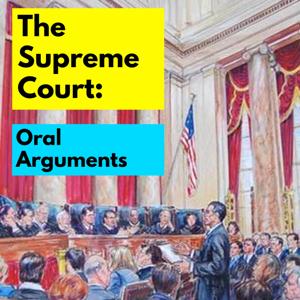
The Supreme Court: Oral Arguments

The Supreme Court: Oral Arguments

By Brad Neal
Download on the App Store

The Supreme Court: Oral Arguments episodes

  • Trump, President of United States v. Slaughter
    Trump, President of United States v. Slaughter | 12/08/25 | Docket #: 25-332
    25-332 TRUMP V. SLAUGHTER
    DECISION BELOW:
    THE APPLICATION FOR STAY PRESENTED TO THE CHIEF JUSTICE AND BY HIM
    REFERRED TO THE COURT IS GRANTED. THE JULY
    17,2025
    ORDER OF THE
    UNITED STATES DISTRICT COURT FOR THE DISTRICT OF COLUMBIA, NO.
    25
    –
    CV
    –
    909
    , ECF DOC.
    52
    , IS STAYED. THE APPLICATION IS ALSO TREATED AS A
    PETITION FOR A WRIT OF CERTIORARI BEFORE JUDGMENT, AND THE PETITION
    IS GRANTED.
     
    THE STAY SHALL TERMINATE UPON THE SENDING DOWN OF THE
    JUDGMENT OF THIS COURT.
    EXPEDITED BRIEFING.
    CERT. GRANTED 9/22/2025
    QUESTION PRESENTED:
    The parties are directed to brief and argue the following questions:
    (1) Whether the statutory removal protections for members of the Federal Trade Commission
    violate the separation of powers and, if so, whether
    Humphrey
    ’
    s Executor v. United States
    , 295
    U. S. 602 (1935), should be overruled.
    (2) Whether a federal court may prevent a person
    ’
    s removal from public office, either through
    relief at equity or at law.
    LOWER COURT CASE NUMBER: 25-5261
    2 hr 32 min
  • Olivier v. City of Brandon
    Olivier v. City of Brandon | 12/03/25 | Docket #: 24-993
    24-993 OLIVIER V. BRANDON, MS
    DECISION BELOW: 2023 WL 5500223
    CERT. GRANTED 7/3/2025
    QUESTION PRESENTED:
    Gabriel Olivier is a Christian who feels called to share the gospel with his fellow
    citizens. After being arrested and fined for violating an ordinance targeting "protests"
    outside a public amphitheater, Olivier brought a § 1983 suit under the First and
    Fourteenth Amendments to declare the ordinance unconstitutional and enjoin its
    enforcement against him in the future.
    The Fifth Circuit, applying its precedent construing this Court's decision in
    Heck
    v. Humphrey
    , 512 U.S. 477 (1994), held that Olivier's prior conviction barred his § 1983
    suit because even the prospective relief it seeks would necessarily undermine his prior
    conviction. The Fifth Circuit acknowledged the "friction" between its decision and those
    of this Court and other circuits. Over vigorous dissents, the Fifth Circuit denied rehearing
    en banc by one vote.
    The questions presented are:
    1.
    Whether, as the Fifth Circuit holds in conflict with the Ninth and Tenth
    Circuits, this Court's decision in
    Heck v. Humphrey
    bars § 1983 claims seeking purely
    prospective relief where the plaintiff has been punished before under the law challenged
    as unconstitutional.
    2.
    Whether, as the Fifth Circuit and at least four others hold in conflict with
    five other circuits,
    Heck v. Humphrey
    bars § 1983 claims by plaintiffs even where they
    never had access to federal habeas relief.
    LOWER COURT CASE NUMBER: 22-60566
    1 hr 26 min
  • First Choice Women's Resource Centers v. Platkin
    First Choice Women's Resource Centers v. Platkin | 12/02/25 | Docket #: 24-781
    24-781 FIRST CHOICE WOMEN'S RESOURCE CENTERS, INC. V. PLATKIN
    DECISION BELOW: 2024 WL 5088105
    CERT. GRANTED 6/16/2025
    QUESTION PRESENTED:
    New Jersey's Attorney General served an investigatory subpoena on First Choice
    Women's Resource Centers, Inc., a faith-based pregnancy center, demanding that it
    turn over most of its donors' names. First Choice challenged the Subpoena under 42
    U.S.C. 1983 in federal court, and the Attorney General filed a subsequent suit to enforce
    it in state court. The state court granted the Attorney General's motion to enforce the
    Subpoena but expressly did
    not
    decide First Choice's federal constitutional challenges.
    The Attorney General then moved in state court to sanction First Choice. Meanwhile, the
    district court held that First Choice's constitutional claims were not ripe in federal court.
    The Third Circuit affirmed in a divided per curiam decision. Judge Bibas would
    have held the action ripe as indistinguishable from
    . Americans for Prosperity
    Foundation v. Banta
    , 594 U.S. 595, 618-19 (2021). But the majority concluded First
    Choice's claims were not yet ripe because First Choice could litigate its constitutional
    claims in state court. In doing so, the majority followed the rule of the Fifth Circuit and
    split from the Ninth Circuit. It did not address the likely loss of a federal forum once the
    state court rules on the federal constitutional issues.
    The question presented is:
    Where the subject of a state investigatory demand has established a reasonably
    objective chill of its First Amendment rights, is a federal court in a first-filed action
    deprived of jurisdiction because those rights must be adjudicated in state court?
    LOWER COURT CASE NUMBER: 24-3124

    1 hr 24 min
  • Urias-Orellana v. Bondi, Att'y Gen.
    Urias-Orellana v. Bondi, Att'y Gen. | 12/01/25 | Docket #: 24-777
    24-777 URIAS-ORELLANA V. BONDI
    DECISION BELOW: 121 F.4th 327
    CERT. GRANTED 6/30/2025
    QUESTION PRESENTED:
    The Immigration and Nationality Act (INA) provides that noncitizens on American
    soil are generally eligible for asylum if they qualify as a "refugee." 8 U.S.C. § 1158(b)(1)
    (A). A refugee is someone with "a well-founded fear of persecution on account of race,
    religion, nationality, membership in a particular social group, or political opinion."
    Id.
    §
    1101(a)(42). Noncitizens are presumptively eligible for asylum if they have "suffered
    persecution in the past." 8 C.F.R. § 1208.13(b)(1).
    If ordered removed by an immigration judge (IJ), noncitizens may appeal the
    removal order-and with it, the denial of asylum-to the Board of Immigration Appeals
    (BIA). From there, "judicial review" is available in "an appropriate court of appeals." 8
    U.S.C. § 1252(a)(5). The INA mandates judicial deference on "findings of fact" and three
    other kinds of administrative decisions.
    Id.
    § 1252(b)(4). The statute also explicitly
    provides for judicial review of the BIA's decisions on "questions of law," but does not
    establish a deferential standard of review for such decisions.
    Id.
    § 1252(a)(2)(D), (b)(9).
    The question presented is:
    Whether a federal court of appeals must defer to the BIA's judgment that a given
    set of undisputed facts does not demonstrate mistreatment severe enough to constitute
    "persecution" under 8 U.S.C. § 1101(a)(42).
    LOWER COURT CASE NUMBER: 24-1042
    0 min
  • Cox Communications v. Sony Music Entertainment
    Cox Communications v. Sony Music Entertainment | 12/01/25 | Docket #: 24-171
    24-171 COX COMMUNICATIONS, INC. V. SONY MUSIC ENTERTAINMENT
    DECISION BELOW: 93 F.4th 222
    CERT. GRANTED 6/30/2025
    QUESTION PRESENTED:
    1. This Court has held that a business commits contributory copyright
    infringement when it "distributes a device with the object of promoting its use to infringe
    copyright, as shown by clear expression or other affirmative steps to foster
    infringement."
    Metro-Goldwyn-Mayer Studios, Inc. v. Grokster
    ,
    Ltd
    ., 545 U.S. 913, 919
    (2005). The courts of appeals have split three ways over the scope of that ruling,
    developing differing standards for when it is appropriate to hold an online service
    provider secondarily liable for copyright infringement committed by users.
    Did the Fourth Circuit err in holding that a service provider can be held liable for
    "materially contributing" to copyright infringement merely because it knew that people
    were using certain accounts to infringe and did not terminate access, without proof that
    the service provider affirmatively fostered infringement or otherwise intended to promote
    it?
    2. Generally, a defendant cannot be held liable as a willful violator of the law-and
    subject to increased penalties-without proof that it knew or recklessly disregarded a high
    risk that its
    own
    conduct was illegal. In conflict with the Eighth Circuit, the Fourth Circuit
    upheld an instruction allowing the jury to find willfulness if Cox knew its
    subscribers
    '
    conduct was illegal-without proof Cox knew its own conduct in not terminating them was
    illegal.
    Did the Fourth Circuit err in holding that mere knowledge of another's direct
    infringement suffices to find willfulness under 17 U.S.C. § 504(c)?
    LOWER COURT CASE NUMBER: 21-1168
    1 hr 42 min
  • Rutherford v. United States
    Rutherford v. United States | 11/12/25 | Docket #: 24-820
    24-820 RUTHERFORD V. UNITED STATES
    DECISION BELOW: 120 F.4th 360
    CONSOLIDATED FOR ONE HOUR ORAL ARGUMENT WITH 24-860
    CERT. GRANTED 6/6/2025
    QUESTION PRESENTED:
    The compassionate-release statute permits courts to reduce a prisoner's
    sentence if the court finds that "extraordinary and compelling reasons" warrant relief. 18
    U.S.C. § 3582(c)(1)(A). Congress placed only two limits on what can count as an
    "extraordinary and compelling reason": (1) it must be "consistent with" "applicable policy
    statements" from the U.S. Sentencing Commission,
    id
    .; and (2) "[r]ehabilitation of the
    defendant alone shall not be considered an extra- ordinary and compelling reason," 28
    U.S.C. § 994(t).
    Sections 401 and 403 of the First Step Act of 2018 reduced penalties for certain
    drug and firearm offenses going forward. Because of these changes, individuals
    sentenced today for these offenses often face mandatory minimum terms of
    imprisonment decades shorter than they would have received before the First Step Act.
    The question presented is:
    Whether, as four circuits permit but six others prohibit, a district court may
    consider disparities created by the First Step Act's prospective changes in sentencing
    law when deciding if "extraordinary and compelling reasons" warrant a sentence
    reduction under 18 U.S.C. § 3582(c)(1)(A)(i).
    LOWER COURT CASE NUMBER: 23-1904
    0 min
  • Fernandez v. United States
    Fernandez v. United States | 11/12/25 | Docket #: 24-556
    24-556 FERNANDEZ V. UNITED STATES
    DECISION BELOW: 104 F.4th 420
    THE PETITION FOR A WRIT OF CERTIORARI IS GRANTED LIMITED TO THE
    FOLLOWING QUESTION: WHETHER A COMBINATION OF
    “
    EXTRAORDINARY AND
    COMPELLING REASONS
    ”
    THAT MAY WARRANT A DISCRETIONARY SENTENCE
    REDUCTION UNDER 18 U. S. C. §3582(c)(1)(A) CAN INCLUDE REASONS THAT
    MAY ALSO BE ALLEGED AS GROUNDS FOR VACATUR OF A SENTENCE UNDER
    28 U. S. C. §2255.
     
    CERT. GRANTED 5/27/2025
    QUESTION PRESENTED:
    Under 18 U.S.C. § 3582(c)(1)(A), a district court has broad discretion to reduce
    the term of imprisonment in any case if it finds that "extraordinary and compelling
    reasons warrant such a reduction." The sole limitation Congress placed on that
    discretion is found in 18 U.S.C. § 994(t), which provides that "[r]ehabilitation of the
    defendant alone shall not be considered an extraordinary and compelling reason." In
    reversing the district court's grant of compassionate release to Joe Fernandez, the
    Second Circuit held that it was an abuse of discretion for the court to have considered
    evidence bearing on Fernandez's potential innocence as well to have found a disparity
    in sentences between Fernandez and several of his co-defendants who were
    cooperating witnesses. That decision was contrary to decisions of the First and Ninth
    Circuits, which have each held that district courts are not restricted with respect to
    matters they may consider under 18 U.S.C. § 3582(c)(1)(A) other than as set forth by
    Congress. The question presented is:
    Whether the Second Circuit erred in recognizing extra-textual limitations on what
    information a court may consider when determining whether there exist extraordinary
    and compelling reasons warranting a sentence reduction under 18 U.S.C. § 3582(c)(1)
    (A).
    LOWER COURT CASE NUMBER: 22-3122
    1 hr 23 min
  • GEO Group, Inc. v. Menocal
    GEO Group, Inc. v. Menocal | 11/10/25 | Docket #: 24-758
    24-758 THE GEO GROUP, INC. V. MENOCAL
    DECISION BELOW: 2024 WL 4544184
    CERT. GRANTED 6/2/2025
    QUESTION PRESENTED:
    Under 28 U.S.C. § 1291, the courts of appeals "have jurisdiction of appeals from all final
    decisions of the district courts." This Court has held that certain orders are immediately
    appealable under Section 1291 even though they do not terminate the litigation. Such
    "collateral orders" include orders denying claims of absolute immunity, qualified immunity, and
    state sovereign immunity.
    The question presented, which has divided the circuit courts 5-3, is whether an order
    denying a government contractor's claim of derivative sovereign immunity is immediately
    appealable under the collateral-order doctrine.
    LOWER COURT CASE NUMBER: 22-1409
    58 min
  • Landor v. LA DOC
    Landor v. LA DOC | 11/10/25 | Docket #: 23-1197
    23-1197 LANDOR V. LA DEPT. OF CORRECTIONS
    DECISION BELOW: 82 F.4th 337
    CERT. GRANTED 6/23/2025
    QUESTION PRESENTED:
    Congress has enacted two "sister" statutes to protect religious exercise: the
    Religious Freedom Restoration Act of 1993 (RFRA), 42 U.S.C. 2000bb
    et seq
    ., and the
    Religious Land Use and Institutionalized Persons Act of 2000 (RLUIPA), 42 U.S.C.
    2000cc
    et seq
    . In
    Tanzin v. Tanvir
    , 592 U.S. 43 (2020), this Court held that an
    individual may sue a government official in his individual capacity for damages for
    violations of RFRA. RLUIPA's relevant language is identical.
    The question presented is whether an individual may sue a government official in
    his individual capacity for damages for violations of RLUIPA.
    LOWER COURT CASE NUMBER: 22-30686
    1 hr 52 min
  • Learning Resources, Inc. v. Trump, President of U.S.
    Learning Resources, Inc. v. Trump, President of U.S. | 11/05/25 | Docket #: 24-1287
    24-1287 LEARNING RESOURCES, INC. V. TRUMP
    DECISION BELOW:
    THE PETITION FOR A WRIT OF CERTIORARI BEFORE JUDGMENT IS GRANTED. CONSOLIDATED
    WITH 25-250 FOR ONE HOUR ORAL ARGUMENT. EXPEDITED BRIEFING. THE CASES WILL BE SET
    FOR ARGUMENT IN THE FIRST WEEK OF THE NOVEMBER 2025 ARGUMENT SESSION.


    CERT. GRANTED 9/9/2025
    QUESTION PRESENTED:
    The International Emergency Economic Powers Act, 50 U.S.C. § 1701
    et seq.
    ("IEEPA")
    permits the President, upon a valid emergency declaration, to "investigate, block during the
    pendency of an investigation, regulate, direct and compel, nullify, void, prevent or prohibit, any
    acquisition, holding, withholding,
    use, transfer, withdrawal, transportation, importation or
    exportation of, or dealing in, or exercising any right, power, or privilege with respect to, or
    transactions involving, any property in which any foreign country or a national thereof has any
    interest[.]"
    Id.
    § l 702(a)(1)(B). Until now, no President in IEEPA's nearly 50-year history has
    ever invoked it to impose tariffs-let alone the sweeping worldwide tariffs imposed pursuant to
    the executive orders challenged here.
    The question presented is:
    Whether IEEPA authorizes the President to impose tariffs.
    LOWER COURT CASE NUMBER: 25-5202
    2 hr 40 min

About The Supreme Court: Oral Arguments

From the publisher's feed

A public good: every Supreme Court Oral Argument since 2010. Making the Highest Court more accessible for a modern audience. The DC Bar blog's piece about this podcast can be found here:…

Best of The Supreme Court: Oral Arguments

Ranked by our users in the last 21 days

More shows like The Supreme Court: Oral Arguments

Planet Money by NPR

Planet Money

30,652 Listeners

Amicus With Dahlia Lithwick | Law, justice, and the courts by Slate Podcasts

Amicus With Dahlia Lithwick | Law, justice, and the courts

3,471 Listeners

Bloomberg Law by Bloomberg

Bloomberg Law

381 Listeners

U.S. Supreme Court Oral Arguments by Oyez

U.S. Supreme Court Oral Arguments

662 Listeners

We the People by National Constitution Center

We the People

1,098 Listeners

Pod Save America by Pod Save America

Pod Save America

87,202 Listeners

The Daily by The New York Times

The Daily

111,832 Listeners

Up First from NPR by NPR

Up First from NPR

56,407 Listeners

Post Reports by The Washington Post

Post Reports

5,207 Listeners

Strict Scrutiny by Strict Scrutiny

Strict Scrutiny

5,731 Listeners

Advisory Opinions by The Dispatch

Advisory Opinions

3,924 Listeners

5-4 by Prologue Projects

5-4

3,531 Listeners

The Ezra Klein Show by New York Times Opinion

The Ezra Klein Show

16,026 Listeners

Amarica's Constitution by Akhil Reed Amar

Amarica's Constitution

388 Listeners

Divided Argument by Will Baude & Dan Epps

Divided Argument

742 Listeners