
Sign up to save your podcasts
Or



Based on Podcast App listening data
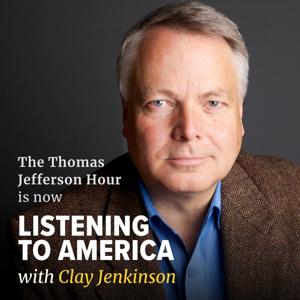
Clay welcomes Professor David Silverman of George Washington University to talk about his new book, The Chosen and the Damned: Native Americans and the Making of Race in the United States. Dr. Silverman argues that race is a social construct, forged in American history as the white European-derived settlers on America's frontier differentiated themselves from those who stood in the way by crafting ideologies of race. His view is that race was not invented by Enlightenment scientists but by people on the meeting ground of Anglos and Natives. The idea that Europeans were "white people" destined by God to possess the continent was a convenient myth to construe indigenous people as subordinate and unworthy of maintaining their sovereignty on lands that were their homelands. By letting race be the lens through which the settlers viewed Indigenous peoples, the frontiersmen lost an opportunity to deal justly with the Natives they encountered along the way. This episode was recorded on March 2, 2026.
Host David Horton and Clay attempt to make sense of the cataclysmic midterm election of 2026. If the election directly repudiated President Trump and the Republican Party, did it also end the MAGA movement? How did Donald Trump go from an improbable comeback victory in 2024 to the 2026 debacle? Will President Trump pull back from the excesses of his second term and realign his administration with the decided will of the American people, or will he double down on such unpopular policies as his fight with Canada and America's allies, his undeclared war against Iran, and the paramilitary actions of the Immigration and Customs Enforcement service (ICE)? What will the next two years bring as the country begins to think about the 2028 Presidential Election? This episode was recorded on November 4, 2026.
Clay interviews Professor Mark Squillace of the University of Colorado Boulder's law school about the history and future of the National Monuments. When Congress created the National Monuments system in 1906, did they consider what the maximum size should be for a presidential proclamation of a new National Monument? Since a president can create a National Monument by executive order, can a later president reduce or eliminate that National Monument? Did the men who created the Antiquities Act understand that many National Monuments, like the Grand Canyon, would later graduate into full National Park status? With the Trump administration paring down some National Monuments, will a test case go to the Supreme Court to determine who, if anyone, has the authority to reduce the size of an already dedicated National Monument? And what was Theodore Roosevelt's role in our interpretation of the Antiquities Act? This episode was recorded on August 6, 2026.
Host David Horton asks Clay to discuss how two very different presidents, Theodore Roosevelt and Thomas Jefferson, viewed power. Both were ardent believers that the United States must control the North American continent. But Jefferson wanted to limit presidential power to ensure the legislative branch of the national government led on almost every public matter. Theodore Roosevelt was much more comfortable with power than Jefferson because he believed the 1787 Constitution was an outmoded, inefficient social compact for the problems of the 20th century. But even Roosevelt would have been startled by the idea of a Unitary Executive of essentially unlimited authority. Has the pendulum reached its limit, and are the people of the United States ready to move back toward regular order, or is the current flirtation with autocracy likely to become the new norm? This episode was recorded on October 25, 2026.
David Horton and Clay discuss the likelihood of a calm transfer of power during and after the November midterm elections. Does anyone believe there will be no allegations of election rigging, of votes by undocumented workers, or charges of election fraud in a few weeks? Time will tell, but Clay and David make a few careful predictions before the election. They also discuss Clay's recent cultural tour of Thomas Jefferson's France — Paris, Dijon, Nimes, the Pont du Gard, and the celebrated Canal du Midi that connects the Mediterranean and the Atlantic. France highly regards Jefferson as one of America's greatest ambassadors. Was the French Revolution in any way a cousin to the American Revolution a little more than a decade earlier? And why was Thomas Jefferson so cheerful about bloody revolution? This episode was recorded on October 17, 2026.
Host David Horton debriefs Clay on his recent cultural tour of the National Monuments of the Four Corners area. Clay teamed up with his friend Dr. Susan Ryan to visit Mesa Verde National Park, Bears Ears National Monument, and Canyon of the Ancients National Monument with a group of 20 participants from across the U.S. The goal was to explore the history and current status of America's National Monuments in the wake of President Trump's executive orders reducing the size of Bears Ears by more than 90%. Susan Ryan was an outstanding cultural tour lead, explaining how Southwestern archaeology is changing in the 21st century to show much greater respect for Indigenous communities. Clay performed as the 26th president, Theodore Roosevelt, and helped lead discussions of the 1906 Antiquities Act text and its several important ambiguities. This episode was recorded on October 9, 2025.
Clay Jenkinson gives four or five lectures annually for the Smithsonian Associates. In his most recent talk, he analyzed three notorious 20th-century censorship cases, all involving books once regarded as obscene. First, the case against James Joyce's novel Ulysses, thought by some to be the greatest novel of the century, went to trial in 1933. Second, the trial of D.H. Lawrence's Lady Chatterley's Lover in 1960, banned in England not just for its explicit sex scenes, but because the adulterous affair was between an aristocratic woman and a mere working-class gardener. And finally, Allen Ginsberg's Beat Generation poem Howl, published by City Lights Bookstore in San Francisco, was tried in 1957. Each case was full of dramatic twists, irony, and humor, and in each case a judge or jury decided these amazing works of literature were not legally obscene. This episode was recorded on August 15, 2026.
Author and explorer Denis Belliveau talks with Clay about his epic journey along the entire Silk Road in the footsteps of Marco Polo. Polo (ca. 1254-1324) traveled from Venice to the far end of China between 1271 and 1295 AD. He visited Kublai Khan in the legendary Xanadu. Denis Belliveau and his traveling companion, Francis O'Donnell, needed 70 visas to make the immense journey, none of it by airplane, much of it on foot, horse, camel, and such fortunate rides they could cadge along the way. They traveled with what Belliveau calls "reckless bravado and a lot of testosterone," through Turkey, Iran, Afghanistan, India, Tibet, and China, among other nations. They were, so far as anyone knows, the first people ever to retrace the entire Marco Polo journey. The result was a PBS documentary and excellent book, In the Footsteps of Marco Polo. You can also learn more at his website: In the Footsteps. This episode was recorded on April 8, 2026.
Host David Horton asks Clay Jenkinson what we have learned from the 9/11 attacks on the World Trade Center, the Pentagon, and all that has transpired since 2001. Clay offers six lessons — beware of overreacting; avoid endless wars that have little to do with the terror attack; keep your eye on the geopolitical ball and don't be distracted by temporary sex scandals; work harder to sustain the national unity that follows a catastrophe; Islam is not our enemy, and it is not the problem; and accept some responsibility for how American actions in the world frustrate and enrage others. Clay argues that America's isolation from Europe and the rest of the world has made us complacent about how our actions and policies inspire violent reactions. This episode was recorded on September 11, 2026.
Clay's conversation with historian Jim Rasenberger, the author of "A Perfect Coincidence: The Extraordinary Friendship and Astonishing Deaths of John Adams and Thomas Jefferson." Jefferson and Adams collaborated on the Declaration of Independence in 1776, served together as diplomats in France for the United States in the 1780s, and cherished each other's friendship. Then the heated politics of their time came between them, until by 1800, they were enemies. Fortunately, they patched their friendship back together when they were safely retired from public life and died on the same day, the Fourth of July 1826, in lovely harmony, one in Virginia, the other in Massachusetts. This episode was recorded on May 22, 2026.
From the publisher's feed
Ranked by our users in the last 21 days

37,792 Listeners
1,562 Listeners
3,779 Listeners
1,141 Listeners

1,094 Listeners
748 Listeners

2,233 Listeners
809 Listeners
4,080 Listeners
6,147 Listeners

16,344 Listeners

4,195 Listeners

211 Listeners

385 Listeners

1,590 Listeners