
Sign up to save your podcasts
Or



Based on Podcast App listening data
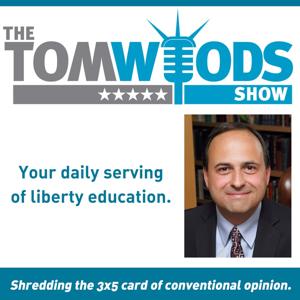
When you read old -- and I mean old, like nineteenth century old -- American writers on money and banking, something jumps out at you: they understood things with a surprising clarity, and had a proto-Austrian conception of why the economy experienced boom-bust cycles. Suddenly it feels less lonely to believe that artificial credit creation leads to a boom that has to end in a bust. In this episode, therefore, I share some unknown American intellectual history. Show notes for Ep. 1344
Stephen Presser and I go from William Blackstone, whose Commentaries on the Laws of England played such a central role in influencing early American ideas about the law, all the way to the Marxist-inspired Critical Legal Studies movement, the feminist legal critique, and back again to the originalism movement. Sponsor: Policy Genius Show notes for Ep. 1343
How many times has this crisis been chalked up to "greed"? As if people hadn't been greedy three weeks earlier. It's time our amateur moralizers learned a little something, and that's the purpose of this episode. My thanks to the Acton Institute, where I delivered these remarks. Show notes for Ep. 1342
Cliff Maloney, president of Young Americans for Liberty (YAL) -- an organization I have enthusiastically supported for over ten years -- joins me to discuss their strategy for the campuses and society at large. YAL developed out of Students for Ron Paul, and are on the front lines of getting our message to young people who might otherwise never hear a dissenting voice. Sponsor: Skillshare Show notes for Ep. 1341
Ben Lewis and I go back into conservative/libertarian history to discuss the work of Frank Meyer, who thought the conservative and libertarian positions were not so difficult to reconcile. Conservative stalwart Russell Kirk wasn't buying it, and the two feuded vigorously. Murray Rothbard, too, weighed in on the controversy. Show notes for Ep. 1340
Friends and foes of the market alike refer to capitalism as a system of "competition." Is that really its characteristic feature, and is that what distinguishes it from other systems? This is actually a misunderstanding, and one that probably turns plenty of people off to the market. What's the right way to think about and explain it? That's what Antony Sammeroff and I discuss in this episode. Show notes for Ep. 1339
In this episode I explore the history of the idea that society can more or less run itself, that there are certain observable regularities in our relationships with one another, particularly in commerce, that cannot be interfered with without negative consequences, and do not actually need to be interfered with in the first place. Show notes for Ep. 1338
Walter Block, who holds the Harold E. Wirth Eminent Scholar Chair at Loyola University in New Orleans, joins me to discuss some particularly tricky questions for libertarians. Show notes for Ep. 1337
Josh Blackman, a professor at South Texas College of Law, discusses the grounds on which U.S. District Court Judge Reed O'Connor found Obamacare unconstitutional. We discuss John Roberts' decision for the Supreme Court as well. Show notes for Ep. 1336 Sponsor: Skillshare
That's a provocative title, to be sure. Author William Cavanaugh, a professor at DePaul University, is not saying that what we recognize to be religious beliefs can never inspire violence. What he is saying -- and I won't spoil the episode by spelling out his thesis here -- forces us to rethink what we thought we knew about religion, secularism, and war. Sponsor: Away Show notes for Ep. 1335
From the publisher's feed
Ranked by our users in the last 21 days
3,954 Listeners
5,578 Listeners
4,865 Listeners

2,265 Listeners
963 Listeners
1,140 Listeners
31 Listeners
326 Listeners
484 Listeners

2,170 Listeners
5,303 Listeners
920 Listeners

499 Listeners

15,943 Listeners
543 Listeners