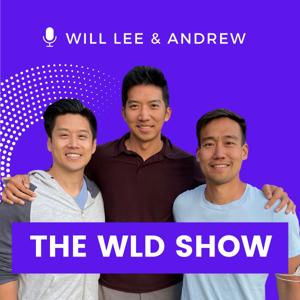
The WLD Show

The WLD Show

By Will Chang, Lee Chang, Andrew HsuSociety & CultureDocumentaryBusinessTechnologyCareers
Download on the App Store

The WLD Show episodes

  • Besties Episode w/ David Duong | Will, Lee, & Andrew Learn Web3: #46

    We bring back a friend of the podcast, David Duong, on to talk about his Web3 Journey. David runs monetization for Apex Legends and his team has made the game over $1.6 billion dollars selling in-game digital goods. David's been learning about Web3 and NFTs through our podcast and shares his insights with us.

    If you liked this episode, you can find more episodes at wld.show!

    1 hr 21 min
  • Marcel Christianis: Breaking Down Smart Contracts in Twitter Threads | Will, Lee, & Andrew Learn Web3: #45

    Marcel has been an engineer for 7 years and is the creator web3pad.xyz, where he explains the unique aspects of NFT contracts such as Loot, Chain Runners, AlphaGirl Club, the Adidas Originals Drop, and ConstitutionDAO. We discuss contract constructs, special attributes, respected builders, contract evolution and how Marcel launched two NFT’s: Mycoverse.xyz’s mushroom NFT’s and his own Retro1990 NFT’s.

    Learn more about Marcel:

    • Marcel’s Twitter: @marcelc63
    • Marcel’s Smart Contract Twitter Thread Breadowns: https://web3pad.xyz
    • Marcel’s Retro1990 NFT’s: https://retro1990.xyz
    • Retro1990’s Instagram: @retro_vintage1990

    Smart Contracts Discussed:

    • Cool Cats
    • Alpha Girls Club
    • Loot
    • AltNoun
    • Constitution DAO
    • Wolf Game
    • SuperSea
    • Chain Runners
    • AdidasOriginal
    • WAGMIGOTCHI

    In this episode, we cover:

    • Marcel’s history
    • How BuildSpace helped Marcel learn Web3
    • Building in Web3
      • How much simpler it was to set up an ETH tip jar tipeth.xyz in Web3 than in Web2
      • Web3’s inherent benefits to developers: ownership, being permissionless, and economy
      • Marcel explains how Rareblocks encourages and enables developers to build upon their platform
      • How active participation and growing a platform, results in NFT holders gaining value
      • How web3 empowers developers and rewards them for building
    • How Marcel finds and reads the code for NFT contracts
    • Why Marcel started to do contract breakdowns
    • Breaking down the Cool Cats contract and how most pfps work
    • Breaking down the AlphaGirls contract and how they reduced minting fees
    • The difference between reading and writing on the blockchain
      • Read: Reading data off the blockchain is free
      • Write: Writing to the smart contract requires paying tokens
    • The difference between on-chain vs off-chain NFTs
    • Breaking down how Loot’s on-chain NFT doesn’t need external links to host images
    • What NounDAO’s on-chain SVGs allows other developers to do
    • How code is part of the NFT art for on-chain
    • Breaking down AdventureGold’s contract and how airdrops work
    • How someone went around AdidasOriginal’s 2 NFT minting limit to mint 300 NFTs
    • How ConstitutionDAO was structured to collect and manage millions of dollars

    If you liked this episode, you can find more episodes at wld.show!

    1 hr 22 min
  • Jon Yan: VectorDAO. How Builders become the Kingmakers. Forming a Superteam of Elite Web3 Design Talent | Will, Lee, & Andrew Learn Web3: #44

    Jon Yan is the founder of VectorDAO, a collective of designers on a mission to improve how designers are employed and to make web3 more accessible. He was previously a designer at Coinbase and a YC founder. We discuss DAO’s, growing DAO’s via minimum viable governance, the history of work in America, VectorDAO’s new employment model & its impact on workers, how liquid super teams could change work and VC investing in the future.

    Learn more about Jon and VectorDAO

    • Jon’s Twitter: @jonjyan
    • Jon’s NFT gallery: https://gallery.so/jon
    • VectorDAO’s Twitter: @VectorDAO
    • VectorDAO’s website: https://vectordao.com
    • Introducing Vector DAO

    Episode notes:

    • What is a DAO?
      • Decentralized organizations (DO) vs. Decentralized autonomous organizations (DAO)
      • Vitalik Buterin explaining DAO’s and associated entities
    • What the simplest form of a “DAO” can be
    • Why a “DAO” for VectorDAO
    • How and why VectorDAO was started
    • Books that inspired Jon
      • The Company: A Short History of a Revolutionary Idea
    • The history of work in America
      • How happiness dropped once the industrial age hit
      • How workers trade off happiness & freedom for a consistent salary
    • How capital has become more abundant and skilled workers are the scarcest asset
    • VectorDAO’s Season 0 goals
    • How VectorDAO negotiates new employment terms
    • How VectorDAO negotiates for equity
    • How the day to day lives of designers have changed in the new employment model
      • Doing less of what doesn’t give you energy
      • Providing more project diversity with much less effort
    • How Jon was inspired by Packy McCormick’s write up on Liquid Super Teams
    • Evaluating which protocols are most likely to succeed based on who the founders are and what talent they’ve attracted
    • How VectorDAO allocates payment if some people contribute differently
    • The roles on the cap table of a new deal
      • Deal lead (BD)
      • Project lead (senior designer)
      • VectorDAO designers
    • How equity is calculated and shared
    • How VectorDAO ensures new members are a good fit and immediately impactful
      • A thorough interview and voting in process
      • Not adding new designers unless there is definitely something for them to do
      • Invest in tooling and the onboarding flow:
        • Sharing the DAO’s rules
        • Teaching new members what the key channels are and asking them to rais their hand
      • Writing a clear mission and purpose
        • Make Web3 a lot more accessible
        • Empower best talent to get best terms possible
    • How VectorDao is iterating and working towards automating organizational logic
    • Why Jon tells everyone to “decentralize slower”
      • Minimum viable governance
    • The biggest differences designing for web3 vs. web3
      • Web3 is much more inter-disciplinary
    • What some good principles in web3 are
      • Yang You’s Talk on Good Design in Web3
    • How VC investment models might change due to service DAO’s
    • How DAO’s will exist to serve member needs
    • How Jon thinks about creating the best possible experience for talent
    • The future of work
      • People opting in as owners
      • Shifting employment goals away from not getting fired
      • How we need to shift how employees and employers think about work

    If you liked this episode, you can find more episodes at wld.show!

    45 min
  • Tae Oh: Gluwa and CreditCoin. Rebuilding the global financial system | Will, Lee, & Andrew Learn Web3: #43

    Tae Oh is the Founder and CEO of Gluwa. Gluwa is a borderless financial platform with 2 million global users. Gluwa got its start enabling people without bank accounts to make easy international purchases. Tae created Gluwa Capital to provide venture loans to microfinancers and lenders in developing countries. Tae also built CreditCoin to help people in developing countries without credit histories obtain credit and create their own, transferrable credit history.

    Learn More about Tae Oh and Gluwa:

    • Twitter: https://twitter.com/taelimoh
    • LinkedIn: https://www.linkedin.com/in/tae-lim-oh
    • Gluwa: https://gluwa.com/about
    • CreditCoin: https://creditcoin.org
    • Gluwa Capital: https://gluwacapital.com/

    Episode notes and links:

    • How Tae Oh got his start in Bitcoin and Crypto
    • The origin story of Gluwa’s first product
    • What CreditCoin is and what it enables
      • The ability for companies and people without a credit history to obtain credit (this is huge for the bankless)
      • The ability to build a credit history that can be used with any lender
    • CreditCoin’s origin story
    • The three types of stable coin:
      1. Fiat backed stable coins - The creator holds 1 USD per coin and custody of issuer has to be exposed to regulatory audits. Examples:
        • Tether
        • USDC
      2. Crypto collateralized stable coins
        • Currency example: DAI
        • Organization responsible for DAI - Maker DAO
      3. Algorithmic stable coins
        • Company example: Basis
    • The types of customers who are most interested in CreditCoin
    • Why Gluwa is considering a DAO to approve a new multi-chain gateway
    • How Tae Oh manages and guides his team across many industries
    • Gluwa’s key performance indicator (KPI)
    • How Tae Oh thinks about and acts on risk
      • Delegate mitigating risk to the right people
      • Don’t worry about work that’s been delegated
      • Continuously group parts of your role, create a job description, hire, delegate it, focus on something only you can do.
    • What’s next for Gluwa?

    If you liked this episode, you can find more episodes at wld.show!

    54 min
  • Kevin Lin: How to be a DeFi Degen (Decentralized Finance Yield Chaser) | Will, Lee, & Andrew Learn Web3: #42

    Kevin Lin is a crypto and DeFi enthusiast. We chat about magic internet money, yield farming, "degen" strategies, and the research and mechanics to get onto a protocol. Not investment advice!

    Kevin found yield farming in March of 2021 and has been hooked since then. We discuss his first investment, getting rug pulled, base yield farming concepts, researching new protocols, create a check list of how to get on a protocol, and tracking your investments.

    In this episode we discuss:

    • Magic internet money
    • Iron finance (the first rug pull):
    • MIT course on crypto
    • In yield farming, you are typically earning interest on your collateral because the protocol founder is paying you to:
      • Stake
      • Lend
      • Provide market liquidity
      • Use the protocol
    • The mechanics of getting onto a new protocol
      • Read the white paper, evaluate the developers, check for social proof, etc.
      • Understand what protocol and coins are required to get onto the protocol
      • Working backwards from the required protocol and coin to understand how you can obtain said coin on said protocol.
      • Getting on a centralized exchange so you can convert fiat into a crypto currency
      • Setting up a crypto wallet
      • Transferring currency from an exchange to a wallet
      • Finding the appropriate "Off ramp" or "Bridge" or "Swap" to get the coin you need
      • Getting onto the protocol
      • Monitoring your investment(s) via services like:
        • https://zapper.fi
        • https://apeboard.finance
    • Different yield protocols (You must do your own research and consider if the risk is worth the reward before investing. Not investment advice).
      • Anchor protocol
      • Aave on Avalanche
      • Wonderland
      • Abracadabra money

    If you liked this episode, you can find more episodes at wld.show!

    48 min
  • Aaron Barr: How a Creative Agency helps their Artists transition to NFTs | Will, Lee, & Andrew Learn Web3: #41

    Aaron Barr is the founder of Atrbute, a creative management agency. Atrbute represents many famous artists and studios such as Shepard Fairey’s (OBEY & Obama’s “hope” poster) Number One Studio, photographer Pari Dukovic (Time cover: Prince Harry & Meghan), and Tristan Eaton (Kid Robot & many famous murals). We discuss his career, how he’s transitioning artists into NFT’s, how he helps artists partner with companies, and how companies are utilizing NFT’s.

    In this episode we discuss:

    • What Aaron and Atrbute offer through creative management
    • What types of artists are most interested in NFT's
    • Onboarding digital artists to NFT’s:
      • How important it is to understand why his artists are interested in NFT’s and what it is they hope to create, before starting to tailor a solution.
      • Ensuring artists create unique, thoughtful contracts which protect them
      • What tools to use to publish an NFT:
        • If the art is a 1 of 1: Superare - https://superrare.com
        • If the art is a collection of 1:1's: Foundation - https://foundation.app
        • If the art is a programatically generated NFT: OpenSea - https://opensea.io/assets
    • The difference between generating art and minting an NFT
    • Programmable on-demand generative art through Art Blocks - https://www.artblocks.
    • How Aaron helps launch new digital art projects
    • How Aaron meets artists and networks with buyers and corporations
    • How Aaron started his creative agency
    • How artists might be the vanguards defining which neighborhoods will be the most desirable
    • How curating your wallet will be like curating your music collection times 10
    • What makes art valuable?
    • How being part of the street art wave has prepared him for the NFT wave
    • What different contract types between artists and corporations look like
    • How has Art Basel changed in 2021?

    More About Aaron and Atrbute

    • Twitter: @aaronlbarr
    • ENS: agentaaron.eth
    • BAYC #5650, Cool Cat #427
    • Tristan Eaton tweet thread on why NFTs
    • Shantell Martin on remapping the old art world with NFTs.
    • Atrbute: https://www.atrbute.com
    • Atrbute IG: @atrbute

    If you liked this episode, you can find more episodes at wld.show!

    54 min
  • Mike Wen: Building Gallery to help NFT Collectors display their NFTs | Will, Lee, & Andrew Learn Web3: #40

    Mike Wen is the founder and CEO of Gallery. Hundreds of the largest NFT collectors use Gallery to curate and display their NFTs. Mike’s first NFT was a piece by Beeple, and when it netted him 100x profit, he became obsessed with collecting more NFT’s. When he couldn’t find a good way to curate & display his collection, he taught himself to code and created Gallery. Investors took notice and Gallery has now raised $2.69M from Collab+Currency, Coinbase Ventures, Dapper Labs and angel investments from 20+ collectors in the NFT space. Today, Mike is focused on making Gallery the go to place for curating, managing, and displaying NFT's.

    In this episode we discuss:

    • What NFT's are: https://ethereum.org/en/nft/
    • What Gallery is:
      • A space for NFT collectors to display their collections.
      • A set of tools for collectors to manage and curate their NFT's.
      • A place to add meaning and context to NFT's
    • How Gallery protects wallet holders from their NFT's being shown without authorization.
    • Mike’s first NFT: Beeple
    • Some of Mike’s favorite galleries:
      • https://gallery.so/mikey
      • https://gallery.so/jo7
      • https://gallery.so/pleasrdao
      • Pleasrdao is the owner of “The Doge that started it all”:
    • How Mike evaluates NFT's and collections
    • Securing an investment from Flamingo DAO - - through an interview with a set of black screens.
    • How Gallery got the top NFT collectors as users such as FlamingoDAO, DCInvestor, and Kevin Rose
    • How to get Gallery membership via OpenSea
    • The difference in mind set when building a Web3 company vs. a Web2 company
    • How Gallery is growing and the roles it’s hiring for: Gallery's Careers
    • If Mike was to do this over again, whether he would’ve done anything differently
    • How NFT's will create the texture of who you are online and what you love
    • How NFT's will represent more and more items such as tickets, music, and experiences:
      • Books, movies, music
      • Collecting your experiences! For example utilizing PoAp’s, which are badges that represent you were somewhere - https://app.poap.xyz
      • Games - Assets and skills
    • Using https://www.artblocks.io as a vending machine to generate your own art
    • What Gallery is focused on next
    • Taking your gallery anywhere and using it as a jumping off point into any 3D world

    Learn More About Gallery

    • Gallery's Twitter: @useGALLERY
    • Mikey's Twitter: @mikeybitcoin
    • Gallery's Open Positions

    Gallery Angel Investors Include:

    @santiagoroel, @Cooopahtroopa, @gabusch, @DeezeFi, @gregisenberg, @pplpleasr1, @_jamiis, @whatdotcd, @andy8052, @dandelion_eth, @seth, @thattallguy

    If you liked this episode, you can find more episodes at wld.show!

    53 min
  • Rick Porter: Building DSCVR. The future of decentralized social | Will, Lee, & Andrew Learn Web3: #39

    Rick Porter is the CEO and Founder of DSCVR. DSCVR’s mission is to create a decentralized social content aggregation platform where users not only control the content, but also the platform itself. Think Reddit, if Reddit’s development was run by its most dedicated community members. Prior to DSCVR worked at Google and Boston Consulting Group Digital Ventures, where he built blockchain projects for Fortune 500 companies. Including a project for DeBeers using the Ethereum blockchain to track its diamond supply chain.

    In this episode we discuss:

    • His previous experience at Boston Consulting Group building blockchain projects for enterprise customers
    • Why Rick learned Rust and WASM (web assembly)
    • What is Decentralized Social (DeSo) and why is it important for today’s society?
    • What are the building blocks within each DSCVR portal?
    • What is DFINITY? Containerized, decentralized computing.
    • Civil resistance / establishing personhood - how do you establish persons or persons?
    • The multi-level altitudes that NFT's can exist at.
      • NFT's can represent your identity and contain more NFTs!
    • The tokens and DAO's on DSCVR
      • Social token - earned via participation on the platform (not trade-able, not purchase-able) - helps make decisions on the platform
      • Governance token - Purchase-able, trade-able, used for powering the platform.
    • How each portal on DSCVR is like a subreddit. Rick's belief that each portal (subreddit) should be a DAO. Thinking about whether each portal should have their own token / NFT / governance.
    • Rick's goal is to create the rails people can build on to create communities. Creating the tools for a community to grow itself. Truly decentralized and governed by the community.
    • Requirements for a community to successfully govern itself.

    We're introducing a new series where Will, Lee, and Andrew Learn about Web3. This is a pivotal moment in time where Web3 has exploded and a lot of smart people we know are dropping their careers to transition into Web3. This is a series where we bring friends on to learn about what's happening.

    Learn More About DSCVR

    • Website http://dscvr.one
    • Twitter: https://twitter.com/DscvrO
    • Introducing DSCVR: A platform that belongs to its community
    • DSCVR Portal Governance

    If you liked this episode, you can find more episodes at wld.show!

    1 hr 1 min
  • High Witches of Crypto Coven | Will, Lee, & Andrew Learn Web3: #38

    We welcome the all women founding team: Nyx, Xuannü, Aletheia, Aradia, and Keridwen behind Crypto Coven to the show! Crypto Coven is a unique set of witch NFT’s which will give holders access to an immersive, narrative-driven digital-world. We discuss the origin of CryptoCoven and geek on how every aspect of the project, from witch silhouettes to colors to astrological signs, and the minting process itself were customized to be as diverse, inclusive, and accessible possible.

    Find CryptoCoven at:

    • Website: https://www.cryptocoven.xyz
    • NFT’s: https://opensea.io/collection/cryptocoven
    • Twitter: https://twitter.com/crypto_coven
    • IG: https://www.instagram.com/crypto_coven
    • How to mint: https://www.cryptocoven.xyz/guide

    In this episode, we discuss:

    • The story behind choosing witches and the Crypto Coven name
    • The lore behind each high witch’s name
    • Community building: How the high witches asked the community for mood boards and articulations (witch descriptions) and used these to weave custom styles and items into each witch archetype so the community would see their fingerprints throughout the collection. How they found the mood boards to be "Asking for proof of humanity through proof of taste"
    • How Savage x Fenty inspired the High Witches to create as diverse and distinct a set of NFT’s as possible. How they wanted to enable people to see as wide a range of women as possible, so that it resonates and people can find art that looks like them.
    • Why they created such a detailed minting guide and why they think they were so successful onboarding people new to NFT’s to CryptoCoven.
    • “Enjoying seeing femininity become part of the default assumption versus an exception”
    • Why the High Witches have a purposefully vague road map and prefer "showing rather than telling"
    • How Neopets - https://www.neopets.com was a big inspiration from the High Witches’ past
    • The process and story behind how they landed on their minting process:
      • How they researched and decided on their specific mint process
        • https://www.paradigm.xyz/2021/10/a-guide-to-designing-effective-nft-launches
        • Dutch auction - https://medium.com/geekculture/what-is-a-dutch-auction-and-why-it-matters-in-the-nft-space-59d5d26369f9
      • Methods used to prevent people from buying witches just based on rarity
      • How the community reacted and discussions they had when people learned about the minting process.
      • How they dealt with and felt about different community expectations.
    • How they customized every aspect each witch and the roll out process
      • The thought process behind creating witch archetypes and building their divination quiz: https://www.cryptocoven.xyz/divination
      • How they used code to make witch silhouettes, colors, items, and attributes as diverse and distinct as possible.
      • How they generated unique names, articulations and lore by sourcing turns of phrase from their community and plugging it into AI in batches until they created unique, amusing names like “mint mint”
    • What the future of Crypto Coven could bring

    We're introducing a new series where Will, Lee, and Andrew Learn about Web3. This is a pivotal moment in time where Web3 has exploded and a lot of smart people we know are dropping their careers to transition into Web3. This is a series where we bring friends on to learn about what's happening.

    Previous Will, Lee, and Andrew Learn about Web3 Episodes:

    • Will, Lee & Andrew Recap After 25 Episodes and Starting a Learning Web3 Series
    • #27 Yoshi Luk: Exploring DeFi (Decentralized Finance)
    • #28 Evan Lai: How to Get Started Learning About Web3
    • #31 Jay Chang: Cofounding Genopets. A Play-to-Earn NFT Game on Solana.
    • #32 Shalin Pei: Coinbase Designer. Unlocking a Playground for Creativity.
    • #33 Howie Zhang: Designing an NFT Game Economy as a Quant Analyst
    • #34 Li Ouyang: Discovering an NFT Community She's Passionate About
    • #36 Peter Ng: Designing Spatial. The Airbnb for NFTS
    • #37 Katherine Liu: Onboarding the Next Million Artists into Web3

    Resources to learn more:

    • Read Chris Dixon: Why Web3 Matters
    • Listen to Tim Ferriss' episode with Chris Dixon and Naval Ravikant on Web3
    • Listen to #14 Elliot Chun: Making the World a Better Place with Blockchain
    57 min
  • Katherine Liu: Onboarding the Next Million Artists into Web3 | Will, Lee, & Andrew Learn Web3: #37

    Katherine Liu is a designer and illustrator building in Web3. She is a co-creator of the Mycoverse, a collection of 3,333 mushroom-inspired NFTs on the Solana blockchain.  The Mycoverse's mission is to onboard the next 1 million artists into web3. She is also the co-creator Nifty Generator, a simple, no-code way to generate NFT collections for Solana or Ethereum.

    She has been a designer at Instagram, IDEO, and Facebook. In parallel, she's launched multiple front page Product hunt projects and many of her own art works. Today, she's learning by exploring projects with her partner, founded a Web3 community, and dreaming up her next project. In this show we discuss:

    • Launching a new NFT generator - NiftyGenerator - on product hunt: https://www.producthunt.com/posts/nifty-generator
      • How NiftyGenerator works - https://niftygenerator.xyz
      • Upload images that are static or animated
      • Upload meta data - ETH or Solana
    • How to think about an NFT and the roles it takes to create one: engineer, marketer, community manager, and designer.
    • Mycoverse - https://mycoverse.xyz/ and its goal to onboard the next million developers onto the Metaverse
    • Porta Penguin - Pooping on penguin - https://www.katherineliu.me/portapenguin
    • Using NiftyPixels to mint your own NFT's - Polygon - https://www.niftypixels.io
      • Choosing Polygon to reduce the cost of minting and sharing
    • How to realize if you have enough conviction about your project: "Do we have 5 to 10 years of commitment?"
    • What Katherine's learned from her projects?
      • The community required to be successful
    • What minting is
      • OpenSea - "Lazy minting" - They don't mint it until someone buys it. (no gas fees until someone actually purchases it)
      • Foundation - You mint your NFT when you upload your artwork - giving name and description
        • Once minted - it's uploaded to the blockchain and then you can't change the information
    • How does Nifty Pixel mint?
      • Transaction happens when you press mint
      • Pressing mint - should open a MetaMask (wallet) window
        • After you confirm the transaction, you're confirming that your wallet is the creator
    • Shared ownership
      • Royal - https://royal.io/
    • How to join the Mycoverse
      1. Join the Discord - https://discord.com/invite/j8hczUtZcr
      2. You can mint this month if you're lucky
    • Electronic mushroom music
      • https://www.youtube.com/watch?v=J-nIBA0V_No
      • https://www.youtube.com/watch?v=C2t-xGAg7-w
    • Katherine's favorite mushroom
      • Favorite to eat - Black trumpet mushroom
      • Favorite aesthetic - Coral
    • What Katherine is excited about, that she's not working on: DAO's

    If you liked this episode, you can find more episodes at wld.show!

    56 min

About The WLD Show

From the publisher's feed

Will Chang, Lee Chang, and Andrew Hsu bring on friends to build relationships and learn from them.

More shows like The WLD Show

The Joe Rogan Experience by Joe Rogan

The Joe Rogan Experience

227,418 Listeners

The Martell Method w/ Dan Martell by Dan Martell

The Martell Method w/ Dan Martell

576 Listeners

The Daily by The New York Times

The Daily

111,832 Listeners

The Diary Of A CEO with Steven Bartlett by DOAC

The Diary Of A CEO with Steven Bartlett

8,327 Listeners

The Russell Brunson Show by Russell Brunson

The Russell Brunson Show

919 Listeners

The Home Service Expert Podcast by Tommy Mello: $200 Million Founder|Forbes, Inc., Entrepreneur Columnist

The Home Service Expert Podcast

730 Listeners

Contractor Evolution by Breakthrough Academy

Contractor Evolution

51 Listeners

The Ezra Klein Show by New York Times Opinion

The Ezra Klein Show

16,026 Listeners

Dan Kennedy's Magnetic Marketing Podcast by Russell Brunson

Dan Kennedy's Magnetic Marketing Podcast

160 Listeners