
Sign up to save your podcasts
Or



Based on Podcast App listening data
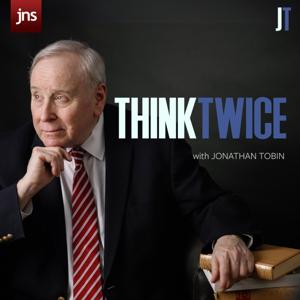
How did supporters of Hamas and others who want Israel destroyed win over so many young people since Oct. 7? According to JNS editor-in-chief Jonathan Tobin, the answer lies in large measure in the ability of progressives to redefine words in such a way as to normalize Jew-hatred and help create a surge of antisemitism.
He’s joined in this week’s episode of Think Twice by scholar Donna Robinson Divine, co-editor of the new book, October 7: The Wars Over Words and Deeds, a collection of essays exploring issues relating to the war on Israel and how the Jewish state’s opponents have helped turn truth on its head to demonize Israel.
According to Divine, on college campuses across the country, “feelings replaced thinking” as many young persons who know little or nothing about the Middle East, were convinced to believe that supporting a genocidal and antisemitic cause was the right thing to do. The veteran scholar of the Middle East said she was shocked not merely at the distorted nature of the discussion about the post-Oct. 7 war but also because not a single head of an elite university told their students to “go and study” the subject of their protests. She says that compared to student protest movements of the past, the pro-Hamas activists don’t seem to know what they’re talking about or have a clear idea of what they want. Other, that is, than wanting Israel to disappear, though even there they don’t seem to realize that doing so would involve Jewish genocide.
Divine points out that a study of the history of the conflict quickly reveals that the goal of the Palestinian movement isn’t about statehood, it’s the principle of not sharing any part of the land with the Jews.
Redefining terms is also important to the cause of delegitimizing Israel. Divine points out that by changing the meaning of the word “genocide”—coined in the aftermath of the Holocaust to mean an attempt to wipe out an entire people—to merely meaning “depriving them of agency,” the pro-Palestinians have smeared the Jewish state as guilty of genocide. Though she also notes that if the Palestinians have lost the ability to determine their own future, it’s because of their own decisions.
Just as sinister is the way Palestinian employed “extreme violence” and rape on Oct. 7, only to see their supporters deny these crimes happened, despite abundant evidence for them provided by the perpetrators.
Most important, is how the Palestinians and their supporters have worked to demonize the Israeli victims, both to make the terrorists appear as if their atrocities are justified and to depict the Jews as deserving of being murdered, raped or kidnapped.
Divine also says that the willingness of opponents of Israel to delegitimize the Jewish state’s actions when they are no different from those of other countries leads to the inevitable conclusion antisemitism is the explanation for these double standards.
Listen/Subscribe to weekly episodes on Spotify, Apple Podcasts, YouTube Music, iHeart Radio or wherever you listen to your podcasts.
Watch new episodes every week by subscribing to the JNS YouTube Channel.
Though the study of history is being slighted by contemporary educators, according to JNS editor-in-chief Jonathan S. Tobin, knowledge of the past, including that of the ancient world, is more important than ever if we are to understand current dilemmas. And that’s especially true in the Middle East.
He’s joined in this week’s episode of Think Twice by Hoover Institution scholar Barry Strauss, one of the leading experts on the ancient world and the author of the new book, Jews vs. Rome: Two Centuries of Rebellion Against the World’s Mightiest Empire.
Strauss’s book tells the story of the three rebellions fought by Jews against the Roman Empire over the course of a 70-year period stretching from 66 C.E. to 136 C.E. that included the Great Revolt, the destruction of Jerusalem and the Holy Temple, a little-known Diaspora revolt and the Bar Kochba rebellion. The history of these struggles is integral to the story of the Jews. But some historians call the Jews of the ancient world Judeans rather than Jews. Strauss disagrees with this since, as he says, “this is to write Jews out of Jewish history.”
The historian says there are some important lessons for Jews and Israelis to draw from these tragic episodes.
One is the danger of disunity. The divisions between the Jews fighting the Romans and each other inside besieged Jerusalem were, he says, “absolutely fatal.” He notes that, there should be a lesson that you can only take political disputes during a time of war or in a dangerous period “only so far.” That’s something that Israelis learned from the Oct. 7, 2023 attack, since the Palestinians believed they were too divided to unite and defend their county.
Strauss says another issue is the relationship between faith and politics. Jewish extremists believed that God would save them if they fought Rome no matter how steep the odds. “Faith is essential for Jews and for everyone in their own particular way. But when you are letting it lead you to politically dangerous, unintelligent decisions, then you have to really think things through and you have to be careful of what you're doing.”
Yet another lesson Strauss says that can be drawn from the revolts is that “small states never are fully independent.” In fact, he added, “Even large states are never fully independent. Everyone needs allies, but small states above all need allies. And so, I think Israel today must learn from the lesson of the failure of the rebels in the great revolts.” Speaking of the Jewish rebels, he says, “They had a plan that was an intelligent plan, which involved getting help from Parthia [an independent kingdom located in modern-day Iraq and Iran that successfully resisted Rome]. But they should have been able to do a cost-benefit analysis and say, it's not likely and maybe back down then.”
The author says the failure of America’s education system to teach history is “terrible” and largely the fault of progressives. “The so-called woke people are selling narratives that give a completely different view of American history and of the world, and that makes it easier for people to push the button of the oldest hatred and to cast the Jews as the villains,” Strauss says. “It’s absolutely essential for the next generation, for good people to get control of the educational system and to bring us back to a sensible educational system in which people can study history without fear or favor in an unbiased way. We know as citizens, whether we're Jewish or not, that education is absolutely essential. So, this is something that we have to prioritize.”
Listen/Subscribe to weekly episodes on Spotify, Apple Podcasts, YouTube Music, iHeart Radio or wherever you listen to your podcasts.
Watch new episodes every week by subscribing to the JNS YouTube Channel.
The victory of Zohran Mamdani is a watershed moment for American Jewry, says JNS editor-in-chief Jonathan Tobin. For the first time in living memory, Jews are dealing with a surge of antisemitism that the election of an avowed anti-Zionist will exacerbate. He is joined in this week’s episode of Think Twice by Rabbi Ammiel Hirsch of the Stephen Wise Free Synagogue in New York City, a leading liberal critic of Mamdani.
According to Hirsch, the danger from a Mayor Mamdani for New York Jews isn’t necessarily a matter of him downgrading protection for Jewish institutions. Rather, he says, “History demonstrates to us that wherever anti-Zionism is normalized and wherever it has support, anti-Zionism has support from high-level government officials, as night follows day, hostility to Jews increases.” Moreover, as he learned from a meeting between the mayor-elect and a group of rabbis, Mamdani is ideologically committed to the war against Israel, it’s “the core principle of his political ideology. That’s why he can’t explain away his support for “Globalize the intifada.”
Hirsch also notes that the surge of antisemitism since Oct. 7 has traumatized liberal Jewish New Yorkers who have seen their erstwhile allies fail them. “Many of them disappointed us and some of them actually betrayed us.”
The rabbi also noted that the disaffection from Israel on the part of many American Jews, is due in part to the failure of liberal Jewish religious denominations including his own Reform movement. He says they “mistaught” the concept of tikkun olam by failing to make it clear that while universal values are a vital part of Jewish identity, many of the youngsters didn’t also learn that defending Jewish rights and expressing Jewish particularism, including support for Israel, is also integral to liberal Judaism.
At the core of the problem is, he said, “There's simply a very deep and broad Jewish illiteracy in the American Jewish community” that can only be corrected by increased emphasis and support for Jewish day schools, camps and trips to Israel.
Everything you learned about the horrors of nationalism and the importance of multilateral and supranational organizations like the United Nations is wrong, says JNS editor-in-chief Jonathan Tobin.
Much of the West has been taught to denigrate the idea of faith in a system of independent sovereign states after World War II and to support systems that undermine them. But the truth is that the most likely source of hate, bigotry and oppression in the 21st century doesn’t come from nationalists, but from liberals and leftists who seek to impose their ideas on the world by any means necessary.
He’s joined in this week’s episode of "Think Twice" by Yoram Hazony, author of the seminal 2018 book The Virtue of Nationalism, which has just been republished in an updated edition. He points out that though modern liberals have accepted the idea that Adolf Hitler’s Nazism was a natural consequence of German nationalism, the truth is that it was a scheme for imperial domination, much like the ambitions of Napoleon and Stalin.
It had nothing to do with the notion of an international order of independent sovereign states that, as Hazony writes, is the best recipe for freedom, despite the fact that all countries are flawed. He also points out that the contemporary push to downgrade national freedom in favor of globalism and the rule of international organizations, like the United Nations or the European Union, is another instance of that same desire for imperial rule in which elites in one place seek to dominate other nations.
Hazony believes that the anti-Zionism and antisemitism directed at Israel is, in large measure, derived from the resentment of Marxists and Europeans who have lost faith in the rights of their own countries to national independence and sovereignty feel about the Jewish state’s willingness to fight for its right to exist and thrive. In this way, Israeli nationalism is viewed as unacceptable and paradoxically linked to the intolerance of the Nazis when, in fact, Zionism is a rational and much-needed response to the powerlessness and lack of national sovereignty of the Jews during the Holocaust.
The intolerance of these anti-nationalists on the left for those, like Israelis, who resist their diktats, is similar to the way true believers in an ideological faith regard those who resist their ideas, he said. That, along with traditional antisemitism, is fueling the fires of hatred against Israel.
Hazony, who leads the Edmund Burke Foundation, which has organized several National Conservative conferences in Europe and the United States since his book was first published, acknowledged that he was troubled by the growth of anti-Israel sentiment among some American conservatives since the Hamas-led Palestinian Arab attacks on Israel on Oct. 7, 2023.
Most American conservatives have embraced U.S. President Donald Trump’s version of nationalism, which is very supportive of Israel. But some figures, labeled by Hazony as “alt-right,” seek to push Jews out of the conservative movement and are hostile to the Jewish state. That’s creating a problem for the Trump administration. Their need to keep their electoral coalition intact may be setting up a situation where they need to confront people like former Fox News host and current political commentator Tucker Carlson, but are “hesitant” to do so. But the author said he still has hope that it will do so in a firm way.
Listen/Subscribe to weekly episodes on Spotify, Apple Podcasts, YouTube Music, iHeart Radio or wherever you listen to your podcasts.
Watch new episodes every week by subscribing to the JNS YouTube Channel.
According to JNS editor-in-chief Jonathan Tobin, a growing number of otherwise marginal right-wing voices are joining forces with most of those on the left to bash Zionism and Israel. He is joined in this week’s episode of Think Twice by Breitbart.com’s Joel Pollak who believes that Zionism isn’t just a movement of Jewish rights but a model for how every group and nation can emphasize success rather than a harmful focus on being victims.
Pollak is the author of the newly republished book The Zionist Conspiracy Wants You and believes that instead of demonizing Zionism, the rest of the world, including the Palestinians, ought to learn from it. In his view, it provides a model for empowering and bettering the lives of non-Jewish minorities who are otherwise mired in divisive minority-group woke politics.
He sees anti-Zionism from the left as, in part, derived from anti-American ideas that oppose all successful nations as morally suspect. And the hatred for Israel that has surged in the last two years is rooted in a desire to spread fear among Jews.
The anti-Israel attitudes that are coming from the right are partially the result of traditional antisemitism and also based in envy of Israel as well as delusional conspiracy theories about the Jewish state controlling the United States. Those who oppose Israel are also putting themselves on the wrong side of history and opposing President Donald Trump, which is a certain loser for conservatives.
Tobin and Pollak disagreed about how to handle people like podcaster and former Fox News host Tucker Carlson and the openly antisemitic Candace Owens. Pollak sees Carlson’s anti-Israel attitudes and platforming of antisemitic guests including Holocaust deniers as the result of the Anti-Defamation League’s attacks on him before he was openly antisemitic.
Tobin believes that Carlson was always an opponent of Israel and that his departure from Fox News just removed the guardrails that existed there which deterred him from platforming hatemongers in the way that he does now in his podcast. Tobin believes that prominent conservatives need to denounce antisemitism even when it comes from friends and allies. Pollak prefers to accentuate the positive and thinks it’s not too late for Carlson to change but agrees that even a “big tent” has walls, meaning that some things must always be unacceptable.
Listen/Subscribe to weekly episodes on Spotify, Apple Podcasts, YouTube Music, iHeart Radio or wherever you listen to your podcasts.
Watch new episodes every week by subscribing to the JNS YouTube Channel.
Israeli Prime Minister Benjamin Netanyahu had no choice but to go along with the scheme but believing that President Donald Trump’s 20-point plan for ending the war in the Gaza Strip can work still requires a leap of faith, says JNS editor-in-chief Jonathan Tobin. He believes that there’s little reason to think Hamas will free the hostages and surrender their arms and control of the Strip even if Trump is offering them no alternative.
Tobin is joined in this week’s episode of Think Twice by JNS contributing editor and columnist Ruthie Blum who believes that while an end to the war with the “barbarians” of Hamas on Trump’s terms is possible, but she said we shouldn’t call that “peace” if it involves releasing more terrorists in exchange for freeing Israeli hostages and believing that the Palestinians are ready to change.
While she was skeptical that Hamas would take this opportunity to end the war, the Trump plan won’t involve trust since nothing will move forward if all of the hostages are not freed first. Still, she feared that any deal that will mandate the release of Palestinian terrorists from prison may lead to more bloodshed in the same way that the 2011 agreement that freed kidnapped Israeli soldier Gilad Shalit led to the Oct. 7 massacres.
She also agreed with Tobin that the Trump administration’s faith in the good will of Qatar is a mistake since that regime funds terrorism and Islamist fundamentalism around the globe. Blum believes that businessmen like Trump and his envoy Steve Witkoff simply don’t understand Muslim fanaticism since they view the world solely through the prism of business deals based on mutual interests. They fail to realize that the war between Jews and Arabs is about much more than real estate.
Blum pointed out that those who claim that Israel can’t achieve its objectives by military means are wrong and that Netanyahu is right. If there is to be any progress toward ending the war it is only because of the military pressure that Israel has exerted on Hamas. What will be needed for Trump’s deal to do more good than harm, as was the case with previous attempts to broker peace, is for him to stick to his word and let Israel “finish the job” of defeating Hamas if they don’t agree to the deal or violate it afterward. That’s not what happened in the past when Israel made concessions to the Palestinians in the 1993 Oslo Accords and the 2005 withdrawal from Gaza.
Blum sympathizes with Netanyahu when he tells his supporters to pipe down about extending Israeli sovereignty to Area C of Judea and Samaria where Jewish communities exist. His priority must be to avoid alienating Trump and showing patience on the issue since that is in Israel’s interests.
The question facing American Jewry is which trend is more important. As JNS editor-in-chief Jonathan Tobin notes, a lot of American Jews have been shocked by both the trauma of the Oct. 7 attacks and the subsequent surge of antisemitism into increased activism on behalf of Israel and giving to Jewish causes. But on the other hand, a large number of Jews, especially progressives, are becoming more assimilated, less interested in Jewish life and alienated from Israel.
According to JNS editor-in-chief Jonathan Tobin, the release of a new documentary film called “Soul on Fire” about the life of Holocaust survivor, author, teacher and Nobel Peace Prize Winner Elie Wiesel couldn’t be timelier. At a time of an unprecedented surge of antisemitism and demonization of Israel, Wiesel’s example of courageous truth-telling is needed more than ever.
He is joined in the latest episode of Think Twice by Wiesel’s son Elisha, who works on Wall Street and for Israeli startups, as well as being a leading human rights activist. Elisha Wiesel said that he and his late mother, who passed away earlier this year, had been searching for a filmmaker to do a documentary about his father before choosing writer/director and producer Oren Rudavsky. He says that acting on his father’s instructions, they have refused to let anyone produce a film based on Wiesel’s classic Holocaust memoir, Night but believed a well-made documentary could help keep his memory alive as well as reintroduce a new generation to his work.
The film traces Wiesel’s Holocaust experience and journey back to life after surviving the camps and then his rise to prominence as an activist and author. But the key incident in it concerns his confrontation with President Ronald Reagan live on national television when he unsuccessfully sought to persuade him not to visit a military cemetery in Bitburg, where German SS soldiers were buried in 1985.
Elisha Wiesel, who was present at the White House for this event says that looking back at it now, he sees how difficult it was for his father, who liked Reagan very much, to lecture him in front of the country. But it was a classic example of how to “speak truth to power,” in the service of a great truth.
He also says that those Jews who speak out against Israel since Oct. 7, 2023 and in favor of “free Palestine” are not following his father’s example. Elie Wiesel was an ardent Zionist and never chose to criticize the Jewish state whether or not he always agreed with its government because he understood how that would be used by antisemites.
“Many of these people think that they're acting in keeping with my father's values. You know, I've seen signs at Israel-hating rallies that actually say, know, Elie Wiesel said, you know, the enemy, the opposite of love is not hate, it's indifference. So, a lot of people go around and they think, you know, ‘I'm being Wieselian. I'm not indifferent. Look at me.’ But of course, I think my father hadn't properly envisioned at the time that he made that statement, how we've gone past, we've gone beyond indifference. We've gone straight to what I like to think of is indignant ignorance.”
He said that the current generation of young American Jews, “Don't feel what I feel in my heart. When Israel is attacked, it's visceral. It's gut level. It's emotional. This is 50% of my brothers and sisters in the Jewish people, so many of whom came, whether fleeing the Farhud in Muslim lands or the Holocaust, you know, to get to Israel. These are my people, my brothers and sisters, who have gotten to a place where they can finally defend themselves and create the state that is transforming the world with its inventions and its ideas.
Elisha Wiesel compared the “Free Palestine” movement and support for Israel-hating New York City mayoral candidate Zohran Mamdani to the punk rock music he loved as a teenager.
“So much of the free Palestine movement to me, and so much of the tear it down, anarchy, let's end capitalism, has all of the violence of punk rock without the good music. It's just people looking for change without thinking too hard about what they're going to build or what should be built.”
When Jews gather in synagogues on Rosh Hashanah and Yom Kippur this month, will their rabbis seek to rally them to stand with Israel and against the surge of antisemitism fueled by blood libels against the Jewish state? Or will they instead use their pulpits to virtue signal their support for the false charges of “genocide” being hurled at Jerusalem? Those are the questions that JNS editor-in-chief Jonathan Tobin is posing.
With mainstream media parroting Hamas propaganda about “genocide” in Gaza, the post-Oct. 7 surge in antisemitism is likely to continue to get worse, says JNS editor–in-chief Jonathan Tobin. Those blood libels are not only fueling the sort of Jew-hatred that is impacting students on college campuses but also raising the threat of more violence directed at synagogues, schools and other Jewish targets.
He’s joined on this week’s episode of Think Twice by Michael Masters, the National Director and CEO of the Secure Community Network (SCN), the organization that is responsible for the security organization for the North American Jews. The SCN monitors threats to Jews and advises community organizations on safety issues providing its own version of an Iron Dome for the community.
According to Masters, the antisemitism crisis on college campuses is not the product of spontaneous efforts to support Hamas and attack the pro-Israel community. The immediate mobilization of protesters and materials for them was organized and coordinated. And much of it was funded by foreign state actors, especially Iran. Moreover, he says these efforts were not merely expressions of free speech but took the form of organizing manuals that were clearly aimed at facilitating violence and other illegal acts.
The most ominous development, Masters points out, is that in the wake of pressure from the Trump administration on colleges and universities to stop tolerating and encouraging Jew-hatred, the pro-Hamas activists are switching tactics. Instead of building takeovers, they are now emphasizing the targeting of Jewish individuals, such as professors and students. Their goal is to silence and intimidate people from speaking out on behalf of Israel and in defense of the Jewish community.
The security expert points out that in the current atmosphere, Jew-hatred unites both the extreme left and the extreme right in a “circle” in which white supremacists and Islamists join together to target Jews. As such, he asserts that what is needed is a unified Jewish community that will advocate against antisemitism and also to get the funding needed to adequately protect Jewish institutions.
While the SCN has a list of recommendations for enhancing Jewish safety, Masters emphasizes the need for training for those responsible for security. While Americans have a Second Amendment right to carry firearms, he says the key to protecting the community is putting weapons in the hands of those who are trained to use them in an emergency.
Listen/Subscribe to weekly episodes on Spotify, Apple Podcasts, YouTube Music, iHeart Radio or wherever you listen to your podcasts.
Watch new episodes every week by subscribing to the JNS YouTube Channel.
From the publisher's feed
Ranked by our users in the last 21 days
40 Listeners

5,159 Listeners
647 Listeners
309 Listeners

453 Listeners

3,175 Listeners

187 Listeners
446 Listeners
67 Listeners

18 Listeners
15 Listeners
31 Listeners

104 Listeners

1,065 Listeners

911 Listeners

5 Listeners

122 Listeners