
Sign up to save your podcasts
Or



In this episode, we address how to deal with a dog who doesn't come when called. Maybe in the field on a bird, on a hike when it sees another dog, or even in the backyard. People get very disturbed over a dog who won't come when called, but the approach to eliminating that problem begins with the simple command of sit first and learning how to teach the dog to respond without all the training tools involved. How do you get a dog to just do what you ask, period? It isn't hard, but it takes an understanding, commitment and clarity in your interactions. Here are some ideas...
In today's episode, we talk about some ideas to get ready for the American Pointing Labrador Association's national event, the 2023 Triple Crown. It's a long 3 days for handlers and dogs, and there are a number of things you can do in this last month before the trip to Idaho. Endurance and fitness for your dog (and you) are of paramount importance. Understand the demands that will be imposed on you and your dog, and how to optimize the state of mind you both go into this with. More is not always better in good preparation, so you give yourself and your dog some serious thought on how to be in the best spot going in.
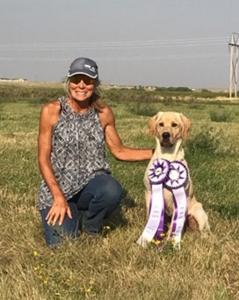
That's a beautiful plate and ribbon you get to adorn your vehicle going home for certain ;)
"Basic Obedience" isn't just doing heel and sit on a leash. That is just the tiniest piece of what this big topic is. The real nature of this work is in creating the relationship between you and your dog and establishing the lines of communication. It is your relationship that determines the success and enjoyment of daily life, training and competitive events. A simple but powerful truth. Join in the conversation...
In this episode, the two common problems we break down are how to prepare for ducks in tests when you have no training group with birds to train with; and secondly, how to go about not inadvertently teaching your dog that breaking is an option, or how to stop it before it becomes worse.
In today's episode, we break down simple solutions to two common problems. 1. What to do about a dog returning on a retrieve but dropping the bird, doing a flyby or otherwise not directly returning the retrieve object. 2. How to address dogs pulling on the leash or tuning you out while leash walking with you, or basically doing anything while attached to you. The answers to these created problems almost always lie in the basics of training.
In this episode, we talk about the fact that more often than not, it is the handling of the dog that brings about failing, as opposed to a dog making a mistake on its own. It's a topic that requires a lot of self-examination, but it can be quite useful in helping your dog as much as possible in testing and competitive venues. At least a few things to think about...
In this episode, we talk about getting as much success out of your dog test running as yours and your dog's talent allows. Often times we don't try as hard as we might because that could lead to failure and we 'just can have that.' Or we think by just working harder or doing more challenging things we will get better. Success is usually based off far simpler things than we think. Your mindset and that of your dogs is of the utmost importance. Have you figured out how to get that in the best spot? Here are some ideas for you..
In this episode, we go beyond young pups and bird exposure. It takes continued exposure to allow the young dog to learn the upland game and all its' nuances. Upland dogs can and should be expected to understand their role in the upland hunt, and willingly work with you. No screaming, loud and repeated whistles or constant instruction. This is actually accomplished in undertaking a similar approach to that you took in teaching your dog to run land and water blinds. You teach them what their job is in a way they understand, and then hold them accountable. It isn't a hard thing to do, but it takes a little time and understanding.
In today's episode, we break down the elements to developing the natural pointing response in a pup. It isn't a series of steps you go through; it is a development of what is happening the mind of that baby as it learns the magic of the world of upland hunting. Pups have to figure out the game in their own way and on their own time. It is important to provide the opportunities for the pup to do this, without correcting or intervening where it doesn't help.
With at least 300 Certified Pointing Retrievers, 90 GMPR's and over 30 4X's, I want on an unofficial basis to weigh in on effective judging in the APLA testing arena. It isn't a glamorous or even fun thing to do. It requires constant attention and focus, awareness of organization standards and an ability to set up tests which represent the standard, across the country. Just wanted to take my own format to discuss what judging in the American Pointing Labrador Association is really all about..
From the publisher's feed
1,715 Listeners

38,060 Listeners
973 Listeners
631 Listeners

46,065 Listeners
262 Listeners
48 Listeners
81 Listeners