
Sign up to save your podcasts
Or

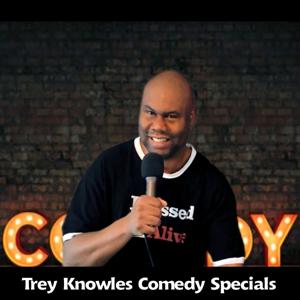


Trey Knowles' The Yiddish Interpreter is an allegorical satire that delivers a provocative message through sharp comedy and symbolism.
In the story, extremist figures conduct secret conversations in Yiddish about misdirected government funds—money intended for Israeli Ashkenazi Jews and the Rothschild's disappears into powerful financial hands.
Meanwhile, a religious authority figure, symbolizing an empire-driven institution, works to distance people from a direct relationship with God. When Trey Knowles is kidnapped and forced to serve as the interpreter of these concealed discussions, he becomes the unexpected bridge between hidden agendas and public truth. Through satire, irony, and layered symbolism, the story exposes a deeper spiritual conflict—contrasting corruption and manipulation with the call to personal faith, discernment, and spiritual freedom.
Trey Knowles' “Azazel: The United States 5-Star General” is an allegorical comedy that fuses dark humor with pointed social satire. The story imagines a powerful U.S. five-star general overtaken by the ancient entity Azazel, whose influence quietly spreads into the minds of prominent technology innovators, including Elon Musk and Palmer Luckey. Under this unseen spiritual manipulation, advanced artificial intelligence and autonomous weapon systems are accelerated toward a future that threatens humanity itself.
Through satire and symbolic storytelling, Knowles challenges audiences to reflect on the difference between humanity as divine image-bearers and a society increasingly shaped by corruption, ambition, and unchecked technological power. The narrative uses comedy to raise unsettling questions about influence, control, and the moral direction of modern innovation—inviting readers to consider whether progress is always guided by human conscience.
Drawing from Jewish apocryphal tradition, particularly the Book of Enoch, Azazel is depicted as a fallen being who introduced forbidden knowledge to humankind, including warfare and destructive arts. In Knowles' allegory, this ancient symbolism is reimagined for the modern age, transforming technological advancement into a stage for spiritual and ethical conflict wrapped in dark comedic insight.
Trey Knowles' “Stop Killing Virgins” is a sharp, thought-provoking allegorical comedy that blends humor with social critique. Through satire and clever storytelling, Knowles confronts the destructive tradition of forcing virgins into marriage or using threats and violence to control their lives.
The play highlights a simple but powerful truth: love cannot be created through fear, pressure, or coercion. Authentic love must arise freely and sincerely from the heart. By exposing the absurdity and cruelty of such practices, the work challenges outdated beliefs and calls audiences to embrace compassion, dignity, and genuine emotional connection.
In this comedic piece, Trey Knowles humorously addresses Netanyahu, reminding him that a true Jew is one inwardly. He urges him to understand that real circumcision is a matter of the heart, not merely a physical act. Through satire, Trey emphasizes the spiritual message that without a transformation of the heart, a person may continue to carry inner torment—symbolized as a “thorn in the flesh”—that cannot easily be ignored. He concludes by reflecting that the land of Canaan is suffering in vain, while the true Israel exists within the soul.
Trey Knowles's stand‑up set “The Republican Church” fires on all cylinders — comedy, critique, and cultural x‑ray vision. With a grin that says I'm about to ruin your brunch, Trey opens by telling Republican Evangelicals not to bother inviting him to their church because, as he deadpans, “Y'all don't know Jesus.” From there, he launches into a fearless roast of a politics‑first Christianity that shouts “God” on Sunday but forgets the heart, humility, and justice of Christ by Monday morning.
Trey's satire slices clean: he exposes a faith culture that has traded the Sermon on the Mount for party platforms, swapped compassion for culture wars, and confused nationalism with holiness. Yet the jokes land with such precision and absurdity that the audience can't help but laugh — even as they recognize the uncomfortable truth beneath the punchlines.
Blending bold humor with spiritual insight, Trey turns the stage into both a comedy club and a prophetic mirror. “The Republican Church” is provocative, unflinching, and laugh‑out‑loud funny — the kind of set that leaves you cracking up while rethinking everything you thought you knew about American Christianity.
Trey Knowles' “Dog Returns to His Vomit” is an allegorical comedy about Great Britain reaping what it has sown. Drawing from the teachings of Yeshua, the story reflects on the principle that a strong foundation is built by hearing His words and living by them. Yeshua compared this to building a house upon solid rock rather than sand. In Trey's witty interpretation, he jokingly asks, “So what did Great Britain do? Built on sand.”
Yeshua taught that a true foundation brings stability when life's storms come, while ignoring His teachings ultimately leads to collapse. In this satire, the unraveling of Great Britain symbolizes the consequences of abandoning truth and righteousness.
The narrative boldly suggests that centuries of deception—pretending to walk in the character of light while practicing falsehood—are finally coming to an end. Through sharp humor and layered symbolism, Trey Knowles critiques the fall of Great Britain's house, portraying the nation as being dismantled by the very same spirit and behaviors that once built its empire.
The comedy reaches its surreal climax when a modern-day British prince encounters the ominous figure of Hades, representing the unavoidable consequences of repeating the errors of the past. What was once ignored can no longer be escaped.
Yet the message does not end in destruction. Echoing the promise of Yeshua, the story reminds readers that those who overcome will be made “a pillar in the temple of my God,” symbolizing strength, permanence, and security in His presence.
In “Play Chess Against Great Britain,” Trey Knowles delivers a humorous allegory that imagines a symbolic chess match between himself and the nation of Great Britain. Through clever satire and playful storytelling, Trey turns the chessboard into a stage where strategy, power, and truth collide.
As the match unfolds, Trey boldly declares “Checkmate!”—announcing that the game is over. With laughter and confidence, he proclaims that the Queen has been seen and the strategy exposed. The moment becomes a comedic revelation, where Trey insists that the players behind the board are no longer hidden.
Blending wit, exaggeration, and satire, Knowles uses the imagery of chess to explore deeper themes of power, influence, and awareness. In his playful yet pointed commentary, Trey makes it clear that Great Britain will not be the last one standing—the game has been uncovered, and the audience now sees the board for what it is.
Through humor and symbolism, “Play Chess Against Great Britain” transforms a simple chess match into a comedic reflection on strategy, authority, and the moment when the final move is revealed.
Trey Knowles' “Go to War” is an inspiring stand-up comedy special where humor meets faith. Taking the stage, Trey shares how to spiritually battle the devil and stand victorious through the teachings of Yeshua. With wit and conviction, he reminds the audience that life is not meant to be driven by money or the pursuit of worldly things, but by the powerful word of Yehua.
Through laughter and reflection, Trey points to the wisdom found in faith—encouraging people not to worry about what they will eat or how they will survive. He reminds listeners to look at the birds in the sky and the animals living in their habitats across the earth. God provides for them, and human life is even more valuable in His sight.
In “Go to War,” Trey challenges the audience to stop chasing the temporary treasures of the world and instead value what truly matters: faith, truth, and the living word of God.
Trey Knowles' comedy script, "White Devils and Black Demons," satirically unveils the hidden powers that govern the world. The "White Devil," driven by lust and deception, disguises himself as Santa Claus while spreading his corrupt way of life—lying, stealing, and killing to gain control. Meanwhile, the "Black Demons" chase after worldly success, unknowingly serving the White Devil's agenda. Through their art and labor, they fuel his power, all while drifting further from the spirit of God.
Trey Knowles' “Royal Blood” is my kind of sharp, bold stand-up comedy where I take a direct look at the British royal family. I say it like this: if I, an indigenous man, walked up to the palace door and knocked, do you really think the royal family would wash my feet? So why do people listen to them like they carry some kind of holy authority?
Did Yehua come dressed in fine clothes living in luxury? No. The ones wearing expensive garments and living in palaces are the kings of this world. I joke with the crowd and tell them, break away from the spell, because she has deceived many nations, and a lot of people on this planet are suffering because of it.
In the routine I make the point that the monarchy looks like a kingdom, but it's not the kingdom of God. It borrows from religion, traditions, and the Bible, but the true spirit of God isn't there. I call it what it is—a system that people follow because of the crown and the image.
Then I compare that with the real messengers in the scriptures, like John the Baptist, a man who lived simply and spoke truth without a palace behind him. I don't hold back in the set. I show the royal family as something people treat like spiritual authority, when in reality it looks more like sorcery and illusion than true leadership from God.
From the publisher's feed
Step into a world where the ordinary becomes unforgettable. Trey Knowles Comedy brings everyday life to the spotlight, transforming familiar moments into laugh-out-loud stories that resonate with audiences everywhere. With a natural, easygoing style, Trey Knowles delivers clean, relatable humor rooted in real experiences—awkward encounters, daily frustrations, and the small details we all recognize but rarely stop to laugh about.
What sets Trey apart is more than just his punchlines—it's his perspective. Blending sharp observational comedy with thoughtful storytelling, he crafts performances that go beyond entertainment. His work often carries deeper meaning, exploring themes like faith, truth, deception, and the human experience in today's world. Through allegory, subtle satire, and clever biblical references, Trey creates a unique balance of humor and insight.
Trey Knowles Comedy isn't just about making people laugh—it's about making them think, reflect, and see life differently. With every set, he invites audiences to find humor in their own lives while uncovering meaning beneath the surface.