
Sign up to save your podcasts
Or



In 2020, wildfires swept across the West, consuming millions of acres of forest and destroying thousands of homes and even whole communities. And sadly, this is just the beginning. Fire is the future here in the West. But what we often forget is that fire is also the past. It’s what our landscape has evolved with. The tricky question is figuring out how we fit into that.
So we wanted to bring you a bonus episode that dives into some of the reporting OPB has done around wildfire. Because, frankly, fighting over fire is really the new front in the Timber Wars. The battle lines are basically the same, it’s just the details of the argument that have changed. Now instead of jobs versus owls and old growth, the argument is over whether logging prevents catastrophic wildfires or makes them worse.
In the final months of the Trump administration, there were a flurry of environmental rollbacks that hearkened back to the Timber Wars, including changes that would make it easier to log old trees and a huge reduction in the area protected for the northern spotted owl. So we wanted to bring you an episode from another podcast, "How to Save a Planet," that helps explain environmental rollbacks like these in light of one of the big ideas we explored: how did environmental laws go from bipartisan agreements to a wedge in the culture wars. And while we looked at this idea as it related to the Endangered Species Act and forests, they explore it as it relates to climate change. The episode is called “Making Republicans Environmentalists Again.”
For more on this episode of "How to Save a Planet," hosted by the journalist Alex Blumberg and the scientist Dr. Ayana Elizabeth Johnson, including a reading list, check out: https://gimletmedia.com/shows/howtosaveaplanet/gmhwdon/making-republicans-environmentalists
If you’ve been enjoying Timber Wars, there’s a new show you should check out. It’s about a weird and wonderful bird: the greater sage-grouse. You’ll find these creatures in wide open sagebrush country, trying to hang on alongside oil and gas drilling, recreational activity, development and ranching, which puts them right in the center of a controversy that has a lot in common with the fight over the spotted owl.
The host, Ashley Ahearn, recently moved to sagebrush country to try to better understand rural America and what this weird, troubled bird can tell us about ourselves and our relationship with the natural world, and we wanted to bring you her first episode. You can find the rest of the series by searching "Grouse" in your favorite podcast app.
In 'Timber Wars,' we've talked about how the northern spotted owl took the blame for a lot of other things that cost jobs and hurt timber-dependent towns, like automation and international competition. Well, there was another huge thing the owl took the fall for—something that cost timber towns even more money than locking up the national forests, at least in Oregon.
In a year-long investigation, OPB, the Oregonian, and ProPublica explored how Wall Street real estate trusts and other investors gained control of the state’s private forestlands—and how they’ve profited at the expense of rural communities.
Is the Northwest fatally divided, or can we overcome our differences and work together? We tell the story of one group of loggers and environmentalists who have found some semblance of common ground. But it didn’t come easy. And no one knows how long it’ll last.
If you want to learn more about the Timber Wars, you can find the additional reading list we mention, plus a transcript for this episode, at: https://www.opb.org/article/2020/09/01/timber-wars-trailer-episode-guide/
Before the Northwest Forest Plan had a chance to succeed, Congress seized upon the threat of wildfires to create a loophole and throw the plan out the window. With old growth once again being logged, the fight to defend it grew both more mainstream and more violent, seeding the tactics for many conflicts to come, from environmental to anti-capitalist movements.
The Timber Wars grew so hot that one of President Clinton’s first acts in office was to fly half his cabinet to Portland to resolve the conflict. The result was the Northwest Forest Plan, the most sweeping conservation plan in U.S. history. But it might never have happened if not for some behind-the-scenes dramas that played out in a Capitol Hill bathroom-turned-office and a presidential lunch buffet.
Mill City was one of dozens of flourishing timber towns, where a job in the woods or at the local sawmill could support a good life. But protests and court cases upended that, leaving locals to ask: are owls more endangered than loggers?
Throughout the 80s, environmentalists lost in the woods and in the courtrooms. There just weren’t many laws that protected trees. But there were laws that protected animals. And the idea started to percolate: what if they could protect the old growth by protecting an animal that depended on it.
Depending on who you are, the northern spotted owl is either the hero of this story, or the villain. And the Endangered Species Act is either an incredible conservation tool, or a hammer that smashes rural economies. But those beliefs miss the fact that it was a single sentence in an entirely different law that locked up the forests. How a reclusive bird halted the march of chainsaws.
For a transcript of this episode, go to: https://www.opb.org/article/2020/09/22/timber-wars-episode-3-the-owl/
For most of America’s history, trees were seen as crops, and the plan was to log the country’s last virgin forests and make them de facto tree farms. We see forests very differently today. How did things change so quickly?
From the publisher's feed
The scramble to meet the energy demands of AI and data centers is leading to what some are calling a "Nuclear Renaissance," and the Pacific Northwest is at the heart of it. Oregon and Washington are the sites of the world’s first full-scale nuclear power plant (Hanford), the world’s then largest pressurized-water nuclear reactor (Trojan Nuclear Power Plant), the only company with regulatory approval to build small modular reactors (NuScale), and a growing number of power-hungry data centers — and yet Oregon has a constitutional amendment banning new nuclear projects. Why? It all comes back to the region's history with nuclear, and the legacy of the environmental movement in the Northwest.
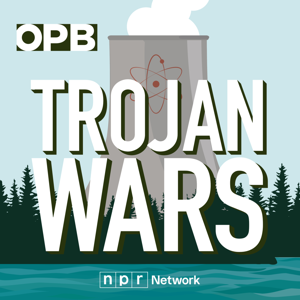
"Trojan Wars," from OPB and 30 Minutes West, tells the story of how our grand plans for cheap, reliable, carbon-free power in the 20th century ended up in a heap of concrete and barrels of nuclear waste on the banks of the Columbia River. And we ask: What went wrong the first time around? And is it possible to get it right this time?

91,022 Listeners
78,422 Listeners

43,852 Listeners

32,046 Listeners

43,359 Listeners
26,831 Listeners

21,595 Listeners
26,151 Listeners

9,187 Listeners

5,746 Listeners
2,133 Listeners
285 Listeners

25 Listeners
134 Listeners

2,223 Listeners
222 Listeners

24,539 Listeners

4 Listeners
4,211 Listeners

16,365 Listeners

4,224 Listeners

218 Listeners