
Sign up to save your podcasts
Or

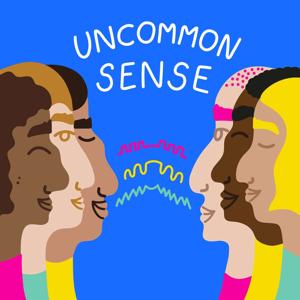


What comes to mind when you think about joy? And can there be joy in protest and refusal? Someone who’s been asking and trying to answer questions about this is Akwugo Emejulu. She’s been investigating the relationship between Black feminist joy, ambivalence and futures, asking how Black feminists are remixing political media, meanings and messages to co-create manifestos for change.
Akwugo has also been mapping the grassroots organising and activism of women of colour for more than 15 years, and in this episode shares her insights about the role of joy and other emotions in understanding society and social change.
Plus: Akwugo introduces us to the work of bell hooks, including her take on Beyoncé’s album “Lemonade”, and gives her pop culture recommendation for some Japanese anime, much to Alexis’ delight!
Guest: Akwugo Emejulu
Hosts: Rosie Hancock, Alexis Hieu Truong
Executive Producer: Alice Bloch
Guest Producer: Chris Garrington
Sound Engineer: David Crackles
Music: Joe Gardner
Artwork: Erin Aniker
Find more about Uncommon Sense
Episode Resources
Rosie, Alexis and Akwugo recommended
By Akwugo Emejulu
From The Sociological Review
Further resources
** Complete our listener survey here! It helps us, a charity, learn who’s listening to Uncommon Sense, and why. Thank you **
Support our work. Make a one-off or regular donation to help fund future episodes of Uncommon Sense: donorbox.org/uncommon-sense
Interested in podcasting with us? Read more here, and contact us at [email protected]
Sign up to the Sociological Review Foundation newsletter
With so many platforms available to share information, there are more means than ever to make a noise. But in the spirit of free speech and academic freedom, those speaking and actually being heard remain grossly unequal. What are the links between voice and power and how can we amplify those voices that we can’t hear?
In this special episode recorded at The Sociological Review Undisciplining II conference, Michaela Benson is joined by Claire Alexander (Professor of Sociology and Head of the School of Social Sciences at The University of Manchester), Dan McCulloch (Senior Lecturer in Criminology and Social Policy at The Open University) and Belinda Scarlett (Library Manager at the Working Class Movement Library) to talk about empowerment, representation and impact, under a common theme: VOICE
Guests: Claire Alexander, Dan McCulloch, Belinda Scarlett
Host: Michaela Benson
Executive Producer: Alice Bloch
Guest Producer: Emma Houlton
Sound Engineer: David Crackles
Music: Joe Gardner
Artwork: Erin Aniker
Find more about Uncommon Sense
Episode Resources
By Claire Alexander
By Dan McCulloch
By Belinda Scarlett
From The Sociological Review
Further resources
** Complete our listener survey here! It helps us, a charity, learn who’s listening to Uncommon Sense, and why. Thank you **
Support our work. Make a one-off or regular donation to help fund future episodes of Uncommon Sense: donorbox.org/uncommon-sense
Interested in podcasting with us? Read more here, and contact us at [email protected]
Sign up to the Sociological Review Foundation newsletter
Life admin often refers to the overwhelming and mundane paperwork that surrounds contemporary living. However, Oriana Bernasconi, a sociology professor at the Alberto Hurtado University in Chile, joins Uncommon Sense to talk about a more serious side of the term – that of paperwork documenting human rights abuse – as well as a living, breathing archive and the analogue spreadsheet.
Author of “Resistance to Political Violence in Latin America: Documenting Atrocity”, Oriana talks about her substantial research in human rights archives documenting the atrocities that took place during the Pinochet dictatorship in Chile. She also talks us through “technologies of memory” and how archives have allowed the living to connect with the dead.
Plus: Oriana introduces us to the works of Judith Butler and Jacques Derrida around performativity and gives her pop culture recommendation for the 16-part TV series “Una historia necesaria”.
Guest: Oriana Bernasconi
Hosts: Rosie Hancock, Alexis Hieu Truong
Executive Producer: Alice Bloch
Guest Producer: Emma Houlton
Sound Engineer: David Crackles
Music: Joe Gardner
Artwork: Erin Aniker
Find more about Uncommon Sense
Episode Resources
Rosie, Alexis and Oriana recommended
By Oriana Bernasconi
From The Sociological Review
Further resources
Read more about the concept of Speeach Acts, as well as the work of Michel Foucault, Hannah Arendt and Jacques Derrida.
** Complete our listener survey here! It helps us, a charity, learn who’s listening to Uncommon Sense, and why. Thank you **
Support our work. Make a one-off or regular donation to help fund future episodes of Uncommon Sense: donorbox.org/uncommon-sense
Interested in podcasting with us? Read more here, and contact us at [email protected]
Sign up to the Sociological Review Foundation newsletter
What comes to mind when we think about toxicity in everyday life? It could be toxic relationships or masculinity – through to consumption, waste, governance and environmental harm. Alice Mah joins Uncommon Sense to discuss toxic expertise, waste colonialism and more.
The author of “Petrochemical Planet: Multiscalar Battles of Industrial Transformation” and “Plastic Unlimited: How Corporations are Fuelling the Ecological Crisis and What We Can Do About It”, Alice reflects on what the petrochemical industry has to do with sociology. From the impact on marginalised communities often having no choice but to live in a toxic environment through to the concept of “waste colonialism”.
She also introduces us to the work of Dr Max Liboiron and their work CLEAR (Civic Laboratory for Environmental Action Research) – an interdisciplinary plastic pollution laboratory whose methods foreground humility and good land relations. Alice explains how the work of CLEAR has impacted her and made her think a little differently when approaching her own work.
Guest: Alice Mah
Hosts: Rosie Hancock, Alexis Hieu Truong
Executive Producer: Alice Bloch
Guest Producer: Emma Houlton
Sound Engineer: David Crackles
Music: Joe Gardner
Artwork: Erin Aniker
Find more about Uncommon Sense
Episode Resources
By Alice Mah
From the Sociological Review Foundation
Further resources
Production Note: This episode was recorded in July 2024.
** Complete our listener survey here! It helps us, a charity, learn who’s listening to Uncommon Sense, and why. Thank you **
Support our work. Make a one-off or regular donation to help fund future episodes of Uncommon Sense: donorbox.org/uncommon-sense
Interested in podcasting with us? Read more here, and contact us at [email protected]
Sign up to the Sociological Review Foundation newsletter
What gets centred and what gets framed as marginal? Who decides? And what are the consequences? UN expert, feminist scholar and social historian Rhoda Reddock – Professor Emerita at The University of the West Indies – joins us from Trinidad and Tobago to discuss the theme of margins, reflecting on the importance of radical Caribbean thought, the contested meaning of the “global south” and the evolution and significance of Caribbean feminism from the 70s to today.
As a member of the UN’s Committee on the Elimination of Discrimination against Women (CEDAW), Rhoda shares her reflections of moving between Switzerland and Trinidad and Tobago for her work. She also gives advice to scholars striving to make an impact – and to those questioning the necessity of moving to the “global north”. Why, Rhoda asks, does scholarship from the “global south” too often get perceived as regionally specific, while the “north” remains regarded as the centre of sociological thought? And how, Rosie and Alexis ask, has the Caribbean typically been regarded – or indeed, dismissed – by the discipline?
Plus: Rhoda also shines a spotlight on Trinidadian-American scholar Oliver C. Cox, author of “Caste, Class and Race”, whose work was a precursor to Wallerstein’s “World Systems Theory” and also to women’s studies today. A fascinating discussion, also featuring celebration of thinkers including CLR James and Walter Rodney, author of “How Europe Underdeveloped Africa”.
Guest: Rhoda Reddock
Hosts: Rosie Hancock, Alexis Hieu Truong
Executive Producer: Alice Bloch
Sound Engineer: David Crackles
Music: Joe Gardner
Artwork: Erin Aniker
Find more about Uncommon Sense
Episode Resources
By Rhoda Reddock
From the Sociological Review Foundation
Further resources
** Complete our listener survey here! It helps us, a charity, learn who’s listening to Uncommon Sense, and why. Thank you **
Support our work. Make a one-off or regular donation to help fund future episodes of Uncommon Sense: donorbox.org/uncommon-sense
Interested in podcasting with us? Read more here, and contact us at [email protected]
Sign up to the Sociological Review Foundation newsletter
What’s meant – and who’s excluded – when community is invoked? Does membership take more than presence alone? How can seeing local crises through a global lens enrich our understanding? Kirsteen Paton joins Uncommon Sense to discuss community, class, resistance, solidarity and more – including her experience of community in the UK cities of Liverpool and Glasgow.
As the author of “Class and Everyday Life”, Kirsteen gives hosts Alexis and Rosie a fascinating potted history of the study of “community” in sociology – moving from the early work of Emile Durkheim and Ferdinand Tönnies, concerned with industrial capitalism, to recent studies of gentrification and the rise of identities beyond those tied to concrete ideas of “place”. They ask: how is sociology developing its thinking about online communities? And if there’s a tendency to idealise and romanticise “community” as typically positive, how should we think about and conceptualise those on the far right?
Also: does talking about place-based communities risk missing the fact that communities are also connected across borders and histories, including colonialism? Kirsteen reflects – via Ambalavaner Sivanandan and Doreen Massey – on how what appears to be “local” (whether crises like the housing one or cases of resistance) is often inextricably linked to the global. Plus: a celebration of Antonio Gramsci, Stuart Hall and more.
Guest: Kirsteen Paton
Hosts: Rosie Hancock, Alexis Hieu Truong
Executive Producer: Alice Bloch
Sound Engineer: David Crackles
Music: Joe Gardner
Artwork: Erin Aniker
Find more about Uncommon Sense
Episode Resources
By Kirsteen Paton
From the Sociological Review Foundation
Further reading
** Complete our listener survey here! It helps us, a charity, learn who’s listening to Uncommon Sense, and why. Thank you **
Support our work. Make a one-off or regular donation to help fund future episodes of Uncommon Sense: donorbox.org/uncommon-sense
Interested in podcasting with us? Read more here, and contact us at [email protected]
Sign up to the Sociological Review Foundation newsletter
Think you know “coffee culture”? Anthropologist Grazia Ting Deng discusses her research into the “paradox of Chinese Espresso” – or why and how coffee bars in Italy, seen as such distinctively “Italian” spaces, became increasingly managed by Chinese baristas since 2008. Grazia tells Rosie and guest host Amit Singh – who highlights the overlap with his own co-authored research into the UK’s desi pubs – about her ethnographic study and how she even trained as a barista to better grasp her subject. Painting a vivid picture of how management by Chinese baristas grew due to economic, social and cultural factors in Bologna, Italy, she describes how and why these baristas have typically preserved rather than altered the culture in place. The coffee bar, she shows, is an everyday site of friction and adaptation where diverse groups come together and interact to construct a convivial space. Crucially, Grazia argues, conviviality is not some lofty goal – as is often thought to be the case – rather, it’s a lived reality, characterised by contingency and compromise.
Guest: Grazia Ting Deng
Hosts: Rosie Hancock, Amit Singh
Executive Producer: Alice Bloch
Sound Engineer: David Crackles
Music: Joe Gardner
Artwork: Erin Aniker
Find more about Uncommon Sense
Episode Resources
By Grazia Ting Deng
Discussed by Rosie, Amit and Grazia
From The Sociological Review
Further reading
Read more about the work of Mary Louise Pratt.
** Complete our listener survey here! It helps us, a charity, learn who’s listening to Uncommon Sense, and why. Thank you **
Support our work. Make a one-off or regular donation to help fund future episodes of Uncommon Sense: donorbox.org/uncommon-sense
Interested in podcasting with us? Read more here, and contact us at [email protected]
Sign up to the Sociological Review Foundation newsletter
What does it mean to make things? Why are some people valorised as “makers”, while others are rendered invisible? And what duty do sociologists have as makers of knowledge and narratives? The “sewing cycling sociologist” Kat Jungnickel joins Uncommon Sense to discuss all this and more; including her years of research celebrating historic female cyclists as radical inventors, makers and hackers, responding to barriers to their freedom of movement and raising crucial questions about power and space.
Rosie (no stranger to DIY) and Alexis (a lifelong fan of taking things apart) ask Kat: what exactly is “Science and Technology Studies” (STS) and what’s the idea of the “black box” all about? How are the factory workers who make “our” clothes regarded in academia and beyond? Aren’t we all “makers” now, feeding our “smart” devices? And what can we learn from “Do It Together” (DIT) communities, like those Kat studied for her doctoral work in Australia, where she met people building their own wi-fi networks? Are they performing radical resistance to capitalism, or simply dealing with its downsides?
Plus: Kat celebrates the work of thinkers who inspire her, including Saidiya Hartman. Hartman’s “Wayward Lives, Beautiful Experiments”, Kat suggests, invites us to interrogate and remake established narratives, and to make space for those previously dismissed and denied a voice. Also discussed: John Urry, John Law, Angela McRobbie, Donna Haraway, Bruno Latour and more.
Production Note: This episode was recorded before Kat Jungnickel's home institution of Goldsmiths, University of London announced organisational restructuring, which includes plans to make more than 50% of academic staff in the Department of Sociology redundant.
Guest: Kat Jungnickel
Hosts: Rosie Hancock, Alexis Hieu Truong
Executive Producer: Alice Bloch
Sound Engineer: David Crackles
Music: Joe Gardner
Artwork: Erin Aniker
Find more about Uncommon Sense
Episode Resources
By Kat Jungnickel
From The Sociological Review
Further reading
** Complete our listener survey here! It helps us, a charity, learn who’s listening to Uncommon Sense, and why. Thank you **
Support our work. Make a one-off or regular donation to help fund future episodes of Uncommon Sense: donorbox.org/uncommon-sense
Interested in podcasting with us? Read more here, and contact us at [email protected]
Sign up to the Sociological Review Foundation newsletter
Burnout has become a byword for workplace exhaustion, but does it have a deeper history? Hannah Proctor joins us to explain how the notion emerged in the USA’s 1960s countercultural free clinics movement, at first relating to the emotional defeat of idealistic activists but came to be seen as simply the result of working too hard. It’s a story that tracks the trajectory of capitalism itself – as Hannah shows referencing thinkers from Luc Boltanski and Eve Chiapello to filmmaker Adam Curtis.
Rosie and Alexis ask Hannah: are there gendered, classed and racialised aspects to how burnout gets discussed? How do structural conditions prevent us from caring for caregivers? And how do the statements of those in power undermine or validate the causes we care about, and thus compound our feelings of defeat and exhaustion?
Hannah explains what psychiatrist Frantz Fanon's work teaches us about the challenges and contradictions of striving to make people “well” in a sick society. Plus, she tells us why the Black Panther phrase “survival pending revolution” is a crucial reminder that while small-scale acts of care remain essential, only wholesale reform can ensure a better, less burnout, world for all.
Guest: Hannah Proctor
Hosts: Rosie Hancock, Alexis Hieu Truong
Executive Producer: Alice Bloch
Sound Engineer: David Crackles
Music: Joe Gardner
Artwork: Erin Aniker
Find more about Uncommon Sense
Episode Resources
Recommended by Hannah
From The Sociological Review
By Hannah Proctor
Further reading
Read about Isabelle Le Pain’s work and watch Adam Curtis's films.
** Complete our listener survey here! It helps us, a charity, learn who’s listening to Uncommon Sense, and why. Thank you **
Support our work. Make a one-off or regular donation to help fund future episodes of Uncommon Sense: donorbox.org/uncommon-sense
Interested in podcasting with us? Read more here, and contact us at [email protected]
Sign up to the Sociological Review Foundation newsletter
What does privilege look like today? How do the advantaged perform “ease”? And why do some of us feel at home in elite spaces, while others feel awkward? Princeton sociologist Shamus Khan joins Uncommon Sense to reflect on elites, entitlement and more. Reminding us that “poor people are not why there’s inequality; rich people are why there’s inequality”, he highlights the importance of studying elites for studying inequality, as the gap between the two grows.
Being the author of Privilege: The Making of an Adolescent Elite at St Paul’s School (2011), Shamus tells Rosie and Alexis about how the way elites justify and see their position has shifted – and how a disability studies perspective helps us to cast a critical eye on the “ease” with which the few seem to nimbly navigate elite institutions. What seems like some of us “have it” and others “just don’t” is, suggests Shamus, socially produced – and what appears to be a “flat” and open world, ripe for the bold to seize, is really far more complex.
Plus: why might people who share the same knowledge be valued differently when that knowledge is held in different – racialised, minoritised – bodies? Also: why TV shows and movies about elites don’t stop at Saltburn, Succession and The Kardashians?
Guest: Shamus Khan
Hosts: Rosie Hancock, Alexis Hieu Truong
Executive Producer: Alice Bloch
Sound Engineer: David Crackles
Music: Joe Gardner
Artwork: Erin Aniker
Find more about Uncommon Sense
Episode Resources
From The Sociological Review
By Shamus Khan
Further reading
Read more about Shey O’Brien, Fabien Acconomoti, Pierre Bourdieu and Frantz Fanon.
** Complete our listener survey here! It helps us, a charity, learn who’s listening to Uncommon Sense, and why. Thank you **
Support our work. Make a one-off or regular donation to help fund future episodes of Uncommon Sense: donorbox.org/uncommon-sense
Interested in podcasting with us? Read more here, and contact us at [email protected]
Sign up to the Sociological Review Foundation newsletter
From the publisher's feed
Our world, through the eyes of sociologists. Brought to you by The Sociological Review Foundation.
The podcast that casts a sociological lens on our lives, our world, our crises.…

90,729 Listeners

8,813 Listeners

15,235 Listeners

7,582 Listeners

10,132 Listeners

2,512 Listeners

967 Listeners
384 Listeners

17 Listeners

10,679 Listeners

3,040 Listeners

2,437 Listeners
28 Listeners

4,213 Listeners

1,096 Listeners