
Sign up to save your podcasts
Or



Dan & Paul chat about different weather systems for D&D they've seen over the years. Do you prefer yours simple, or very detailed? Dice-based or DM narrative fiat? And why is it so important for wilderness adventures and wargaming?
Numerical weather prediction (NWP) uses mathematical models of the atmosphere and oceans to predict the weather based on current weather conditions. Though first attempted in the 1920s, it was not until the advent of computer simulation in the 1950s that numerical weather predictions produced realistic results. A number of global and regional forecast models are run in different countries worldwide, using current weather observations relayed from radiosondes, weather satellites and other observing systems as inputs.
Mathematical models based on the same physical principles can be used to generate either short-term weather forecasts or longer-term climate predictions; the latter are widely applied for understanding and projecting climate change. The improvements made to regional models have allowed for significant improvements in tropical cyclone track and air quality forecasts; however, atmospheric models perform poorly at handling processes that occur in a relatively constricted area, such as wildfires.
This description uses material from the Wikipedia article "Numerical weather prediction", which is released under the Creative Commons Attribution-Share-Alike License 3.0.
Fresh from playing the Paranoia Mandatory Bonus Fun Card Game, Dan and Paul discuss their experience with various editions of the Paranoia RPG. Stay alert, trust no one, and keep your laser handy!
Paranoia is a humorous role-playing game set in a dystopian future along the lines of Nineteen Eighty-Four, Brave New World, Logan's Run, and THX 1138; however, the tone of the game is rife with black humor, frequently tongue-in-cheek rather than dark and heavy. Most of the game's humor is derived from the players' (usually futile) attempts to complete their assignment while simultaneously adhering to the Computer's arbitrary, contradictory and often nonsensical security directives.
Originally designed and written by Greg Costikyan, Dan Gelber, and Eric Goldberg, and first published in 1984 by West End Games, since 2004 Paranoia has been published under license by Mongoose Publishing. The game won the Origins Award for Best Roleplaying Rules of 1984 and was inducted into the Origins Awards Hall of Fame in 2007. Paranoia is notable among tabletop games for being more competitive than co-operative, with players encouraged to betray one another for their own interests, as well as for keeping a light-hearted, tongue in cheek tone despite its dystopian setting.
This description uses material from the Wikipedia article "Paranoia (role-playing game)", which is released under the Creative Commons Attribution-Share-Alike License 3.0.
Paul's acquired an ancient treasure: A copy of M.A.R. Barker's 1975 "War of Wizards" game, still in the shrink wrap, from Gary Gygax's personal collection no less! This is the first-ever publication set in Tékumel, the world of the Empire of the Petal Throne. Inspired by the D&D spellcasting system, it features two opposing wizards cast a barrage of spells at each other across an arena. What does these elder rules look like? Can Dan & Paul make sense of them within an hour?
War of Wizards is a board game published by TSR in 1975. It was TSR's first publication for M. A. R. Barker's world of Tékumel.
David M. Ewalt, in his book Of Dice and Men, described how University of Minnesota professor M. A. R. Barker "made his game-design debut at TSR. A scholar of ancient languages, Barker had spent decades crafting a fantasy world called Tékumel, writing thousands of pages of histories, describing its culture, and even constructing its languages. He served as adviser to the university's wargaming club, and after Michael Mornard showed him Dungeons & Dragons, Barker wrote two games based in Tékumel; a tabletop role-playing game, Empire of the Petal Throne; and a combat-oriented board game, War of Wizards."
Originally published by TSR in 1975, it was reprinted by Tita's House of Games in 1999. War of Wizards predates TSR releasing Empire of the Petal Throne by a few months, making it their first Tékumel publication.
This description uses material from the Wikipedia article "War of Wizards", which is released under the Creative Commons Attribution-Share-Alike License 3.0.
Dan & Paul chat about the complications of invisibility in D&D, how to handle it, and how easily opponents can counter it, through the ages. How often have you cursed because of it?
In fiction, people or objects can be rendered completely invisible by several means:
In some works, the power of magic creates an effective means of invisibility by distracting anyone who might notice the character. But since the character is not truly invisible, the effect could be betrayed by mirrors or other reflective surfaces.
Where magical invisibility is concerned, the issue may arise of whether the clothing worn by and any items carried by the invisible being are also rendered invisible. In general they are also regarded as being invisible, but in some instances clothing remains visible and must be removed for the full invisibility effect.
This description uses material from the Wikipedia article "Invisibility", which is released under the Creative Commons Attribution-Share-Alike License 3.0.
Paul & Dan share their thoughts on Unicorns, which have been part of the standard monster list since the earliest days. Are they meant to be magical, fey representations of ineffable mysteries? Or are they meant to be a high-level brute melee attacker? Do they really belong in the world of D&D at all?
In European literature and art, the unicorn has for the last thousand years or so been depicted as a white horse-like or goat-like animal with a long straight horn with spiralling grooves, cloven hooves, and sometimes a goat's beard. In the Middle Ages and Renaissance, it was commonly described as an extremely wild woodland creature, a symbol of purity and grace, which could be captured only by a virgin. In encyclopedias, its horn was described as having the power to render poisoned water potable and to heal sickness. In medieval and Renaissance times, the tusk of the narwhal was sometimes sold as a unicorn horn. The unicorn continues to hold a place in popular culture. It is often used as a symbol of fantasy or rarity.
This description uses material from the Wikipedia article "Unicorn", which is released under the Creative Commons Attribution-Share-Alike License 3.0.
Dan & Paul give their thoughts on the 2023 movie Dungeons & Dragons: Honor Among Thieves. For old-school D&D players, is it worth the watch, or another one for the garderobe?
Dungeons & Dragons: Honor Among Thieves is a 2023 American fantasy heist comedy film directed by Jonathan Goldstein and John Francis Daley, who co-wrote the screenplay with Michael Gilio from a story by Chris McKay and Gilio. Based on the tabletop role-playing game Dungeons & Dragons, it is set in the Forgotten Realms campaign setting and has no connections to the previous film trilogy released between 2000 and 2012. The film stars Chris Pine, Michelle Rodriguez, Regé-Jean Page, Justice Smith, Sophia Lillis, and Hugh Grant.
Dungeons & Dragons: Honor Among Thieves had its world premiere at South by Southwest on March 10, 2023, and was released in the United States on March 31, 2023, by Paramount Pictures. The film received positive reviews from critics and audiences and grossed over $208 million worldwide, making it the tenth-highest-grossing film of 2023.
This description uses material from the Wikipedia article "Dungeons & Dragons: Honor Among Thieves", which is released under the Creative Commons Attribution-Share-Alike License 3.0.
Paul & Dan reflect on lessons we've learned for our D&D games based on playing wargames in the recent past. Is there anything we can use to improve our fantasy RPG? Heck, yes!
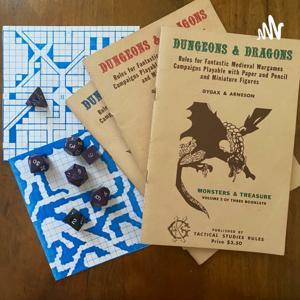
The original Dungeons & Dragons set, subtitled Rules for Fantastic Medieval Wargames Campaigns Playable with Paper and Pencil and Miniature Figures, was written by Gary Gygax and Dave Arneson, and was published by TSR in 1974 as a digest-sized boxed set in a brown wood-grain box. The set included three digest-sized books: the 36-page "Volume 1: Men & Magic", the 40-page "Volume 2: Monsters & Treasure", and the 36-page "Volume 3: The Underworld & Wilderness Adventures". The set also included six reference sheets of tables and charts.
A wargame must simulate warfare to a reasonable degree of realism, though what counts as sufficient realism depends on the players. Military wargames need to be highly realistic because their purpose is to prepare officers for real warfare. Recreational wargames only need to be as realistic as it pleases the players, so in most recreational wargames the emphasis is on verisimilitude, i.e. the satisfactory appearance of realism. In any case, no wargame can be perfectly realistic. A wargame's design must make trade-offs between realism, playability, and fun, and function within the constraints of its medium.
Fantasy wargames arguably stretch the definition of wargaming by representing fictional or anachronistic armaments, but they may still be called wargames if they resemble real warfare to the satisfaction of the players. For example, Warhammer Fantasy Battle has wizards and dragons, but the bulk of the armaments are taken from medieval warfare (spearmen, knights, archers, etc.).
Validation is the process by which a given wargame is proven to be realistic. For historical wargames, this usually means being able to accurately recreate a certain historical battle. Validating military wargames is sometimes tricky as they are typically used to simulate hypothetical future scenarios.
This description uses material from the Wikipedia articles "Dungeons & Dragons (1974)" and "Wargame", which is released under the Creative Commons Attribution-Share-Alike License 3.0.
Dan & Paul discuss the large variety of different morale rules in classic D&D -- and its roots in related wargaming. Which method is best? What would be most believable? What makes the best gameplay? What's easiest for the DM to manage?
Clausewitz stresses the importance of morale and will for both the soldier and the commander. The soldier's first requirement is moral and physical courage, both the acceptance of responsibility and the suppression of fear. In order to survive the horror of combat, he must have an invincible martial spirit, which can be attained only through military victory and hardship. The soldier has but one purpose: "The end for which a soldier is recruited, clothed, armed and trained, the whole object of his sleeping, eating, drinking, and marching is simply that he should fight at the right place and the right time.
Military morale is in a large sense inseparable from civilian morale because each reacts upon the other and both are in large measure based on fidelity to a cause. But there is a certain kind of morale that is distinctly military. It begins with the soldier's attitude toward duty. It develops with the soldier's command over himself. It is a spirit that becomes dominant in the individual and also in the group. Whether the soldier has physical comforts or suffers physical hardships may be a factor but is seldom the determining factor in making or unmaking his morale. A cause known and believed in; knowledge that substantial justice governs discipline; the individual's confidence and pride in himself, his comrades, his leaders; the unit's pride in its own will; these basic things, supplemented by intelligent welfare and recreation measures and brought to life by a spirit of mutual respect and co-operation, combine to weld a seasoned fighting force capable of defending the nation.
This description uses material from the Wikipedia article "Morale", which is released under the Creative Commons Attribution-Share-Alike License 3.0.
Paul & Dan discuss the history of what counts as the "standard" die in D&D used for hit dice, damage, miscellaneous checks, and more. Was switching from the six-sided to the eight-sided die really such a great idea?
Various shapes like two-sided or four-sided dice are documented in archaeological findings; for example, from Ancient Egypt and the Middle East. While the cubical six-sided die became the most common type in many parts of the world, other shapes were always known, like 20-sided dice in Ptolemaic and Roman times.
The modern tradition of using sets of polyhedral dice started around the end of the 1960s when non-cubical dice became popular among players of wargames, and since have been employed extensively in role-playing games and trading card games.
This description uses material from the Wikipedia article "Dice", which is released under the Creative Commons Attribution-Share-Alike License 3.0.
Dan & Paul reconsider some of the most feared undead in D&D -- wights, wraiths, and spectres. You know: the types that are most likely to drain your character's XP. How do you like your level draining best?
The undead are beings in mythology, legend, or fiction that are deceased but behave as if alive. Most commonly the term refers to corporeal forms of formerly alive humans, such as mummies, vampires, and zombies, who have been reanimated by supernatural means, technology, or disease. In some cases (for example in Dungeons & Dragons) the term also includes incorporeal forms of the dead, such as ghosts.
The undead are featured in the belief systems of most cultures, and appear in many works of fantasy and horror fiction. The term is also occasionally used for real-life attempts to resurrect the dead with science and technology, from early experiments like Robert E. Cornish's to future sciences such as "chemical brain preservation" and "cryonics."
Rob Bricken of io9 identified some of these types as among "The 12 Most Obnoxious Dungeons & Dragons Monsters".
Wandering DMs Paul Siegel and Dan “Delta” Collins host thoughtful discussions on D&D and other TTRPGs every week. Comparing the pros and cons of every edition from the 1974 Original D&D little brown books to cutting-edge releases for 5E D&D today, we broadcast live on YouTube and Twitch so we can take viewer questions and comments on the topic of the day. Live every Sunday at 1 PM Eastern time.
This description uses material from the Wikipedia article "Undead", which is released under the Creative Commons Attribution-Share-Alike License 3.0.
Thumbnail image courtesy of Midjourney.
From the publisher's feed
176 Listeners

76 Listeners
241 Listeners
12 Listeners
16 Listeners
182 Listeners

7 Listeners
5 Listeners
5 Listeners
6 Listeners
3 Listeners
102 Listeners
90 Listeners
31 Listeners
18 Listeners