Wealth Actually

Wealth Actually

Download on the App Store

Wealth Actually episodes

  • HOW NOT TO INVEST
    BARRY RITHOLTZ's new book "How Not to Invest" has received a warm reception. We talk about investing mistakes, the Trump Tariffs, and curating a good media diet.
    https://youtu.be/pS4f45v2iRk
    https://www.amazon.com/dp/1804091197/
    "How Not To Invest" Transcript
    Frazer Rice (00:03)Welcome aboard, Barry.
    Barry (00:04)Well, thanks so much for having me, Frasier.
    Frazer Rice (00:06)Well, we are recording in the midst of chaos and disorder. We're basically in day three, trading day three of the tariffs and trying to understand all of that. But back at the matter of hand, your new book, I read it really good. I thought it did a really good job of sort of colloquially putting some process and structure around not making bad investing decisions. Tell me a little bit about the impetus for the book.
    Barry (00:35)Sure, so the last book, Bailout Nation, was 15 years ago when I've had a lot of friends and family say, when's the next book coming? And, you know, I had a little, like, hey, that was kind of a slog, stuff blowing up and forcing me to rewrite entire sections of the book every time some new company went belly up. And I came home from Christmas break from vacation.
    You have that dead zone a few days before you're back in the office January 2nd. And I just started thumbing through some old quarterly calls for clients and research notes and market commentaries. You know, I had moved the blog from GeoCities in the nineties to Typepad in the two thousands to WordPress in the 2010s. And so I was looking at some of these old things and like, God, I never revisited this.
    This is such a great piece of research. I love this academic take on where alpha or even beta comes from. And I'm just kind of mulling it over. I start writing down chapter ideas on three by five cards like these. And I end up using this giant bulletin board on my wall. It just basically I start putting stuff up and I start rearranging them.
    And pretty soon it becomes obvious. Hey, these ideas, a lot of them are don'ts. Don't do this. Don't do that. Avoid this. Try not to make this bad mistake. And ultimately, I kind of came to the conclusion that, know, we've part of the reason I held off writing a book is there have been tens of thousands of investing books telling people what to do. And we're all pretty mediocre investors still.
    Maybe it might be useful if we learned what not to do and thus "how not to invest" was born.
    Frazer Rice (02:35)We found kind of an interesting crucible to test all of this with sort of Trump's tariff initiatives and a bunch of chaos on that front. As you think about what we're living in right now with uncertainty, whether manufactured or not, what are some of the top things that you think about that you tell people, your clients and otherwise?
    to keep in mind as we sort of weather this storm and try to learn a little bit about what the future is going to look like.
    Barry (03:06)Right. I had no idea what what the sequel would be named. Maybe it could be how not to run an economy or what we'll play with that. But so so what's happening these days are kind of fascinating because the first third of the book I spent a lot of time talking about how little we really know about about what's happening right now. And we learn even less about the future. And so our
    Frazer Rice (03:12)Ha
    Barry (03:34)A hot take on these things is maybe we shouldn't build portfolios based on having to predict where the economy is going to be, what the hot sector is going to be, where the hot geography is going to be, what the best companies are. Maybe we need to be a little more robust and capable of withstanding this. And the tariffs are a perfect example of how little we know. Look, the obvious examples of "How Not to Invest"
    Nobody had heading into 2020 in their year had forecast global pandemic that shuts the world's economy. And by the way, stocks go straight up. They just after a 34 percent crash, they go straight up from there. Nobody had that. Nobody had Russia invading it. Ukraine, Israel Hamas war, 500 basis points of Fed hiking, double digit losses in stocks and bonds in the same year. So when you look at all the annual predictions,
    You would think we would be a little more humble, have a little more humility about this. And the ironic thing about what's going on, I keep pointing to the television. The ironic thing about what's going on is like this should have been completely foreseeable. It's a failure of our own imaginations to imagine anyone would do this. Trump, for his whole adult career, has been enamored and enthusiastic about tariffs.
    He calls himself Tariff Man. He ran on tariffs and he tried like half a dozen different rationales. We'll protect domestic industry, we'll protect our borders, we'll reduce bad things coming into the country, we'll get other countries to lower their tariffs and cover more of their own defense costs. Like he said all of this and collectively, and I include myself in this, nobody had the slightest idea that, and he will
    Completely upend the world's economic order. He will tear the band-aids off of long-standing allies and relationships and supply chains and all these things in pursuit of a goal that I don't think a whole lot of people think makes a lot of sense and the market obviously Was wholly unprepared what we see going on now is simply the market saying hey
    The price today is our expectation of profits and revenues a year forward times some multiple, which typically reflects collective psychology. And we thought the revenues and profits are going to be much higher. This new regime is going to make everything more expensive. It's going to reduce consumer spending.
    They'll have less discretionary cash, less capex spending, less hiring. let's ratchet our GDP expectations down, you know, 100, 200 basis points. And so it just goes to show you nobody knows what's coming. Even after a presidential candidate says this is what I'm going to do. We still can't wrap our heads around.
    Frazer Rice (06:41)One of the things I think too is, you know, I don't really ascribe genius to Trump on anything, certainly not economically. I don't even put it to him politically, but he is in the same sentence as P.T. Barnum as far as understanding ratings and media. And I…
    Barry (06:55)No, he's a genius. I will tell you, he in his own way has an incredible feel for what excites the public. As did P.T. Barnum. He knows exactly how to get people enthusiastic. He knows how to craft a message. Just look at his performance in all the debates.
    He has this incredibly intuitive sense of here's how to catch people's attention, keep their attention, and get them behind a story. Now, whether that story is rational or makes sense or, you know, forget even heterodoxy, whether it can be done, that's another conversation. But credit where credit is due, he's a communication genius. And you mentioned P.T. Barnum, another showman of the highest order. Trump is a brilliant
    Showman, we can have another discussion about how effective he is as a steward of the economy and every time he's won an election, he's won against a weak unpopular candidate, both times a woman, he's never been able to beat a man, he's able to tap into
    a certain angst and a certain anger that exists at a certain level of the country and it's kind of fascinating. mean hold the disaster that is this past week aside. There is something fascinating about watching a master at work even if it's towards ends that seem to really be damaging the US and global economy.
    Frazer Rice (08:46)Yeah, I mean the other part too is I mean he's very good at declaring victory or jettisoning things that aren't working very quickly and moving on and sometimes leaving a path of destruction in his wake that everyone else has to fix.
    Barry (09:01)No doubt about that and you know when you look at when you look at what's been going on here They keep coming out like my best-case scenario here is no no this is a negotiating tactic There'll be a whole bunch of side deals You know we'll cut a deal with Israel because there's a special relationship there and then something will happen with the UK and then Korea and Japan and before you know it like When we look at what's going on now
    No one really believes that we expect the trade deficit with Vietnam to be closed. I mean, if everybody in Vietnam spent every last penny of their salaries buying U.S. goods, it still wouldn't close the trade deficit. Unless you're going to get a Ford F-150 pickup truck, unless you're get three of them purchased by every Vietnamese, that trade deficit's never going to be closed. So…
    It doesn't make any sense. What was said on its face. We're tariffing penguins in Antarctica. Like part of me, I am I am both bemused and comforted by that. Because it allows me to hold on to my wishful thinking that dear Lord, please let this be a negotiating tactic. We're really not tariffing penguins. Are we?
    Frazer Rice (10:26)No, mean, part of it to me is it feels like that economically speaking, we're firing Bill Walsh and hiring Woody Hayes to install the wishbone and then drafting a kicker in the first round and a punter in the second round. And I look at it and go, this wasn't how I was brought up. And I'm not quite sure I ascribe that notion. How do you think about this in terms of the things you talk about in your book in terms of
    I love the William Golding quote, nobody knows nothing and I subscribe to that too. I I feel like a lot of people are sort of opining on things that they are six or seven levels of abstraction away from and therefore, you know, it's useless opinion. And then sort of taking data that we don't understand and then getting all worried about things that they don't really have a lot of control over. If you were just…sort of take someone right off the deck and say, you know,...
    31 min
  • CIVICS
    As the United States acclimates to the "flood the zone" governing style, reasoned discourse around civics has crumbled.
    https://youtu.be/ngx0GxJjmDM
    There are many causes. Polarizing media, bombastic claims, and systematized gas-lighting on both sides have created one of the most toxic political environments since the Vietnam War.
    However, the absence of civics and good citizenship concepts have laid the groundwork for the hysterics of today.
    LINDSEY CORMACK has a way forward. She is the author of the book "How to Raise a Citizen "
    https://www.amazon.com/How-Raise-Citizen-Why-Its-ebook/dp/B0DBWYTXJ4/
    Outline:
    Why are Civics Important?
    Recent stats on the absence of civics
    Understanding structures
    Understanding the "why" of structures and civics
    Knowing what the Constitution says
    Knowing that the Constitution evolves too
    Understanding federalism
    Government funding mechanisms
    Communication- how to broach inflamed subjects
    How to raise the next generation
    What makes a good citizen? 
    Going beyond jury duty and voting
    Civics and Active participation
    Intersection with wealthy multi-generational families
    Joint decision-maling
    Believing in something greater than self
    Guardrails of ideals melded with open-mindedness and curiosity
    Right holder vs Duty bearer (Rights come with obligations)
    Justice vs compliance 
    Control vs grace
    Right and wrong in civics
    Contacting Lindsey
    Links: www.howtoraiseacitizen.com
    IG: @howtoraiseacitizen
    Lindsay discussing civics on Errol Louis' YOU DECIDE Podcast
    The Intersection of Civics, Money and Presidents
    Rights and Obligations with David Haass (Civics)
    Background
    LINDSEY is an Associate Professor of Political Science at Stevens Institute of Technology. She is the former Director of the Diplomacy Lab. She is the secretary of community board 8 in Manhattan and the co-chair of the Street Life Committee. Lindsey is the creator of DCInbox, a comprehensive digital archive of Congress-to-constituent e-newsletters.  Finally, she is also the author of Congress and U.S. Veterans: From the GI Bill to the VA Crisis.
    Frazer's interest in citizenship and civics:
    You may be wondering why a show about wealth management (and beyond) would be interested in citizenship and civics.  
    In a nutshell, I get asked three times a day what can be done to raise responsible kids.  Because families (and the answers to those questions) are different. The answers should come from within, I ask what they (the parents or grandparents what think it takes to be a "good citizen." 
    The answer to that question can then lead into the discussions I need to have about stewardship and a variety of other concepts.
    Additionally, good civics is good business. Businesses ignore the politics around them at their own peril. Board dynamics are also the intersection of civics, joint decision-making and constituent accountability for businesses.
    Executives have to be good at this. The values that make people successful are also the ones that people want to pass down to their kids
    Personally, politics and civics are ingrained in me.  I majored inhHistory and political science major in college. I worked in many NYS campaigns, the NYS Department of Economic Development, and ran the Republican Party in Bedford, NY for a year. More recently, I was on the board of my co-op for 7 years and president of the NYC Estate Planning Council. Civics and participation are a big part of my worldview.
    Transcript
    Frazer Rice (00:32.447)
    As we get acclimated to the new flood the zone component of politics, reason discourse has crumbled. And I think absence of civics in public life is the cause. Lindsay Cormack has a way forward and she's the author of How to Raise a Citizen. Welcome aboard, Lindsay.
    Lindsey Cormack (00:46.978)
    Thank you so much for having me. I'm excited to talk with you today.
    Frazer Rice (00:50.025)
    This will be a lot of fun. It harkens back to my background before wealth management and lawyering and all that stuff. Tell us a little bit about what you do and the impetus for the book.
    Lindsey Cormack (01:02.574): Background
    Sure, so for the last 10 years, I've been a professor at Stevens Institute of Technology. This is primarily in an engineering school in Hoboken, New Jersey. It is one of the reasons that I ended up writing this book. I have some of the brightest students that I've ever been around. They have really high test scores. They know how to do school.
    When I teach them intro to American government, I realize most of them have been failed by our school systems. They do not understand the landscape of the government. They don't understand their own routes of power. They're not practiced and having hard conversations. I've got wonderful students who are going to go on to successful careers in everything. We should make sure that they have this positive look at government and this better understanding than they're getting. And it's true that it's not just happening in New Jersey. It's kind of everywhere.
    Frazer Rice (01:47.737)
    What does the absence of civics look like in the education system? I seem to recall a stat that you put forward that it's almost like less than 1%. It's actually focused on in a curriculum in public schools.
    Lindsey Cormack (02:00.652) on Civics
    Yeah, so it's really hard to say here's how civics instruction happens. Every state has its own approach. Within every state, the independent schools have different approaches than the public schools. The charter schools or the mini schools have different approaches. The modal form of delivery across the United States is usually in your seventh or eighth grade of school. At that grade, you have some social studies class.
    That's where students are going to learn a little bit about the founding. They'll learn about some like westward expansion. They're taught a history lesson about like how we got to where we are. The actual lessons that they hear vary. But that's like the basics. We usually wait until the second semester of 12th grade to give students a class called government. The amount of instruction time that we've had on civics and government has only gone down from the 1940s. It is the subject that has the least amount of focus and time allocated to it.
    And it also has the lowest amount of federal dollars spent on it. For every $50 that gets spent on STEM, the science, technology, engineering, math disciplines, only five cents go to civics. We don't give it enough attention in schools and we haven't been doing that for a very long time.
    Frazer Rice (03:07.564)
    I mean, I'm never going to be one to say take money away from STEM. At the same time, to not have that background is crazy. With the polarization of information that's out there, the ability to deal with information is vital. The news that you get, the values you have and the understanding of our structures are vital. How do you think about that in terms of structuring your curriculum?
    Lindsey Cormack (03:34.734)
    So for me, in my intro to American government class, it moves very, very slowly. Like we're coming up on midterms. We've been in school for about eight weeks and we still are not done with the Constitution. We're still in the amendments. That's because I know that if our students know the rules of the game, they can figure out everything else with a clearer brain.
    And so we go really line by line figuring out what did this mean? What were they trying to say? What are they not saying? I think that's animportant starting piece that we don't have in most K through 12 educational systems. It doesn't surprise me that we don't have this. The end result is for most kids in high school, it's a score on an SAT or an ACT. Neither one of those exams has any components of social studies.
    And if it's not tested, it's not taught. So I understand why it's not in the curriculum, because we don't think we need to evaluate students on this.
    Frazer Rice (04:25.531)
    You dive into the Constitution, which is a great underpinning of how the United States works. I'm sure you go into the history of it and where many of the concepts and values came from. What else surrounds what you're teaching on that front?
    Lindsey Cormack (04:41.336): Learning to Communicate
    Usually I start with:, "what have they heard so far?" I like to start any conversation that might be controversial with this. It's helpful with students who have difference of opinions.
    I just like to set the table and say like, well, what have you heard? Here's something that I heard a few years ago that really stuck. The constitution doesn't say anything about slavery.
    And I was like, that is such an interesting take. Let's go read it with a keen eye for that. Like if you just do a control F and try to find slavery, you're right. It doesn't say slavery.
    There's three to four oblique references to the practice that are in there that takes a little bit more observation. You just have to have a keener eye to it. And that's something where I like to go with like, what are they starting with? Then how can we get to something that lets them appreciate something in a bigger? Or fuller or more robust manner?
    Frazer Rice (05:24.169)
    The history of the Constitution is important too, For example, you can get things like three-fifths voting for slavery, There may be previous incarnations of slavery, but it's been changed to reflect different values and cultural norms.
    Lindsey Cormack (05:40.962): The Evolving Constitution
    Yeah, that's right. That's something that I think our schools do an OK job at. We teach them this is a historical form of theater.
    You know, we say to our kids 250 years ago, some really smart guys got together and wrote this document. Isn't it great? But I like my students to think of themselves as the car
    29 min
  • CONGESTION PRICING
    For those of us who live in New York, mass transit is the norm and traffic is a minor form of apocalypse. In response to this persistent issue, New York City implemented a new congestion pricing plan.
    https://youtu.be/TeObZEnjmv4?si=fQTxzRCe6b-sGH5F
    Besides the increased funds for badly-needed infrastructure improvements, the plan made other promises. These also include reduced commute times, better air-quality, and improved safety for all road users.
    https://www.amazon.com/Movement-Yorks-Long-Take-Streets-ebook/dp/B0CV9FNFWV/
    Because the sample size is small, it is an open question of whether congestion pricing has delivered? Can it deliver? And how did we get from the horse and buggy, to the street car, to the train and automobile-based system we have now? Will it apply to other cities in the U.S.?
    Nicole Gelinas and I took some time to trace New York's transportation history in her new book and analyze the prospects for congestion pricing's effectiveness going forward.
    (*UPDATE: 20 minutes after we stopped recording on 2/19/25, President Trump announced that the U.S. Department of Transportation was pulling its approval of New York City's congestion pricing plan. Governor Holchul has met, apparently unsuccessfully, with President Trump on the topic. Litigation has already started. STAY TUNED.)
    NICOLE GELINAS, a Chartered Financial Analyst (CFA) charterholder, is a Manhattan Institute senior fellow and contributing editor to City Journal. She lives in New York City. She is the author of the recent book, Movement: New York's Long War to Take Back Its Streets From the Car.
    Outline
    How did you get interested in congestion pricing and the development of transportation in NYC?
    New York City's Transit History
    What are some of the "tragedies" (Cross Bronx Expressway / death of streetcar) and "near misses" (The Saving of Washington Square Park and Grand Central Terminal) that we don't know about?
    How much credit or blame should we give Robert Moses?
    Congestion pricing- what is it trying to do (and is it trying to do too much)?
    As a revenue raiser
    To reduce congestion
    Help environment
    Quality of Life
    What are the early returns on its effectiveness? 
    (Anecdotally, to me it seems like it is having a positive congestion effect in Manhattan) 
    Uber/Taxis?  Notwithstanding these initiatives, what about these often empty cars?
    E-Bikes? Now that the city has addressed cars, what about the safety concerns of motorized bikes?
    How is the program affecting Westchester, Long Island, New Jersey and Connecticut?  
    As a result of these changes, has the air quality shown any improvement?
    Meanwhile, is London a Success? 
    Because of its heady reputation of being one of the most forward cities on congestion control, urban planners trot out London as an example for others. Is this warranted?
    (However, having been there in November, I thought the traffic was insane! )
    Did they do other things to screw up a good initiative?
    Congestion Pricing's Future (*Before Trump's Involvement)
    I never met an automatic tax that a politician didn't see to expand and the tax is automatically going up by law,
    Regarding government's growing addiction to revenue,
    Will the program expand?
    Will the borders go north? Brooklyn? Queens? 
    Or can it go backward under Trump?
    Regardless, does the MTA have the will to cut costs?
    Notwithstanding the controversy, is there any political will to enhance safety?
    Wish list: What would be your favorite next NYC transportation initiative?
    If we want to learn more, what's the best way to get the book and keep track of your work?
    Further Details on NeW York's Congestion Pricing Plan
    THE WEALTH TAX
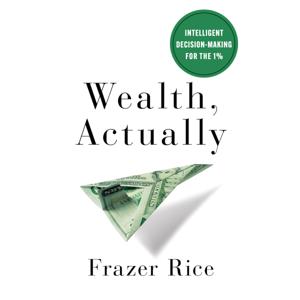
    https://www.amazon.com/Wealth-Actually-Intelligent-Decision-Making-1-ebook/dp/B07FPQJJQT/
    32 min
  • “Wealth Actually” Podcast Trailer
    https://youtu.be/xNeFuqsU7A4
    Podcast Trailer
    Welcome to the "Wealth Actually" podcast trailer. I'm FRAZER RICE. After 170 episodes, I thought I'd check in to make sure that everyone understood what to expect from the show going forward, especially if you're new to it. For those newcomers, it was time for a quick podcast trailer.
    Ultimately, I'll be talking to a lot of different experts in their various fields.
    By day, I'm a chief operating officer / wealth strategist for large complicated families. This involves wealth management, tax, trustee issues, family dynamics, and the odd business succession story.
    I'm also a lawyer which means I'm interested in legal issues that surround these concepts.
    Finally, I enjoy politics and public policy. I grew up in it, and so I like to think about it and its interaction with my day job.
    Ultimately, this show is paired with a book called Wealth Actually, and the best way to reach me is via www.wealthactually.com.
    I hope this podcast trailer was helpful. I'm always looking to get it better. If you have guest ideas, topics to explore or or other ways to increase its reach, I'm happy to listen. Finally, if you have other shows that I think are worth experiencing, send them along.
    (For those repeat listeners, you will notice I changed the theme music too. It's a little more thunder, a lot less synthesizer. Let me know what you think of it.)
    Enjoy the show and be sure to like, subscribe, and share with your friends.
    More Episodes
    Find more episodes in the podcast section HERE
    Book
    To buy a copy of the book "Wealth, Actually", see the link below. (There is a great audiobook version that I just produced and is accessible on Amazon too)
    https://www.amazon.com/Wealth-Actually-Intelligent-Decision-Making-1-ebook/dp/B07FPQJJQT/
    Social Media
    Linkedin
    Twitter
    IG
    BlueSky (NEW!)
    Podcast Trailer
    1 min
  • THE IRS
    The Internal Revenue Service is a massive "Three Letter Agency." It's a bureau of the Department of the Treasury and (believe it or not) one of the world's most efficient tax administrators. In fiscal year 2020, the IRS collected almost $3.5 trillion in revenue and processed more than 240 million tax returns. It has over 90,000 employees.
    It is also about as popular as Communism and Dog Catchers with most people! This makes running this most public of organizations a challenge for garnering resources and maintaining safety, stability and confidence in the revenue collection that makes this country go.
    https://youtu.be/mXxwh0IR3Ig
    Charles “Chuck” Rettig is a Shareholder at Chamberlain Hrdlicka in the Firm's Tax Controversy & Litigation practice and served as Commissioner of the Internal Revenue Service (IRS) from 2018 through 2022. He shares his experience with us and some pointers in dealing with the Service.
    How the IRS operates and its priorities:
    The volume of work and responsibility of the Internal Revenue Service
    The structure of the agency
    Data Science is the Future
    What it does that people may not be aware of
    Other parts of the Treasury opine on tax policy, but the agency provides guidance on workability
    Chuck as the Commissioner appeared before Congressional Committees 37 times in 4 years.
    Personality matters both internally and externally
    The Commissioner has an 11 person security detail and receives 3 credible death threats / week.
    What to expect in the next years:
    Legislative Uncertainty
    Administrative Challenges
    The Service has almost 400 Million "clients" with huge disparities in sophistication
    Resources are always a struggle- getting bang for the buck
    Personnel departures from the Service
    Prediction: Increased aggressiveness at the state level
    What best practices in front of the IRS look like.
    Setting up your affairs with a ling term strategy in mind
    Interacting with an Examiner
    Speed and Humanity
    The 3 headed approach to family office planning
    High end advisory work with the T&E group
    The overall context in working with the structure and culture of the IRS - having a backdoor channel
    Litigation support for those situations that need it.
    Links
    With Kelley Miller: The IRS Audits You- What's Next?"
    Transcript of the Show
    https://www.amazon.com/Wealth-Actually-Intelligent-Decision-Making-1-ebook/dp/B07FPQJJQT/
    Frazer Rice (00:01)The IRS and taxation in general is in all sorts of tumult with the new administration. How to deal with the IRS, how to file your taxes, how to plan for things going forward. It's something to think about. We have Chuck Redig on and he is a terrific resource for all of our listeners. He's a shareholder at Chamberlain Herdlica. It is in the firm's tax controversy and litigation department.
    Frazer Rice (00:26)Most importantly, he served as commissioner of the IRS from 2018 through 2022. So we have a little inside baseball here on how the commission works and things to think about in your own practice. So Chuck, welcome aboard.
    Chuck Rettig (00:32)
    Thank you for having me. It's a privilege to be out.
    Frazer Rice (00:42)Well, it's a treat for us to have you and a real great opportunity. First and foremost, look, the three letters IRS are scary to just about anybody who comes in contact with them on a personal basis. Maybe break down a little bit how the IRS operates and what its priorities are.
    Background
    Chuck Rettig (01:01)Yeah, you know, when I went on board, somebody high up in Treasury, and I'm basically a kid from Los Angeles and Irish headquarters in Washington, D.C., and somebody from Treasury said to me, you know, congratulations, it's a Senate-confirmed position, and you are one of the five most powerful people in the United States, but you are absolutely the most hated. And I remember shaking his hand going, okay, thank you, you know, and this is something I'm still interested in doing.
    Reflection
    Looking back, I look back with a lot of pride.for the opportunity. basically a tax guy from a tax practice, 36 years in tax and state planning and other related things in one firm in Los Angeles, the opportunity to go on board of the IRS. And if you will make a difference. This was in 2018, which was about a year and a half-ish, right? Depending upon when you say COVID started and gave us the opportunity to go in and see what we can do to change things. But I always kept in my head.
    the anxiety people have for the IRS. At all levels, you could be the most sophisticated tax professional, or you could be the taxpayer on the street. Individual, corporate, everything in between. And everybody interacts with the internal revenues of us. The IRS interacts with more Americans than any other public or private sector organization on the planet. And for a variety of reasons, there's a lot of challenges for the agency. But the operation itself,
    The physical part of the operation, I'll just kind of give you a once over, is headquarters is in Washington DC, 1111 Constitution. I moved to Washington DC, had an apartment a few blocks away from there, thinking, oh, I'll just walk to work.
    The IRS Commissioner and Security
    And one of the first things you realize is, okay, well, the commissioner is not going to be out in public by themselves, tying into this most hated thing. had what mostly was an 11 person protection detail with you at all times, averaged one to three to five, what they call credible death threats per month. And it's hard to adjust to, right? It's like, if you will, for a federal government salary, you really have to want to do government service and make a difference when you see the things that most people are not aware of. But headquarters, Washington, DC, the…
    The Size and Scope of the Service
    Headquarter ability is 1.2 million square feet. You know, there were about 85,000 employees when I was there. Currently, it's about 100,000 employees, 519 offices throughout the world in terms of what we think of in terms of operations. So I was there in 2018 to 2022, and the commissioner has a term, my term expired November 12th, 2022 by statute. But just during the term that I was there,
    IRS implemented seven major tax acts, right? Starting with TCJA in December 2017. So in five years, you're redoing all your systems, right? You have to figure out how you have to code the systems for changes in tax law. And in addition to that, you gotta be prepared. So you redo some of your systems and put them on the shelf so you're ready to go with the changes, but everything you think is gonna become tax law doesn't. So tremendous effort to try to get things moving and get it operating, if you will, behind the scenes. And then, you know.
    Frazer Rice (04:28)And so, you were put in charge of this, the scale is massive. You're dealing with essentially one of the largest corporations in the country, even though it's a government agency. Chronically underfunded, as we always hear in the news, and so you don't have the resources to do what you want to do, either technologically or people-wise, and so on. And then you're called to account for why things go wrong when they do or how awful you are on a daily basis because you're the you're the you're the bearer of bad news oftentimes. How did you adjust to that?
    Job Requirements
    Chuck Rettig (05:01)So I think you have to have thick skin. You have to know why you're there. We were there to serve the country, right? What a lot of people said is, hey, Chuck followed his son into government service. My son is a major in the United States Army. When I went on board, my son was deployed. He's deployed three times. And sort of if you will serve in the country and look at the flag, I do pause when I look at the flag.
    DC is different than pretty much any other part of the United States. Everybody points fingers. Nobody takes responsibility. Nobody takes accountability. And they all want to send out a tweet of, we just grilled the IRS chief. I testified in Congress about 37 times, Ways and Means Committee and Senate Finance Committee. And a lot of that also was during COVID, where we had tremendous struggles during COVID, as the rest of the world did, right? And so,
    Frazer Rice (05:53)Huh. Right.
    COVID and the IRS
    Chuck Rettig (05:57)You just really have to hunker down, move forward. And by nature, the commissioner of the Inter-Northern Service, the only person who could ask me to leave would be the president of the United States. And I served equal terms under President Trump and President Biden and relied on the fact that, you know, if they want to fire me, they can fire me. But my lines inside to the employees were, we're going to do what we're going to do.
    We're going to do the right thing. Very impartial, non-political at all.and we're going to move forward. And then I would always add in, if somebody wants to fire me, they can fire me. Of course, I would add in and send me back to my home in Los Angeles, to my friends, you know, get me out of the snow in DC. And then other people come in and go, it sounds like you're trolling to get terminated.
    I go, no, but when I think about home compared to I think about DC, you know, maybe I'm ready. But that was my, if you will call it. My son in the military has a thing. If you think you're all that, bring it, right?
    The Personal Touch
    And I adopted that, I adopted that for the IRS. If people wanna take shots at us, if you will verbally, make your comments. I will say I got counseled on when I testified that the staffers for some of the senators thought I was intimidating the senators when I wanted to testify. Senate finance has 28 senators. And I said, it's one against 28, how can I intimidate them? They said, well, sir, you.
    You have a look and then you throw tone if you disagree. I said,...

    40 min
  • PRESERVING LEGACIES
    https://youtu.be/h1yo6l7V0Yw
    Preserving legacies is about more than cataloging "stuff" and keeping a spreadsheet. Done well, it can provide the grounding for intergenerational communication, engagement with outside constituencies and, in certain cases, monetization.
    This involves a organized process:
    Preserving Legacies and Cataloging
    With the horrible recent storm damage in North Carolina and Florida and the horrible Los Angeles wildfires, the cataloging process is on the forefront of many families' minds.
    Storytelling Development
    The artifacts of a family can be the keystone of family narrative building and next-generation education.
    Fan/Constituency Engagement
    The building of physical digital museums can be the centerpiece of engagement for internal and external constituencies. From extended families, to customers and extended fan-bases, advanced legacy preservation is more than just "stuff."
    Monetization
    In certain situations, these efforts can lead to new forms of business and monetization. For artists, authors and musicians, these museum efforts can add value to IP revenue streams and transactions.
    Preserving Legacies
    We talk about case studies with stars like Def Leppard, Chris Paul and Jon Bon Jovi. However, we also go through the importance of preserving legacies with families that aren't filling 50,000 person stadiums.
    We distinguish "Preserving Legacies" from Estate Settlement (where many families first begin this process). That said, this show pairs well with the Estate Settlement episode with Joel Schoenmeyer.
    Background
    BRAD MINDICH is the Founder/CEO of Inveniem which is the leading archiving/fan engagement company that works directly with artists, estates, athletes, brands, and individual celebrities on finding, organizing, preserving, and monetizing their artifacts and history.
    INVENIUM, and its fan-facing brand Definitive Authentic’s, overarching message to its clients is Your Past Is Your Future® and this philosophy sets the tone for how the company holistically and strategically partners with its clients to both preserve and extend legacies and connect clients deeper with their fans. The company’s client list is confidential, but it includes some of the world’s most iconic creators.
    https://www.amazon.com/Wealth-Actually-Intelligent-Decision-Making-1-ebook/dp/B07FPQJJQT/
    https://bsky.app/profile/frazerrice.bsky.social/post/3lgul3z7nrs2a
    https://open.spotify.com/episode/0C9Bost6uihR1Pj8MnsppE?si=cbf4a554b9f04cfa
    26 min
  • ESTATE SETTLEMENT
    Estate Settlement is one of the most feared parts of wealth transition. It is where trust and estate planning meet their first real test- usually when a will is put in front of the probate court system. JOEL SCHOENMEYER, Head of the Family Wealth Group at a Major Regional Bank joins us to discuss the ins and outs.
    https://youtu.be/OwepMwX0uao?si=YKevHbmDrtrRv12b
    What is Joel's background?
    I spent the first 15+ years of my career as a trusts and estates attorney. First at a few different law firms, including Sidley Austin – back when they had a T&E group. Then as a solo practitioner for more than a decade. In 2012 I made the transition to working for financial institutions, where I have held a number of roles:
    Legal department, in the trust counsel group
    Senior Trust Advisor on an ultra-high net worth team
    National Head of Estate Settlement
    Senior Wealth Strategist in a multi-family office group
    I’m now in charge of the Family Wealth group at Fifth Third, which is an offering for ultra-high net worth clients and families.
    Just broadly, can you explain what happens from a legal perspective when someone dies?
    Sure. First, a little terminology:
    “Estate settlement” is the overall process of wrapping up a deceased person’s affairs, a job that’s usually handled by an “executor”. That settlement process can include lots of different things, but it can be broken down into a few broad topics:
    Inventorying and collecting all assets;
    Identifying and then paying debts and expenses, including taxes (both final income taxes and, if the estate is large enough, estate taxes); and
    Distributing what remains according to the decedent’s estate plan (or if they didn’t have one, according to state law).
    “Probate” can be a part of estate settlement, and involves court supervision of the above process, to make sure that it is handled correctly. I spent some of my time as an attorney drafting Wills and Trusts. However, I spent even more time in court, dealing with probate issues (including litigation).
    We are going to be talking about messy estate settlement issues and how to avoid them. Why is this important?
    I will say that, throughout my career, I have met clients (or potential clients) who say, “I don’t care what happens when I die – that’s someone else’s problem.” However, most people do NOT want to cause problems for their loved ones. The death of a parent or spouse or sibling is difficult enough without having to figure out where their stuff is, or what they wanted to do with it.There’s also the positive aspect. You have family and friends – and possibly charities – that you hope will thrive after your passing. Why wouldn’t you want to set things up so that they actually get your hard- earned money? Do you want to have that money go to the IRS or some probate litigators?
    How should people start to think about their estate?
    I break the issues to consider down into four interconnected categories:
    Assets
    Debts and expenses (including taxes)
    Personal Relationships
    Estate Plan (Will, Trust, etc.)
    One thing you will notice is that your estate plan is only one category here. A lot of people think that having a Will and/or Trust in place means that they are “done” with planning for their death. That’s just not true.
    So let’s start with assets in the estate settlement process. What is the big mistake people make with their assets in the context of planning for death?
    The main mistake is not paying attention to how your assets are titled. This is especially the case where people have an estate plan but then also have assets with a listed beneficiary, or assets owned jointly.
    For instance, I once handled an estate where the decedent’s Will gave away her interest in a home – but the decedent already owned the home in joint tenancy with her sister! As a result, the gift under her Will was ineffective (but the situation created a lot of litigation as well as conflict). Too often people don’t have a handle on how assets will pass when they die, so they don’t have a holistic plan.
    One other example: husband marries later in life, then dies with a $5 million life insurance policy. That policy was purchased before he got married, and the initial beneficiary was his mother. After the decedent got married, he should’ve updated the beneficiary to his spouse, but he never got around to it.
    Another asset-related issue that I encounter: “dead” assets, which is my term for assets that really have little or no value but that are painful to get rid of. Timeshares are the quintessential dead asset, to my mind – estate settlement folks HATE them.
    It sounds like there could be estate settlement issues with debts and expenses.
    That’s correct. Keep in mind that debts survive your death – they don’t just disappear. If you name beneficiaries for all of your assets but then die with debts, your executor will have to figure out how to come up with the money to pay those debts – and that will probably involve a court proceeding.
    Another issue – specific to wealthy individuals – involves the estate tax. That tax is due nine months after death, with very few exceptions. Now, nine months might seem like a long time, but it really isn’t. That’s especially the case if the decedent owned a lot of illiquid assets, like real estate, or private equity, or even a working business.
    For instance, what if the decedent dies with an estate of $100 million and gives all of his assets to his children? The estate tax will be roughly $40 million, which is a LOT of money to raise in a short amount of time. Do you obtain a loan? Do you sell the business or real estate quickly?
    What’s the best solution for a living person looking to simplify things with respect to both assets and debts?
    Speaking generally, you need someone to take a deep dive into both your assets and your debts/expenses/taxes. Who this “someone” is depends on your personal situation. Some people pay their attorney to do this work, although that can an expensive proposition. Other people use their financial institution, or their financial planner, or even an accountant. But the important point is that you – with the assistance of an advisor – need to have eyes on all of your assets and liabilities.
    You mention personal relationships as another important issue. What do you mean by that?
    I’m really talking about understanding whether your estate plan takes into account the relationships between your friends and family. It might actually worsen those relationships. This comes up a lot in the context of beneficiaries.
    An obvious situation: you have two children but giveone child 2/3rds of your assets and the other child only 1/3rd. Now, you may have good reasons for doing that – or even bad reasons, which is allowed, since it’s your money. However, you are also potentially leaving a mess. What are the ways to deal with these personal relationship issues?
    Three Things to Keep in Mind:
    First: Family Dynamic Awareness
    You need to be pretty clear-eyed about whether your kids get along, or whether your spouse gets along with your kids from a prior marriage. Don’t close your eyes to reality. Don’t assume that your family will have good relationships after you are gone. (You being alive may be the only thing forcing them to be civil to one another.)
    Second: Staffing
    You should be thinking not only of family members as beneficiaries, but also about who is in charge of handling your estate (and any trusts created as a result of your death).
    It’s vitally important to NOT create situations where people who don’t get along have to work together.
    This applies to co-executors or co-trustees. or in a situation where one of them is “handling” the other person’s finances.
    Pro tip: If you have a son and daughter who don’t get along, do NOT name your daughter as trustee of the trust for your son’s benefit. They are both going to be miserable!
    Third: Communication
    I think this goes for all categories. Transparency solves a lot of these issues, although it may involve some uncomfortable conversations. But I really believe that telling people what your plan is, and explaining the rationale BEHIND your plan, is key. To go back to what I was just saying about leaving differing amounts to your beneficiaries: maybe this makes sense.
    For instance, maybe one of your children helped to grow the family business and the other one never contributed. In that case, you should articulate this reason why the child who helped gets more than the child who didn’t. Similarly, if one child is very wealthy but another is struggling but working hard you might want leave more to the struggling child. Please, make sure you explain why!
    FInally, how does the actual estate plan factor in here?
    Usually we aren’t talking about obvious errors, like a Will or Trust that gives away 105% of your assets. I often encounter situations where the estate planner tries to translate your wishes into legal language that doesn’t work when applied in the real world. Here’s a situation I encountered a couple of years ago: Dad (a widower) has a son and a daughter. His Will gives daughter a right to buy his home within 30 days of his death. Now, I found this provision while dad was still living, and had to ask:
    Why did only daughter have the right to buy? Not to get ahead of myself in talking about personal relationships, but would daughter’s right to buy anger son? Is this just a situation where daughter was in the area, or lived at the home for longer than son, or had more of a claim to it?
    “30 days” is really fast – did the daughter have the ability to raise this type of money (or obtain a loan) that quickly?
    What are your quick take-aways on the Estate Settlement process?
    I would say there are two of them.
    Number 1 is: track (or have someone else track) your assets and your debts,...
    36 min
  • THE SOUL OF WEALTH
    This week, "Wealth Actually" meets "THE SOUL OF WEALTH" as I speak with DR. DANIEL CROSBY, Ph.D. about his new book.
    https://www.amazon.com/Soul-Wealth-reflections-money-meaning-ebook/dp/B0CP625K99
    https://youtu.be/Y6dUcW_eQW4
    Outline (Soul of Wealth)
    -Behavioral Finance-Issues with the "research"-Building consensus around money decisions-How our brains trick us into faulty wealth processes-Teaching people to stretch the time horizon of their planning
    Biography
    Educated at Brigham Young and Emory Universities, Dr. Daniel Crosby is a psychologist and behavioral finance expert who helps organizations understand the intersection of mind and markets.
    As a leading voice on the impact of behavioral finance, "The Soul of Wealth" isn't Daniel's only writing.
    Dr. Crosby's first book, Personal Benchmark: Integrating Behavioral Finance and Investment Management, was a New York Times bestseller.
    His second book, The Laws of Wealth, was named the best investment book of 2017 by the Axiom Business Book Awards and has been translated into Japanese, Chinese, Vietnamese and German.
    His latest work, The Behavioral Investor, is an in-depth look at how sociology, psychology and neurology all impact investment decision-making. 
    Finally, Daniel publishes the highly respected Standard Deviations podcast- where you can find his personal thoughts on financial psychology and interviews with experts in the wealth management and psychology fields.
    Money - The Soul of Wealth
    Daniel's book presents 50 short essays which explore what wealth really is and provides practical suggestions for how to change your thinking and your actions in small, powerful ways, for a wealthier life.
    Soul of Wealth Topics:
    How you spend your money reveals your values.
    That money can buy happiness if spent well.
    What makes a good financial plan.
    Why willpower is overrated.
    How to master delayed gratification for the ultimate wealth hack.
    Why anything worth doing carries some risk.
    Contacts:
    @DANIELCROSBY TWITTER
    STANDARD DEVIATIONS PODCAST
    Behavioral Scientist, Brian Portnoy on the 100th Episode of "Wealth Actually"
    https://www.amazon.com/Wealth-Actually-Intelligent-Decision-Making-1-ebook/dp/B07FPQJJQT/
    31 min
  • NIGHT MOVES
    Author and investment expert, JARED DILLIAN, joins the podcast for the second time to discuss his new collection of short stories, NIGHT MOVES. We talk about his talent for moving across formats and between fiction and non fiction. We go into the need for story-telling and the importance of holding an audience. Finally, we look for crossovers in his writing from his personal history, his move to South Carolina and his experiences in the Coast Guard and Lehman Brothers.
    https://www.amazon.com/Night-Moves-stories-Jared-Dillian-ebook/dp/B0DDLB49X1/
    "Night Moves" by Jared Dillian
    From his military experience and investment experience to his DJ'ing prowess and obvious for multi-faceted talent for writing, Jared is a creator and a Renaissance Man- and a terrific, no nonsense person to speak with about the ins and outs of publishing.
    https://www.youtube.com/watch?v=c7pratxa3EY
    Writing across formats and how that led to NIGHT MOVES? 
    Non fiction 
    Novel 
    Short story - is the format a challenge or an opportunity?
    Newsletter - The daily grind of the Daily Dirtnap
    How to move between the daily pressure of writing a newsletter to the longer form content in non-fiction?
    Then, how do you move to the character development and world-building involved with fiction?
    Themes in NIGHT MOVES
    Sex, desperation, wistfullness
    Writing in a women's voice (how do you get into that headspace?)
    What does research consist of for short stories?
    Genre Favorites?
    Where you end the story determines whether it’s a comedy or tragedy
    Do you start knowing where you want to end up?
    What does the format of a writing day look like?  Ie do the newsletters get in the way or help with other projects?
    Do you get stuck?  (Is there where it’s convenient to have the newsletters)
    Music and Writing- The Crossover into NIGHT MOVES
    DJ’ing composing - what are the similarities in that process?
    Any crossover to investing?
    Where do we find the book and how else can people keep track of JARED?
    JARED'S SUBSTACK
    DAILY DIRTNAP
    Jared on "Wealth Actually" talking about his previous book, "NO WORRIES"
    https://www.amazon.com/Wealth-Actually-Intelligent-Decision-Making-1-ebook/dp/B07FPQJJQT/
    "Wealth Actually" by Frazer Rice
    29 min
  • HOW TO RETIRE
    "How to Retire" (by Christine Benz) deals with a concept full of fear, emotion, math and uncertainty: retirement.
    Even the wealthiest, who have a margin of safety, run into issues of purpose, time management and legacy.
    Layer onto that the risks of longevity, dementia, divorce, managing cash and investments in inflationary times, and navigating the byzantine health and elder care systems.
    No wonder "retirement" is a scary topic.
    Christine Benz' new book "How to Retire" is here to help get our arms around this topic.
    With 20 interviews with experts in the field, Christine has written a terrific reference for retirees to get their arms around this stage in life.
    Her book covers the numbers, the emotion and the structure for people entering the golden years.
    CHRISTINE BENZ is director of personal finance and retirement planning for Morningstar and senior columnist for Morningstar.com. In that role, she focuses on retirement and portfolio planning for individual investors. She also co-hosts a podcast for Morningstar, "The Long View", which features in-depth interviews with thought leaders in investing and personal finance.
    https://www.amazon.com/How-Retire-lessons-successful-retirement-ebook/dp/B0CP5X3TYK/
    How to Retire
    How to Retire with Christine Benz
    The Numbers (Funding Retirement and Resilient Investing)
    The Transition to Retirement (AKA "The Countdown")
    With a plan in mind, what is the role a Dry Run with Retirement?
    The Buy-In: Getting consensus from spouses and family on what life will look like
    The First 2 years: The Importance of a Detailed Calendar
    How Are You Going to Use the Time?
    Having entered the role of caregiving, retirement may be more of a "job" than you think
    "End of Life": When Should you Give up the Keys and Long Term Care with CAROLYN MCCLANAHAN
    Estate Planning (with past "Wealth Actually" guest JENNY ROZELLE)
    With all of this frre time, how do spouses adjust to spending so much time together?
    https://www.youtube.com/watch?v=IN5C7Ko6XBY
    https://open.spotify.com/episode/50ZO3JLl4bAdf95b64UQIZ?si=XJEYU2h4ToG8rL_Qkou6eA
    https://www.amazon.com/Wealth-Actually-Intelligent-Decision-Making-1-ebook/dp/B07FPQJJQT/
    Frazer Rice's "Wealth Actually"
    30 min

About Wealth Actually

From the publisher's feed

Covering the issues that affect business, entrepreneurship, wealth, trusteeship and culture.

More shows like Wealth Actually

Masters in Business by Bloomberg

Masters in Business

2,181 Listeners

The Meb Faber Show - Better Investing by The Idea Farm

The Meb Faber Show - Better Investing

950 Listeners

White Coat Investor Podcast by Dr. Jim Dahle of the White Coat Investor

White Coat Investor Podcast

2,442 Listeners

Animal Spirits Podcast by The Compound

Animal Spirits Podcast

2,032 Listeners

Bogleheads On Investing Podcast by bogleheads

Bogleheads On Investing Podcast

617 Listeners

The Long View by Morningstar, Christine Benz - Director of Personal Finance and Retirement Planning, Ben Johnson - Head of Client Solutions, Amy Arnott - Portfolio Strategist

The Long View

934 Listeners

Kitces and Carl - Real Talk for Real Financial Advisors by Michael Kitces, MSFS, MTAX, CFP and Carl Richards, CFP

Kitces and Carl - Real Talk for Real Financial Advisors

243 Listeners

WashingtonWise by Charles Schwab

WashingtonWise

463 Listeners

The Prof G Pod with Scott Galloway by Vox Media Podcast Network

The Prof G Pod with Scott Galloway

5,388 Listeners

All-In with Chamath, Jason, Sacks & Friedberg by All-In Podcast, LLC

All-In with Chamath, Jason, Sacks & Friedberg

10,190 Listeners

Ask The Compound by The Compound

Ask The Compound

337 Listeners

Honestly with Bari Weiss by The Free Press

Honestly with Bari Weiss

8,430 Listeners

Retirement Planning Education, with Andy Panko by Andy Panko

Retirement Planning Education, with Andy Panko

1,070 Listeners

The Great Retirement Debate with Ed Slott & Jeffrey Levine by The Great Retirement Debate with Ed Slott & Jeffrey Levine

The Great Retirement Debate with Ed Slott & Jeffrey Levine

145 Listeners

Prof G Markets by Vox Media Podcast Network

Prof G Markets

1,449 Listeners