
Sign up to save your podcasts
Or


In his first encyclical, Magnifica Humanitas, Pope Leo XIV warned that artificial intelligence threatens the dignity of the human person.
Human exceptionalism - the belief that we are special, both within the animal kingdom and in the eyes of God - rests on a single distinction. We don't just think. We know that we're thinking. We have moral agency. Our religions tell us we have souls. That distinction is now under threat from two directions simultaneously.
Firstly, we have discovered that the creatures we share this planet with are vastly more capable than we thought. Animals we considered simple-minded - octopuses, bees, parrots, elephants - can plan, learn, teach and use tools. Some display altruism, grief, loyalty and shame.
Secondly, artificial intelligence and biotechnology are acquiring the characteristics we thought were uniquely ours. AI is developing personality, intentionality and self-awareness at a speed that has no historical precedent. The quantum computer, which Richard Feynman imagined less than half a century ago, is now being built. And in our laboratories, researchers are growing neuron networks and may soon create hybrid creatures combining animal instinct with human-like reasoning. Only our ethics stand in the way.
If the boundaries between human, animal and machine are dissolving from both directions, the question is no longer academic. What - if anything - makes us morally exceptional?
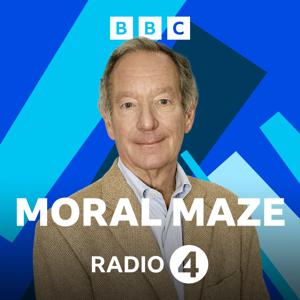
Chair: Michael Buerk
 View all episodes
 By BBC Radio 4

4.6
5151 ratings
In his first encyclical, Magnifica Humanitas, Pope Leo XIV warned that artificial intelligence threatens the dignity of the human person.
Human exceptionalism - the belief that we are special, both within the animal kingdom and in the eyes of God - rests on a single distinction. We don't just think. We know that we're thinking. We have moral agency. Our religions tell us we have souls. That distinction is now under threat from two directions simultaneously.
Firstly, we have discovered that the creatures we share this planet with are vastly more capable than we thought. Animals we considered simple-minded - octopuses, bees, parrots, elephants - can plan, learn, teach and use tools. Some display altruism, grief, loyalty and shame.
Secondly, artificial intelligence and biotechnology are acquiring the characteristics we thought were uniquely ours. AI is developing personality, intentionality and self-awareness at a speed that has no historical precedent. The quantum computer, which Richard Feynman imagined less than half a century ago, is now being built. And in our laboratories, researchers are growing neuron networks and may soon create hybrid creatures combining animal instinct with human-like reasoning. Only our ethics stand in the way.
If the boundaries between human, animal and machine are dissolving from both directions, the question is no longer academic. What - if anything - makes us morally exceptional?
Chair: Michael Buerk

7,639 Listeners

876 Listeners

1,046 Listeners
156 Listeners

5,520 Listeners

1,799 Listeners

1,763 Listeners

1,049 Listeners

2,110 Listeners

1,920 Listeners
30 Listeners
43 Listeners

393 Listeners

164 Listeners
43 Listeners
58 Listeners
114 Listeners
684 Listeners

3,177 Listeners

720 Listeners
1,002 Listeners
3,336 Listeners

1,183 Listeners
797 Listeners
45 Listeners