
Sign up to save your podcasts
Or

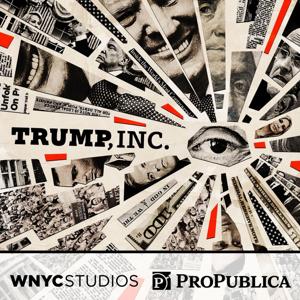

The “Trump, Inc.” podcast has long explored how people have tried to benefit through their proximity to the Oval Office. And we're going to continue digging into that as the Trump administration is tasked with rolling out more than $2 trillion in bailout money.
We spoke to two people this week to help us understand the stakes. “Some policymakers sitting in the Treasury Department or some other government agency have this awesome power to say, ‘You get the money, you go out of business,.’” said Neil Barofsky, who served as the government’s watchdog for the 2008 bank bailout. “One of the most important things we can do is make sure that power is exercised fairly, consistently, and, most importantly, consistent with the policy goals that underlie this extraordinary outpouring of taxpayer money.”
We also spoke with journalist Sarah Chayes, a former NPR correspondent who has reported on corruption and cronyism in countries experiencing economic shock. She said powerful players often “take advantage of adversity and uncertainty to enrich themselves.”
But Chayes also described something else. She coined it “disaster solidarity.” That’s when there’s so much suffering, so much adversity, “that people's tolerance for selfish, hogging, me-first behavior is really low.”
And that’s where you come in. We want your help to dig into the coming bailout. If you know something, please tell us.
Sign up for email updates from Trump, Inc. for the latest on WNYC and ProPublica's investigations.
Hosted by Simplecast, an AdsWizz company. See pcm.adswizz.com for information about our collection and use of personal data for advertising.
 View all episodes
 By WNYC Studios

4.6
55635,563 ratings
The “Trump, Inc.” podcast has long explored how people have tried to benefit through their proximity to the Oval Office. And we're going to continue digging into that as the Trump administration is tasked with rolling out more than $2 trillion in bailout money.
We spoke to two people this week to help us understand the stakes. “Some policymakers sitting in the Treasury Department or some other government agency have this awesome power to say, ‘You get the money, you go out of business,.’” said Neil Barofsky, who served as the government’s watchdog for the 2008 bank bailout. “One of the most important things we can do is make sure that power is exercised fairly, consistently, and, most importantly, consistent with the policy goals that underlie this extraordinary outpouring of taxpayer money.”
We also spoke with journalist Sarah Chayes, a former NPR correspondent who has reported on corruption and cronyism in countries experiencing economic shock. She said powerful players often “take advantage of adversity and uncertainty to enrich themselves.”
But Chayes also described something else. She coined it “disaster solidarity.” That’s when there’s so much suffering, so much adversity, “that people's tolerance for selfish, hogging, me-first behavior is really low.”
And that’s where you come in. We want your help to dig into the coming bailout. If you know something, please tell us.
Sign up for email updates from Trump, Inc. for the latest on WNYC and ProPublica's investigations.
Hosted by Simplecast, an AdsWizz company. See pcm.adswizz.com for information about our collection and use of personal data for advertising.

6,881 Listeners

9,238 Listeners
4,113 Listeners

1,576 Listeners

3,530 Listeners

484 Listeners
5,627 Listeners

12,704 Listeners

14,450 Listeners

6,467 Listeners

1,542 Listeners

3,506 Listeners

2,800 Listeners
1,405 Listeners

32,354 Listeners

1,196 Listeners
9,475 Listeners

5,767 Listeners

421 Listeners

12,874 Listeners
8,562 Listeners
670 Listeners

16,525 Listeners

2,821 Listeners

644 Listeners
11,013 Listeners
2,608 Listeners
1,965 Listeners

7,014 Listeners

82 Listeners

246 Listeners

20 Listeners

86 Listeners